
The United States Colonial Marine Corps was the United Americas force-in-readiness, a space infantry service set up under the National Security Act of 2101 and first seen on screen in Aliens. It carried the battle honors of the old amphibious United States Marine Corps into extrasolar work: orbital assault, colony security, and the small rifle missions that defined frontier fighting. By fiscal year 2179 it fielded about 165,000 active Marines, down from a 2165 peak of 240,000 after Tientsin, organized into four combat divisions, four aerospace wings, and three Marine Space Forces.
Name And Identity
The official name is the United States Colonial Marine Corps. The Aliens Colonial Marines Technical Manual shortens that to USCM. Free League's Colonial Marines Operations Manual and the Alien RPG core book prefer USCMC. Both labels point at the same service.
The Corps kept a United States name after the United Americas merger. The Technical Manual calls it America's interstellar force-in-readiness with a leading role inside the UA. The RPG treats the United Americas as an extension of the United States government, with the preexisting American military industry paving the way for the Colonial Marines to become the main peacekeeping force. That is why armor, ships, and briefing slides still read USCM in the Aliens year, even when the troops answer to a UA joint command.
The United Systems Military is the wider armed service of the union formed in 2202, and the corps is one part of it. That service appears around the USM Auriga in Alien: Resurrection, after the company era that produced Ripley 8. The Technical Manual and the Operations Manual stop before that union, so they do not use the later Marine name.
After the Colonial Protection Act in 2187, the service was renamed the United Americas Colonial Marines (UACM). Recruitment opened beyond North America, while the old insignia and traditions stayed on the uniforms. Fireteam Elite's ranks poster, hung during the 2202 campaign, uses that later name. Aliens: Fireteam Elite 2 then used USCM for the United Systems Colonial Marines during the 2207 campaign at LV-558.
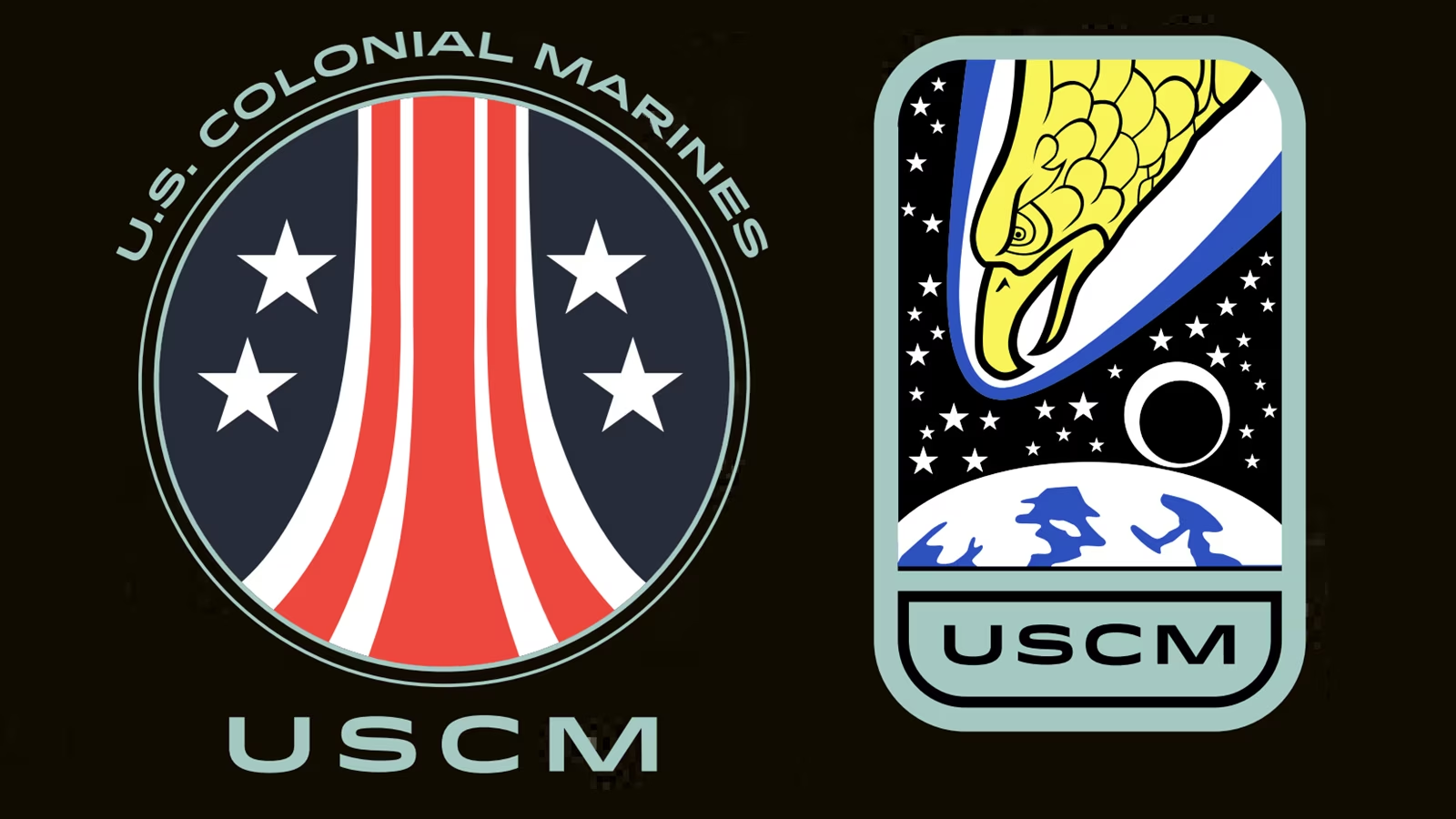
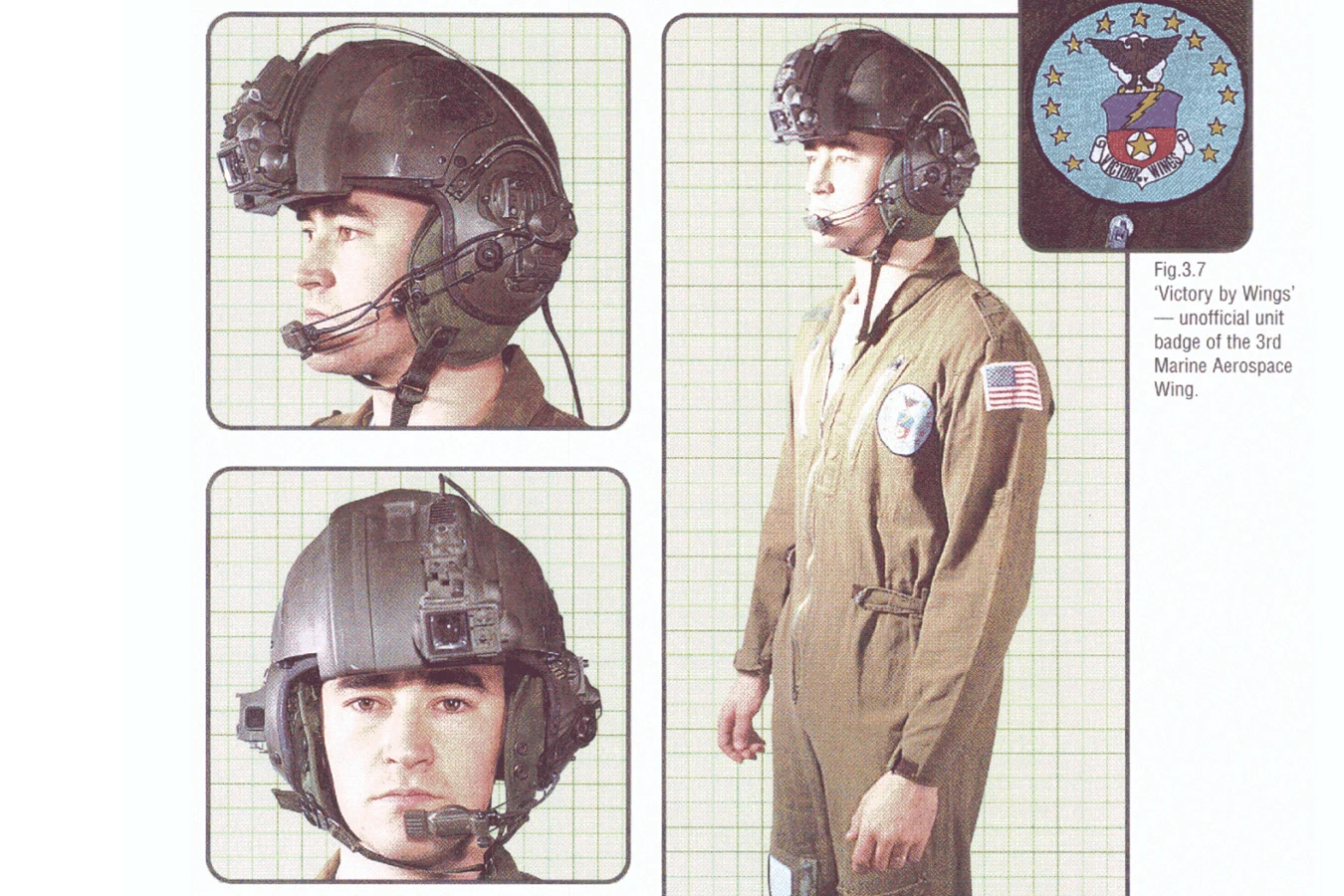
The Corps badge approved in 2101 by Secretary of Defense Tiptree is a geometric mark nicknamed Tiptree's wigwam: seven vertical stripes, four white stars, and a blue field. The red stripes stand for fight in aerospace, land, and sea. The stars stand for an open American frontier. Marines discouraged flashy unit badges, so unofficial patches only tended to appear on long distant deployments.
History
Founding
The Technical Manual dates the Corps' incorporation to the end of the previous century and says the battle honors of the old amphibious Corps came with it. The RPG timeline has the United States already building an off-world peacekeeping force around 2069, first as an Outer Rim defense fleet and then as Colonial Marines. The Operations Manual puts the birth of the USCMC in a late-21st-century extrasolar resource fight against the China-led CANC coalition, when the United States needed a standing force that could reach colonies on the edge of the Outer Veil.
The National Security Act of 2101 is the legal anchor in all three books. It fixed the fighting structure at four combat divisions and four aerospace wings, plus organic support, with a fifth division and wing held as reserve. The United Americas then formed in the 2103 to 2106 window after American nations left the old UN interplanetary body. From that point the Colonial Marines operated with the Canadian, Latin American, and United States aerospace forces under United Americas Allied Command (UAAC).
Early Campaigns
The first big extrasolar test was the Torin Prime revolt, about 2106 to 2108, when J'Har insurgents turned a colonial world into a two-year civil war. The UA Outer Rim fleet took the embarrassment, and the peacekeeping follow-up on Thedus went worse. The UAS Archangel was destroyed there in 2108 to 2109, with more than 15,000 military and civilian dead. Expansion money that had been meant for the Rim fleet moved to the Colonial Marines instead.
A Colonial Draft Act failed in 2109. After that the Corps used a Weyland-Yutani program of Artificial Womb Soldiers, humans grown for eighteen years, marked with the middle initials A.W. and surnames like Sword or Hatchet. Those troops later fought in the Arcturian conflicts and the Dog War, then were pulled back during Tientsin. New intake stopped in 2165.
Through the 2140s and 2150s the Corps fought the kind of wars the later manuals treat as normal frontier work. The Core Conflict and the Helene Uprising put Marines against Consortium synthetics and UPP-backed forces on Helene 215. Operation Arcturan Freedom in 2159 stormed the Xian Po garrison and left Arcturus as a UA protectorate. The Dog War in Canes Venatici, 2160 to 2163, ended with the Pang Ho Treaty and the Chinese Arm partitioned.
Tientsin And The Peak
The Tientsin Campaign on 8 Eta Boötis A III, from about 2162 to 2165, was the largest conventional war the Corps fought before Aliens. The world sat a few parsecs from the UA and UPP border, with a colony of hundreds of thousands and mines that mattered to both sides. A coup, the destruction of the USCSS Endeavor, and a full UA push ended in a nuclear strike that wrecked the ecosystem. When the shooting stopped, Tientsin was left independent and both powers pulled back.
Colonial Marine strength hit about 240,000 at the end of that campaign, then sat idle with troops and no matching war. The Technical Manual, written from FY 2179, already shows the drawdown to 165,000 active and about 50,000 reserve. A thin Red Line demilitarized zone later separated the old border, and the Crestus Cluster forts were finished by 2175.
Marine 70 And The Aliens Year
The Marine 70 Program, begun around 2167, rebuilt the kit the film later made famous. The M577 APC and an upgraded UD-4 Cheyenne came out of Tientsin-era Defense Department requirements. The M41A Pulse Rifle replaced the older Harrington rifle, and each platoon was assigned a non-combatant Hyperdyne 341-B synthetic.
Smaller wars still ate ships and companies. During the Linna 349 campaign in 2174 to 2175, the USS Sulaco took an orbital hit and survived, and a UA occupation force stayed on a Three World Empire colony after the so-called Bug Boys coup. Classified jobs at Epsilon Ceti IV and Betelgeuse left crews in medpods that wiped memory. By the late 2170s the Technical Manual could already say the Corps had fought on more than two dozen extrasolar worlds in eighty years. The RPG rounds that to nearly thirty.
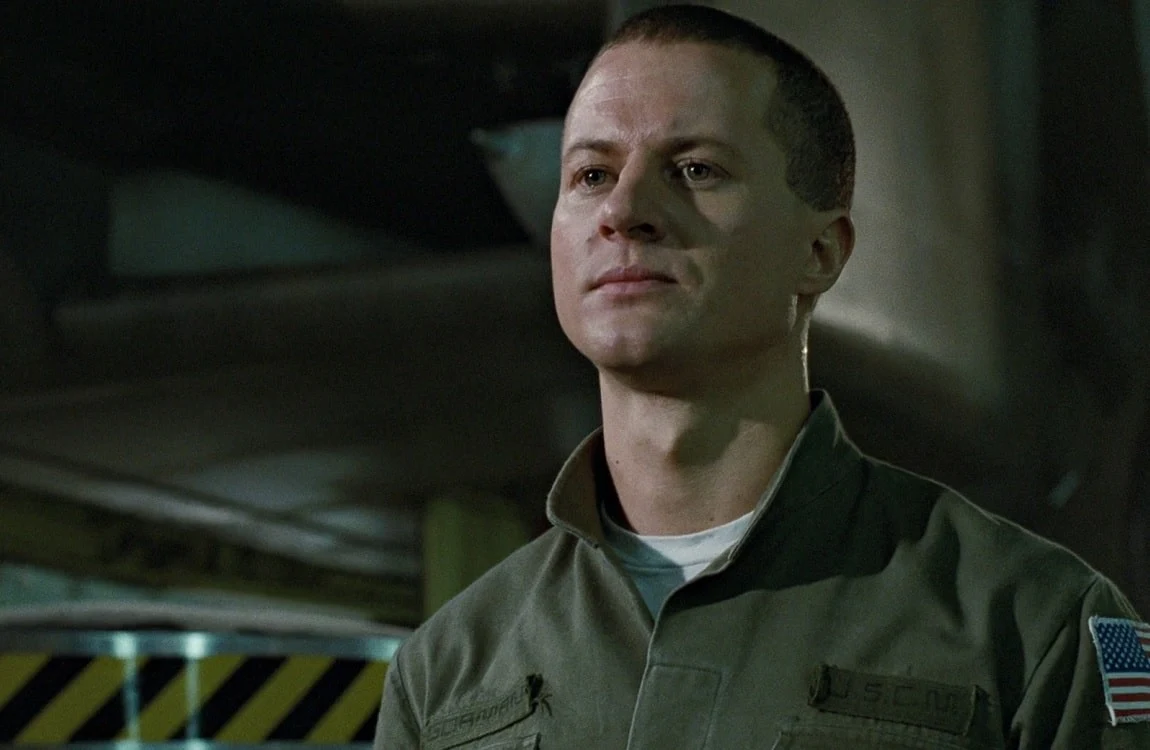
In 2179 a rifle unit from 2nd Battalion went to LV-426 after contact was lost at Hadley's Hope. Lieutenant Gorman held formal command from the APC. Master Sergeant Apone ran the sweep until the hive took him. They fought the hive under Hadley's Hope in Aliens. The atmosphere processor then detonated and wrecked the colony. Only a handful of people left the moon, including the remaining Sulaco Marines who could still walk.
Frontier War And The UACM Rename
The Operations Manual moves the clock into the 2180s. Marine Space Forces were reshuffled in 2180 for a wider Frontier, and reserves later went forward when the Border Bombings and Frontier War began around 2184. Battalions and starships were lost in numbers the Aliens-year Technical Manual never had to record. A colonial draft came back for the first time in more than twenty years.
The same decade sent more rifle companies into Xenomorph work that the film had treated as a one-off disaster. Aliens: Colonial Marines put the 118th Battalion off the USS Sephora back over LV-426 after the Sulaco returned. Dark Descent later used the UACM name on Lethe in 2198. Aliens: Fireteam Elite hangs the later ranks chart aboard the Endeavor in 2202, after the 2187 rename. Five years later, on the 2207 campaign at LV-558, that ship stamped USCM for the United Systems Colonial Marines. The Operations Manual's campaign close even floats a planned UACMC merger under a single UA banner, which is future talk in that book, not a finished fact in the Technical Manual.
Three World War
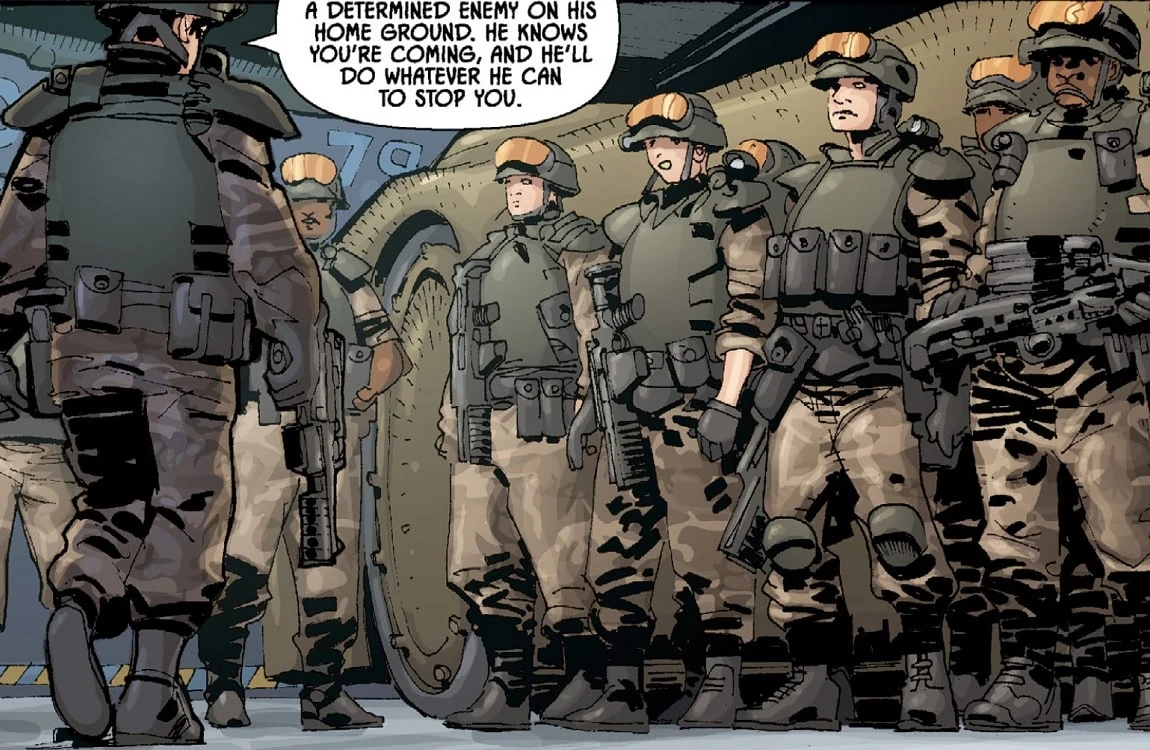
Colonial Marines fought the Three World War in the late 22nd century, in Aliens vs. Predator: Three World War. Machiko Noguchi brought a Jungle Hunter clan together with Marines from the USS Tarawa and other Conestogas. They took a Queen off Ryushi and hit a beachhead on Caparis VII, where Killer Predators had been running tusked Xenomorphs as attack dogs. The joint fleet broke that clan, and Machiko lost her blooding mark after the fight.
Rage War
In 2692 the Corps fought the Rage War, the latest large Colonial Marine war in Tim Lebbon's Titan trilogy. The Rage were humans who had left the colonies centuries earlier and came back with android generals and tamed Xenomorph armies.
Isa Palant sealed a ceasefire with Kalakta, and Yautja ships then fought beside Marines and Weyland-Yutani in that human-Predator alliance. The company still wanted a live Xenomorph and salvage from the Rage flagship Macbeth. Liliya burned the android generals, most of Macbeth went with them, and Marshall shut the human dropholes with the wreck of Phoenix.
Organization
Command
The Technical Manual splits the Corps into a supporting establishment and the operating forces. Recruiting, schools, research, and logistics sit in the first pile. About 58 percent of all Marines sit in the second, under US Space Command, with command posts at Houston, Texas, and O'Niell station at L-4. Those operating forces also answer, at the alliance level, to UAAC, which can put Colonial Marines beside Canadian, Latin American, and aerospace units on the same job.
If the Secretary of Defense and UAAC high command were knocked out, the Operations Manual gives interim advisory authority to the highest-ranking Colonial Marine officer under the President of the United Americas. Field stories still hang on a named officer with a ship, a battalion, or a platoon.
Marine Space Forces
Fighting strength was grouped into three Marine Space Forces, each tied to a United States AeroSpace Force fleet. MSF Sol covered the core systems from O'Niell, with the 1st Colonial Marine Division, the 1st Marine Aerospace Wing, and the only theater that routinely held two divisions. MSF Eridani sat at Happy Days on Helene 215 and watched the American and Chinese arms out toward Thetis and the Solomons. MSF Herculis worked from Chinook 91 at Georgia 525 along the Anglo-Japanese arm toward the Network fringe, about 35 parsecs out.
The Operations Manual redraws those maps after the 2180 restructure. Sol picks up a heavier home-system job and a major base at Rigel Kentaurus. Eridani swings onto the Anglo-Japanese arm and the Tartarus Sector, including the only listed USCMC base in UPP space at 52 Tau Ceti. Herculis takes the American Corridor, the Advance, and the Borderline Region. The books disagree on which arm belongs to which MSF, so the safe reading is theater names first and local task forces second.
A Colonial Marine Division was built around three infantry regiments and meant for orbital assault plus a stay on the ground. A Colonial Marine Aerospace Wing looked large on paper, on the order of 300 dropships, 30 heavy-lift shuttles, and 100 strikeships, but much of that strength sat attached to the division. Frontier work then broke the MSFs into autonomous task forces of regiment size or less, which is why Colonels and Lieutenant Colonels show up in stories more often than anyone counting four divisions on a wall chart.
From Division To Fireteam
The ladder under a division is the one later Marine teams actually drop with: regiment, battalion, company, platoon, section, squad, fireteam. A Marine Amphibious Unit in the Technical Manual is a reinforced battalion with two to four line companies, its own starlift, and at least thirty days of ground supplies. The Operations Manual's sample 33rd MAU, the Gunfighters, musters about 2,200 troops around 3rd Battalion, 5th Marine Regiment, a Cheyenne squadron, and a logistics battalion.
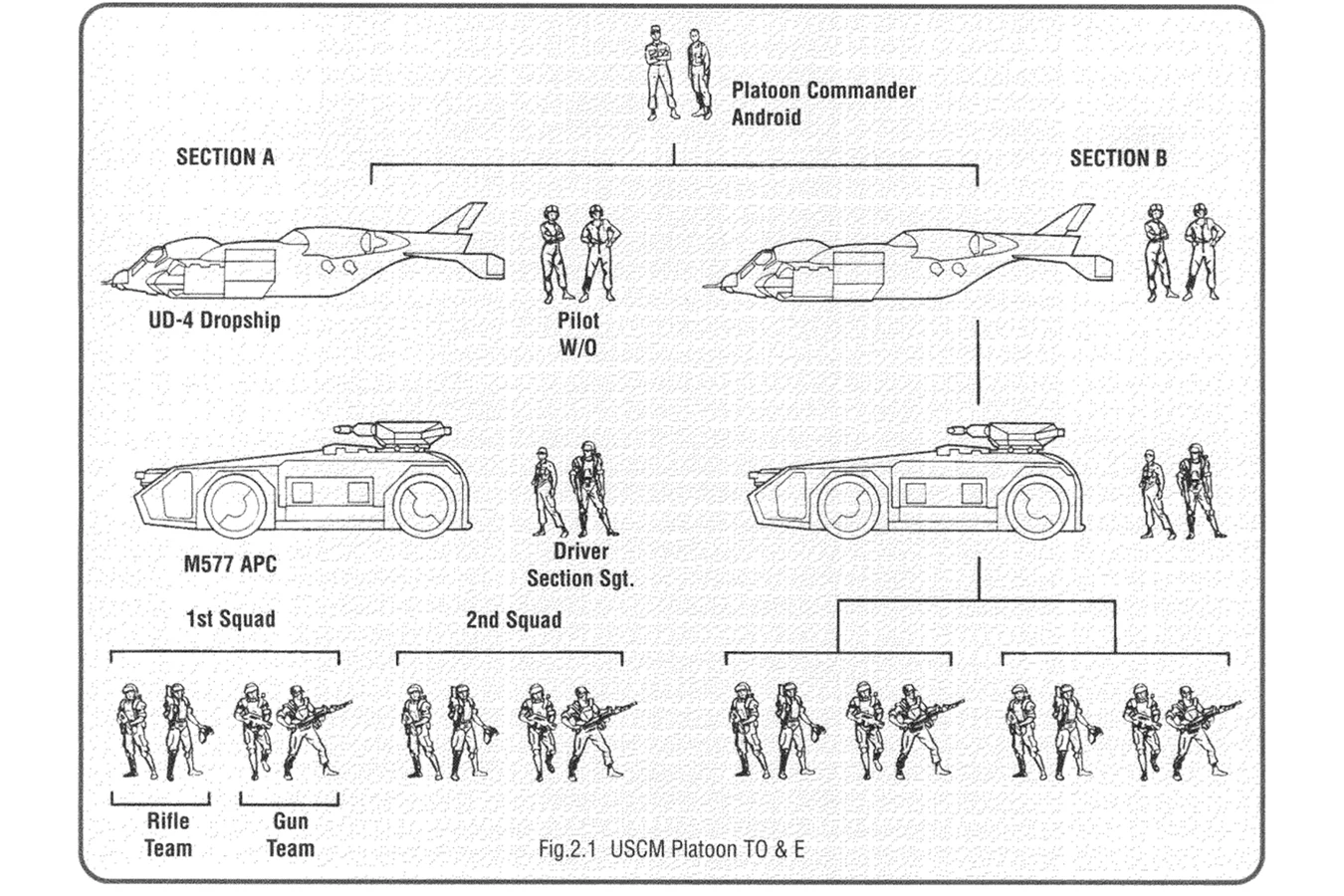
A line rifle company in that later book is 86 Marines: a headquarters and three rifle platoons. Below that, Marine 70 doctrine threw out the old triangle of two up and one back. The working unit became a pair. A fireteam is two Marines. A squad is a rifle team plus a gun team. A section is two squads in one APC. A platoon is two of those sections.
Rifle Platoon
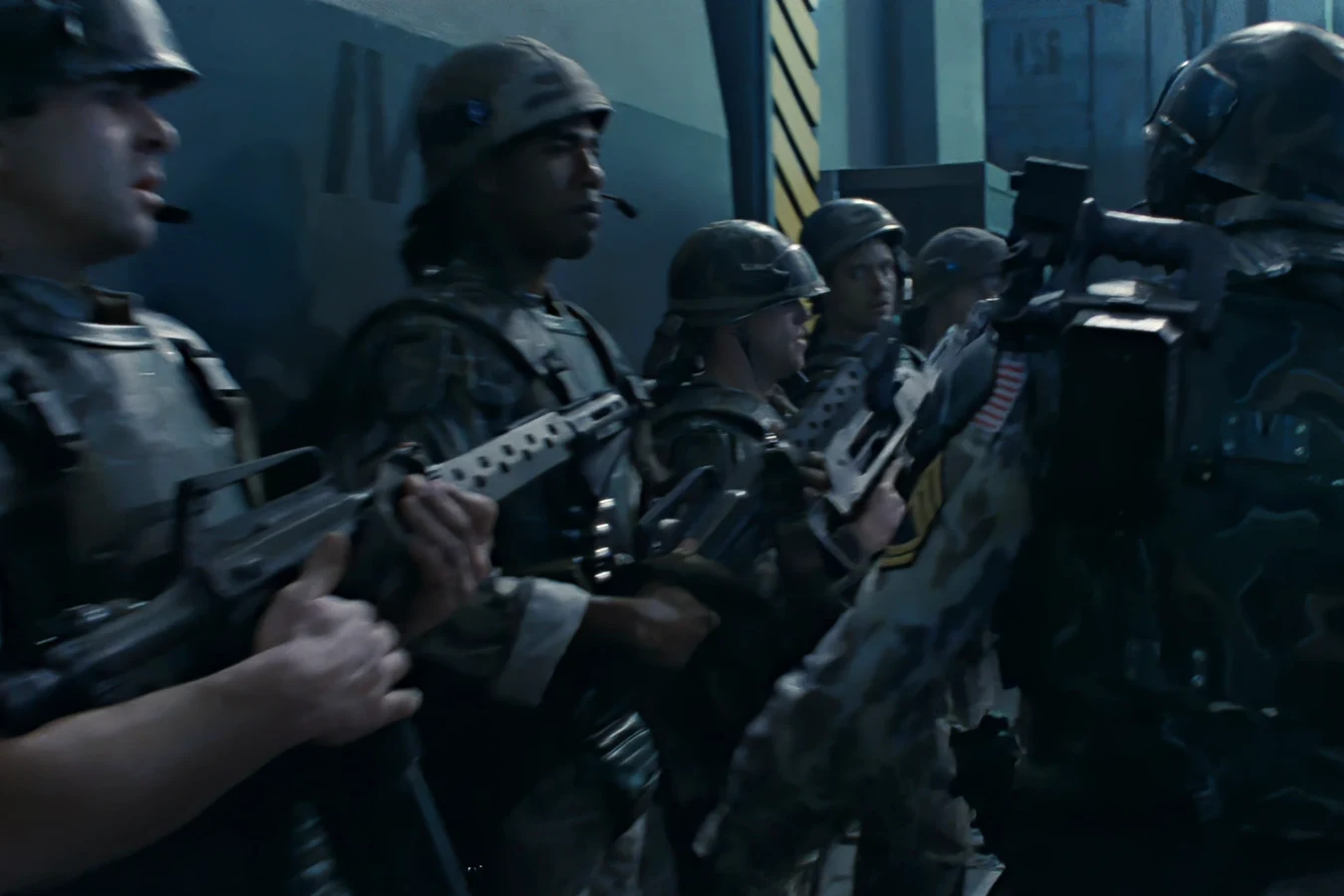
The Technical Manual's paper rifle platoon is about 25 Marines, including APC and dropship crews, and often thinner in the field. Each section rides one M577 and brings a UD-4 from the aerospace company. A Lieutenant commands, with one or two synthetics for advice, medicine, and spare driving or flying. A four-Marine squad puts a Corporal and a Lance Corporal over two Privates or PFCs. One pair carries pulse rifles. The other pairs a pulse rifle with an M56 Smart Gun.
Typical organic heavy kit on that same chart includes eight M240 incinerators, eight UA-571 remote sentries, a pair of M78 plasma guns or M5 rocket launchers, a stack of M83 SADAR rockets, and one M402 mortar. Sensors were meant to cover about a 1,000 meter frontage. The Operations Manual stays close: a 24-Marine platoon plus commander and adjutant, or a 22-Marine campaign platoon with a Staff Sergeant and an android specialist, still built around two APCs and two Cheyennes.
Doctrine
Colonial Marine doctrine assumed a non-linear battlefield and a rifle section that could hold ground without waiting on a higher headquarters. The Technical Manual wanted small autonomous units with their own transport, sensors, and heavy weapons, so a Lieutenant could push two sections at once. Overstretch made that look larger than it was: a battalion might cover a continent, and a regiment might be asked to watch a whole planet.
The job list in the Operations Manual is wider than a stand-up fight. Marines did colony defense, disaster response, fauna hunts, insurrection work, peacekeeping, and corporate security. Colonel Joe Kerwin's Marine 70 review already complained that the Corps was being used for UA police duty and pest control instead of the war it had been built for. The "bug hunt" line on the Sulaco mission is that same complaint from the rifle-squad end of the net.
Combined arms still sat under that infantry idea. The Cheyenne put the section on the ground and stayed nearby as a gunship. The APC was the rolling command post and the ride back to the pad. Motion trackers, sentry guns, and helmet cameras were meant to make a thin platoon look like a larger force than it was. When those systems failed, as they did under Hadley's Hope, working command moved to whoever could still lead.
Recruitment And Training
The Technical Manual wants a high-school graduate with a clean record, height between 147 and 200 centimeters, and a pass on simple physical and written tests. The average recruit in that book is 178 centimeters and 72 kilograms. Women to men sit at about 1 to 2.6. About 24 percent of applicants wash out, most of them because they cannot handle the technical kit, with the rest failing rappel work, space sickness, or the moral screen.
Boot camps in the Technical Manual are still Parris Island, San Diego, and Guantanamo Bay. The Operations Manual starts a lot of infantry time at Camp Pendleton. Recruits usually arrive between 18 and 23, train as riflemen first, spend their first months as Privates, and make PFC inside a year. Entry is listed as draft, volunteer, or coercion, depending on the decade. The largest Outer Rim recruiting office in the RPG is DP-27.
Officers go through OCS at Camp Barrett, Quantico, or transfer in from Annapolis and the USASF aerospace school at Gateway. Infantry officers then take Quantico's infantry course and a hostile-environments course at Camp Hanneken on Mars. Aviators train at Gateway or Kennedy ASFB in Florida. Artillery and armor still use Fort Sill and Fort Knox. Leading Edge already has a Colonial Marines Staff College that can push a green Lieutenant into the field fast, and names Gorman as the example.
Ranks
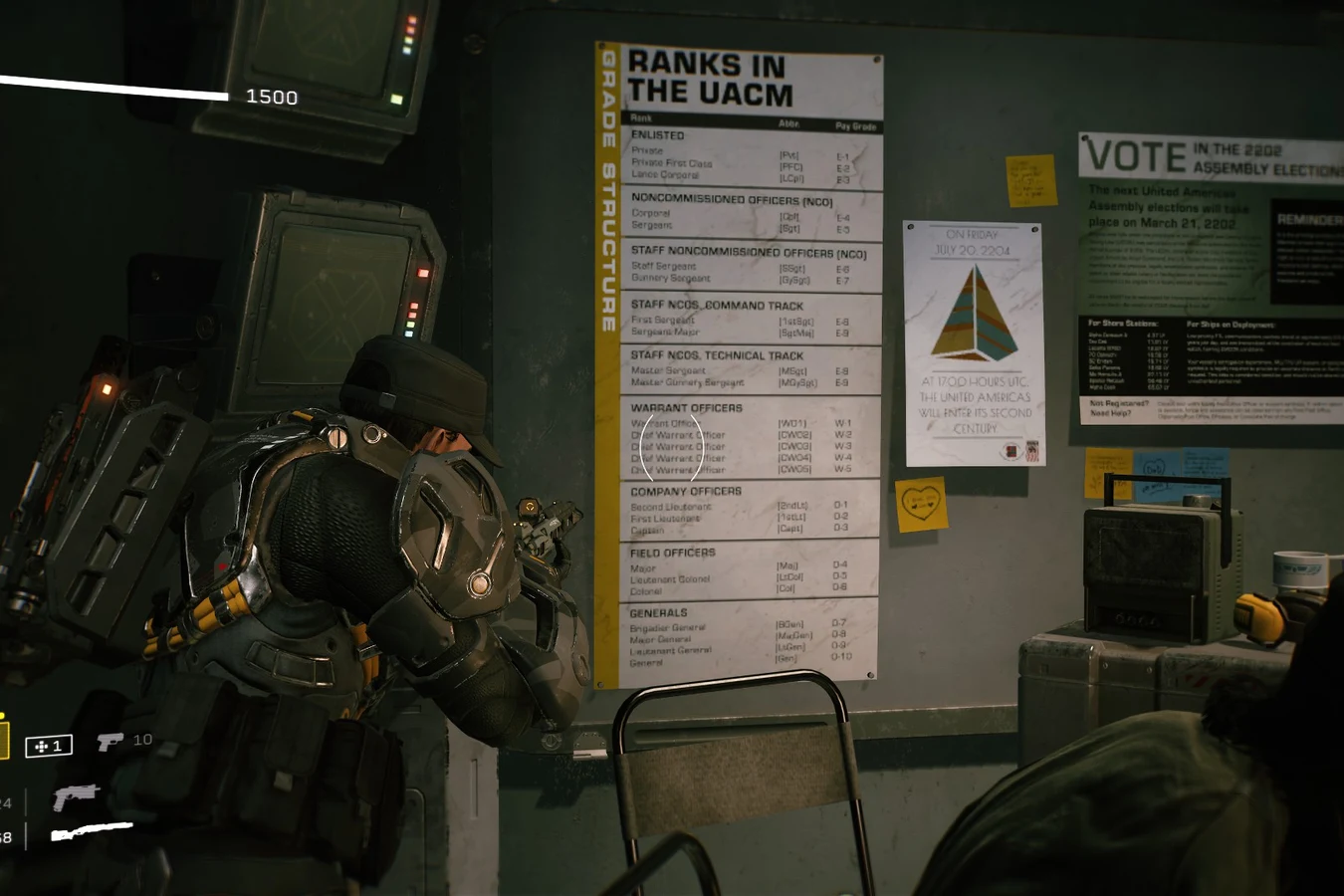
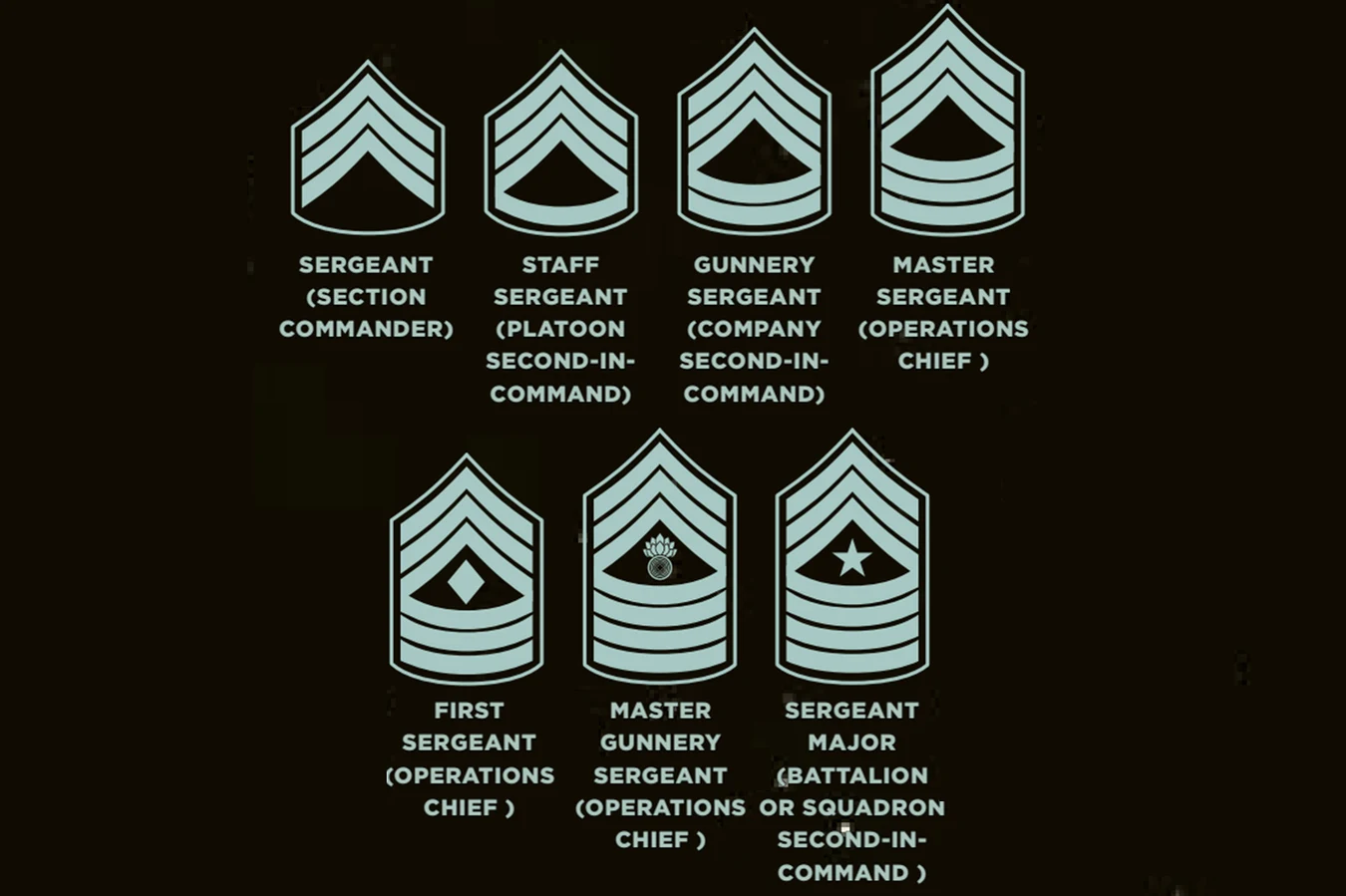
Colonial Marine ranks stay close to a real United States Marine ladder: junior enlisted, NCOs, staff NCOs, warrants, company officers, field officers, and generals. The books argue about who sits in which seat, not about inventing exotic titles. Fireteam Elite's UACM poster is the only widely seen chart that prints every pay grade from Private to General, including dual E-8 and E-9 tracks and W-1 through W-5.
The Technical Manual barely bothers with pay grades. It cares about billets: the Lieutenant in the APC, the section Sergeant, the Warrant Officer in the Cheyenne, the android in the command slot. The Operations Manual keeps a full USMC-shaped list for character creation, then undercuts it for play. Most player Marines stay Private or PFC. The squad NCO is usually a Corporal or Sergeant. Higher ranks stay rare because the book wants the table, not the Lieutenant, deciding the next move.
Weapons
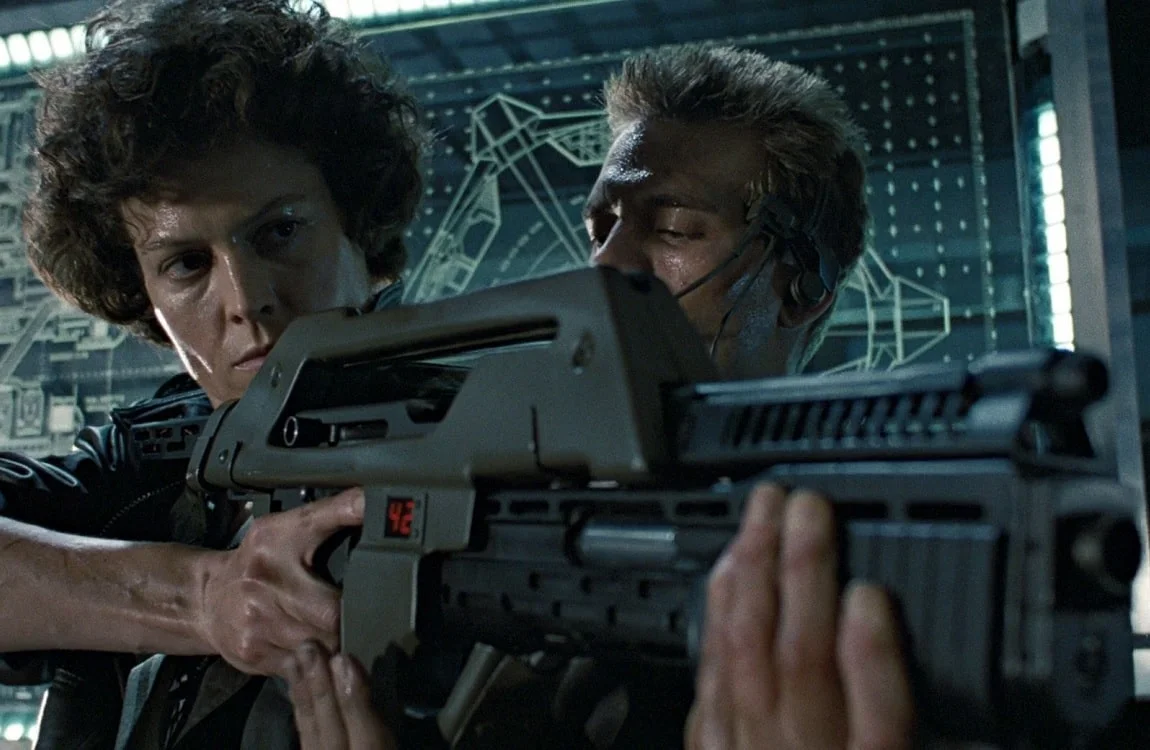
Standard rifle issue after Marine 70 was the M41A, a 10mm caseless pulse rifle with a 30mm underbarrel grenade launcher. Squad automatic fire sat on the M56 Smartgun. Close work and hive clearing added the M240 Incinerator, M5 rockets, and the UA-571-C remote sentry. Marksmen drew the M42A from a battalion pool. Sidearms were the M4A3 or, more and more, the VP-70.
Platoon heavy kit in the Technical Manual also counted disposable M83A2 SADAR rockets, a pair of M78 PIG plasma guns or M5 rocket launchers, and one M402 mortar for a section front. Each SADAR was a 3.1-kilogram one-shot tube with a cooled infrared seeker live for twenty minutes and a 10-meter backblast lane. The M78 PIG was a 15.2-kilogram phased-plasma rifle with a 30-round feed, claimed to open heavy-tank flank armor at 1,000 meters after a three-second charge. The 80mm twin-tube M402 mortar fired ten rounds from a rotary magazine in under eight seconds. Later Colonial Marine weapons added the M90 minigun, the bouncing Skeeter launcher, and Fireteam Elite 2's Type 111 particle emitter, none of which sat on that 2179 list.
Equipment
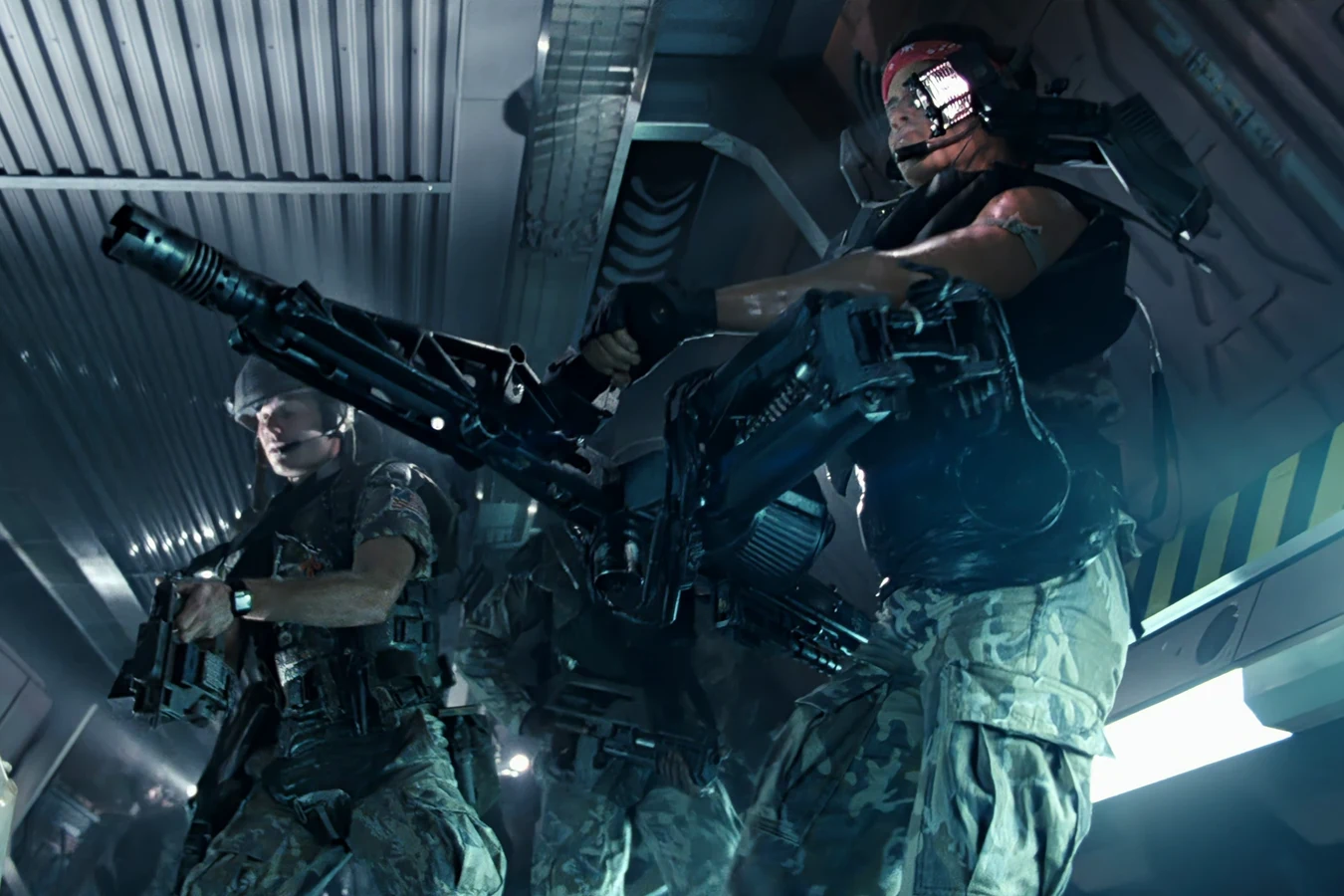
Field kit in the Technical Manual starts with the M3 armor stack, an M10 helmet, IR-absorbing battledress, a TNR shoulder lamp, an IMP pack, and the M314 motion tracker. The vest was a two-piece clamshell of titanium-aluminide over boron-carbide ceramic and carbon fiber, with a Venlar liner meant to stop fragments and small-arms fire. Battledress dyes soaked up infrared until washing wore them down, the rear-left TNR halogen lamp clipped off as a hand torch, and the IMP A-frame held about 24 kilograms.
The M10 helmet carried a camera, boom microphone, IFF beacon, and PRC 489/4 radio, with vest biomonitors feeding heart rate and breathing up that same net. The M314 marked movement out to about 1,000 meters in open country and under 20 meters inside walls. Corpsmen such as Dietrich carried a marked medic pouch with dressings and a handheld vitals monitor.
Ships
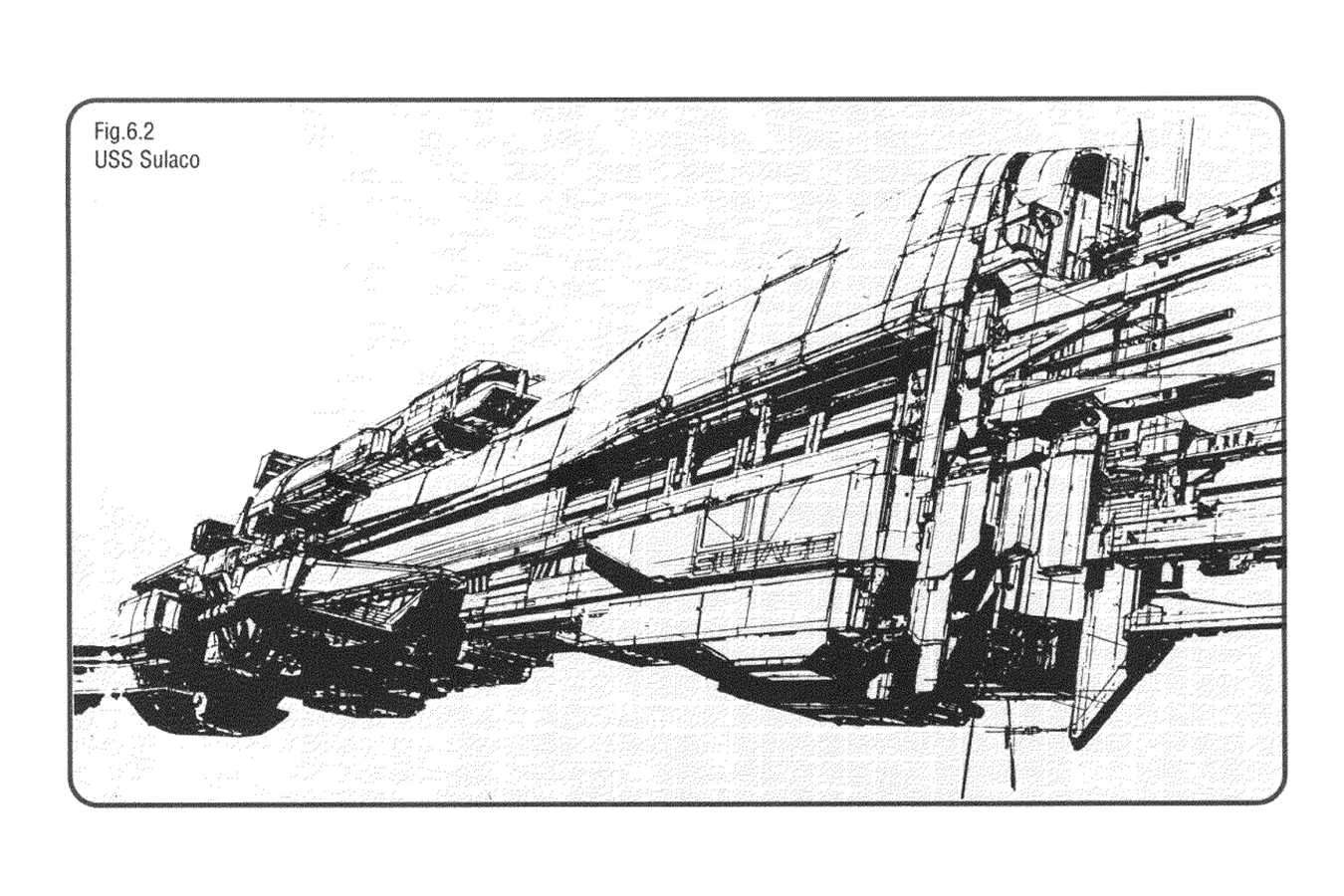
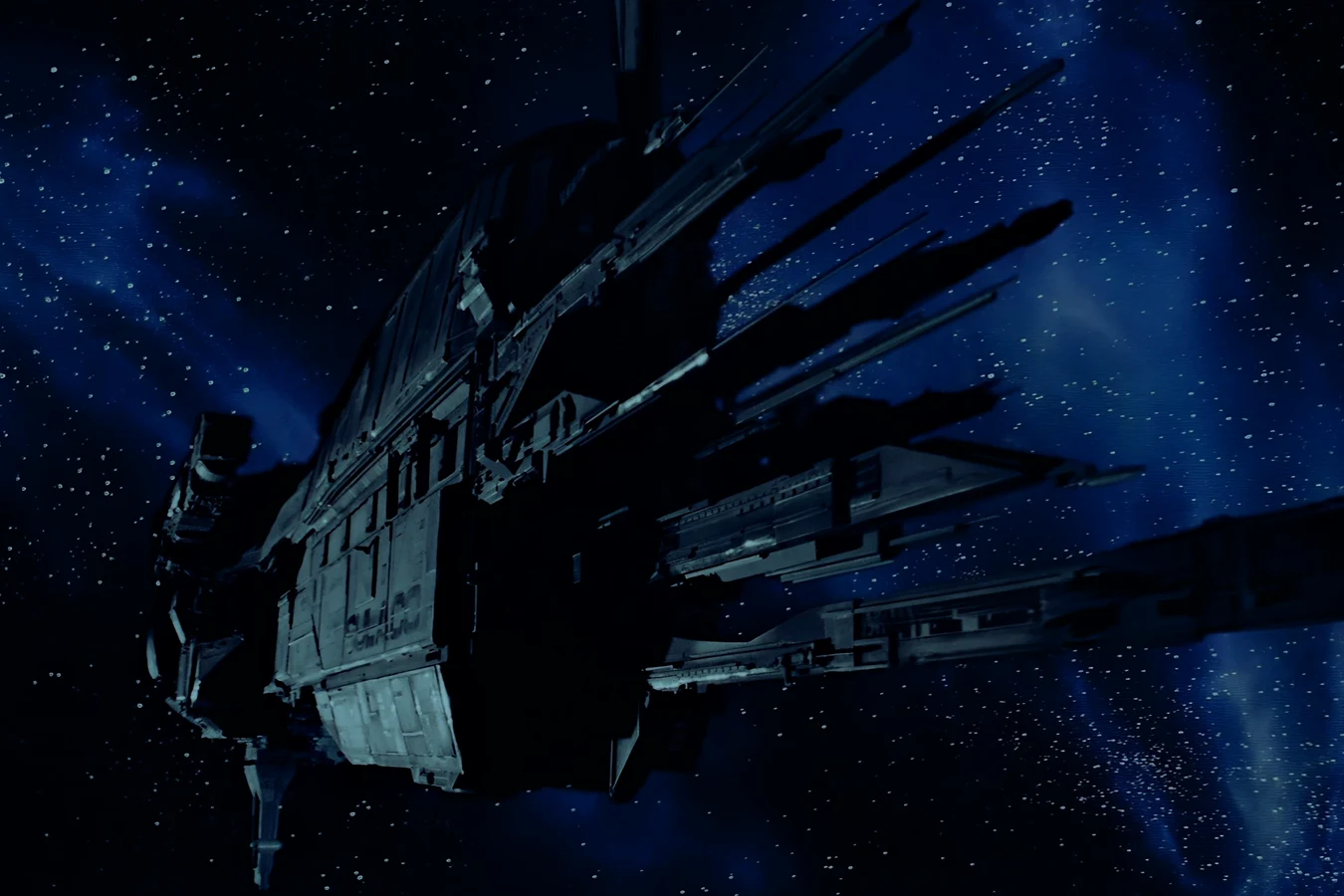
The Corps kept its own frigates and troop transports so a task force could stay out without waiting on another branch. The Technical Manual's workhorse is the Conestoga class, 36 built and 27 in service in the Aliens year, about 385 meters long, with the Sulaco as the thirteenth hull. A Conestoga could sleep 90 in standard capsules, stretch toward 300, and carry four shuttles plus a 1.2 million cubic meter cargo volume. The Bougainville class attack transport was already coming in as the next lift ship. Later Colonial Marine ships such as the Sephora, Marlow, Verloc, Endeavor, and Otago kept that same orbital-assault job.
From orbit a rifle section rode the UD-4L Cheyenne, a late-Tientsin light shuttle built to lift 16,000 kilograms from an unprepared pad and still fly as a gunship. The bay took an M577 with the turret stowed, and a two-person crew flew it. Early UD-4B ships used Atco Wyoming F23 turbines and lacked the later nose cannon, while the UD-4C and UD-4L added better engines, more missile hardpoints, and the GAU-113/B 25mm rotary gun. Troop marks swallowed the APC, gunship marks hung extra rocket and missile pods, and skycrane marks hauled underslung cargo. The longer-range UD-4S stayed out on patrol, and a planned UD-24 was meant to haul tanks in the early 2180s. A Conestoga also carried Type 337 EEVs as lifeboats, the same class that left the Sulaco after LV-426.
Vehicles
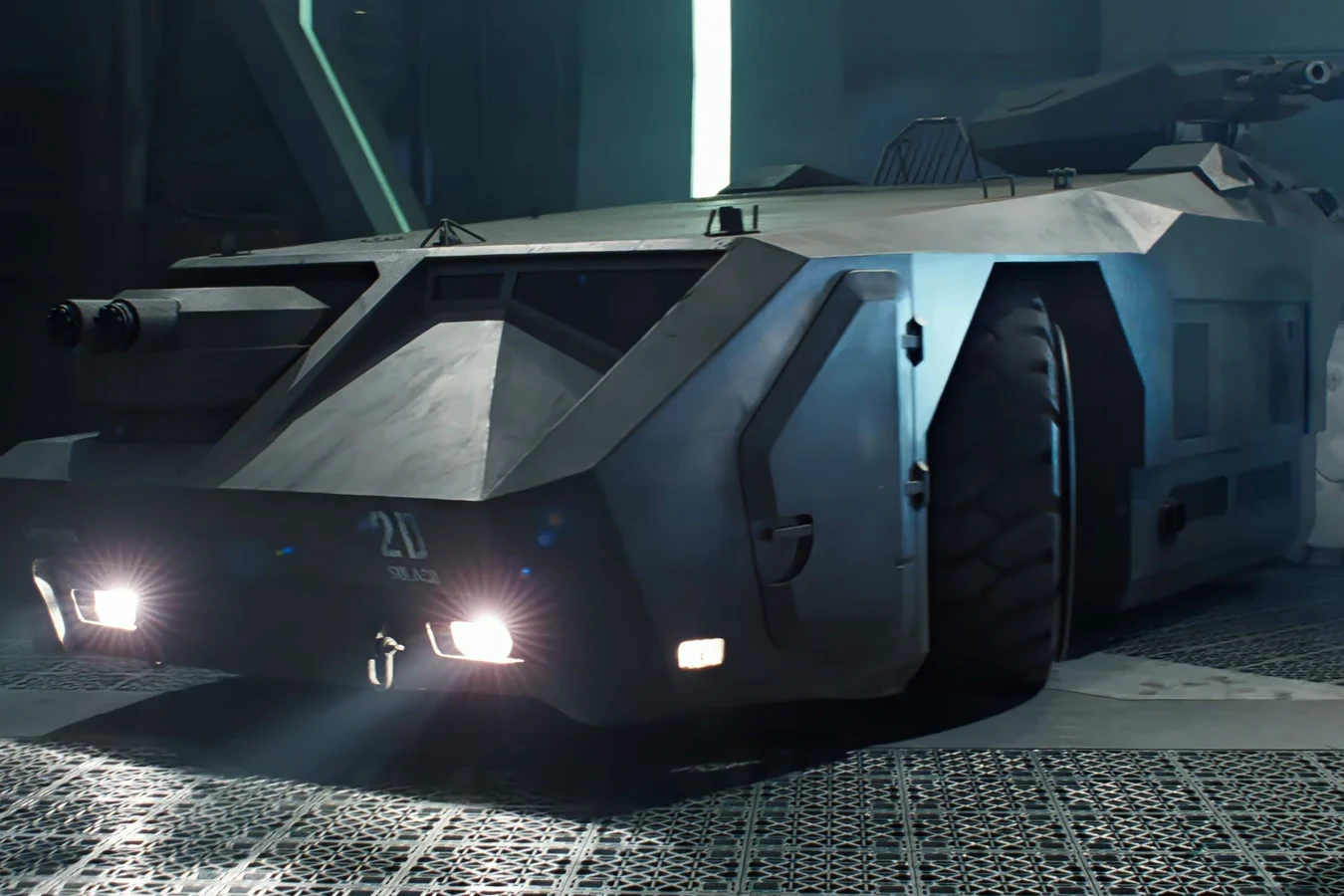
On the ground the M577 carried a driver, a gunner, and twelve passengers, with about two days of real supply even when a full Marine 70 load packed three days of ammunition. Combat weight sat at 14,500 kilograms so a Cheyenne could swallow the hull, with a 150 km/h road speed. A hull cupola held twin RE700 20mm gatlings, and the sliding rear turret came as plasma guns on the M577A, free-electron lasers on the M577A2, or particle beams on the M577A3.
The M579 Daisycutter sat on the same chassis with a quad 20mm gatling for point defense on Linna 349. Heavier Marine vehicles in the manuals include the M22 Jackson and M34 Longstreet tanks, the M40 Ridgeway heavy tank, and the 158mm M292 self-propelled gun. Later lines add the Stinger XT-37 recon buggy.
Mech Suits
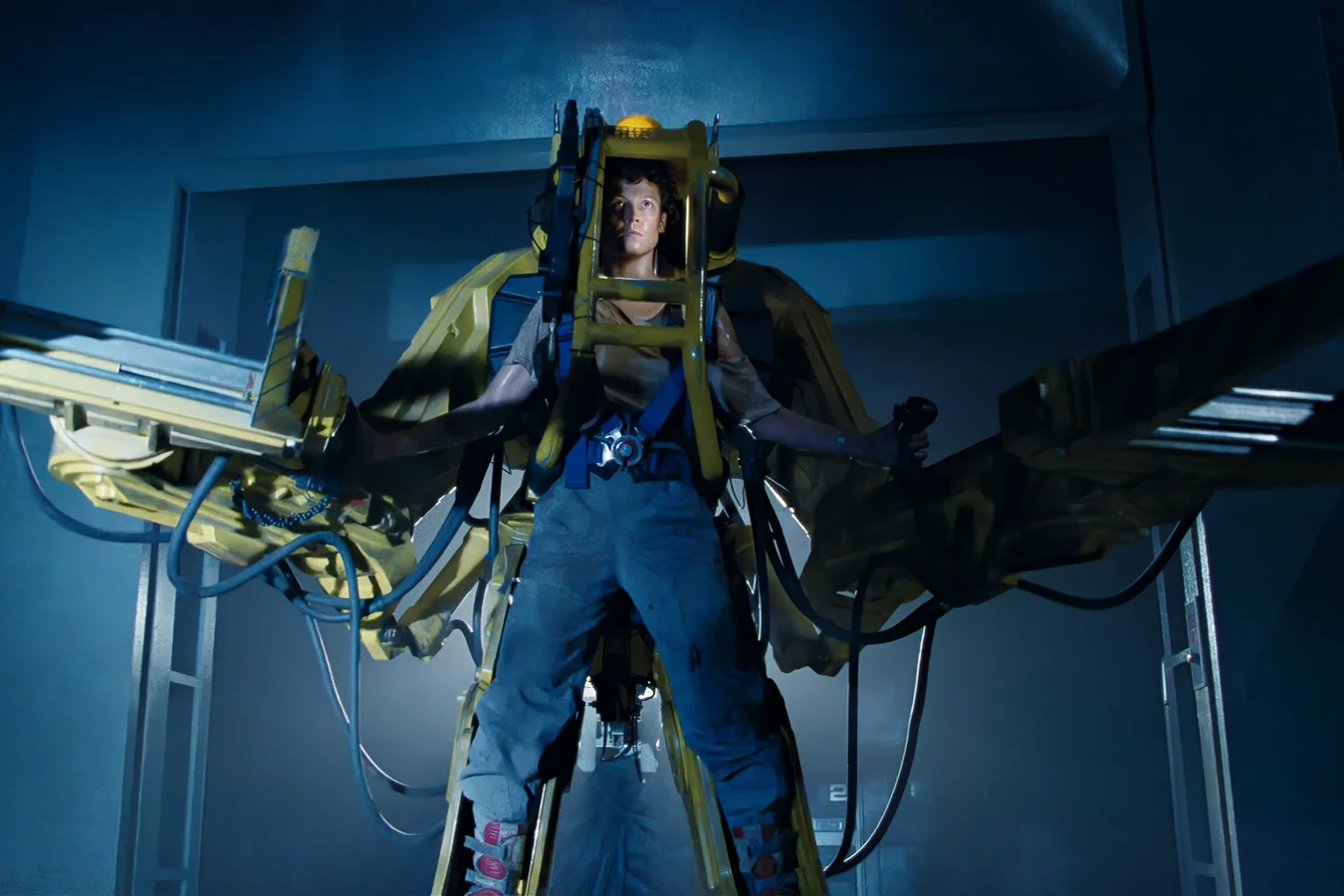
Cargo bays and engineers used the Caterpillar P-5000 Powered Work Loader as a walking forklift for dockyards and spacecraft holds, not as a fighting suit. It could place about 4,000 kilograms of cargo or ordnance and hang welders or cutters on the claws as well as pallet grips. An operator usually backed into the roll cage, but the same machine could run empty by remote through its onboard camera feed, as Blue Marsalis later did in Alien: The Cold Forge. Ellen Ripley still drove one against the Queen in the Sulaco hangar.
Later Marine stories added combat mech suits built to clear hives. The first experimental MOX units, short for Mobile Offensive ExoWarrior, appeared in Aliens: Tribes with a neural link and stimulant drugs that kept the driver hyper-alert and later addicted. Private Shitkicker used one to kill the Queen on TodLab LXI, then overdosed and wrecked the station. The later MAX suits, Mobile Assault Exo-Warriors from Aliens: Berserker, were thicker, acid-resistant, and carried flamethrowers, pulse rifles, and grenade launchers. After operator Max died on DS 949, technician Brian Ellis took over that suit.
Androids In The Corps
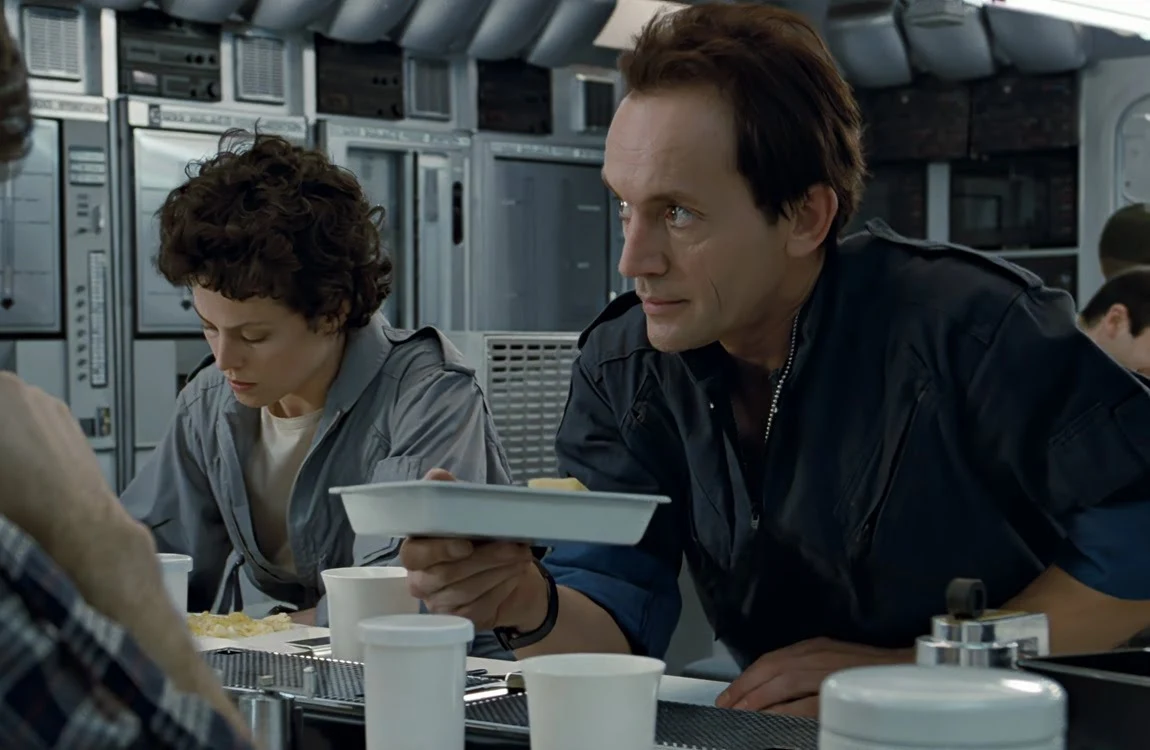
Marine synthetics were Corps property, not commissioned officers. After the '51 New Deal, UA and ICC rules banned synthetics from combat roles and required behavioral inhibitors by 2160. Marine 70 still put one 341-B in each platoon as a technical adviser, medic, and spare driver or pilot. Bishop is that billet on the Sulaco: seated beside the Lieutenant, useful in a crisis, and not wearing gold bars.
The Operations Manual sometimes labels the command adjutant synthetic as warrant-equivalent and lets that unit remote-fly a Cheyenne from a portable terminal. Other combat androids in later games and comics sit outside that legal box, either as company troops or as UPP refits. The Technical Manual also notes the practical limit: a synthetic is fragile against hydrostatic shock, which is why Bishop can be torn in half and still keep talking.
The Company And The Corps
Weyland-Yutani did not own the Colonial Marines, but it sat close enough to write parts of the job. The Operations Manual says the Corps can be activated as corporate security, co-financed by the Colonial Administration and the company, to protect short-term company interests. The same firm designed a large share of Marine hardware and supplied the 341-B synthetics. Platoon commanders disliked those call-outs, because a rifle section sent to hold a wellhead was no longer a force-in-readiness for a real war.
The Technical Manual already has that tension in an undated mission on Cristóbal, where Space Command's body count and the local massacre did not match, and a corporate partner secured the wellheads after the shooting. On LV-426 the company interest was live specimens, and the inexperienced Lieutenant in the APC was the officer Carter Burke could work around. Later stories add company commandos in APE suits and Dog Catcher teams that are not Marines at all, only dressed for the same corridors.
Notable Colonial Marines
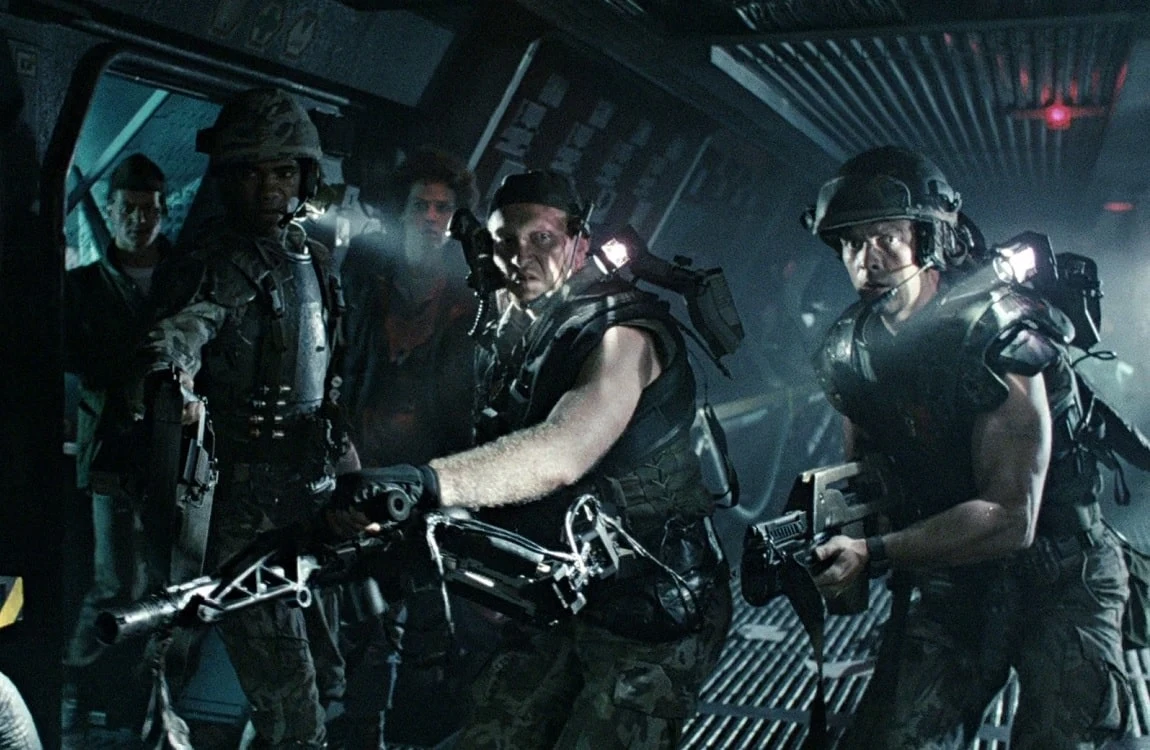
Most rifle missions never get a name on a poster. A few Colonial Marines did, because a film, a game, or a comic left them in command after the Lieutenant was gone, or because they walked out of a hive that had already eaten the rest of the unit.
Corporal Dwayne Hicks
Corporal Dwayne Hicks started the LV-426 mission as a fireteam leader on the Sulaco, service number A27/TQ4.0.48215E9. After Apone vanished and Gorman went down, he took working command of whoever was left, got Ripley and Newt off the colony, and left with acid burns and a wrecked Bishop. In theatrical continuity he died when the EEV hit Fury 161 at the start of Alien 3. Expanded stories give him earlier bug hunts, a wife lost on the Paradox, and several survival paths that keep him alive after the Sulaco.
PFC Jenette Vasquez
Private First Class Jenette Vasquez was one of the Sulaco's two smartgunners, paired with Mark Drake through training and the hive fight. She held the retreat after Drake died in acid, then detonated a grenade with Gorman in the vents rather than be taken alive. V. Castro's 2022 novel Aliens: Vasquez filled in a Los Angeles childhood, prison time, a Corps contract, and twins she had to give up to stay in uniform. Her sister Carmen Vasquez later died on another Marine mission in the Colonial Marines comics.
PFC William Hudson
Private First Class William L. Hudson was the Sulaco combat technician, service number A08/TQ1.0.41776E3, with four weeks left on his enlistment. He walked Hadley's Hope with the motion tracker, panicked after the dropship crash, then held Operations and helped set the sentry guns that bought the survivors time. A Warrior dragged him under the floor. He died in the hive when the processor detonated, and Aliens: Colonial Marines later found his cocooned body with a Chestburster wound.
Private Rookie
The unnamed Private called Rookie dropped from the USS Marlow onto BG-386 in Aliens vs. Predator 2010. He was a combat technician in the Hudson mold, and he killed the Matriarch in the Freya's Prospect refinery by firing the fuel tanks around her. He also fought company combat androids, a Young Blood hunter, and the Karl Bishop Weyland synthetic that ran the site. Major Van Zandt, already infected, asked him for a mercy kill on the way through. Rookie was one of the few people who left that moon alive.
Corporal Andrew Harrison
Corporal Andrew Harrison, platoon nickname Frosty, dropped from the USS Verloc onto LV-1201 in 2231 during Aliens vs. Predator 2. Separated from his platoon, he brought a northern beacon up, woke the Primary Operations Complex hive, and kept moving after Dunya staged his death. He killed adult Xenomorphs, a Predalien, and a Praetorian, then finished a Queen with a minigun inside Engineer ruins before getting off-world with other survivors. That Verloc corporal remains one of the few Marines who beat a three-way fight and lived.
Corporal Christopher Winter
Corporal Christopher T. Winter dropped from the USS Sephora with the 118th Battalion seventeen weeks after the Sulaco left LV-426, in Aliens: Colonial Marines. He boarded the drifting hull, fought company troops through Hadley's Hope and the Engineer wreck, killed a Raven Xenomorph from a P-5000 Power Loader, and ejected a second Queen from a hangar after the rest of the fireteam pulled out. The survivors left the moon on a company FTL ship with a rescued Hicks.
Zula Hendricks
Zula Hendricks began as a Colonial Marine in the Dark Horse comics, already a friend of Amanda Ripley in the Isolation-era window of Aliens: Defiance. She went AWOL after company work and injuries, then spent Resistance and Rescue hitting Weyland-Yutani black sites with Amanda. The novel Alien: Prototype put her on Jericho 3. Alien: Rogue Incursion later stranded her at Castor's Cradle on Purdan, where a Facehugger implanted her and a medpod cut the embryo out. By Alien: Inferno's Fall she was running the multinational Jackals from the warship Righteous Fury, with Olivia Shipp as one of her captains and Mae as her synthetic daughter.
Sergeant Wilks
Sergeant Wilks is the Dark Horse Earth War Marine who used to be Hicks on the page, before Alien 3 forced the rename. In 2192 he led the first human mission to Xenomorph Prime, then known as G-435, and got out with Billie after the rest of the unit died. He later fought General Thomas Spears at Third Base during Nightmare Asylum, when Spears was breeding Xenomorphs for a private reconquest of Earth. An android built from Ripley's records joined Wilks and Billie for the Female War strike that went back to the Queen Mother. His story belongs to the later Xenomorph war on Earth, not to the Sulaco roster.
Lieutenant Joseph Henry
Lieutenant Joseph Henry commanded the first series named for the Corps, the 1993 Aliens: Colonial Marines comic, from the Conestoga USS Melville. Command gave him a bad-attitude detachment after he assaulted an officer, including Carmen Vasquez. The unit cleared swimming Xenomorphs on Bracken's World, lost the Melville when crewman Beech wrecked the orbit, and died with Henry when the Alphatech station blew during the last fight against Ernst Kleist.
Olivia Shipp
Olivia Shipp survived the 2172 outbreak on Zagreus as a teenager in Alien: Echo, then spent the rest of her life in Colonial Marine uniform. She fought at the first Katanga siege as a corporal, served as a captain in Zula's Jackals, and commanded the UAS Endeavor as colonel of the 33rd Marine Regiment during the 2202 LV-895 campaign. By 2207 she held general's rank on that same ship in Aliens: Fireteam Elite 2, shot Dr. Pearce on the LV-558 campaign, and sent the closing report from the Endeavor. Among named officers she is the rare career that runs from a dead colony childhood all the way to flag rank without becoming the villain of the story.
Captain Kylie Duncan
Captain Kylie Duncan commanded the Midnighters from the assault carrier USS Benning during the 2184 raid on Iran's Hasanova colony. She opened the locked storehouses so adult Xenomorphs could kill the colonists and hide the job. Corporal Russell Becker left that unit and sent security cores from the Data Cannon. Duncan later died in a buried Weyland pathogen vault after Kamran Afghanzadeh tackled her. The fight is in Alien: Into Charybdis.
Major Akoko Halley
Major Akoko Halley, Snow Dog of the 39th Spaceborne DevilDogs, is the Rage War Marine who sent the 2692 Yautja ceasefire from LV-1529 and later boarded Macbeth with Isa Palant. She started as a captain on the Trechman Two hunt in Devil Dogs, then ran smaller 39th jobs such as Spite before Gerard Marshall pulled her off an Addison Prime staging run. After LV-1657 she went rogue with Palant and a wrecked Rage android, lived through the flagship boarding, and meant to report in with sergeant major Huyck.
Lieutenant Johnny Mains
Lieutenant Johnny Mains commanded the 5th Excursionists, the VoidLarks, on the Arrow-class Ochse during the 2692 Rage War. He fought Yautja at Southgate Station 12, crashed on habitat UMF 12, and was last seen arming a hangar nuke on the Rage sister ship Othello with Gemma Lieder. The Rage flagship Macbeth later received the signal that confirmed Othello's destruction.
Conclusion
The United States Colonial Marine Corps was a United States service inside a United Americas alliance, founded in 2101 to reach colonies the old amphibious Corps could not. It peaked after Tientsin, shrank into the Aliens year, and kept sending two-section rifle platoons off Conestogas long after the first hive on LV-426 had already shown what those platoons cost.
Later books rename it the UACM, send it through the Frontier War, the Three World War, and the Rage War, and put corporate security in the charter, but the working unit stays the same: a Lieutenant, a Sergeant, a four-Marine squad, a dropship, and an APC. Hicks, Vasquez, Hudson, and the later names on this page are what that structure looked like after they lost the radio.
Sources
Main film, manuals, and games that supply the Corps' name, strength, theaters, and rifle-platoon doctrine.
Film
- Aliens (1986)
- Alien: Resurrection (1997), for the later United Systems Military, not the USCM
Books And RPGs
- Aliens Colonial Marines Technical Manual (Lee Brimmicombe-Wood, 1995)
- Colonial Marines Operations Manual (Free League, Alien RPG)
- Alien RPG Evolved Edition core rulebook (Free League)
- Aliens Adventure Game (Leading Edge Games, 1991)
- Predator: Incursion, Alien: Invasion, and Alien vs. Predator: Armageddon (Tim Lebbon, Titan)
- Alien: Enemy of My Enemy (Mary SanGiovanni, Titan)
- Alien: Into Charybdis (Alex White, Titan)
Comics
- Aliens vs. Predator: Three World War (Dark Horse)
- Aliens: Colonial Marines (Dark Horse, 1993)
Games
- Aliens: Fireteam Elite (2021)
- Aliens: Fireteam Elite 2 (2026)
- Aliens: Colonial Marines (2013)
- Aliens vs. Predator 2 (2001)
- Aliens vs. Predator (2010)
- Aliens: Dark Descent (2023)
External Sources
- Colonial Marines Operations Manual (Free League Publishing)
- Alien RPG (Free League Publishing)
FAQ: United States Colonial Marine Corps
Quick answers about the USCM name, founding year, strength, Marine Space Forces, and how the Corps relates to Weyland-Yutani.
Is it United States or United Systems Colonial Marines?
The corps began as the United States Colonial Marine Corps (USCM). After the Colonial Protection Act in 2187 it became the United Americas Colonial Marines (UACM). Aliens: Fireteam Elite 2, in 2207, uses USCM again for the United Systems Colonial Marines. The United Systems Military is the wider armed service of that union.
When was the Colonial Marine Corps founded?
The National Security Act of 2101 set the Corps at four combat divisions and four aerospace wings, plus a fifth division and wing in reserve. The books also give it late-21st-century roots in the old amphibious United States Marine Corps.
How many Colonial Marines were there in 2179?
The Technical Manual, written from fiscal year 2179, puts active strength at about 165,000, with roughly 50,000 in reserve. That was down from a 2165 peak of 240,000 at the end of the Tientsin campaign.
What is the difference between USCM and UACM?
Aliens and the Technical Manual use USCM / USCMC for the United States Colonial Marine Corps. After the Colonial Protection Act in 2187, the service was renamed the United Americas Colonial Marines (UACM). Fireteam Elite's 2202 poster uses that name. Fireteam Elite 2, set in 2207, stamps USCM for the United Systems Colonial Marines.
What is a Marine Space Force?
Operating forces sat under US Space Command and were grouped into three theaters: MSF Sol for the core systems, MSF Eridani along the outer arms, and MSF Herculis toward the Network fringe. Each paired a Colonial Marine Division with an aerospace wing.
How big is a Colonial Marine rifle platoon?
The Technical Manual's paper platoon is about 25 Marines in two sections, each with an M577 APC and a UD-4 dropship, plus a Lieutenant and a synthetic. The Operations Manual sits in the same neighborhood: two sections, two APCs, and a command pair.
Did Weyland-Yutani control the Corps?
No single company owned the service. The Operations Manual still says the Corps could be activated for corporate security and was co-financed in that role by the Colonial Administration and Weyland-Yutani. Platoon commanders often hated those jobs.
Tag Categories: Alien Universe Organizations | Alien Universe Factions | Colonial Marine Lore | Alien Lore