
The M3 Pattern Personal Armor is the Colonial Marine fighting vest from Aliens. Marines wore it with the M10 ballistic helmet, a TNR lamp on the left shoulder, and webbing hung from load-bearing arches over the plates. The Aliens Colonial Marines Technical Manual lists it as a rigid layered shell based on the French armed forces' Cuirasse de Combat. In 2179 the Sulaco squad took that kit into Hadley's Hope. Later games kept the camo clamshell, then Aliens: Fireteam Elite and Aliens: Fireteam Elite 2 put Marines in a later vest and a more closed helmet.
Design And Specifications
Personal protection for a Marine rifleman is treated as essential because the main threats are no longer just small-arms fire. Artillery blast and fragments do as much of the killing, so the M3 pattern is built to stay light and wearable while still stopping what it can. The Tech Manual bases the shell on the French Cuirasse de Combat and moulds it as a sandwich of four layers. Later Marine books and games credit Armat Battlefield Systems as the maker. The 1995 manual itself describes the pattern without a company stamp.
The outer skin is an ultra-light titanium aluminide alloy. That skin gives the vest its shape and burns away in a controlled way if a laser hits it, which is the ablative layer. Under that sits a core of boron carbide resin-bonded to graphite-composite carbon fiber. Boron carbide is a very hard ceramic meant to smash a bullet on contact and form a cone-shaped base that soaks up the remaining energy. The carbon-fiber layer then splits apart across a wide area so the hit is spread instead of punching a neat hole. On the inside is a woven liner of 1500 denier Venlar fibers. That liner deforms around the impact and catches any chips or fragments thrown off by the first three layers.
Any bullet or fragment that hits the shell weakens that panel, so the standing rule is to swap the damaged section at once. In the field the vest is not a hard stop against high-velocity ball ammunition or HEAP small-arm rounds. It can be expected to stop low-powered ball and to take some of the sting out of impact-fused explosive bullets, grenade fragments, and artillery splinters. The shell also uses curved, rounded surfaces to cut its radar return, plus infrared masking so the wearer is harder to pick out on thermal sights. Under the plates, standard USCM battledress utilities are two-piece polycotton coveralls printed with dyes that soak up infrared at different frequencies, which breaks up the Marine's heat outline until washing wears those dyes down.
Vest, Lamp, And Pack
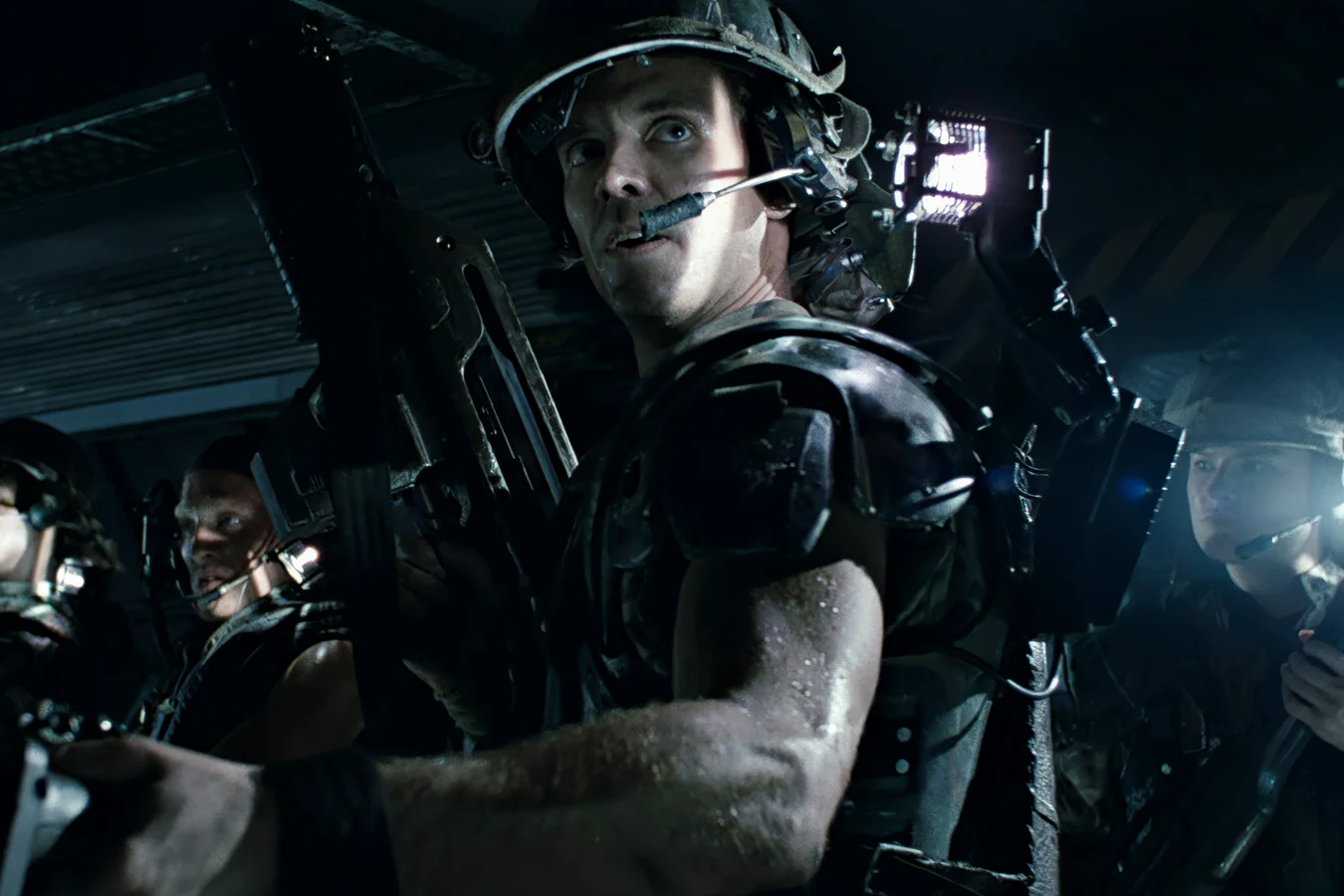
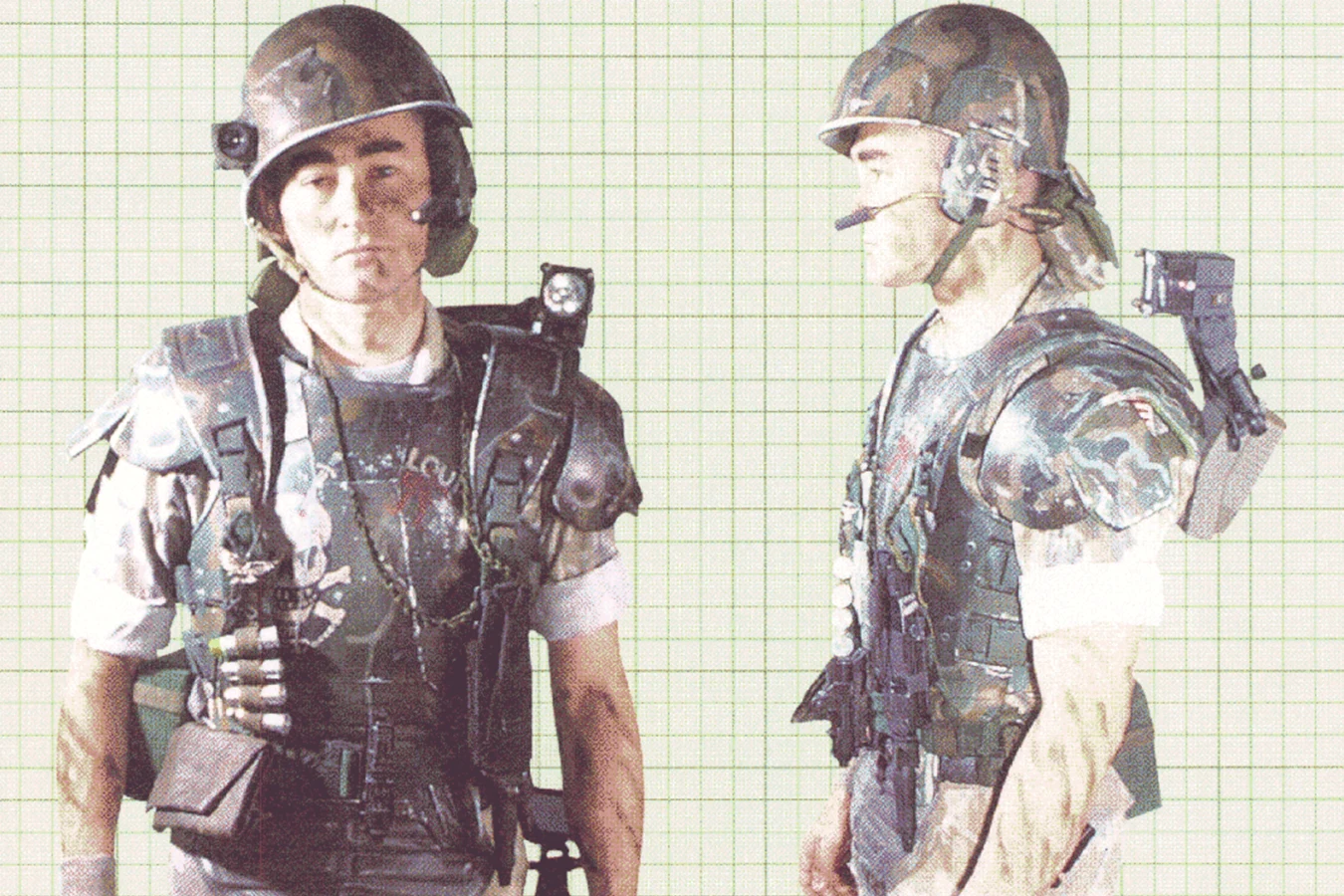
The main piece is a rigid vest that covers the chest and belly, front and back, from the groin to the neck. It is a two-piece clamshell locked at the sides by plastic clips. Above each shoulder a rigid load-bearing arch takes the webbing straps. Those arches are padded underneath so the wearer can hang an Individual Marine Pack without grinding the collarbone. Two segmented plates on webbing straps cover the front and side of each shoulder.
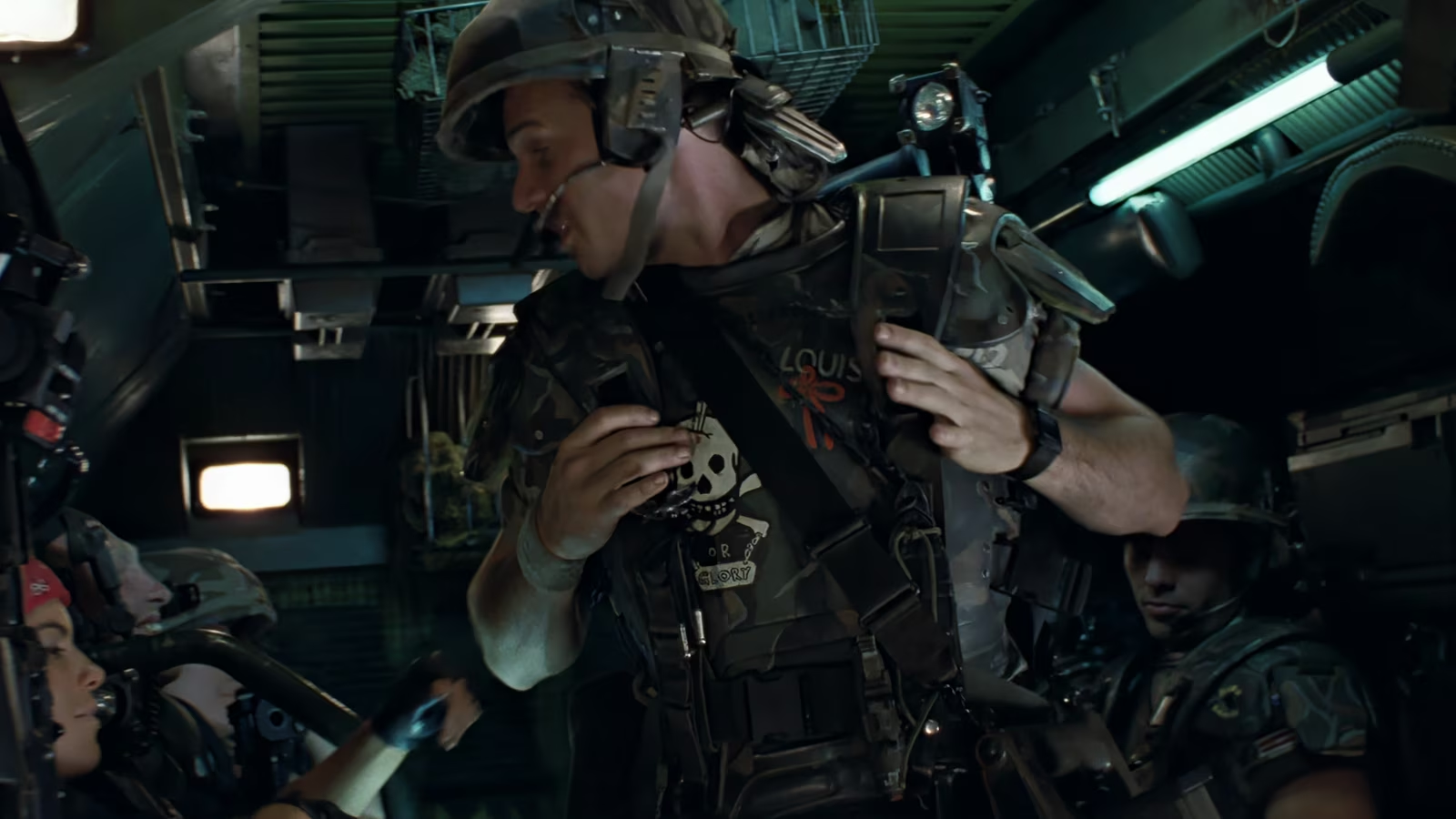
Inside the clamshell are remote biomonitors that read heart rate and breathing. An optic cable runs that data to the PRC 489/4 transmitter in the M10 helmet, so a section commander and medevac crew see the same life signs as the camera feed. On the rear left shoulder a bracket takes a high-powered halogen white-light TNR lamp. The lamp runs from a rechargeable internal battery and has a carrying handle, so a Marine can pull it off the mount and use it as a hand torch. Vasquez and Drake could hang the same lamp on a smartgun harness plate when they were not wearing the full vest stack.
Three brackets on the back of the vest take an IMP frame. The pack is a lightweight medium load rated to about 24 kg, hung on a carbon-fiber A-frame that clips to those rear mounts. It sheds rain but is not waterproof, so Marines get liners for the main compartments and pockets. A Tech Manual figure shows a Marine with a light IMP on the vest, an M83 SADAR stowed on top of the pack, and an entrenching tool on the back. On the Sulaco drop, Apone and Hicks wore that vest and lamp through the colony search with M41A Pulse Rifles, the same silhouette the manual draws for a rifleman in warm-temperate battledress.
Abdominal Pad And Greaves
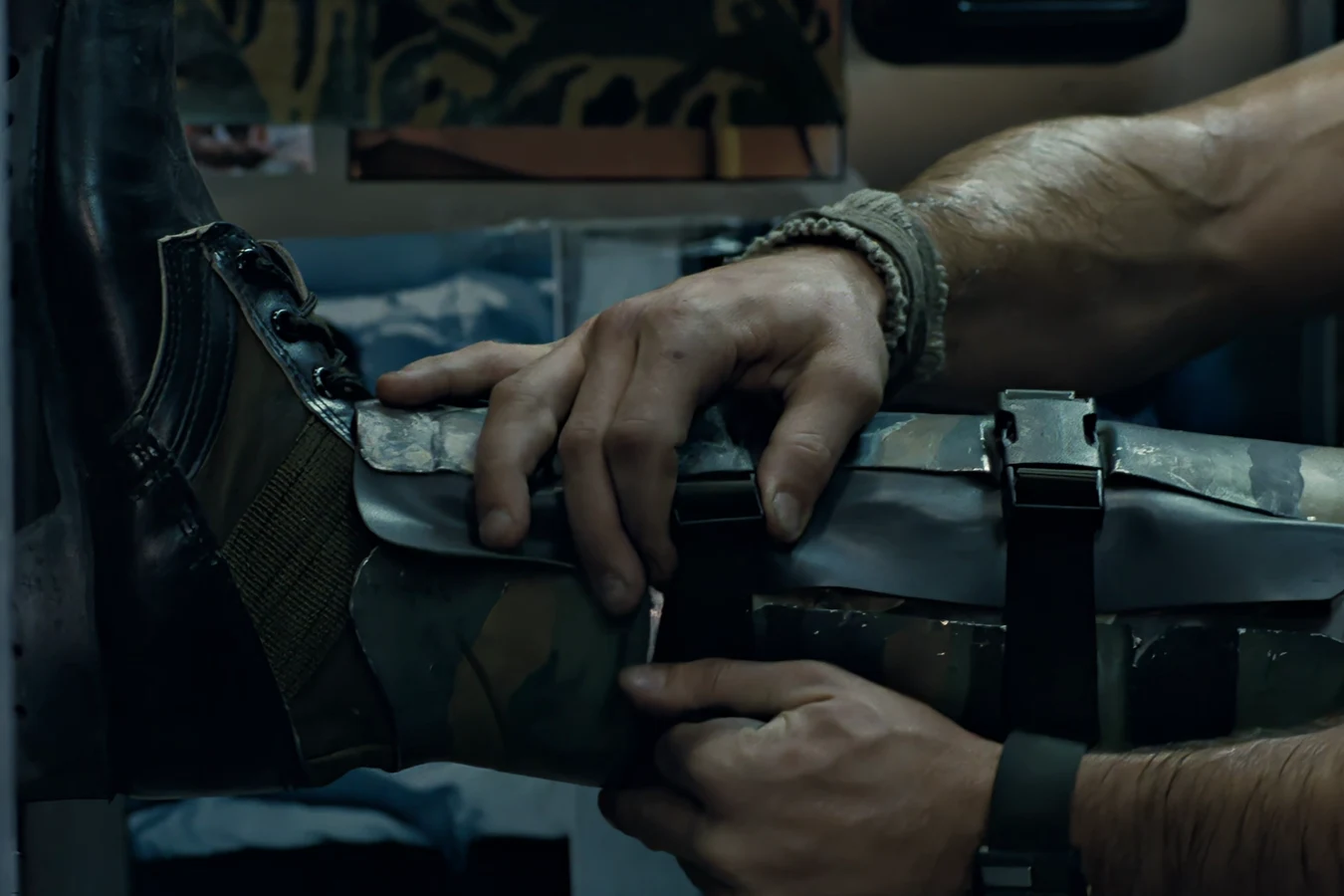
Below the M3 vest sits a separate pad that covers the front abdomen and groin. It is a flexible sheet of rheological ballistic armor, a material that stays soft until a hit makes it stiffen, then is held on by a diaper-style harness. A rigid plate is fixed to the lowest part of that pad to protect the genitals. Leg armor is a pair of clamshell greaves that cover the lower leg from ankle to knee. The knee segments hinge on webbing straps and tie around the leg above and at the back.
The Tech Manual's full rifleman figure adds the rest of the fighting load around those plates: ammo pouches, a combat knife, a 30mm grenade bandolier, the shoulder lamp, a hand welder, and a wrist location transponder. Field boots are a separate issue from the vest. The standard M3 boot has a leather upper. Jungle and arctic variants change the shaft, but all of them use a synthetic sole with layers of resin-bonded flexible Venlar micromesh against spikes such as caltrops or panji sticks. Some wearers later claimed that sole saved feet from land mines.
M10 Pattern Ballistic Helmet
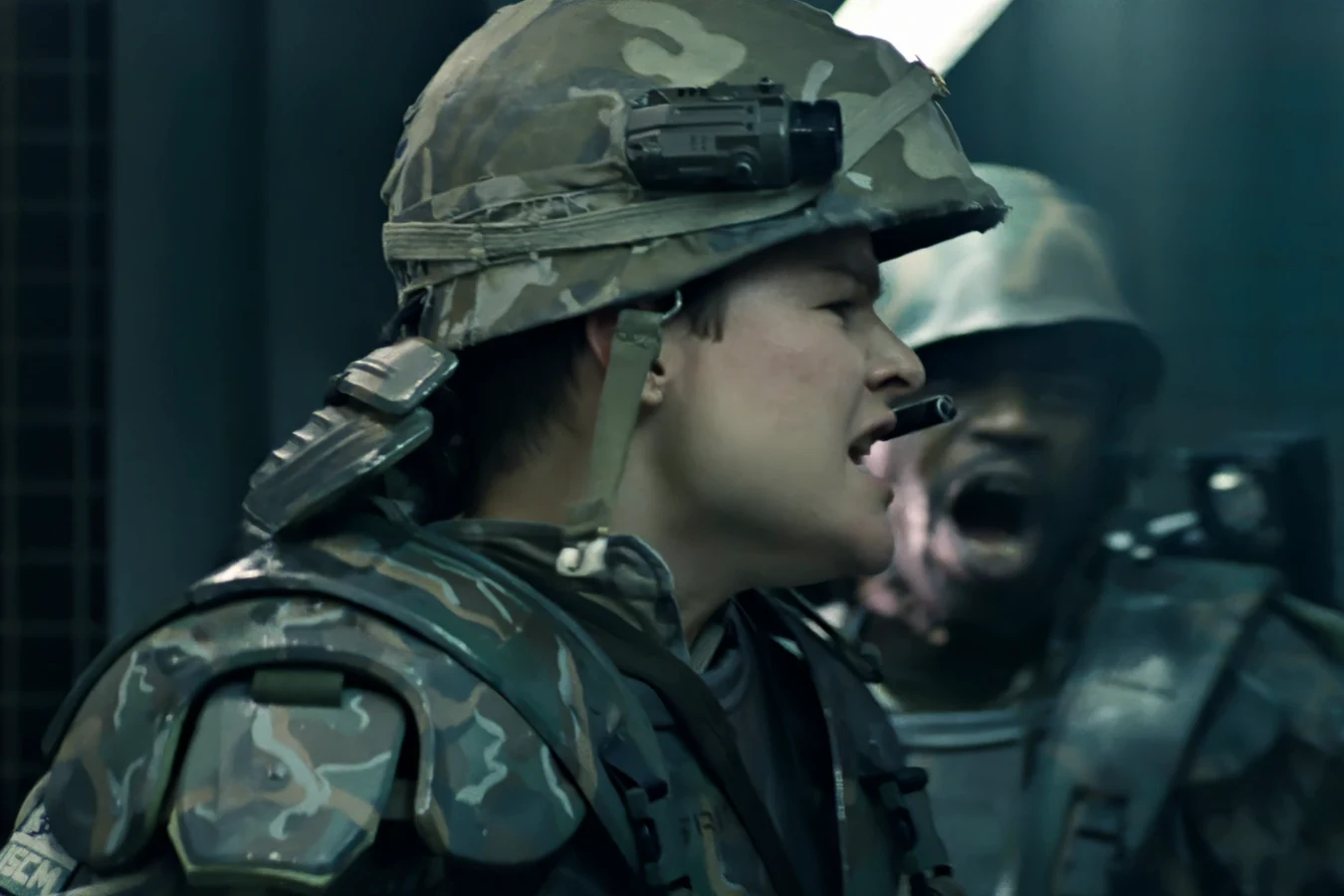
Head protection is the M10 pattern ballistic helmet. The shell uses the same layered idea as the vest and carries the Marine's comms, camera, and identification gear in one stack. Built in are a tactical camera, an audio microphone, an Identification Friend or Foe transmitter, and the PRC 489/4 receiver and transmitter. A passive infrared sight flips down over the right eye and paints thermal pictures from the camera over the real scene, the same way a head-up display sits on a cockpit glass.
The comms set itself is a headset clipped inside the helmet, with a boom microphone, an earpiece, and a microstate receiver and transmitter. An interface ties that headset to the Motoca 419 tactical camera on the right side of the shell so both share one transmitter. The camera sends digital optical and infrared pictures at a standard 25 frames a second. In heavy electronic warfare that rate is cut to 12.5 frames, or as low as 1 frame a second, to keep the picture readable. An optic cable from the headset to the vest biomonitors keeps heart rate and breathing on the same net as the video, for the section commander and for medevac.
Audio and video go out on VHF, usually between 1.5 and 40 MHz. Video needs a wide channel, and the headset also sits on a multiplex voice net, so every signal is encrypted, compressed, and sent as a 128-level pulse-code stream. The antenna is a tiny fraction-wavelength dipole in the headset with a tuning unit that behaves like a longer aerial. Besides voice and picture, the PRC 489/4 holds an IFF transponder, a radio-location beacon, and a GPS link when satellites are up. The set can hop frequencies to stay ahead of direction-finding, intercept, and jamming. When an enemy is using direction-finding to call artillery onto a squad, a commander can drop the video and spread the voice net across a wide band so the traffic looks more like background noise.
All of that traffic dumps into a Tactical Operations Center, usually in an M577 APC or a UD-4 dropship, or on laptop terminals in the dirt. A section post shows helmet-camera and vital-sign screens, with extra panes for motion trackers and UA 571-C sentry guns. The voice net is multiplex, so everyone can talk at once, which is why commanders switch it to simplex when the channel turns into noise. That is the system Gorman watched from the dark bay while the rifle team walked LV-426, and it is why blank helmet screens were as much a part of the hive fight as the gunfire.
Limits And Combat Use
The vest is a fragment and low-power stop, not a shield against a dedicated armor-piercing shot. On Helene 215, PFC Doug Boone of the 21st MAU took a Japanese 8.1 mm explosive rifle round square in the chest. The fuse went off on the plate and spent its energy there instead of punching into his belly. Eight other Marines on that line had the same luck that day, and Boone blamed a bad ammo lot rather than a miracle vest. The shell can win against an impact-fused round if the fuse is early, and it can still lose against a clean high-velocity hit.
In a trench fight, men of the 16th Colonial Marine Regiment under Captain McCarthy threw or launched M40 grenades, then turned away from the blast and hunched so fragments hit the vest and the backs of the legs. They did that at ranges inside ten meters, with the clamshell and greaves on. The plates were there to take that blast and the enemy's splinters, not to walk through a Warrior or a HEAP core.
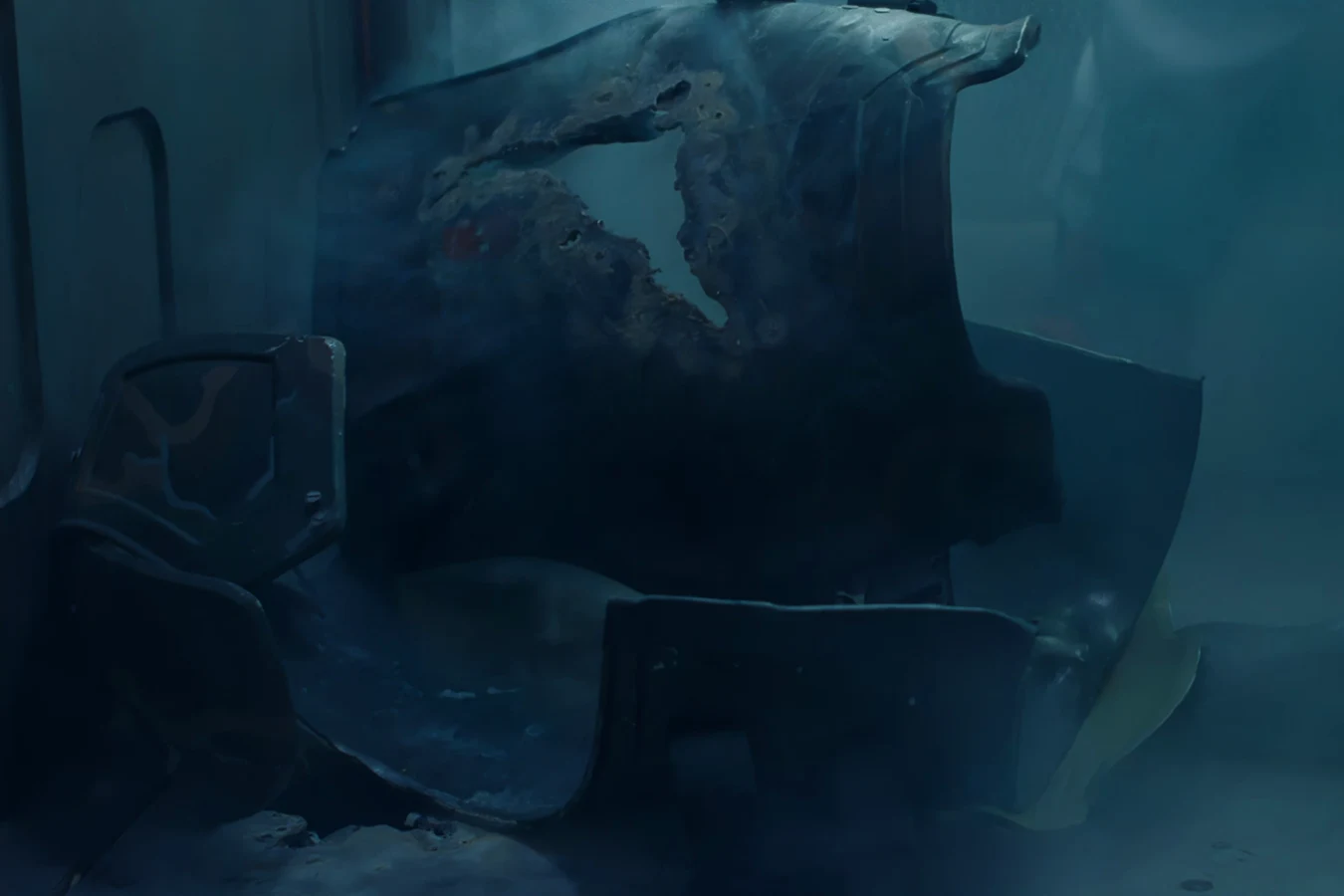
Xenomorph blood cuts through those same layers. At Hadley's Hope, Hicks took acid through the kit on the way out of the processor, and later games show chest plates with melted holes where a splash ate the ceramic and liner. Smartgunners often left the helmet off because the M56 head-mounted sight and gun tracker replaced that stack. Drake and Vasquez fought in the vest without the M10. Gorman never put the armor on for the colony search. Hudson painted a skull and dagger on his plate, wrote Louise over the heart, and marked a calendar and GAME OVER on the helmet cover. Dietrich had a nurse's caduceus on the front of her M10, BLUE ANGEL across the back, and a red no symbol on the chest.
Newer Armor Types
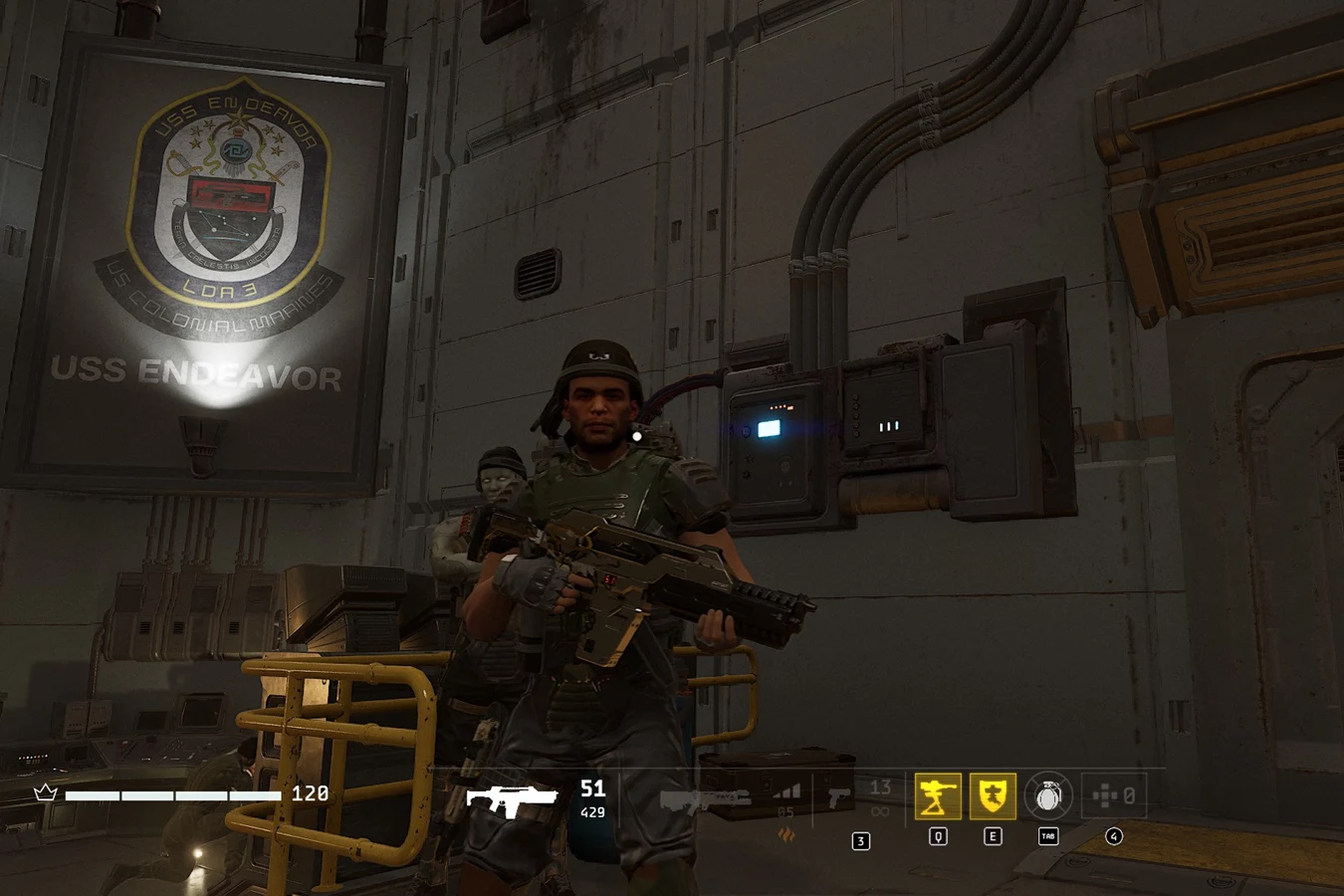
Aliens: Colonial Marines kept the 2179 clamshell, camo covers, and shoulder lamp close to the film kit. Fireteam Elite on the USS Endeavor moved to a later vest: a ribbed olive chest plate, matching shoulder cups, and a darker enclosed helmet with the light on the shell instead of a TNR on the rear-left bracket. The under-suit is a full tactical coverall rather than the short-sleeve battledress of the Sulaco drop. Fireteam Elite 2 keeps that later plate and helmet as the working Marine look, with class kits and cosmetics layered on top rather than a return to the M3 clamshell.
Aliens: Bug Hunt names a close variant as M3-1 armor. On that hunt, a tail went through Heimbuch's M3-1, which is the same lesson the Tech Manual already gives for HEAP and high-velocity ball: a named pattern is still a fragment vest, not a sealed fighting suit. The later Fireteam plate covers more of the torso and hides more of the head, but it is still personal armor over fatigues, not a powered shell.
Behind The Scenes
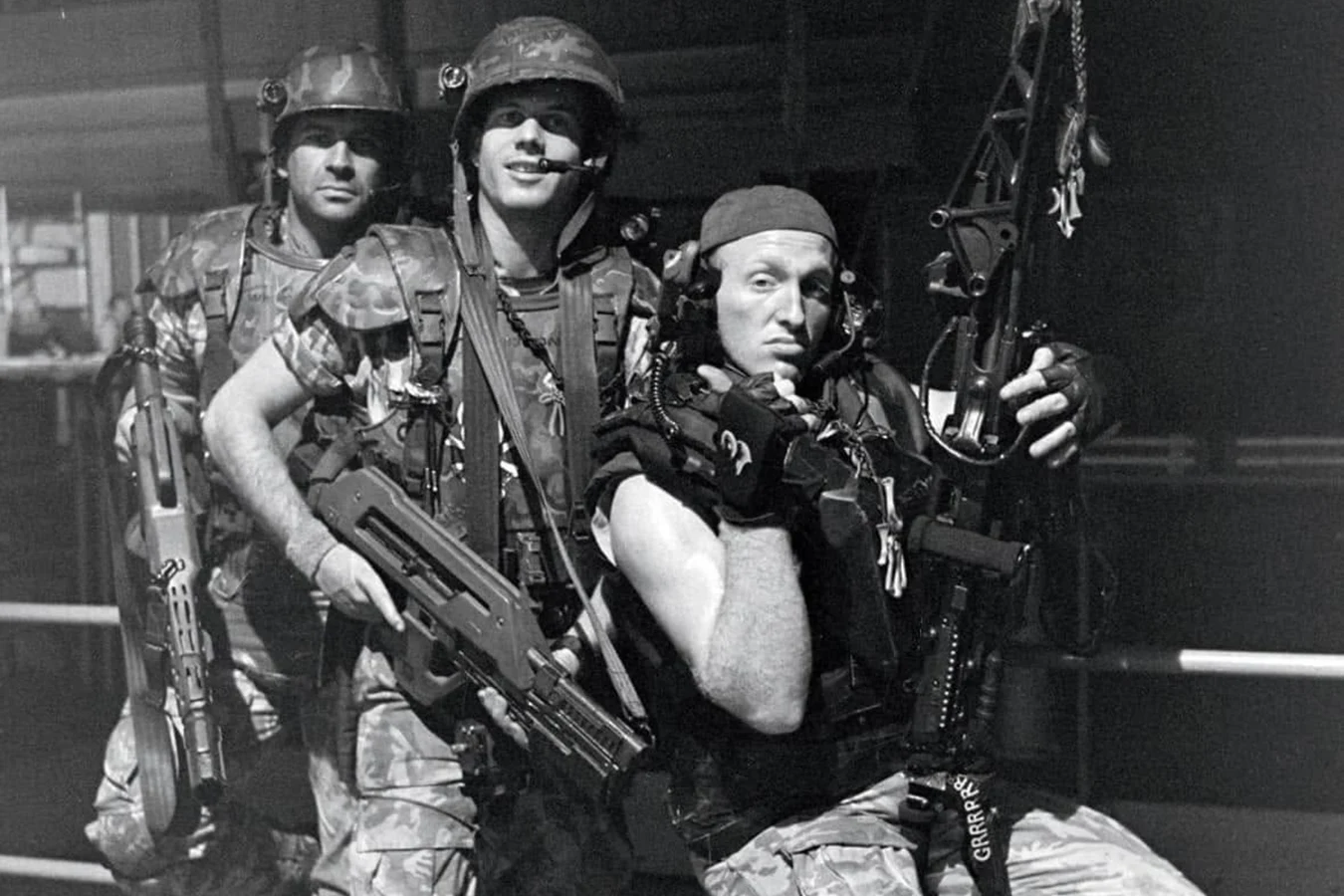
James Cameron wanted Vietnam in space, so the Marines had to look like a working infantry section rather than a clean future army. Costume designer Emma Porteous handled the uniforms and personal kit, and master armorer Terry English built the metal. Three aluminium sets were made for each of the seven principal Marines, fitted to the actor, with extra Kevlar suits for stunt work. English and his crew hand-painted the plates in Humbrol enamels, and the cast were told to mark their own kit the way Vietnam troops marked helmets and flak jackets.
English built the film armor as ten pieces: chest and back plates as a cuirass, epaulettes over the shoulders, pauldrons with a small plate inside each cup, and a colet at the bottom of the backplate. A small bridging plate on 2-inch webbing at the right rear shoulder could swing aside so a performer could get in and out. Green camping-mat foam and black foam strips padded the inside. Film-used shoulder cups also used a waffle-pattern foam that later replica sets often miss. Cameron also designed aluminium throat guards, lined with foam and hung on nylon webbing. English built them, then the production left them off because they got in the way.
The helmets started as United States M1 steel pots with added aluminium plates and cloth nape flaps. Dummy camera housings were cast in filler or resin. Surviving examples carry a Pentax 110 lens ring marked 1:2.8 18mm. Some helmets had working microphones and radio packs in pouches under the neck flap, which is how live lines were recorded on the move. The ear cups came from ear defenders. Greaves were aluminium with foam knee pads, comfortable enough to kneel in, and marked left and right with the wearer's name. The groin pad was grey padded vinyl with aluminium plates. When the costumes were first auctioned in 1987, pieces from different Marines were mixed, which is why a Hudson-marked vest can sit with Dietrich greaves in later collections. Prop Store later screen-matched an Apone chest set stenciled APONE on the plate and APONE No1 inside, from the APC load-up.
Conclusion
The M3 vest is a layered fragment shell with a Venlar liner, a TNR lamp, and biomonitors that feed the M10 helmet. At Hadley's Hope the Marines wore the vest and helmet through the colony search. Gorman watched the camera feeds from the APC, and acid still burned through the plates.
Appearances
- Aliens (1986)
- Aliens novelization by Alan Dean Foster (1986)
- Aliens: Newt's Tale (1992)
- Aliens Colonial Marines Technical Manual (1995)
- Aliens versus Predator (1999)
- Aliens versus Predator 2 (2001)
- Aliens: Infestation (2011)
- Aliens: Colonial Marines (2013)
- Alien: River of Pain (2014)
- Aliens: Bug Hunt (2017)
- Aliens: Fireteam Elite (2021)
- Aliens: Dark Descent (2023)
- Aliens: Fireteam Elite 2 (2026)
Sources
- Aliens Colonial Marines Technical Manual (1995)
- Aliens: Fireteam Elite (2021)
- Aliens: Fireteam Elite 2 (2026)
External Sources
Tag Categories: Colonial Marine Lore | Alien Lore