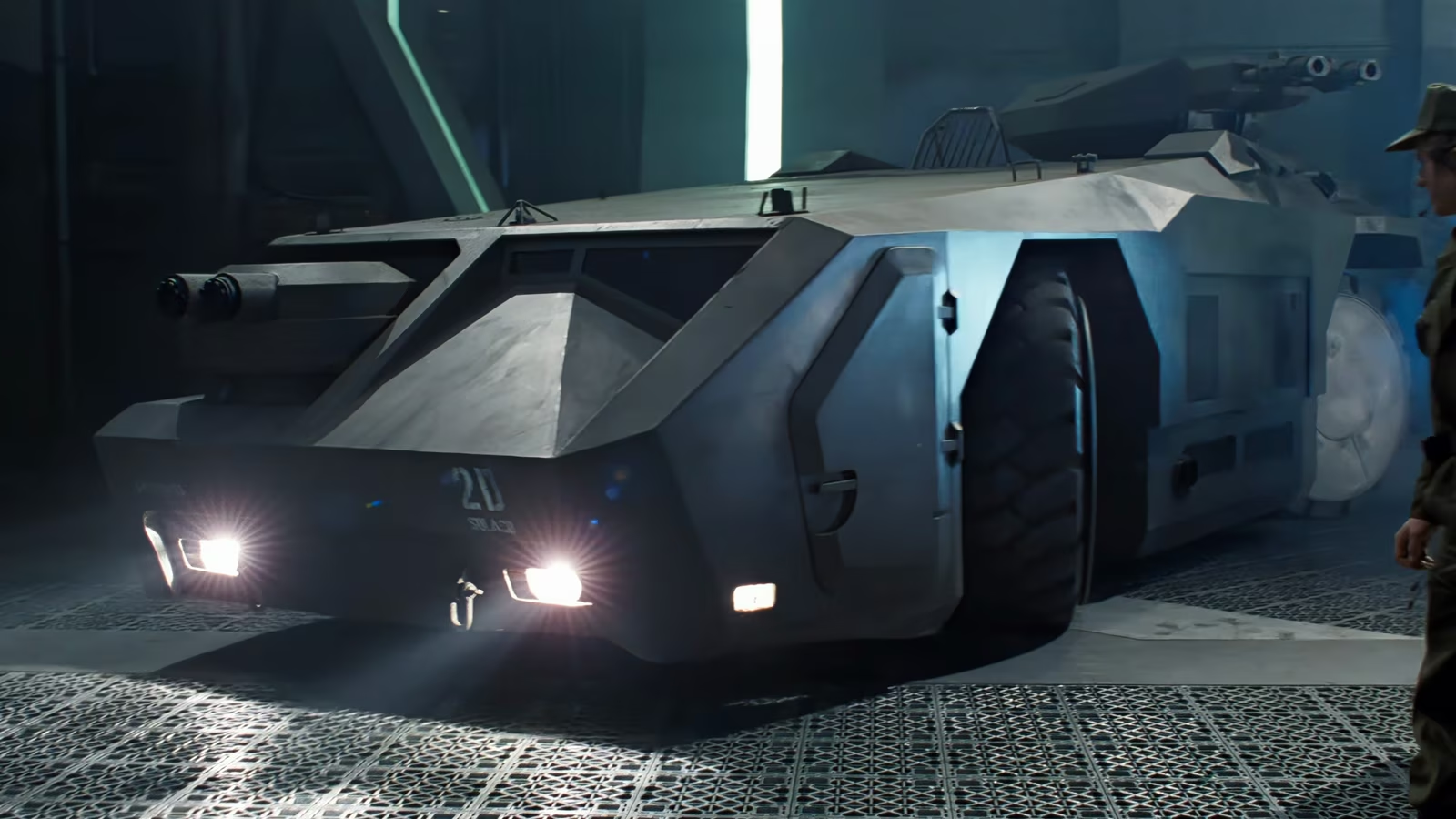

The M577 Armored Personnel Carrier is the Colonial Marine troop truck from Aliens. It was a light multi-role APC, able to ride a dropship into combat. The Aliens Colonial Marines Technical Manual lists a two-person crew, twelve passenger seats, and a roof turret that slides back so the vehicle fits in a UD-4 Cheyenne bay. In 2179 the USS Sulaco dropped one on LV-426, and Ellen Ripley later backed the burning hull out of the hive mouth to pull the last Marines out.
Design And Specifications
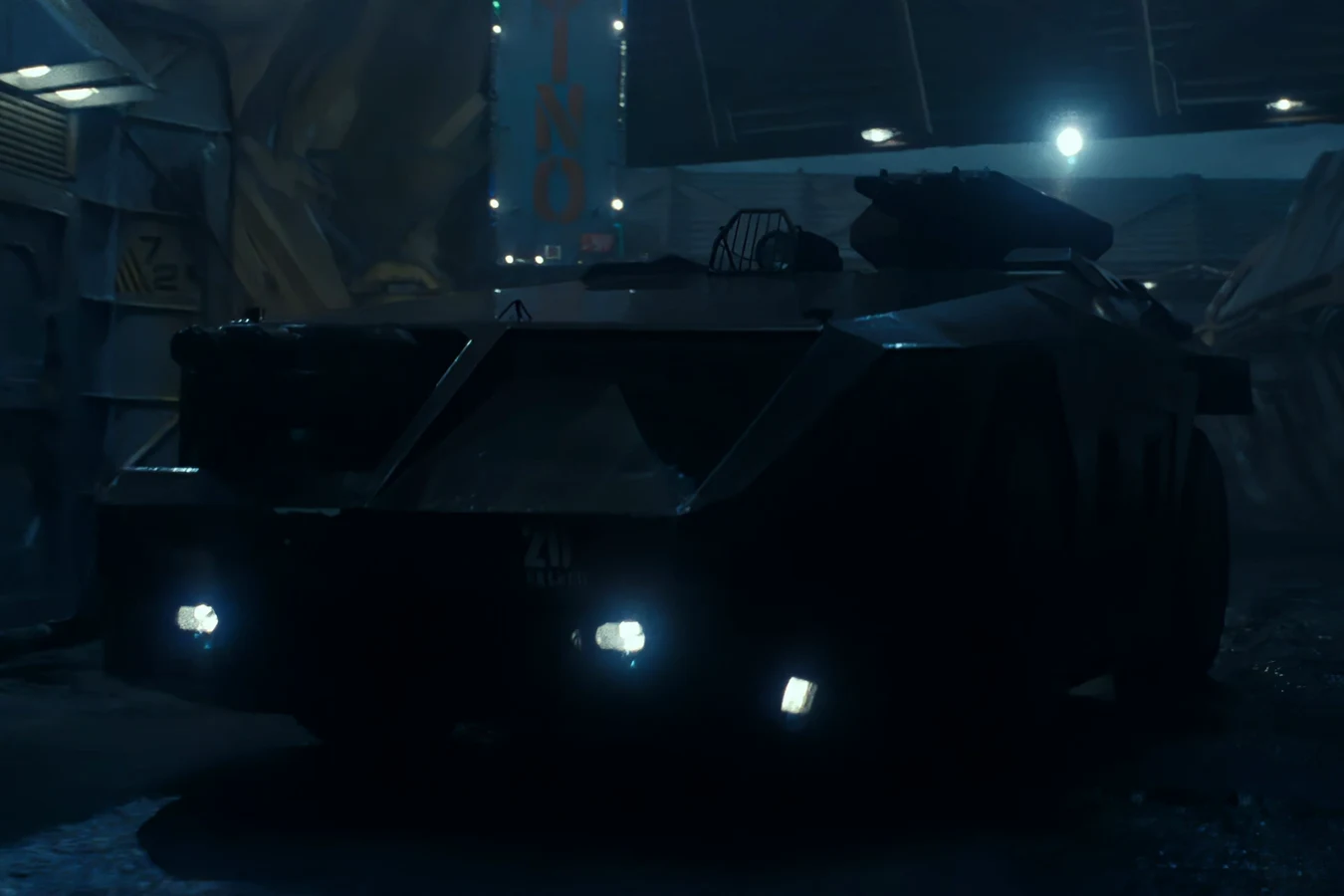
A rifle section rides with a driver and a Sergeant in one M577, and a dropship from the aerospace company joins that section for a drop. Two sections make a rifle platoon, about 25 Marines on paper including APC and dropship crews, often fewer in the field, plus one or two synthetics for technical work, medicine, or a spare driver. The vehicle is a multi-role mover for a light rapid-reaction force: get the squad in, stay on overwatch, and get them out. The Marine 70 plan wanted a cheap APC that a dropship could carry, so the combat weight had to stay below 25,000 kg, and the finished hull is thinner than the heavier carriers still used on Earth.
Combat weight is 14,500 kg. With the turret stowed the hull is 9.22 m long, 3.38 m wide, and 2.17 m high. With the turret raised those figures change to 8.58 m long and 2.81 m high, because the gun pack sits farther forward on the roof rail. Road speed is 150 km/h, with a dash from a stop to 42 km/h in six seconds. The APC can climb a 60 percent grade and clear a vertical step of 0.5 m. Film units on the Sulaco carried the stencil 2D on the nose, with SULACO painted on the hull so the vehicle stayed tied to its ship.
The Technical Manual never names a factory. Alien: The Blueprints later credits Lock-Mart Industries for the production hull. The prototype frame came from the M570 family of wheeled vehicles, first built in the late 2160s as a prime mover and mortar platform, then cut down until a Cheyenne could swallow it with the turret on the rear track.
Chassis And Armor
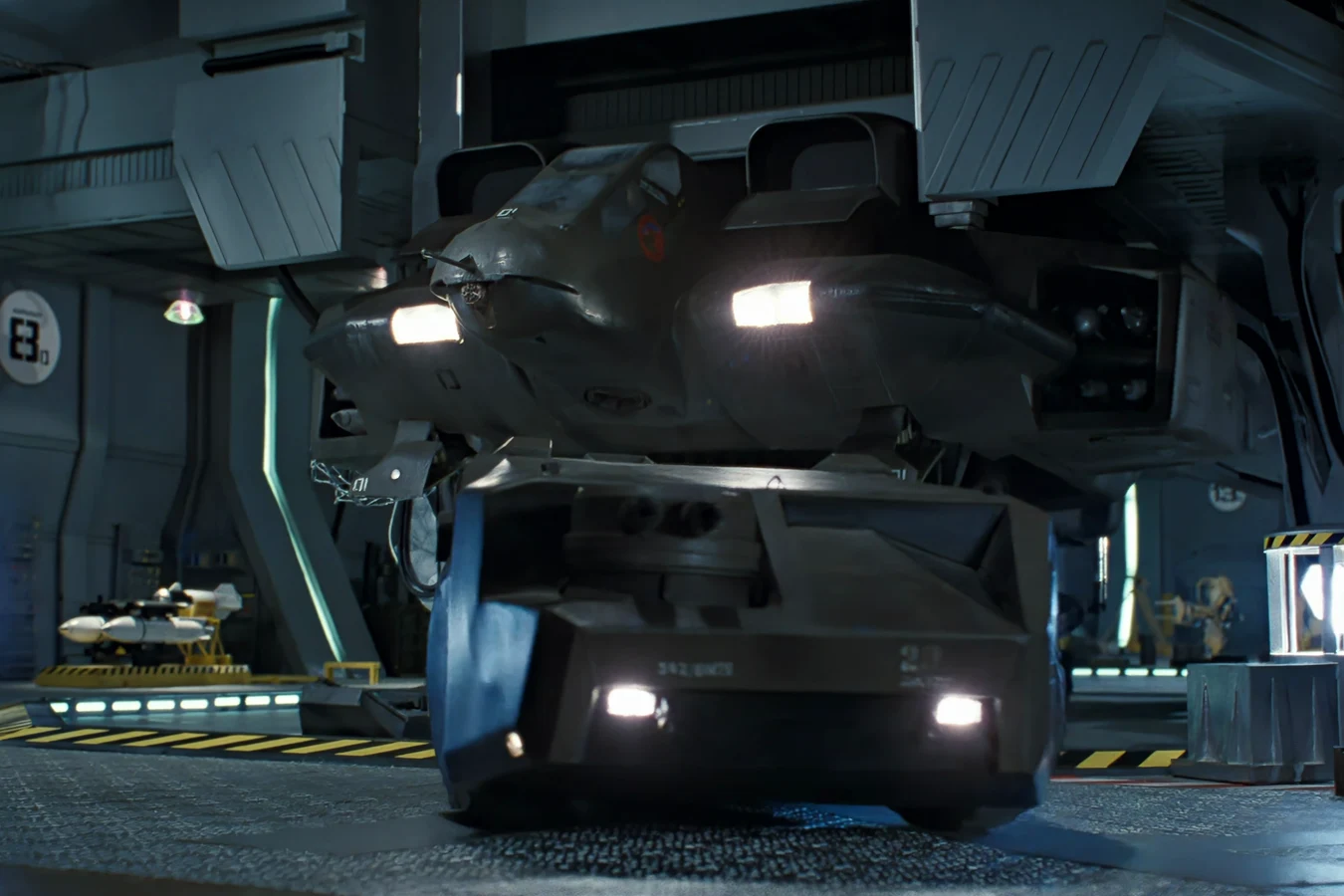
The chassis is bonded titanium with a 5 cm foam-packed floor cavity against forged-fragment mines. An Arco Continental R-370 multi-fuel gas turbine puts out 286 kW, about 19.7 kW/kN of power to weight. Each of the four 159 cm wheels takes power on its own through a fully automatic electronic transmission. Wheels are lighter and more reliable than tracks, even if they do worse in deep mud. The tires are armored against small arms and splinter, and a central pressure system lets the driver drop them for soft ground, then pump them back up for road speed.
Resting ground clearance is only about 22 cm. A hydro-pneumatic active suspension can add a full 30 cm so the hull can take that half-meter step without slamming the floor. The hull itself is welded light alloy, then latched and bonded to the titanium frame rather than welded, because an alloy-titanium joint fails from piezo-electric fatigue if it is fused. Inside, boron carbide ceramic tiles sit on a woven fire-resistant Venlar liner that limits spall if a round comes through. Each tile carries a polymer resin coat, 2 mm on the outward face, that also gives a little ablative cover against pulsed lasers. The specification sheet lists a 2 mm alloy skin, 4 mm boron carbide plates, and a 3 mm Venlar backer.
That stack stops fragments, rifle fire, and low-speed armor-piercing rounds such as rifle grenades. It does little against a dedicated tank killer. The slab sides also make a large radar return. Radar-absorbent skinning only partly hides that shape. Hull paint is laser absorbent against lidar, and cooling patches under the skin break up the infrared outline so the APC does not read as one hot block.
Weapons
A hull cupola on the forward starboard quarter mounts two synchronized Republic Electric RE700 20 mm gatling cannon. A 1,700-round multi-feed drum offers high explosive, high-explosive armor piercing, and Beehive anti-personnel flechette at a switch. The shells carry no powder of their own. The gun feeds each round into a revolving chamber, then sprays a two-part hypergolic mix that ignites and launches it. Binary propellant at this caliber is rare in Marine service, the other example being the 25 mm GAU/113 on the Cheyenne, and it saves weight while raising rate of fire and reliability. The cupola only covers the front, 60 degrees left and right of the nose, and it cannot shoot from a hull-down hide.
The main battery sits in a self-contained turret that includes its own ammunition and power. Geared electric motors run that turret down a rail to the rear so the gun pack can drop behind the hull, cutting headroom for a shuttle or dropship bay. The weapons stay stabilized for fire on the move, elevate from -7 to +85 degrees, and hydraulic rams can tilt the whole pack 15 degrees to keep a level shot or steal a little extra elevation. The section commander runs target lock from the Tactical Operations Center, and an automatic tracker can take the job if the officer is busy. Early production hulls had no splash guards on the rear wheels or barrels. Brigadier General Teresa Jayes of the 1st Colonial Marine Brigade spent two months arguing with Marine Command in Houston after off-road runs with stowed turrets packed those barrels with mud. The pack in that turret changed by production mark.
Crew And Passengers
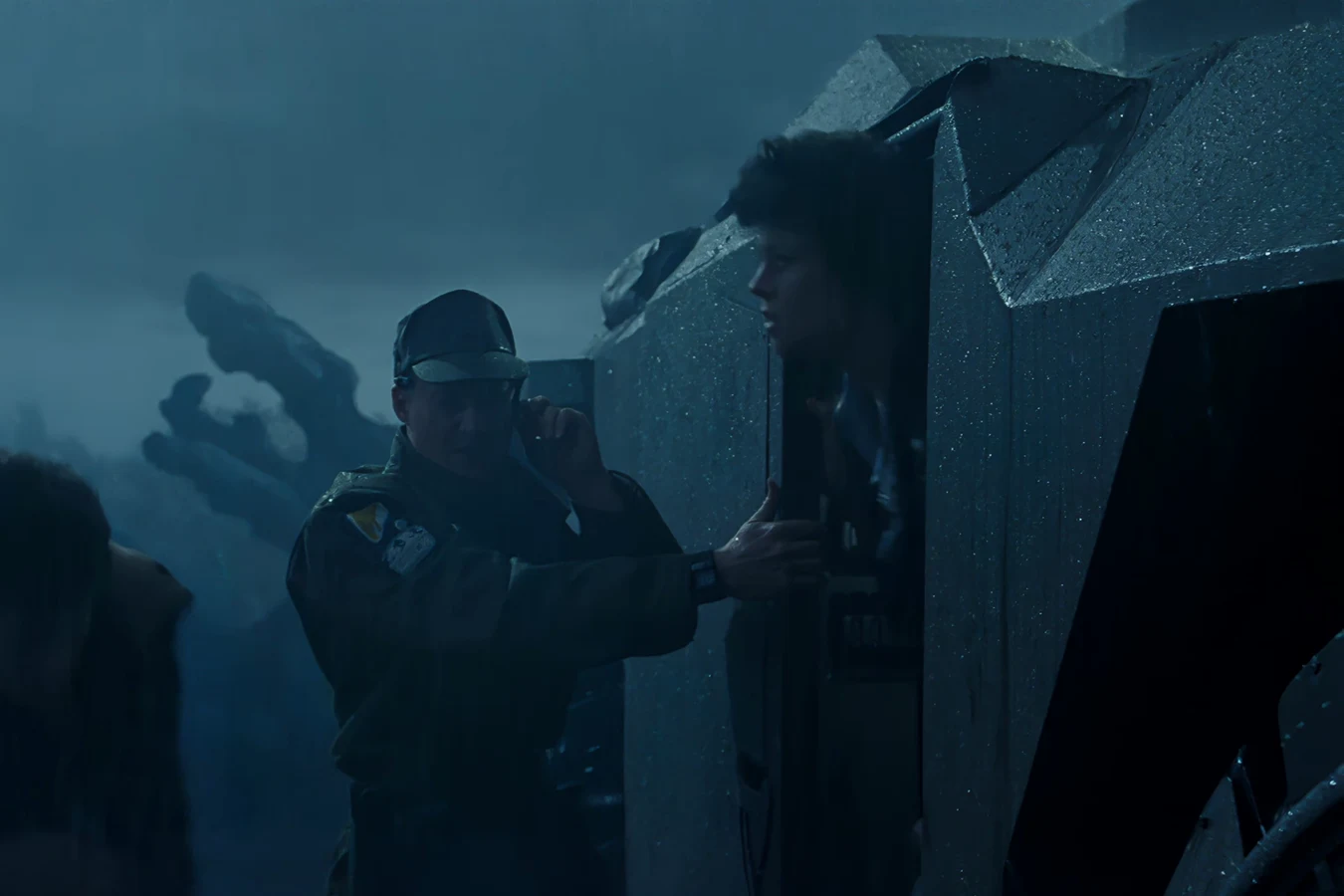
The crew is a driver and a section commander, with twelve passenger seats, all fitted with yoke harnesses for an orbital combat drop. Entry is through the main starboard sliding door or a small port-side driver's hatch. Alien: The Blueprints puts eight seats at the rear and four along the starboard side, two of them forward of that door, and leaves the gunner seat empty during a drop. The cabin is roomy enough for M41A pulse rifles, spare drums, and three days of ammunition if the Marine 70 load is packed in full, though that crush of crates leaves little walking room. When resupply is close, crews usually carry no more than two days of stores.
Tactical Operations Center
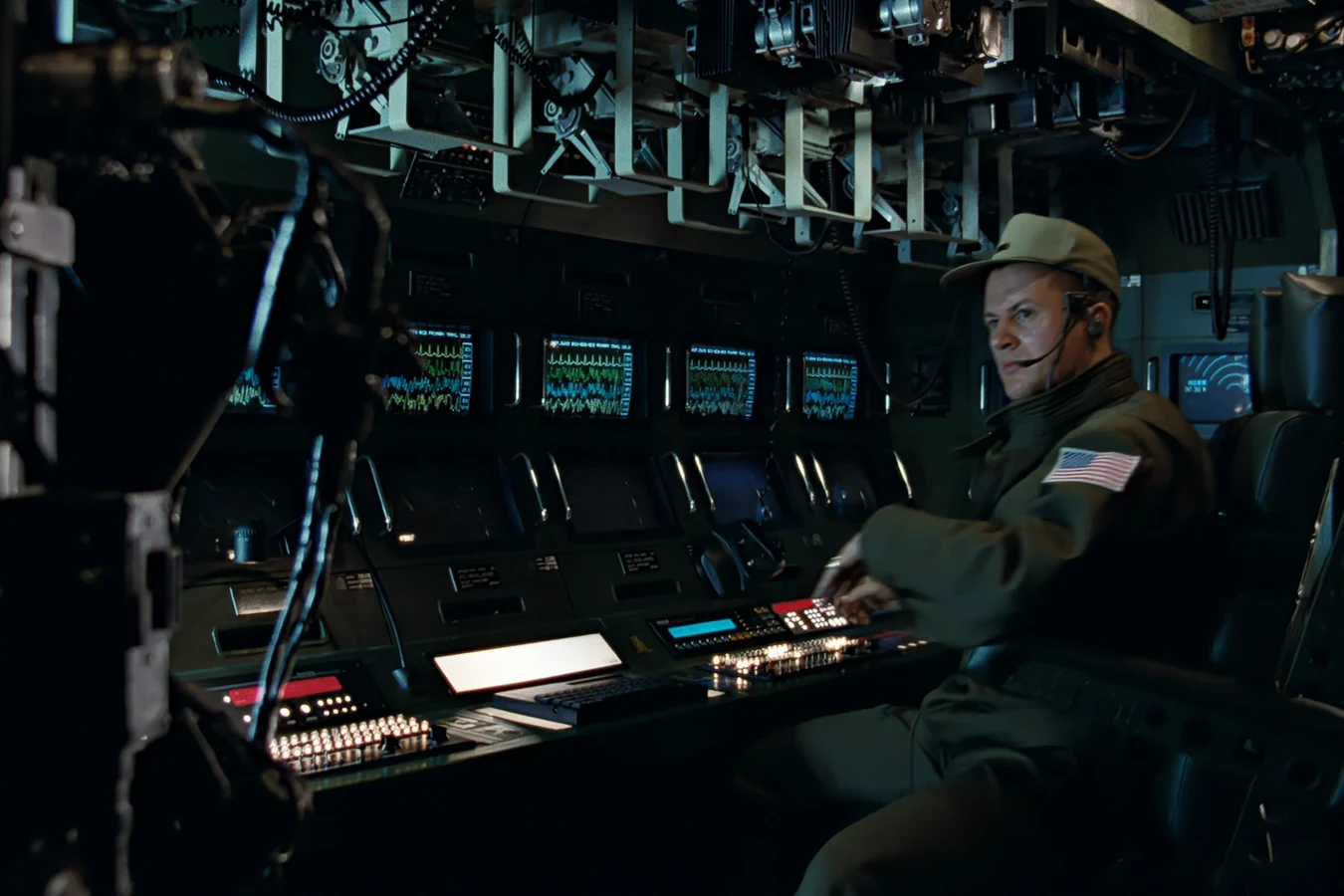
The rear of the crew bay is the Tactical Operations Center, the dark console where the section commander watches the squad without leaving the hull. Each Marine's M10 helmet carries a PRC 489/4 headset and a Motoca 419 tactical camera on the right side, plus bio-function leads from the armor. Those cameras send optical and infrared video at 25 frames a second, or as low as 1 frame a second when the air is thick with jamming. Audio and video ride VHF between 1.5 and 40 MHz, encrypted, compressed, and sent as a 128-level digital pulse stream so a wide video channel can still share a multiplex net. The same headset holds an IFF transponder, a radio-location beacon, and a GPS link when satellites are up.
All of that traffic dumps into the TOC, which can also run from a dropship or from laptop terminals in the dirt. A section post usually shows a bank of helmet-camera and vital-sign screens, with secondary panes for motion trackers and UA 571-C sentry guns. An FDMA base set keeps those voices and pictures on one band without overlap. The net is multiplex, so everyone can talk at once, and the commander can lock it to simplex when the channel turns into noise. Second Lieutenant Valerie Cooper sat in that dark bay and watched her own Marines fight and die on the screens, knowing a company officer was watching her feed from farther back. On the Sulaco drop, Lieutenant Scott Gorman ran that station while the squad swept the colony.
The driver's own view is a forward window of quartz armored crystal, plus periscope ports to the sides and front quarters. Multi-function screens at both crew seats fuse the tactical picture around the hull. A sensor cluster rides with the main searchlight and can sweep a 270-degree zone ahead and around the vehicle: a turreted thermal imager, television optics from x4 to x20, an ultraviolet detector, and an ultrasonic motion tracker. Millimeter-wave targeting radars in the forward cupola and the main turret can lock what those sensors find, or search on their own, with about 3,000 m of useful track on a person-sized target in open ground. A white-light and infrared searchlight on the nose lights a target when the crew wants active illumination.
Active defense is a rear chaff and flare dispenser on a multi-cartridge rotary feed, plus a fire-control jammer that can spoof millimeter-wave tracking radars if enough power is left. The same dispenser can throw particulate smoke as a screen against ranging or pulsed lasers. The driver or commander can slap those systems on, and they also fire on their own once armed. Staff Sergeant Billy Arter treated the big ECM button as a fighting chance against infrared seekers and no chance at all against a radar-homing shot.
Variants
The Technical Manual keeps the same M570-series hull and swaps the roof pack. Three turret marks stay on the M577, and the M579 turns that chassis into an air-defense truck. A later recon carrier took the same drop-and-carry job on a lighter hull.
M577A
The first service turret mounts two 20 mW Boyars PARS 150 phased plasma cannon. A 6 mW hydrogen fuel cell feeds a homopolar fast-discharge generator and is good for about 3,000 shots before a refill. The laser first cuts an ionized path in the air. An electromagnetic coil then charges that path into a magnetic tunnel, a five-gram cadmium telluride pellet is fed in, and the beam vaporizes it into plasma and throws that plasma at about 5,000 m/s. The two guns fire in sequence rather than together, so the cyclic rate is 40 rpm once cooling is allowed for. Each gun carries up to 1,000 pellets. Maximum useful range depends on the local air, and in clean conditions it can reach about 4,000 m.
M577A2
The M577A2 swaps those plasma guns for two Republic Dynamics M2025 40 mW free-electron lasers in the 2.0 to 3.0 micron band, useful against ground and air targets. A 10 mW hydrogen cell drives the same style of fast-discharge generator. The beam is made by running an accelerated electron stream through a static field, so the gun needs no chemical lasant, and the wavelength can be tuned to the local air. A reactive tune, cued by laser return, can retune if smoke or steam is thrown up to block the shot. In dazzle mode the beam runs at 20 to 50 kW as a continuous wash that burns out optics or blinds infantry and pilots, which is the efficient setting because it avoids the blooming and ionization that come with pulsing. In pulse mode a full-power shot superheats a spot and can punch infantry armor or the skin of a missile or aircraft, with an ideal-air range against aerospace craft of about 3,000 m. Sergeant Dom Lance of the 5th Reserve Colonial Marine Brigade treated 1,000 meters as the practical pulse limit in dirty weather, both for scatter and for the visible ionization trail a directed-energy shot leaves.
M577A3
The newest turret mounts two 20 MeV charged-particle cannon run by a turboalternator. A Martin-Continental micro magnetohydrodynamic turbine supplies the 20 mW needed to drive those accelerators. Turbine fuel is enough for about 50 seconds of fire, and the turret carries some 300 kg of deuterium as beam mass. Effective range against light armor is about 3,000 m. Past that the beams can still scramble unshielded electronics.
M579
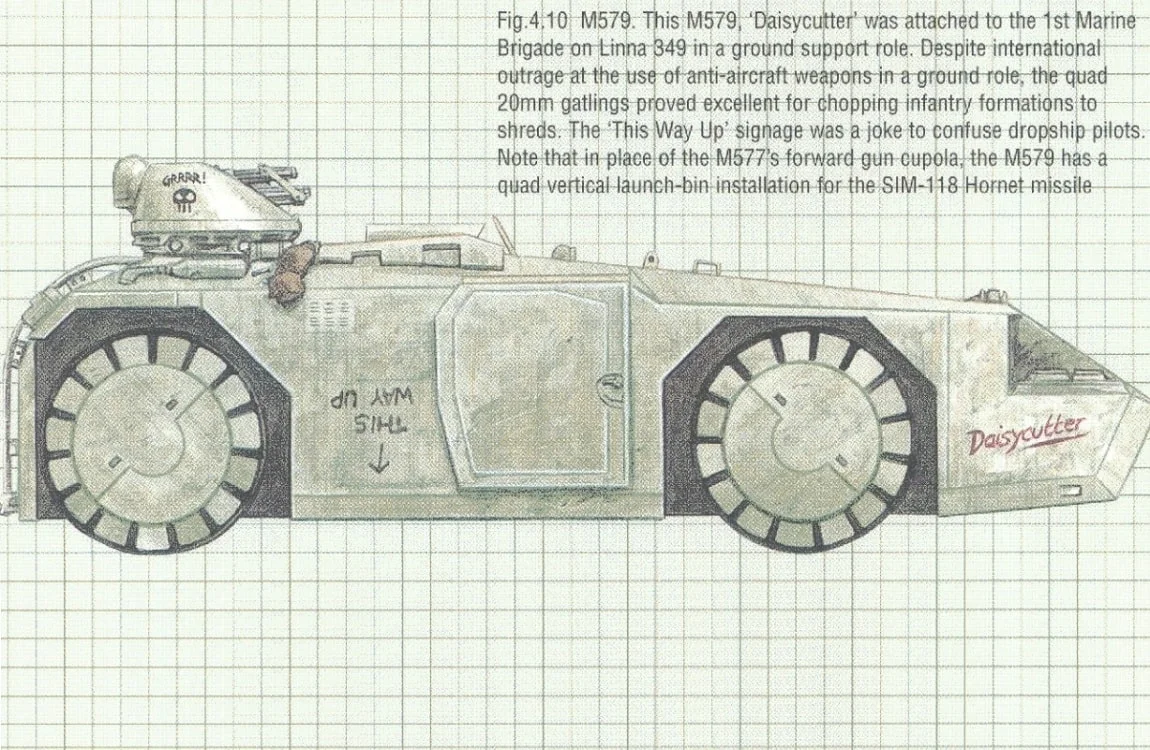
The M579 is the only Technical Manual variant with a published picture. A quad 20 mm gatling pack replaces the sliding roof turret, slaved to a multi-spectrum sensor that can fill a 1,500 m bubble with high-explosive and armor-piercing shells, even against very fast incoming shots. The forward RE700 cupola is gone, replaced by a four-cell vertical launch bin for the SIM-118 Hornet missile. One hull named Daisycutter, attached to the 1st Marine Brigade on Linna 349, used those gatlings on infantry and drew international protest for turning an anti-aircraft gun onto people on the ground. The "This Way Up" joke on that hull was painted to confuse dropship pilots.
M540 Armored Recon Carrier
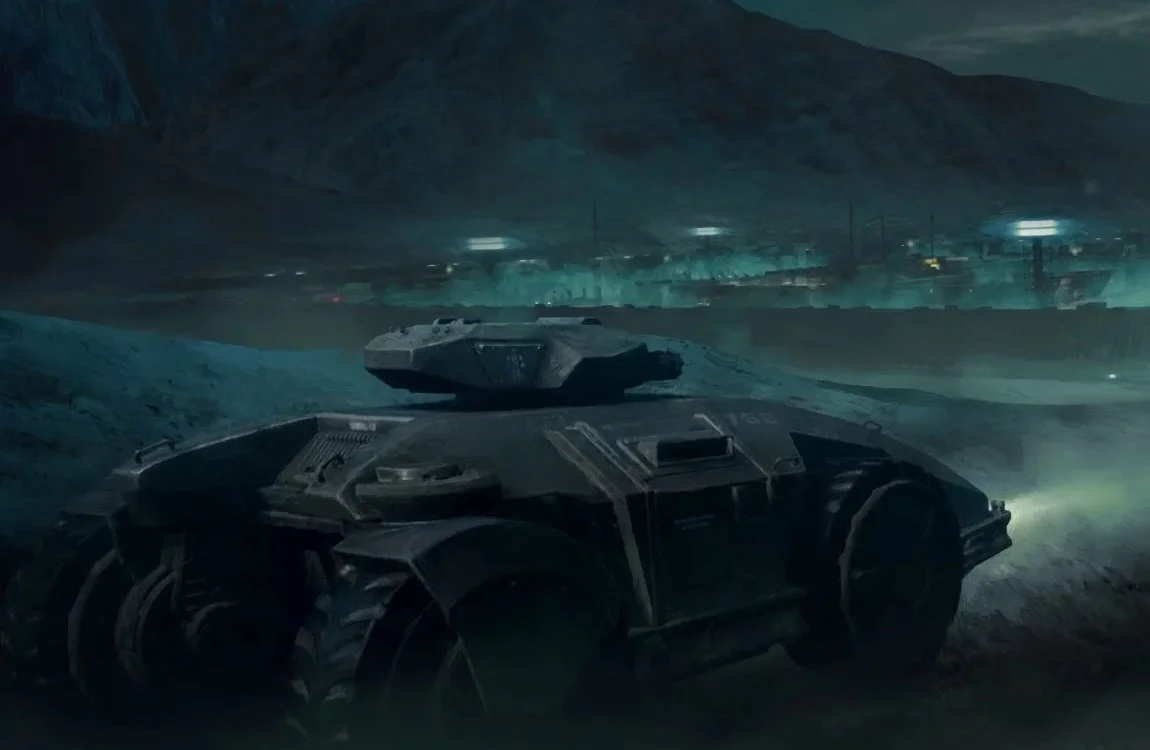
Cobb Motor Company built the M540 Armored Recon Carrier, also called the ARC, as a lighter personnel and recon truck. The USS Otago assigned one during the Xenomorph outbreak on Lethe in 2198, in Aliens: Dark Descent. It hauled a five-man recon team or a full rifle squad, with sensors and a command suite for ground recon. Twin synchronized RE700 20 mm cannon sat in a computer-controlled turret instead of the M577's sliding roof pack.
Weyland-Yutani APC
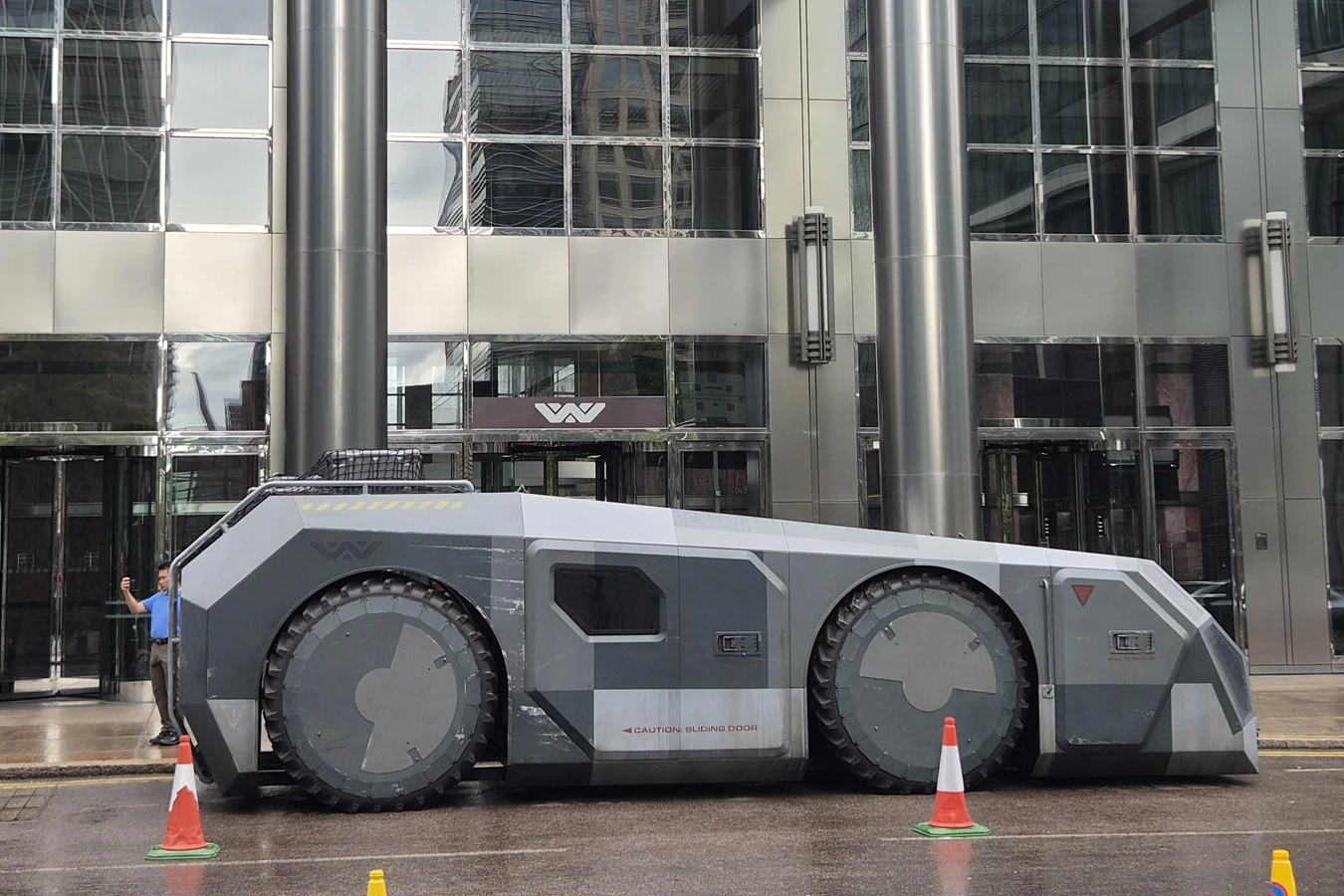
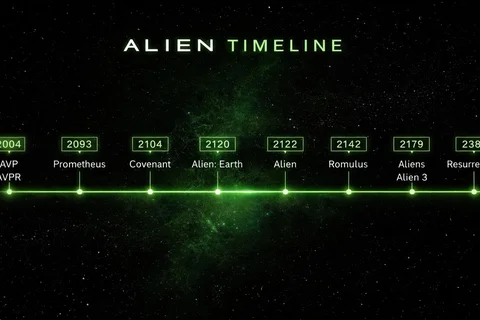
Alien: Earth Season 2 filming put three Weyland-Yutani APCs on the street at Canary Wharf in London, parked in front of a Company building. All three used the same new hull, painted a different grey than the Marine M577. The trucks carried Weyland-Yutani logos, and black-clothed soldiers came out of them with Pulse Rifles. The series is set in 2120, fifty-nine years before the Sulaco mission in Aliens.
The APC On LV-426
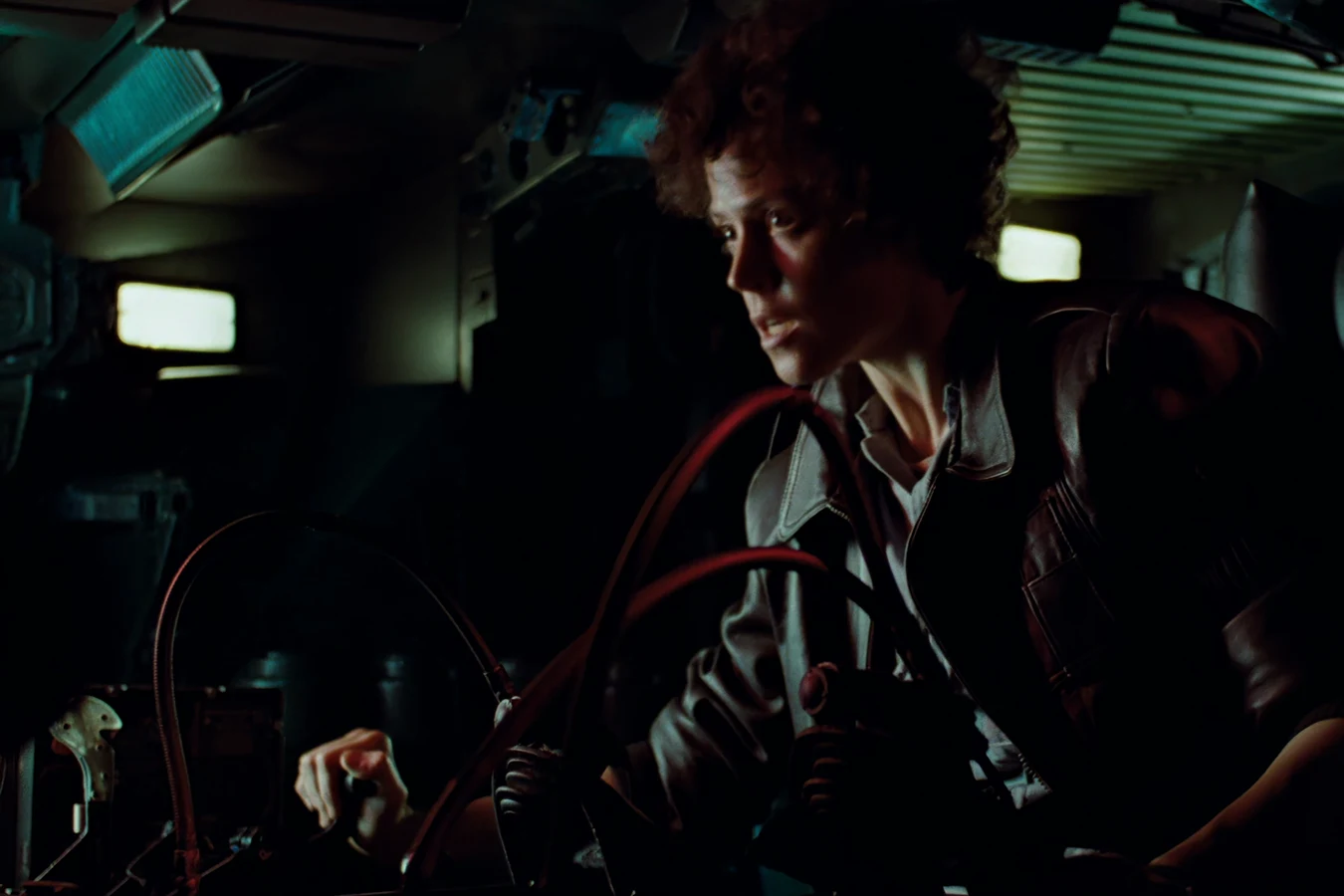
The Sulaco's Cheyenne put the M577 down outside Hadley's Hope and the squad rolled through North Lock into empty streets. Master Sergeant Apone ran the sweep on foot while Gorman watched helmet feeds from the TOC. Frost later drove the hull to the atmosphere processor when the motion readings led under the plant instead of toward living colonists. Alan Dean Foster's novelization put Wierzbowski in that seat with Bishop.
Gorman ordered the guns cold near the reactor, then froze on the net when Warriors came off the walls. Drake dumped an empty M56 Smartgun harness and brought an M240 incinerator up as he fell, and that stream set part of the APC on fire. Ripley took the driver sticks, backed the burning hull out of the hive mouth, and pulled Hicks, Vasquez, and Hudson out. The dropship crash soon after left the carrier wrecked at the processor. Hudson and Hicks later cut the pair of UA 571-C sentry guns out of that wreck and welded them into the colony holdout.
M577 In Alien Comics
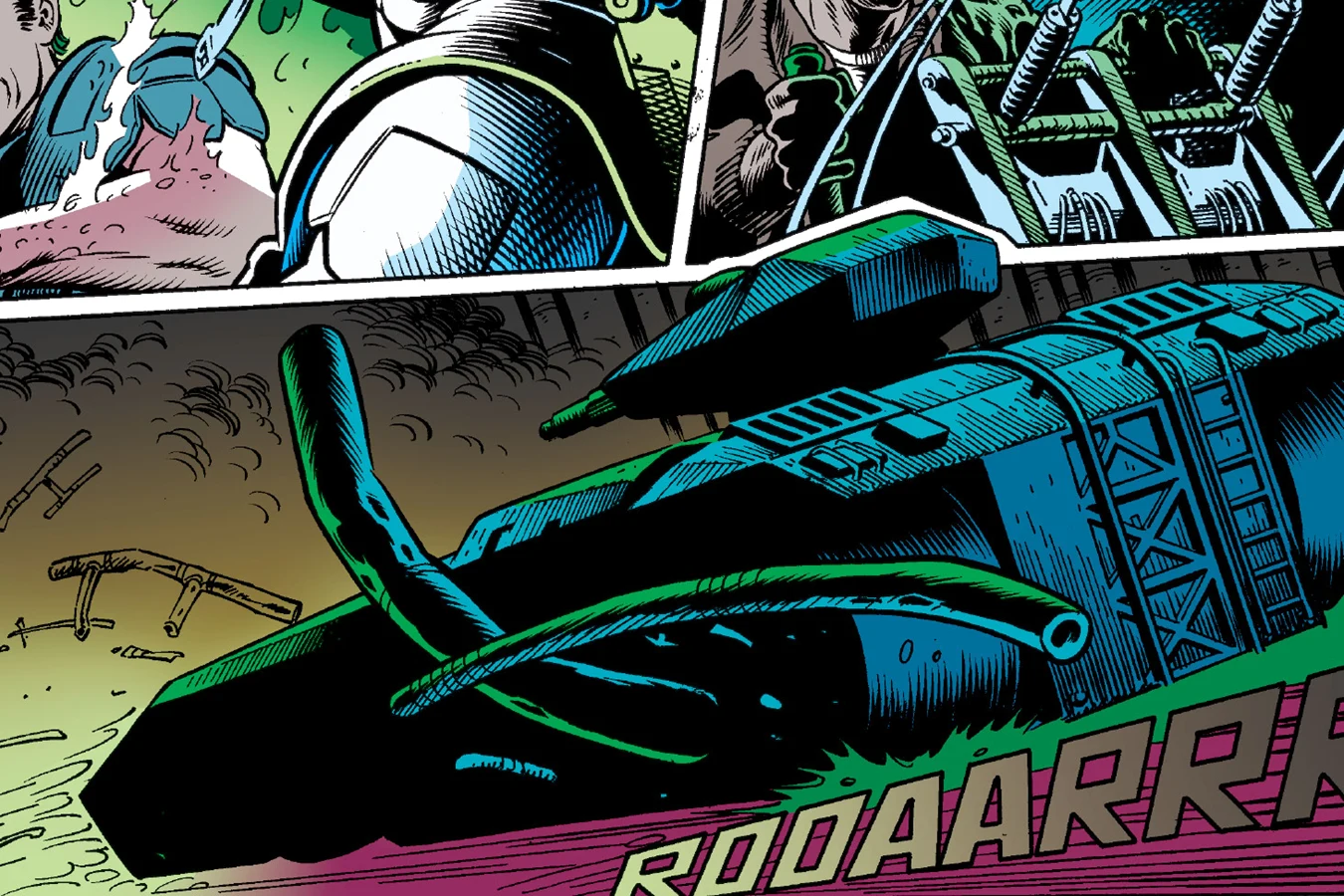
Dark Horse published Aliens: Newt's Tale as a two-issue miniseries in 1992, written by Mike Richardson with covers by John Bolton. The comic retells the film from Newt's side of the vents, including the drop, the processor fight, and Ripley backing the APC out of the hive mouth. Bolton's APC keeps the low slab hull and rear turret, and the extraction still ends with Hicks, Vasquez, and Hudson dragged out of the fire.
In Brian Keene's story from Aliens: Bug Hunt, an M577 waited outside the Taurus Seven depot with synth driver Thomas while two rifle squads went into the hive.
M577 In Alien Games
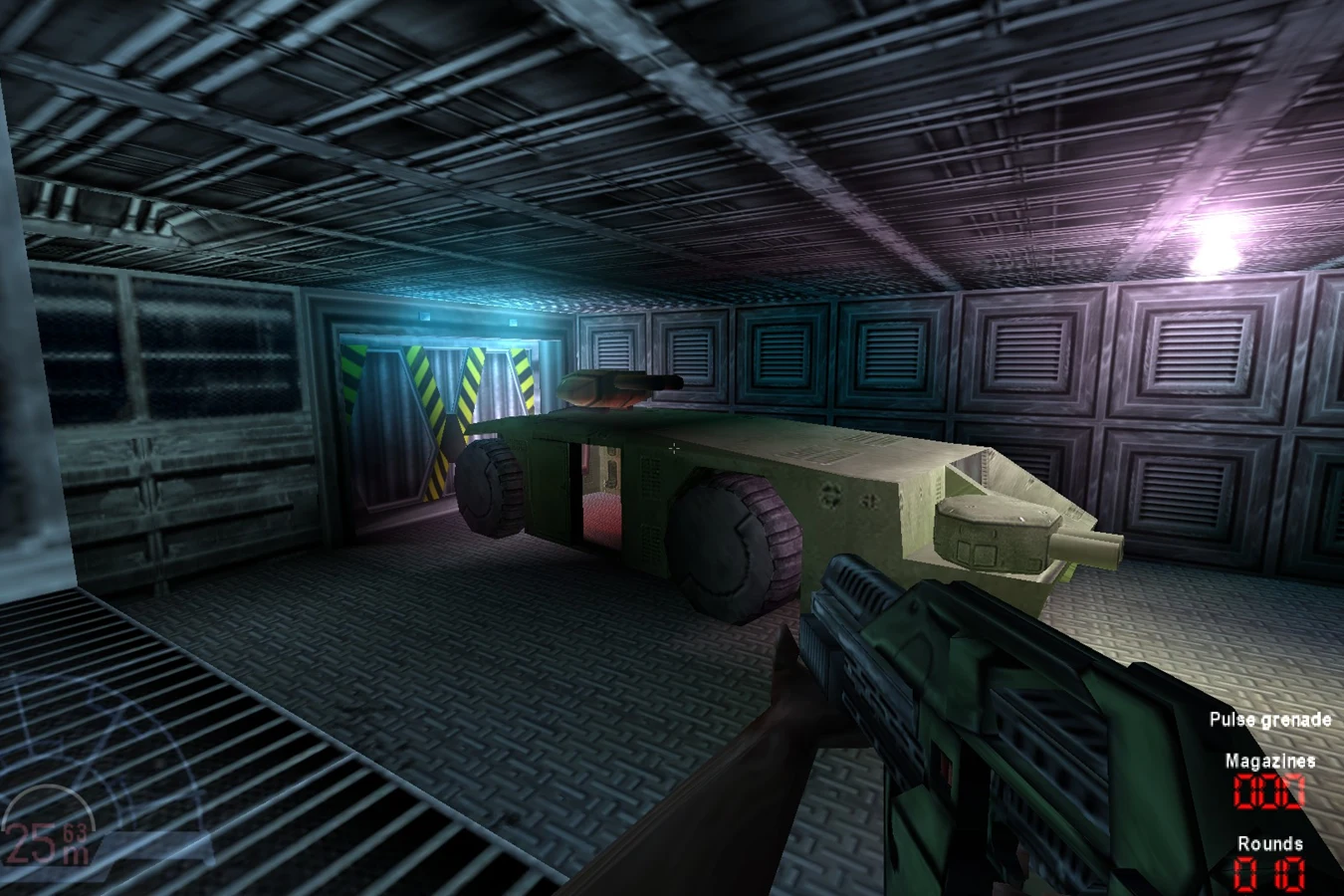
Aliens versus Predator in 1999 used an M577 to get Private Anderson from a new colony around the Derelict to the atmosphere processor. He stepped out of the open starboard door inside that plant for the third Marine level, Invasion, and the processor later blew. None of the main games let a player drive the APC.
Aliens versus Predator 2 put a small convoy of M577s on LV-1201. Corporal Harrison rode one after a hive woke in the main colony complex, then opened the tunnel doors so the rest of the hulls could reach the outlying Forward Observation Pods. Aliens versus Predator: Extinction treated the APC as a Marine support unit that could haul infantry and add turret fire on a colony map.
Aliens: Infestation used one as an escape truck that crashed into the Derelict and dumped the squad in the Space Jockey chamber. Aliens: Colonial Marines in 2013 returned to Hadley's Hope and left wrecked and intact M577s in the colony and processor as scenery for the USS Sephora mission.
Merchandise
Halcyon made the first plastic kit in 1987 as item HAL01, a 1/35 Armoured Personnel Carrier in green polystyrene with a clear sprue for the windshield and lights and waterslide decals for the 2D Sulaco markings. That kit was the company's first Aliens tooling, about 65 parts, and it stayed the standard scale build for years. Aoshima later sold a finished 1/72 die-cast M577 for collectors who wanted paint instead of a glue kit. Hollywood Collectibles Group packed a roughly 7-inch APC with its exclusive UD-4 Cheyenne, a 250-piece run scaled to sit in the dropship bay.
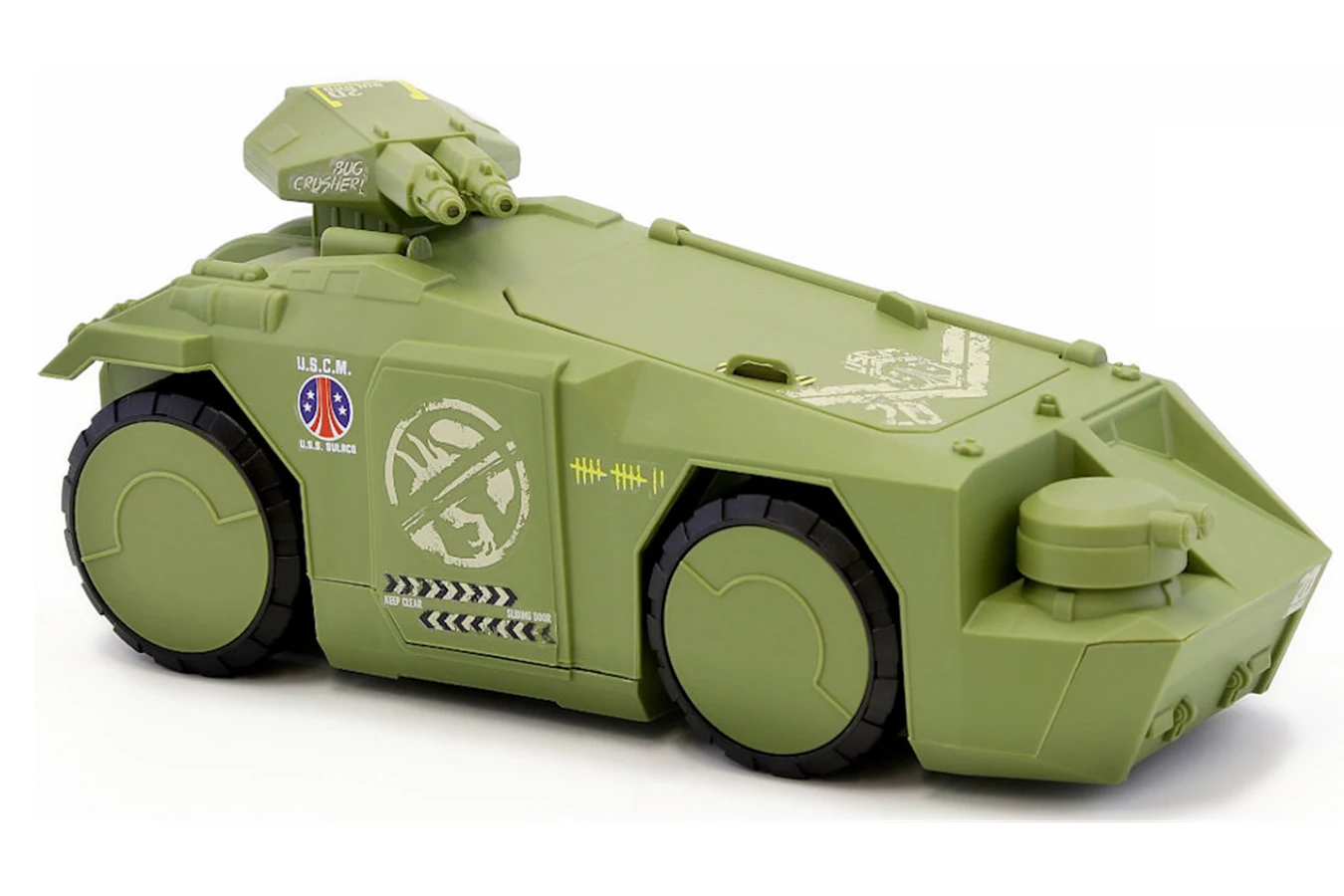
Kenner listed an APC for the early 1990s Space Marines line and never shipped it, which left the Stinger XT-37 as the closest Kenner truck. Lanard filled that gap in early 2020 with the Walmart-exclusive Alien Collection Advanced-APC, a new sculpt about nine inches long for 3.75-inch figures. The top cannon and front turret both turn, the cockpit lid opens for two figures, and the stickers include BUG CRUSHER! on the turret, a slashed Xenomorph on the sliding door, yellow kill tallies, and U.S.C.M. / U.S.S. SULACO on the bow.
Behind The Scenes
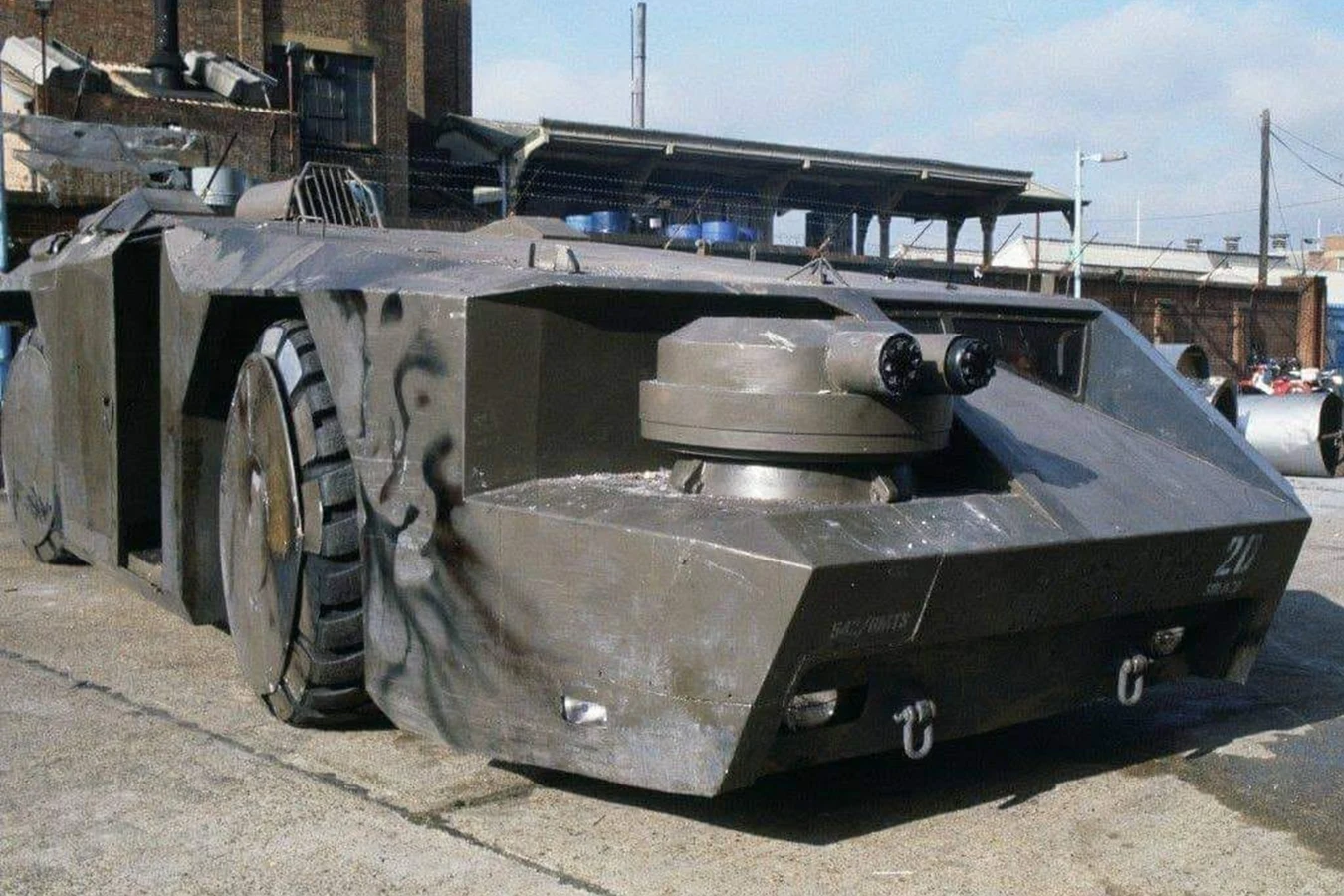
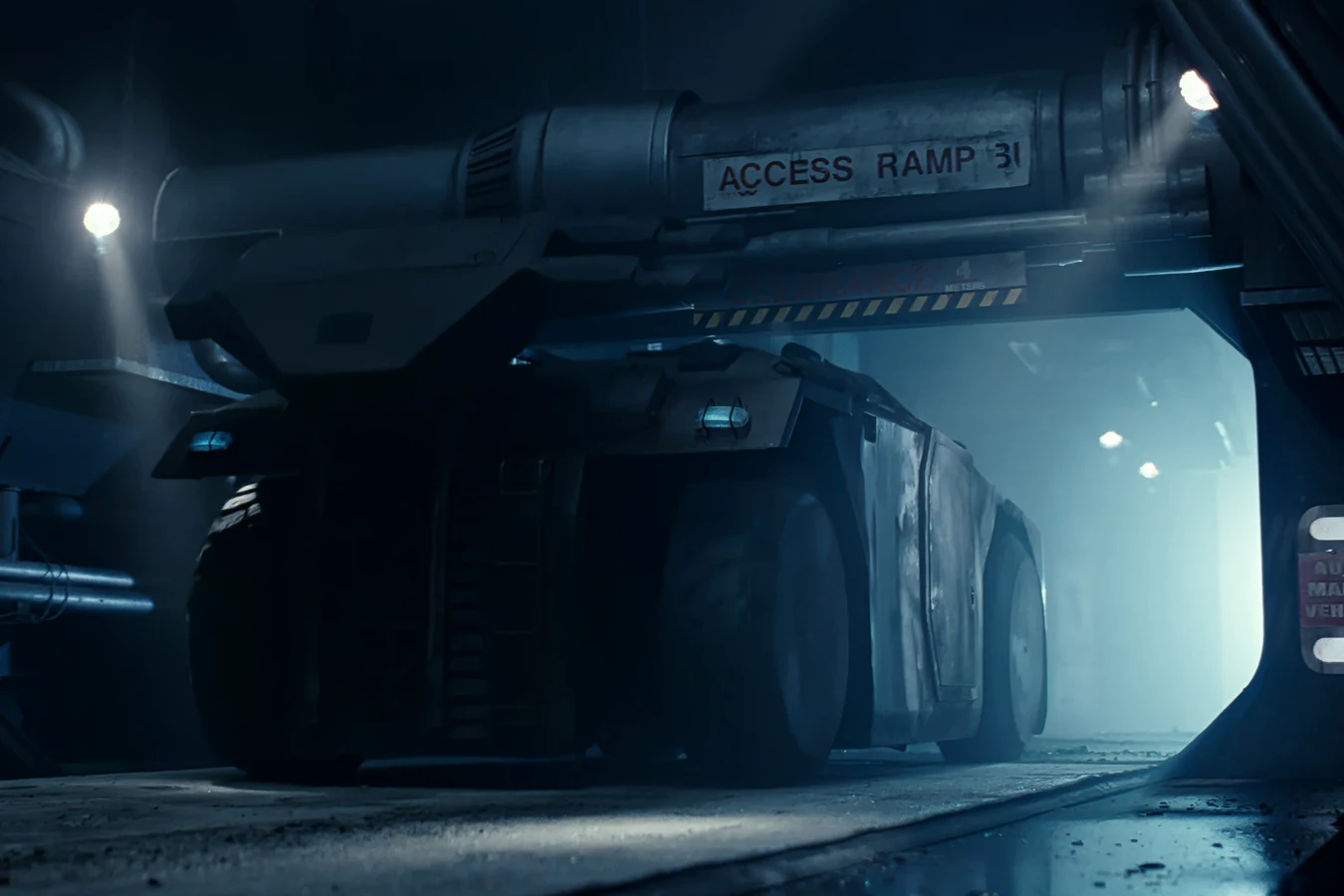
Ron Cobb first drew a scratch-built wedge with four huge wheels. The budget killed that plan, so the production bought a four-wheel-drive, four-wheel-steer Hunslet ATT77 aircraft towing tractor, 635 horsepower, from British Airways at London Heathrow. The tractor arrived at about 72 tons because airport tugs are packed with lead for traction, heavy enough to go through the floor at Acton Lane Power Station, where the hive interiors were shot. The crew pulled about 44 tons of that ballast. James Cameron then bent Cobb's drawings around the remaining frame, and a metalworking shop in Slough, near Pinewood, built the outer shell in less than two weeks. The finished prop could manage about 35 mph.
Interior scenes used a separate, larger set dressed by Crispian Sallis and Mark Harris, which is why Marines who stand straight inside look taller than the hull when they step out. The driver sticks Ripley grabs are foot pedals from an Avro Vulcan bomber, flipped upside down. The nest pictures on Gorman's monitors were ordinary video feeds, not invented graphics. A remote-control miniature with a working turret covered some of the driving and crash work. Robert Skotak and Peter Russel designed the miniature corridor for the rescue run, Faisal Karim built it, and a spark rig made the hull scrape the walls.
The full-size APC sat in London's Leicester Square in 1986 before the film opened, then spent years parked behind Pinewood until it was scrapped around 2000. Alan Dean Foster's novelization gives the same vehicle six wheels instead of four. Cameron's 1985 script and that book also had Hicks take the fire-control stick and blast a Warrior off the roof after it tore a hatch and dragged Gorman out to the waist. The film never shot that beat and used a falling cargo box for Gorman's head wound instead.
Conclusion
The M577 is a 14.5-ton drop-transport APC that trades thick armor for a hull a Cheyenne can swallow, then makes up for that thin skin with a sliding turret, a pair of RE700s, and a TOC that lets a lieutenant watch every helmet in the squad. On LV-426 it carried the Sulaco Marines into Hadley's Hope, burned at the processor, and still got Hicks, Vasquez, and Hudson as far as the hatch before the wreck was stripped for sentry guns. Later comics, games, and kits kept that low gray box in hangars and toy aisles, and the Hunslet tug under the Pinewood shell is why the film carrier still looks like a piece of airport kit wearing guns.
Appearances
- Aliens (1986)
- Aliens novelization by Alan Dean Foster (1986)
- Aliens: Newt's Tale (1992)
- Aliens Colonial Marines Technical Manual (1995)
- Aliens versus Predator (1999)
- Aliens versus Predator 2 (2001)
- Aliens versus Predator: Extinction (2003)
- Aliens: Infestation (2011)
- Aliens: Colonial Marines (2013)
- Aliens: Bug Hunt (2017)
- Alien: The Blueprints (2019)
- Aliens: Dark Descent (2023)
External Sources
- Ron Cobb: Aliens concept art
- Scalemates: Halcyon HAL01 Armoured Personnel Carrier
- AvP Galaxy: Weyland-Yutani APCs at Canary Wharf
Tag Categories: Alien Universe Vehicles | Colonial Marine Lore | Alien Lore