Aliens: Bug Hunt: Anthology Overview And Stories

Aliens: Bug Hunt is a 2017 short-story anthology edited by Jonathan Maberry and published by Titan Books on 18 April 2017. Maberry closed the book after a London dinner with Titan publishers Nick Landau and Vivian Landau, then worked with in-house editor Steve Saffel. The brief was Colonial Marines against hostile life, the "bugs" Hudson named in Aliens, not a tour of the whole franchise.
The eighteen stories run from film-adjacent prequels to hunts that never meet a Xenomorph. Yvonne Navarro, Christopher Golden, James A. Moore, and Tim Lebbon were already in Titan's Alien line, Lebbon with Out of the Shadows. Weyland-Yutani paid for specimens, fuel research, and cover-ups across the book. Some pieces sit next to the films. Others treat the universe as larger and stranger than the movies show.
Short Stories
The collection contains eighteen stories, mostly featuring separate hunts, with several continuing characters and events from earlier Alien stories.
Chance Encounter
By Paul Kupperberg
Warrant Officer Gilmore and Navigation Officer London were on EVA from the commercial ship USCSS Typhoon, down for repairs on an unexplored low-gravity world in the Zeta Reticuli system. Company standing orders sent them out to log the planet. They recorded giant airborne Floaters and watched a black predator they nicknamed a Leaper kill one. Science Officer Jepson judged the Floaters native and the Leaper almost certainly not. Weyland-Yutani then ordered a Leaper specimen, dead or alive.
Captain Lawford sent Gilmore, London, Katz, and Jepson back armed. London climbed a dying Floater alone for tissue and the bonus. A Leaper burst from the wound, then more tore out of the carcass. Their screams jammed the radios. The pack herded the team toward a hive inside an older Floater carcass, where London found thousands of leathery eggs. Laser fire showed acid blood and armored heads. Gilmore detonated London's spare oxygen tank at the hive mouth, Katz threw the last grenade into the packed entrance, and the four reached the Typhoon.
Infrared later showed the fire dying after about three kilometers. Floater and plant samples went back with the ship. No official Leaper DNA was logged. London hid a Leaper egg in his cabin to sell himself. It hatched, and a Facehugger locked onto him before anyone else knew he had kept it.
Reaper
By Dan Abnett
Marines dropped from the Conestoga-class assault ship Montoro onto the agro-world LV-KR 115. Lieutenant Teller had his first command without Captain Broome, who rode the second Cheyenne to a secondary landing zone. The target was a Weyland-Yutani Model 868 Ceres harvester named Consus, 210,000 metric tons, crew of 68, silent for three weeks after leaving its harvest grid. Sister harvester Demeter had aborted five rescues because of weather. The Marines loaded non-lethal rounds, expecting a human breakdown.
Pilot Canetti put the lead dropship under the port baler housing in zero visibility. Exterior and interior hatches had been torch-welded shut from inside. Wiring in the serviceway was gone, not stripped. They found a belt buckle, a wedding ring, and boot eyelets. Automated track data showed nine weeks off course with no yield after Consus hit a buried mass in the crop, a cavity about fifty meters across. The last four of the 68 crew had welded themselves into control-deck lockers and died of thirst, afraid to cut their way out.
Teller aborted. Canetti could not raise Demeter or drop two. When the "storm" lifted, the hull paint was gone, and the returning wall was a kilometer-high swarm that ate organics. Canetti died on the hull. The swarm came through the hatches the Marines had cut. Sergeant Bose turned and fired until it took him. No one from the lead drop is shown getting out, and Broome never answered.
Broken
By Rachel Caine
Bishop woke as a newly activated unit, designation HS17B48XG5-D5, standing on a failsafe hatch that dropped defective units into a disassembly chute. Dr. Sasaki let him live. Unlike the identical chess-named synthetics from the same batch, Rook, Castle, King, and Knight, he showed curiosity and a will to stay alive. They were shipped to Haarsa Colony, a Terraforming Division showpiece with 47 colonists.
Company F, a mix of ex-Marines, mercs, and criminals under Kee Parker, had seized the colony and held 11 hostages, including four children, for a ransom the company refused to pay. Weyland-Yutani ordered the central converters blown, flooding the complex with Prevox, a terraform gas that binds oxygen. Lieutenant Lucky Larsen ordered an evacuation of walkers and up to twelve cryo cases. Bishop disobeyed, re-enabled eleven smart-linked masks, and went after the hostages. Rook was already with Company F. Bishop rejected the sync, stabbed Rook's nexus, and posed as him long enough to stall Parker's order to bomb the Marine ship.
The converters blew and most of Company F died in the collapse. Bishop carried masked survivors out in trips of two, then remotely shut the masks on two Company F men who had shot him through a nexus. He put the dropship on autopilot and powered down, expecting to die on Haarsa. Larsen was later reassigned and left word that a synth might still be usable. Apone took Bishop onto the team after they lost their previous synthetic, with Hudson already there. Rook was left paralyzed on the write-off colony.
Reclamation
By Yvonne Navarro
After boot graduation, Dwayne Hicks married fellow Marine Rachel Miller about eight weeks after she pinned a groper's hand to a cantina table with a Ka-Bar. They were stationed together, each gained two ranks, and had eleven months before her deployment. Her squad went to a small airless moon four parsecs beyond Beta Trianguli Australis to check reports of pirated ships, aboard the Paradox.
Video messages were routine until they landed, locked a beacon about sixty kilometers out, and she reported moving shadows on a dead rock. The last message showed a large black attacker, sensors full of motion, and a two-man patrol overdue. Her matching Claddagh wedding band hit Send. The Corps listed them missing, presumed hijacked. Hicks pushed until three non-judicial punishments, then stopped publicly.
Five years later, reclaim orders for abandoned gear on that same moon omitted names, so Hicks was not auto-barred. The landing team found multiple ships, then the Paradox, landed rather than crashed, with small-arms starbursts on the hull. Interior lights had been killed on purpose. Freeze-dried Marines lay under a smashed console. Rachel was there, the right side of her skull caved in, still holding her pulse rifle. Hicks took her wedding ring. Resin coated the hypersleep bay. Something large and fast took the boarding party. Hicks, calf wounded, sealed the hatches and was the only landing-team vital left. The reports called it a lethal non-human life form of indeterminate origin. Paradox crew status changed to killed in action, and Hicks went back to his usual squad with the ring and the intent to find the creature later.
Blowback
By Christopher Golden
Apone's later Sulaco squad was on an earlier tour of the toxic moon Clytemnestra, orbiting Thestias in the Pollux system, under Lieutenant Emma Paulson. Two Weyland-Yutani research teams were already dead. The classified brief was an atmospheric gas that could stabilize two otherwise explosive fuel elements. If it worked, ships could be redesigned for much higher speed. The Marines were there to clear local fauna so a third science team could build a compound.
Thin, tall, glassy-black fliers with two pairs of membrane-covered eyes glided on the wind. Pulse rounds detonated them because their body solvent was propane, not water, a risk the company already knew about. Corporal Tim Stenbeck died in the first blast. Zeller was sliced open, poisoned by the atmosphere, then incinerated when Dietrich plasma-shot the flier on him. Paulson ordered a retreat. Pilot Khan covered the ramp, then refused to lift off.
External instruments had found the stabilizer source. The fliers exhaled the gas, so a full kill could destabilize the atmosphere or destroy the moon. Paulson changed the job from wipeout to live capture. Hicks confronted her over the withheld intel before Apone ordered him to stand down. Malinka was injured. Vasquez hauled Dietrich to her feet and shoved her into the retreat. The rest of the named squad, including Spunkmeyer, Crowe, and Wierzbowski, reached the dropship. The fliers were still scraping the hull, and the capture attempt is not shown.
Exterminators
By Matt Forbeck
Corporal Cynthia Dietrich and Private First Class Ricco Frost were on leave at Sullivan 9, a remote Weyland-Yutani refueling station, after six months on a slow transport from the outer rim. They slipped away from the rest of the platoon and bribed an attendant for directions to the illegal off-site saloon Last Chance. Their weapons were still on the ship. Four locals were already trapped. A hard, chitinous six-legged creature was glued to Park's chest with acid, not his face.
Park convulsed and vomited a living swarm. The chest-hugger fell off as an empty shell, his torso opened from the inside. Bright gaslight drove the bugs back until they chewed the gas line. Frost poured unlabeled liquor in a ring and lit it. Bugs on bartender Berto drove him into the burning bar. Tim and Jesse ran into the dark with the flashlight and died there.
Frost lit the bottle and threw it at the leaking propane tank in front of the bar. Dietrich was between him and the blast and took the worse injuries. Both woke in a hospital. Frost gave the captain and two company reps the full account. They treated it as concussion and bad liquor. Park, Berto, Jesse, and Tim were dead. Dietrich wanted to know if the bugs were dead. Frost thought they had killed enough, and she wanted a flamethrower next time.
No Good Deed
By Ray Garton
Bounty hunter Madison "Mad" Voss and her custom synthetic Jex went after escaped convicts Enzo Jaeger and Jack Bates, who had bombed the docks of the prison ship Tartarus and stolen a shuttle. Warden Jeffrey Wallingford hired Voss dead or alive for the remaining five-million bounty. Jaeger headed for Hadley's Hope on LV-426 so old associate Lupo, a heavy-equipment operator, could get them a ship.
The colony was already under attack. The vehicle bay held blood, abandoned Daihotai tractors, and a jammed bay door. Lupo spoke over cameras, warned them something was inside, and refused to open up. Xenomorphs hit them in the bay. Bates, who claimed MetCon Pharmaceuticals had tested the drug Haxon-K on him, transformed into a larger rusty-red form and fought one off Jaeger. Another dragged Jex by the ankle. Voss wounded it with a flash grenade and later carried the damaged synth out with a severed leg.
Bates reverted, wounded and naked. Voss provoked him into transforming again, and Jaeger shotgunned most of Bates's face off to stop the charge. Voss then shot Jaeger above the right eye and cut a finger from each body for print and DNA confirmation at Tartarus. Colonists screamed over the speakers to be let out. Voss refused and ran into the storm with Jex on her back. Lupo and the barricaded settlers were left in the outbreak.
Zero To Hero
By Weston Ochse
On 9 July 2182, Corporal Franklin Sykes was ranking Marine at a nearly played-out Weyland-Yutani molybdenum mine on LV-666, a moon of the water planet Lambda Serpentis II. The garrison was eighteen Marines. He had blackmailed a company administrator to get posted there, away from Xenomorph rumors, and spent his off hours on the game Charity Rock. Tunnels 10 through 14 sent an SOS: three dead, seven wounded.
First Squad entered Tunnel 10. Shire and Phillips reconned, then went silent. Shire staggered back talking about people spitting, then seized and went still. In Meeting Room 57, six miners spat on a seventh, then rushed the Marines with blank faces. Sykes locked them in. Private Albright tied it to a prison-barge "vaccination" riot. Company med techs had recently given the miners a new strain of penicillin. Sykes treated the played-out mine as a bioweapon test, with spit as the delivery method.
Hundreds of miners charged. Albright and Franks did not make the room. Infected Phillips spat on Sykes's faceplate. The saliva moved like an organism under the seal. Sykes shot Phillips, tore off the helmet, and found wet residue on his glove. The agent shut down voluntary movement. Haywald and Michia froze upright first. Sykes starved last, still wanting to spit, waiting for someone to open the door. No rescue is shown.
Dark Mother
By David Farland
Carter Burke was still inside the Atmospheric Processing Plant after he locked Ellen Ripley out during the Aliens climax, unarmed. A Xenomorph carried him through the plant and smashed him into a plasteel bulkhead. He woke cocooned in resin among settlers, including children, many already chestburst. Only his face was free. The resin on his left hand was still soft.
He saw the Queen lay a large white egg. A drone first set that egg aside after he shouted, then placed another at his feet. He offered Weyland-Yutani resources, a new world, livestock, and people. The Queen ignored him and laid another egg. He planned to accept implantation, reach a ship, enter stasis, and leave instructions so the embryo could be harvested, then opened his mouth for the Facehugger.
He later woke to sirens and a fifteen-minute evacuation warning. The Queen and drone were gone. The egg was still there, and something was moving in his gut. At thirteen minutes he heard a flamethrower and Xenomorphs in pain. Dream and waking mixed as he broke free and climbed emergency stairs while the plant came apart. At two minutes he reached the landing platform. The shuttle was already lifting off. A Chestburster tore out of him on the platform as the one-minute warning sounded. The last beats may be dying hallucination. Either way, Burke did not leave LV-426.
Episode 22
By Larry Correia
The M41A received an in-universe history in the Saga of the Weapon segment titled "The M41A Pulse Rifle," not a single combat plot. After campaigns like Kochan and Miehm, the Corps wanted the fragile Storm rifle replaced and the older Harrington Automatic Rifle retired because its 6.8mm armor-piercing round was too weak against newer body armor. The Marine 70 program forced a new small-arms competition. Weyland-Yutani sued over the Storm, then dropped the case amid bribery claims.
Retired Corporal Jonathan LaForce, a distant cousin of gun designer John Moses Browning, built the prototype in his garage while running a food truck. He kept the HAR's over-and-under layout and pump grenade launcher, but switched to electronic pulse ignition after rebel "sonic shaker" weapons on Miehm crippled Marine HARs. That ignition is why Marines nicknamed it a pulse rifle even though the official designation stayed M41. He snuck into the early trials as an observer, grouped better with oversized 12mm Darnall caseless than the corporate entries, then later fired 6,000 rounds after being frozen in mud without a malfunction. He refused buyouts, partnered with struggling manufacturer Armat, and used Armat's experimental 10mm x 24 caseless round with a rotating breech and U-bend conveyor magazine. The M41 entered Colonial Marine service in 2171.
Early subcontracted ammo used a bad propellant mix. On LV-832 and other deployments the rounds stuck or cooked off inside the conveyor as the gun heated, sometimes detonating the grenade launcher. Marines died clearing stoppages. Armat tracked the bad lots and redesigned the rifle for less ammo sensitivity. That cleaned-up service model became the M41A, with more cooling vents and a dimmer for the digital ammo counter after Marines taped over early bright LEDs on night ops. Reputation recovered at places like DeLorme, where M41As kept firing with glowing muzzles through a night of plaza fighting.
Deep Background
By Keith R.A. DeCandido
Reporter Nickole Kejela of the Hasegawa News Service was embedded with J Company after CEO Hiromi Hasegawa pulled her off a profile of Dr. Shalaballaz Rao. The public brief was to humanize Marines as a favor to Emilio Cruz, Colonial Marine Corps chief of staff. The real brief was whether the Corps and Weyland-Yutani had covered up Hadley's Hope. At Camp Obama on the California-Nevada border, J Company trained on M41A Mark 2 rifles, then cryoslept on the ship Nellie to LV-418 to evacuate a research team from sinkholes.
Marines in EVA suits pulled six scientists from a hole. Corporal Hakim Rashad found an underground chamber packed with large ovals. Lieutenant Emily Berenato wanted a sample. Corporal Li Hsu warned the hole would collapse, so Rashad photographed instead. Outpost chief Dr. Aparna Pradhuman had no record that such a chamber existed. A Weyland Corp planetary survey from about a century earlier, given to her, omitted sinkholes. HNS archives of the same survey listed geologic instability and underground biological readings.
A Facehugger locked on Berenato. After it dropped, her chest burst. Xenomorphs overran the base in about a day. Sergeant Ayed Stepanyan got the science team into the mess and was the only one out, burned by acid blood. Hsu and Big D died in the comm room after killing six. The last stand on the Patio left Kejela, dying Stepanyan, Rashad, and Private Malik Washington. Two weeks later Hasegawa received a Marines-coded transmission in Kejela's ID, with files proving the company had hidden Xenomorphs on LV-418. She deleted the message and called Cruz, who treated the dead as Marines doing their job and promised the Weyland-Yutani board would pay her as usual.
Empty Nest
By Brian Keene
Two rifle squads went from a UD-4 dropship into a hive in the central air-filtration control room of the supply depot Taurus Seven. An M577 APC waited outside with synth driver Thomas. Lance Corporal Michael Lombardo was the last man of his squad inside after Heimbuch took a tail through M3-1 armor, Blazi died from acid blood at point-blank smartgun range, and Antonio died deeper in. The other rifle squad went silent.
Lombardo found Alice, about forty, kneeling among hatched eggs, dead Facehuggers, and cocooned crew. She was not cocooned. Four drones were in view, more in shadow, and a large egg sac on the ceiling kept the Queen in place. He lied to Commander Maffei that all other civilians were already dead and asked to fall back with one survivor. He lured four drones into the tunnel and fired his last under-barrel grenade once Alice was out of splash range.
On the way to an exit she gave her name. Everyone else had already hatched, and she had terminal cancer. She wanted another pregnancy before she died. At the exit she stopped him with the news that the hive was not following because they had sent her, then cut his throat with the combat knife he had given her. She had bargained with the Queen for implantation. Lombardo died against the wall before the Chestburster opened her chest. Command and Thomas were still outside. No Marine extraction completed.
Darkness Falls
By Heather Graham
Retired Colonial Marine captain Angela Hall was growing tomatoes on the terraformed mining world Oleta and trying to stay unknown. She was the only survivor of an earlier attack on Planet 8 in Star Magnolia that used condor-dragon reptile hosts, and she had killed a Queen there. Her partner Daniel had not come back. A silver-mine opening ended in screams, four dead in the new shaft, and two children missing. Civilian police chief Warrick Tarleton, uncle of the missing children, arrested her for failure to cooperate because he needed that past.
Lieutenant Colonel Simon Nicholson, an academy officer with no field experience and a family stake in the mines, blamed gas in the oxygen system and sent green Marines in small units with gas masks. Recruits died in waves. Angela identified Blue Moon giant-centipede hosts and hybrid Xenomorphs from the footage. Android science officer Tommy II denied Company eggs within his knowledge. Angela took a heavy flamethrower in with Tommy II and three Marines, pulled niece Dublin out, and lost one Marine to an impalement on the way back.
The other cave was rock salt. Tarleton, still alive, burned a hybrid off Angela when her flamethrower ran dry. Remaining Marines arrived with Tommy II on a salt-thrower. Rock salt melted the hybrids. Marines burned and cut the remains, and Tommy II salted the cave mouth. Tarleton accused Simon's cousin Joe Nicholson of going further than his father, who had imported the centipedes as mine labor, because Simon, not Joe, was the heir. Joe was arrested for a penal colony. Simon survived and was finished as a commander. Angela would not take full command. She took the children and Tarleton to her farm.
Hugs To Die For
By Mike Resnick and Marina J. Lostetter
General Amotz was pulled off leave to inspect a half-built military space station where the Company was using "neutralized" Facehuggers so Xenomorph blood could cut and build. Nearby Marines were on leave, so security Ribar and Cortez came with her, and Amotz let Ribar's ten-year-old son Daniel come along. Tour guide Mr. Jones showed the Egg Lab: robots, a tank of hundreds of "neutered" Facehuggers in yellow fluid, a vault of eggs, and a mannequin host. Staff cut the tail and cauterized the ovipositor so a hugger could not implant. Eggs opened on warm movement, mammalian pheromones, and carbon dioxide.
A retrieved hugger tore a robot arm. Acid cracked the tank. Neutered huggers piled on the glass in a triangle, then stabbed their own so acid melted the window. Some huggers still had tails. They had reached unopened eggs. Jones, Cortez, and both lab-hall guards were implanted. Acid burned Ribar's shin to bone. Amotz ordered emergency evac and mercy-killed the four implanted adults with head shots.
Station aide Miss Campbell refused to leave Daniel's quarters. Amotz would not force her. She carried the boy through halls still under construction, shot down three huggers, and threw him across a hole acid had eaten in the deck. Ribar and the pilot pulled her through the bay door. Ribar shot a hugger off her boot, and through her foot, then shut the door on her legs so it would not jam open. Amotz woke bandaged on the ship with the unfinished station receding. Daniel had acid burns on both arms. Campbell's fate is unknown. Marines would not endorse the Company's construction method.
Deep Black
By Jonathan Maberry
Master Sergeant Alyn Harper's three-person Force Recon team reached Fiorina 161 about ten years after an EEV from the Sulaco crashed there in Alien 3. Sergeant Lulu Hoops flew the dropship through an ice storm. Sergeant Bax Patel and synthetic ship pilot Sid completed the team. They had just shut down NeoNorse zealots building hyperspeed torpedoes, and expected leave. Someone had landed at the old lead and iron prison mine and turned the lights on.
The lease had expired after Weyland-Yutani closed the prison because asteroid lead was cheaper. The visitors were not Marines and not the current company occupation. On the ground sat a 900-foot Jingti Long exploration cruiser, painted as a white dragon, the only real Weyland-Yutani rival Harper and Bax had fought before. Their operators wore multi-arm combat rigs. The Sulaco EEV sat in a cleared field, stripped to a shell. The mine was thermally dead. Thermals showed about eighteen cooling signatures forward on the cruiser and about ten packed around the reactor.
Rules of engagement called the EEV Marine property and the mine the company's. The real order was to secure any Xenomorph material and deny it to rivals. A rear hatch stood ajar over a lake of blood, shell casings, and a bloody non-human handprint. One human scream in Chinese was followed by Xenomorph shrieks, plural, coming toward the hatch. Harper laid out how the species had been underestimated, from the Nostromo through Acheron and Fury, and that Earth wanted samples of this. All three refused the retrieval order. Harper shouldered his rifle. Whether they die, burn the ship, or escape is unresolved.
Distressed
By James A. Moore
A Marine squad three hours from R&R at Liddiwell Habitat boarded the industrial freighter Shiname Maru to answer a distress call. Artificial gravity had failed. Two minutes in, Perkins jacked a workstation and a telescoping metal limb punched through her helmet. Sergeant Pho opened up with a PAR-320. The limb dragged her corpse toward a starboard hull breach. The Marines first assumed a Xenomorph. The thing in the corridor was a jointed, many-armed machine-organism with lights that wrecked helmet cams.
It took Pho's arm, then pulled him into the mass. Captain Ogambe's Hemming 450 assault cannon blew chunks off. Callaghan's plasma cooked Pho inside the core. The machine split into three sculpted units, bled a thick fiber-laced fluid that ate polymer, armor, and hull, and fed rebuild tubes. Du Mariste, watching from outside, saw the same slime on the exterior. The company, through Du Mariste, wanted the remaining ship intact.
Callaghan burned through both umbilicals that held colony-build freight. Patel dropped a pressure wall on a second unit and blew the docking charges once they reached their jump ship. Cargo slid away. Over half the Shiname Maru's hull was blistering as the organism fed. Perkins and Pho were dead. Murneau lost a leg. Ogambe and others were wounded. The organism still held the freighter and was rebuilding. Callaghan believed the company already had samples from the fluid on Bendez's armor.
Dangerous Prey
By Scott Sigler
A damaged Warrior protector, last of a ten-Warrior cadre, carried a wounded Marine home and left a scent trail. Sigler later wrote Aliens: Phalanx. First contact with humans had been mixed sizes and skin colors, some armed, survivors taken as hosts. Second contact was uniform green-armored Marines who stayed coordinated. Two rifle hits ruined the protector's arm. By the time it returned, its cadre and most of those Marines were dead.
In the egg room the Marine was glued to a wall with hardening spit. The dying protector was taken to the Old Queen, who ate it for colony protein. A chosen egg opened on carbon dioxide and a weak-then-steadier heartbeat. The Facehugger courier launched, tail-choked the Marine, locked bony hooks on the teeth, and left an embryo in the lower esophagus. An egg is engineered to recognize three cues: vibration for movement and size, a repetitive heartbeat, and carbon dioxide. Any two peel the lips back.
A later cadre of 116 followed the trail to a Marine base of flat-sided mounds, lights, and barricades. They split around a sealed door guarded by a lone smartgunner. A vehicle fired a cone of flame. Five Marines ran for the opening door. The leader vaulted the barricade, knocked the smartgunner down, and locked an inner jaw on the cheek. Hollow teeth injected fluid that slowed the Marine without killing the host. Interior gunfire stopped. The implanted crawling Marine produced a Young Queen. Protectors pulled her free and fed her royal mucus. She would reach adult size in under a week. The Old Queen was dying and passed knowledge to her daughter. No named Marine survivors are shown.
Spite
By Tim Lebbon
Seven Marines of the 39th Spaceborne, the DevilDogs, plus pilot Huyck, dropped onto Weller, a huge artificial habitat more than two hundred years old, after nineteen days of dead comms. Durand, eleven years in and Major Halley's wingman, rode the drop. Minutes out, Halley added that the company also wanted research retrieved. The crew were still the Marines' priority. The place was briefed as independent, with a Weyland-Yutani stake.
East arm and hub were empty of a fight, then stacked with people burned to carbon at failed exits, about forty in one room, station complement 98, including child-sized bodies. Damage was to people, not structure. Head-sized, pear-shaped, four-winged flyers that Sprenkel named fire spites spat floating liquid fire that ate combat suits. Eddols burned, ran, and detonated a grenade that killed many and scattered her. Xenobiology specialist Private Misra found no record of the species. Halley ordered withdraw and sheek-gas. Misra refused, held the squad at gunpoint, and admitted an ArmoTech man had promised a million credits for research in a lab under the north wing. Halley already knew the prize was a Xenomorph. Halley, Durand, and Bestwick shot Misra.
On the run-out, spites hit from rooms, ducts, and ceiling. Sprenkel's leg was torched. The floor collapsed. Durand fell into a flooded basement. Her suit's life-support died. Oxygen to the mask held. She climbed out as the dropship launched. With systems dead, her vitals read as deceased. Halley's team believed her dead. About fifty slower fire spites closed from both ends of the corridor. She braced and opened fire. The north-wing Xenomorph was never reached, and the facility was not sterilized.
Behind The Scenes
Maberry first saw Alien in a packed New York matinee after a projectionist friend ran the trailer for weeks, then stayed to watch it again, the same habit he had after Night of the Living Dead. Aliens in 1986 became his favorite of the films, and the Marine camaraderie later fed Echo Team in his Joe Ledger books. The anthology deal came from that London dinner with the Landaus, then Saffel. Filling the roster took about two days once word got out, and he turned down a couple of hundred pitches.
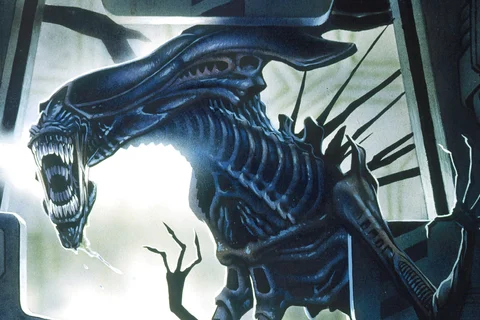
Interior Alien-head art, used as a frontispiece and again on each story title page, is uncredited. Blackstone Audio released an ensemble-cast audiobook on 31 May 2018. Golden's River of Pain and Moore's Sea of Sorrows were already in the same Titan line as Lebbon's first novel. Maberry's introduction warns that some stories fit existing canon and others sit farther out on the edge. The Sulaco prequels still skip Corporal Ferro and Private Drake. Blowback gave the dropship to Corporal Khan instead of Ferro.
Conclusion
Bug Hunt is Titan's 2017 Colonial Marine anthology, eighteen separate hunts instead of one novel plot. Some stories put Apone's later Sulaco people on earlier jobs and give Hicks a wife already dead before LV-426. Others send units against swarms, company tests, and specimens Weyland-Yutani still wants brought home, then leave most of those squads dead or walking away from the retrieval.
Sources
- Aliens: Bug Hunt, edited by Jonathan Maberry (Titan Books, 2017)
- Related continuity: Aliens (1986), Alien 3 (1992), Alien: Out of the Shadows, Alien: Sea of Sorrows, Alien: River of Pain
External Sources
Tag Categories: Alien Merchandise | Titan Alien Novels