Predator: Cold War: Novel Plot & Lore

Predator: Cold War is a 1997 novel by Nathan Archer, published by Bantam Spectra in May 1997 in the Dark Horse Science Fiction Novels line. It followed NYPD detective Schaefer and Russian lieutenant Ligacheva after a hunter ship crashed on the Yamal Peninsula, six months after the New York hunt in Predator: Concrete Jungle. Archer novelized Mark Verheiden's Dark Horse comic and brought back Schaefer, Rasche, and General Philips.
Plot Summary
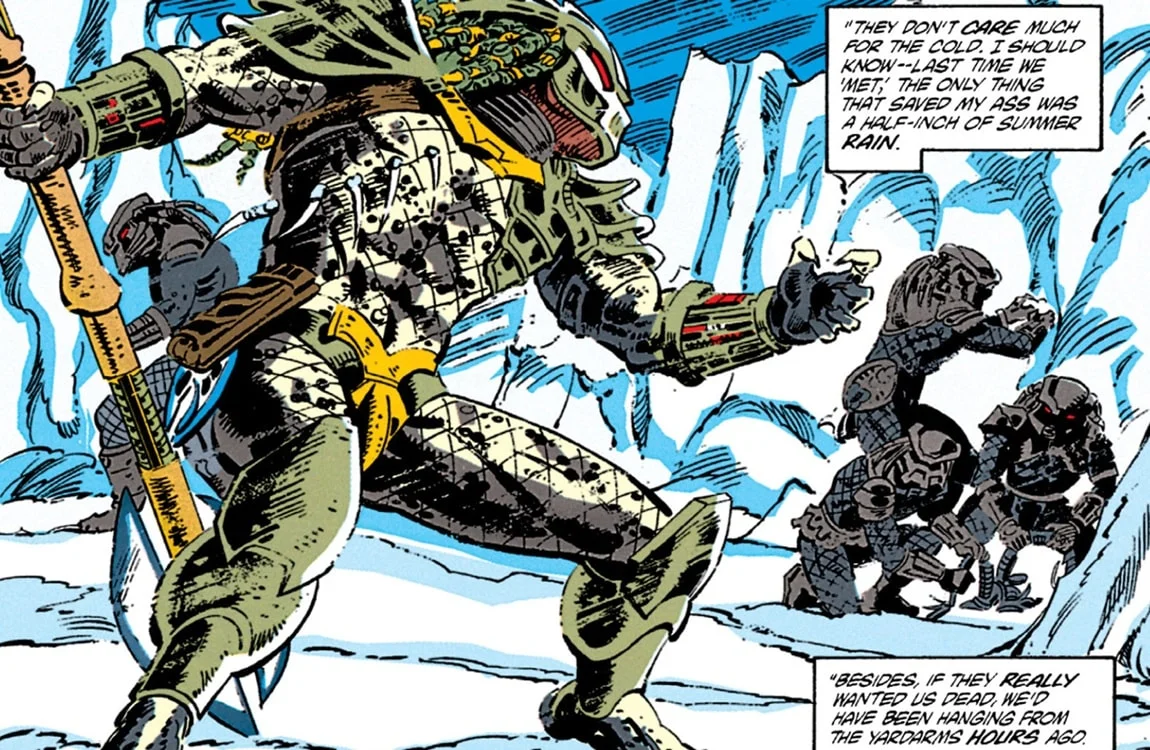
The Yamal Crash
Polar midwinter closed over the eastern fringe of the Yamal oil fields, with the sun gone until spring. Reindeer herder Taro was tracking a stray across packed ice when a bright object dropped through the overcast faster than any pipeline plane he knew. He took it for the rumored American Aurora. It burst from the clouds in orange flame, roared overhead until the air rippled, and crashed beyond the horizon.
Heat followed the wreck, so Taro left the reindeer and walked toward the glow. The village radio and the army at the Assyma pumping station would have cost too many hours if anyone in the craft was alive. After a little more than an hour he was sweating in furs, the ice ahead was wet, and the fallen object lay in a long ravine he knew. Three red dots settled on his forehead from empty air, then a blue-white blast killed him.
Pumping Station 12
Lieutenant Ligacheva had been six months in her first command as the lone officer at Pumping Station #12 on the Assyma Pipeline, a post of about a dozen workers where she was the only woman. She had kept the job by a hard asexual front, flattening drunks, and playing soccer with the crew in summer. The men went to the nearby herder village for company and left her alone.
Dr. Sobchak, the last geologist left in a science wing that had once held a dozen men, called her for what a messenger called a seismic shock about twenty kilometers northeast. The real alarm was his radiation chart. Something had shaken the ground and thrown a spike, and background radiation then held at four times normal. Ligacheva did not trust Moscow to act on old instruments and a geologist nobody respected, so she took the squad herself and kept the radiation reading from the men.
The First Massacre
They left in a snow-tread tractor. Pyotr Salnikov drove along the pipeline to the eighteen-kilometer marker, then turned east, while the outside air fell from −34°C to −42 before the wreck warmed it to −28. On a ridge they found Taro hung by the ankles from a splintered pole, head gone, his prized rifle left in the snow, and huge clawed boot-prints leading on. Ligacheva sent Salnikov, Utkin, and Igor Vetrov after the trail.
Salnikov reached unexpected heat and was slashed from cheekbone to throat. A blade killed Utkin, and Vetrov had time to scream once before Ligacheva reached the ridge. She watched a flash erase Private Anton Mikhailovich Starostin's head and blow Dmitri Dolzhikov's chest apart, then the same weapon hit the tractor and the vehicle exploded. A bolt went through her shoulder. She played dead while a cloaked figure dropped its camouflage, stood well over two meters in killing cold, and cut the head and spine from young replacement Mikhail Alexandrovich Barankin. Village herders later smelled the burning truck, refused to follow the tracks, and dug her out.
Moscow
Crew superintendent Galyshev got her as far as the station, then the army flew her to Moscow at high expense. General Ponomarenko had dumped her on the Yamal as a first command and called that promotion a mistake, but he would not make her the scapegoat. He wanted the truth of what was on the ice, and he sent her back with a relief force.
While she was gone the workers talked strike. Sobchak guessed a downed American plane or satellite. Master pipefitter Sergei Yevgenyevich Buyanov walked Salnikov's two guard dogs after a storm lull. The female broke the leash, charged a hillside, and came back gutted onto his chest. Three masked hunters stood watching, almost bare in the cold, shortest of them well over two meters.
Philips And New York
About six months earlier, last summer, hunters from space had used New York as a hunting ground and set a ship down on Third Avenue on a Sunday morning. General Philips had begun the cover-up, then been parked in an empty office with a phone that did not ring. US command had usually ordered him to let the hunters take a few trophies rather than start a war, but in New York he had fought on the human side. His superiors treated Philips, Schaefer, and Rasche as the reason the hunters left, and blamed him for leaving no captured kit.
Philips put the New York losses at two or three and judged that the hunters had left because they grew bored and the weather turned cool. Schaefer later said he had killed one with a wooden stake after guns failed, and that a half inch of summer rain had saved him. Technician Shearson then flagged satellite infrared and a radioactivity scan at a label reading ASSYMA PS #12, a spot that had been empty three days earlier. Off-books advisor General Emory Mavis ruled out a Russian warhead, read the seismics as a shallow southeast impact with no radar track, and called Philips. After New York had yielded no captured gear, Mavis wanted the wreck kept from the public and from Russian hands.
Rasche In Oregon
Rasche had quit the NYPD after New York, taken a sheriff job in Bluecreek, Oregon, and moved with his wife Shari and their two boys. He had been sheriff a little over four months, and the hunt followed him into sleep. Under dentist gas he almost strangled Dr. Krelmore, taking a hygienist's mask for a hunter. Psychologists treated the creatures as stress hallucinations.
Schaefer had stayed at 1 Police Plaza because he would not be driven out of New York. He refused Colonel Leonard E. Smithers in his office. Smithers wrecked a cocaine sting, then a planted gunman murdered the van backup: Rawlings, Horshowski, and two technicians. Dealer Baby and shotgunner Reggie held Schaefer until the shop window blew in. Schaefer beat Reggie with a frying pan and arrested Baby. Smithers's men then executed both dealers and sedated Schaefer.
Schaefer Recruited
Philips's researchers had been reassigned, and Schaefer was the man he could still find who knew the hunters. The detective had joined NYPD in 1978, made detective in 1986, and spoke fluent Russian and French. Philips wanted the wreck kept out of Russian hands more than he wanted it for America. Schaefer doubted the same species would land in Siberia because they hated cold. Philips answered that the New York ships had not leaked neutrons or sprayed furnace heat, and this one did.
If Schaefer came, Philips would try to get information on Dutch, and Schaefer accepted. Rasche learned he was missing from Officer Weston, found a note linking Philips and Smithers, beat Smithers in midtown room 3710, and forced the Siberia mission out of him. Rasche then walked into the UN, named Assyma, and got Russian ambassador Grigori Komarinets to take him to Russia.
The American Jump
Captain Lynch led a squad trained for six months and never in a real hunter fight. Lassen spoke Arabic, Wilcox Spanish, and Dobbs some Swahili. None of them spoke Russian until Schaefer. They jumped from a modified B-2 into Russian airspace in Type 19D heated suits and modified M-16s, both tested to −50. Seven men went: Wilcox, Lassen, Dobbs, Gennaro, Schaefer, Lynch, and Philips.
At the UN, Ambassador James Theodore Ridgeley accused Moscow of clandestine arctic nuclear work, and Komarinets told CNN his government knew of no such activity. Mavis used that denial as cover: Washington could call a later Russian protest a terrorist or nuke response, and Philips's black-budget team could be disowned as freelance if they died.
The Station Raid
Buyanov bowed, called the three watchers lords, and ran. Anatoli Shvernik and Dmitri Vesnin pulled him through the east door, then a blade sawed through ten centimeters of steel. A hunter rammed a spear through Anatoli's chest. Another crushed Vesnin's hold, drove wristblades into his back, and Vesnin's dying spasm pulled the alarm. A third crushed Buyanov's skull under a sandal.
Sobchak locked himself in, watched heat and double-normal radiation move inward on his instruments, and left his coat and boots in the anteroom. Galyshev armed about a dozen workers with AK-74s. In the pipeline bay they found Buyanov, Vesnin, and Shvernik hung headless from the overhead steel, then the two dogs. The hunters were in the boiler room, pressed to metal Galyshev knew as 120°C. Three red dots settled on his face and took his head, then Leskov, Shaporin, Rublev, and the rest of the crew died in the dark. When the Americans later counted the bodies they found twelve humans and two dogs. Sobchak was not among them.
Ligacheva Returns
Ligacheva's relief force arrived as the Americans were inside the wrecked east door, and she arrested the seven-man party at rifle-point. Sergeant Yashin blamed the Americans, and Ligacheva did not. She kept Schaefer to talk, locked the others in the workers' barracks, and found flow-control valves, capacitors, and other heating parts removed rather than smashed. The hunters had stripped the station for repairs.
They found Sobchak on his lab floor, hands, feet, and one ear black with frostbite, raving about being tired of white. He had hidden through the screams, too afraid to fetch boots after the heat failed, but he had also charted the hunters and drawn a map. Schaefer read a base or ship in a ravine about eighteen or twenty kilometers from the station, and a medical crew was called. The story leaves Sobchak there. Ponomarenko radioed and ordered an immediate attack so America could not take the site. Ligacheva refused another massacre, so Ponomarenko left her with the prisoners and gave the attack to Yashin.
The Firefight
Philips's men blew the barracks door with C-4 hidden in his boot, and the blast killed the door guard. Lynch recaptured Ligacheva at the storeroom. She pulled Schaefer between herself and Lynch's M-16, ran for the east door, and Schaefer went with her. Three Russian vehicles and the Americans around that door then opened fire on each other.
Wilcox's suit leaked yellow heat-fluid and Gennaro's seams burst. Then Gennaro's M-16 exploded into his face, and Dobbs's gun blew next. Ligacheva read −60°C, well below the −50 rating on the American kit. Within about five minutes the Americans surrendered to Yashin's men. Ligacheva sent Kazakov and driver Maslennikov to congratulate Yashin, then took the small snow tractor northeast with Schaefer to find the ship herself.
The Ravine
Yashin decided she was selling the wreck and came after her. The little tractor stopped at a ravine about fifty yards across and twenty yards deep, and from the rim Yashin fired to kill her. Three red dots then marked his chest, and a blue-white blast ripped him open. Maslennikov led the six remaining soldiers down the ropes and blamed Ligacheva and Schaefer.
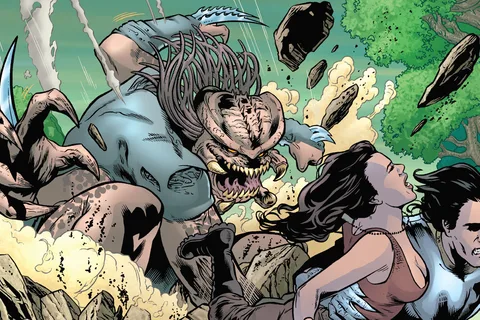
A cloaked hunter speared the first man off the rope. Gunin hit a snow-hidden spike trap. Pushkov ordered the others to shoot anyway, and bullets hit Gunin's arm before the hunter cut his heart out. The rest of that party died over several long minutes. Schaefer held Ligacheva back, took her entrenching tool, and attacked while the hunter turned a corpse for a spine trophy. He slashed the chest, tore the mask, and beat the exposed face with the mask edge. The hunter mimicked Schaefer's voice and burned the skin off one side of his scalp with the shoulder cannon. Ligacheva jammed an AK-100 into its open mouth and emptied a thirty-round magazine. They left the body, fearing traps.
Inside The Ship
The canyon warmed as they walked Sobchak's map, and near the wreck Schaefer judged about 60°F. The ship sat in a heat-melted pit, half buried, radiating so much heat the permafrost had failed. It was visible, unlike the New York hulls, and it looked like a different model. They opened Lynch's pack and found demolitions-grade C-4 and Teflon-coated depleted-uranium magazines that fit the AK-100. The boulder they stood on collapsed, they fell onto the hot hull, and Schaefer's plastic suit melted as they went in.
There was no airlock, only oily warm fog and orange-red light from patterned walls. A torn bay had been patched with ordinary terrestrial plumbing and circuit boards that carried Cyrillic lettering. An unmasked hunter knocked them down and lifted Schaefer by the throat. Schaefer stabbed it with a shard of the broken red wall. A second hunter laid the canyon sentry's corpse on the floor. Ligacheva fired the depleted-uranium load, then shot each downed hunter in the head. They ran out on a hiss from deeper in the ship.
The Launch
Back at the station, Washington aborted the mission under the call sign Cold War. Moscow knew the US team had orders to capture or destroy the ship and was threatening war, and a high-ranking Russian political official was inbound. Philips was told to gather his men, avoid the aliens, and let the vessel leave. He bushwhacked the soldiers left on the prisoners, rearmed his team, and went after Schaefer to stop him leaving a wreck on Russian soil.
On the hull Schaefer wired the C-4 as one satchel while a living hunter stood in the open hatch, unmasked, watching. Wilcox's team appeared on the rim and ordered weapons dropped. Philips shouted that new orders were to let the hunters lift off. Schaefer dove for the pack, took a bullet through the outer thigh from Wilcox, and rolled to the hunter's feet. The hunter looked at the rim and ran back into the ship. Wilcox lined up a head shot, and Rasche, in a Russian overcoat with an AK-74, shot Wilcox through the shoulder instead. Ponomarenko and twenty or thirty Russian rifles then covered the Americans.
The Cover-Up
The ship powered up while Ligacheva dragged Schaefer and Rasche pulled them up the rocks. She set the detonator to forty-five seconds before Ponomarenko's rifles stopped her. He claimed the vessel for the Russian people and said the air force would try to force it down if it launched. Ligacheva hit the start button with her toe and kicked the pack through the open hatch. The ship rose in blue-white fire. About thirty seconds later the distant speck became a fireball, then a sky-whitening blast far larger than C-4. She judged the ship's power source, or the jury-rigged repairs, had gone up, and that there would be no wreckage.
Ponomarenko told her the career was finished and that hearings would follow. She offered to tell the world how the new Russia treated its soldiers and how they had lied to the Americans about the visitors. Komarinets cut in, in English, and said they could count on Philips to clear the incident without parliament or press. Both sides would hide the fight over the wreck, hide Yashin's and Wilcox's killings, and deny the aliens existed. The cover she expected was something like Iranian terrorists. Schaefer, burned, half-scalped, and shot in the thigh, told Rasche she had refused the threat, and that if Russia did not want her the NYPD might.
The Hunters
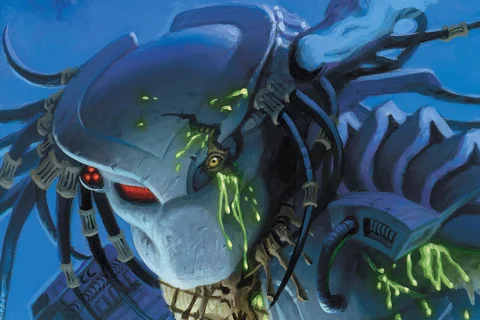
The book never uses the word Yautja. Human characters call them monsters, creatures, aliens, hunters from space, ice demons, snow devils, or arctic ghosts, not a species name. Buyanov saw three together on the ice. Ligacheva later stood over three bodies in the torn bay, then a living hunter appeared in the hatch and launched the ship, so the book never gives a firm headcount. They stood well over two meters, with mottled yellowish skin, decorated snakelike braids, mesh, metal masks, and sandals whose front claws marked snow. Yellow-green blood marked wounds. Ordinary small-caliber fire did little, but the depleted-uranium Teflon rounds punched through.
They liked heat and hated cold. They basked on the 120°C boiler plate, and their steps melted Siberian ice, but they fought in −60°C air with almost no coats. Schaefer treated Yamal as a crash, not a chosen hunting ground. They hung armed prey and took heads and spines, and they also stripped the station for spare parts. The wreck leaked heat and radiation, unlike the cloaked New York fleet. Wrist controls sat on a dying sentry's arm, the hunter in the ravine repeated Schaefer's "Go home," and hidden spear and spike traps guarded the approach.
Confirmed Kills
Taro, a Yamal reindeer herder, died first, hung headless on the ice. Ligacheva's original squad died on the first ridge, among them Salnikov, Utkin, Vetrov, Starostin, Dolzhikov, and Barankin. The worker crew of twelve died in the station, including Buyanov, Shvernik, Vesnin, Galyshev, Leskov, Shaporin, and Rublev, plus both guard dogs. Yashin died on the canyon rim. Maslennikov's six, including Gunin and Pushkov, died in the ravine. Smithers's gunman murdered Rawlings, Horshowski, two technicians, Baby, and Reggie in New York before anyone reached Siberia. Philips's C-4 killed the unnamed barracks door guard.
Ligacheva killed the canyon sentry with a full magazine into the mouth after Schaefer tore the mask off. She then killed two hunters aboard with depleted-uranium fire and head shots. The launching hunter and the ship were destroyed in the sky. Schaefer, Rasche, Ligacheva, Philips, Komarinets, Ponomarenko, and Wilcox lived. Lynch's jump team was last seen on the rim. Sobchak's death is not on the page, but the frostbite made survival without hands and feet unlikely. The book never says what happened to Dutch after Central America.
Key Characters
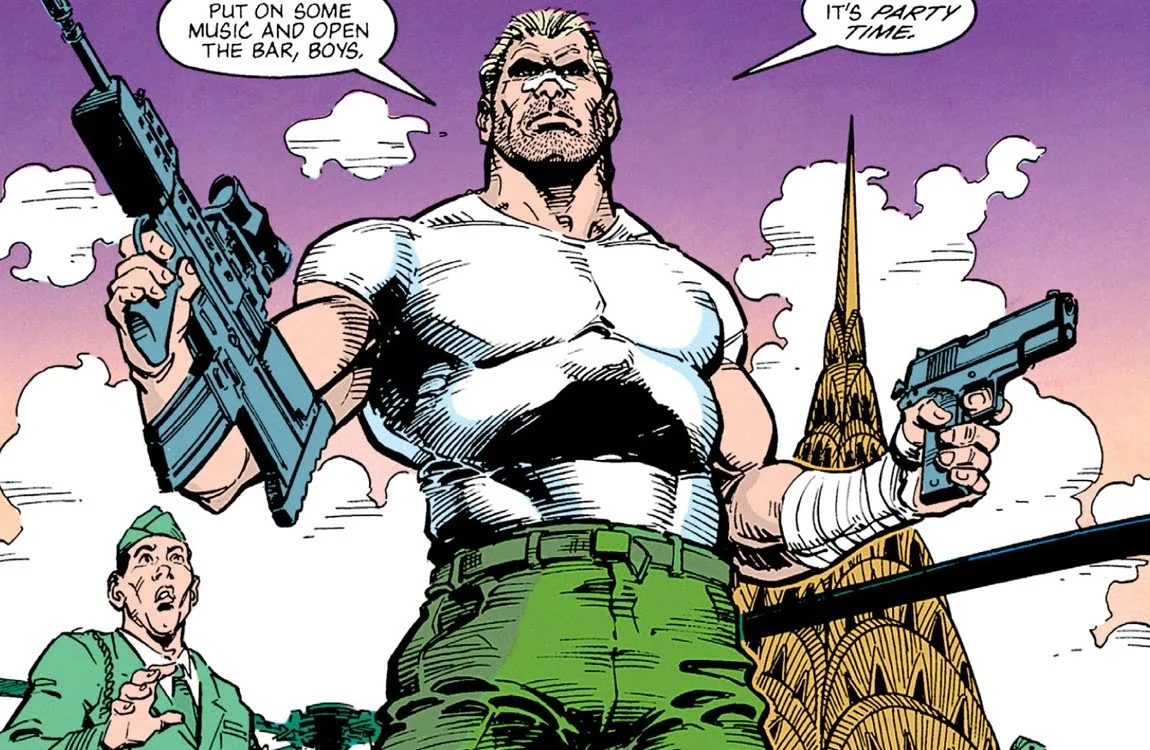
- Schaefer was an NYPD homicide detective, Dutch's brother, with no first name in this novel. He was kidnapped onto the Siberia jump, fought the ravine sentry, took a thigh wound from Wilcox, and lived through the launch.
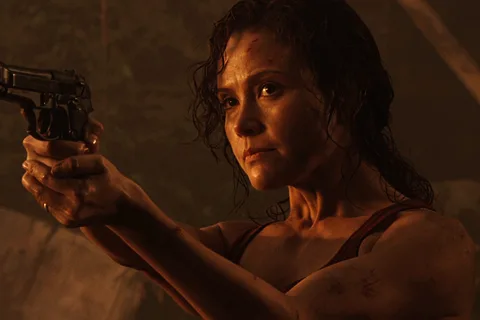
- Lieutenant Ligacheva commanded Station #12 and had no first name in the book. She survived the first massacre, killed three hunters, kicked the C-4 into the hatch, and faced a finished career under the cover-up.
- Rasche had left New York for a sheriff's job in Bluecreek, Oregon, with Shari and their two boys. He tracked Schaefer through Smithers, arrived with Komarinets, shot Wilcox, and pulled Schaefer off the hull.
- General Philips ran the unofficial hunter desk, recruited Schaefer with a promise of news about Dutch, received the abort order, and then helped Komarinets bury the incident. He never delivered Dutch's fate.
- General Ponomarenko commanded the military district, ordered Yashin's attack, claimed the ship for Russia, and then joined the silence.
- Sergeant Yashin went around Ligacheva for the general's favor, recaptured the Americans after the firefight, and died on the rim when he tried to shoot her as a traitor.
- Dr. Sobchak was the last station geologist. He mapped the wreck, hid through the worker massacre, and was found frostbitten.
- Captain Lynch led the US jump team, lost Ligacheva at the east door, and stood on the rim at the end.
- Wilcox feuded with Schaefer from the firing range, shot him in the thigh, and lived after Rasche hit his shoulder.
- Grigori Komarinets was Russia's UN ambassador. He denied clandestine work on CNN, brought Rasche north, and brokered the final cover story with Philips.
- Dutch Schaefer was a covert operative who had killed one jungle hunter in Central America and then vanished. He never reached Siberia in this novel, but Schaefer, Rasche, and Philips mentioned him several times, and Philips used news of him as bait.
- Taro was a Yamal reindeer herder and the first human kill on the ice.
Place In The Books
Bantam sold the novel as the second of three Predator paperbacks, after Archer's Concrete Jungle in 1995 and ahead of Sandy Schofield's Big Game. It is a comic expansion, not a film book, and a direct sequel that brings back Schaefer, Rasche, and Philips. The detective is still only Schaefer here. Later Dark Horse series Predator: Hunters III gave him the first name John. The book never prints Val Verde, OWLF, Peter Keyes, or a reunion with Dutch. Carr and McComb do not appear.
This is the Siberia crash that follows the New York city hunt. A damaged ship leaked heat and radiation, raided a pumping station for parts, and left no recoverable wreck after Ligacheva's bomb. Titan later bound Cold War with Concrete Jungle and Big Game in The Complete Predator Omnibus.
Editions
Bantam Spectra released the first American mass-market paperback in May 1997 in the Dark Horse Science Fiction Novels line. Catalog listings give 265 pages. The painted cover is a gold-masked hunter with a spear against a brown field, credited to John Bolton. Millennium issued a British edition in January 1998 at 320 pages, then a June 1998 reprint with a Dimitri Patelis cover and 266 pages.
Titan Books reprinted the text in The Complete Predator Omnibus on 30 January 2018, bound with Concrete Jungle and Big Game. Titan lists that paperback at 672 pages. There is no separate modern standalone of this book.
Behind The Scenes
Nathan Archer is the science-fiction pen name of Lawrence Watt-Evans. Dark Horse asked him for another Predator novelization after Concrete Jungle. He turned down Big Game because he did not know the Southwest well enough and did not like the story, then took Cold War because it was a direct sequel with Verheiden's cast. He had studied a little Russian as a teenager and trusted himself more with Siberian Russians than with a New Mexico setting he had never seen. After this book he was done with the hunters and was glad to see Steve Perry take the next novels. Verheiden's third Schaefer miniseries, Predator: Dark River, reached shops in 1996 and sent the detective back into the South American jungle after Dutch. Bantam never turned that comic into a novel. The third Dark Horse Science Fiction paperback was Sandy Schofield's Big Game in 1999, the New Mexico story Archer had already refused.
The Cold War comic had no scene the films had already used, so he did not have to drop a set piece the way he had dropped the subway massacre from Concrete Jungle. He added the opening of Chapter 9 so he could work in friend Jon Cohen and the comics shop Collectors World. Verheiden's joke about One Life to Live became The X-Files, then Fox blocked that Fox-owned title and it landed as Melrose Place. Watt-Evans corrected Russian name forms, most obviously changing Ligachev to Ligacheva, because a woman cannot carry the masculine surname, and he rewrote cold-weather description from New England winters rather than Verheiden's more poetic ice. He also moved the pumping station onto real oil ground on the Yamal. His main research was Russian small arms, the AK-74 and the then-new AK-100, plus another watch of both films and a reread of his own New York novel.
Conclusion
Predator: Cold War is Nathan Archer's 1997 Bantam sequel to Concrete Jungle, from Mark Verheiden's Dark Horse comic. It takes Detective Schaefer and Lieutenant Ligacheva from a Yamal pumping station to a crashed hunter ship in a ravine. The book ends with the wreck destroyed in the sky, both governments agreeing to a terrorist cover story, and Dutch still missing.
External Sources
- Cold War at the Internet Speculative Fiction Database
- Lawrence Watt-Evans on writing Cold War
- The Complete Predator Omnibus at Titan Books
Tag Categories: Predator Merchandise