
Colonial Marine ranks look simple until you open more than one book. This article explores the grades and billets shown across canon and semi-canon sources: the film Aliens, the licensed ALIENS Adventure Game, the Aliens Colonial Marines Technical Manual, Free League's Colonial Marines Operations Manual, and the UACM wall chart in Aliens: Fireteam Elite.
From USCM To UACM
The Corps itself changes name between those sources. Early material calls it the United States Colonial Marine Corps (USCM / USCMC). After the Colonial Protection Act in 2187, it was renamed the United Americas Colonial Marines (UACM). The Technical Manual is written from fiscal year 2179, the same year as Aliens, so it still speaks USCM. Leading Edge's 1991 RPG sits in that same late-2170s neighborhood. The Operations Manual belongs a few years later, around the mid-2180s, still before the rename. Dark Descent lands in 2198, already under the UACM name after 2187. Fireteam Elite's ranks poster hangs aboard the Endeavor during the 2202 LV-895 campaign, fully in that later era.
How Colonial Marine Ranks Work
The shape is familiar if you know United States Marine Corps grades: junior enlisted, NCOs, staff NCOs, warrants, company officers, field officers, generals. Colonial Marine lore rarely invents exotic titles. It argues about who sits in which seat. Fireteam Elite's UACM poster is the only widely seen source that prints abbreviations and pay grades for every step from Private to General, including dual E-8 and E-9 tracks and W-1 through W-5.
The Technical Manual barely bothers with pay grades. It cares about doctrine: small autonomous rifle units that carry their own transport, sensors, and heavy weapons on a non-linear battlefield, organized so a Lieutenant can push two sections without waiting on higher HQ.
Above the platoon, the same Manual sketches a whole Corps. The National Security Act of 2101 set the Colonial Marines at four combat divisions and four aerospace wings, plus their organic support. By FY 2179 strength sat around 165,000 Marines, down from a 2165 peak of 240,000 after Tientsin, with about 50,000 more in reserve as a fifth division and wing.
Operating forces answer to US Space Command and are grouped into three Marine Space Forces: Sol for the core systems, Eridani out along the American and Chinese arms, and Herculis up the Anglo-Japanese arm to the Network fringe. Those MSFs ride with United States AeroSpace Force fleets, pairing a Colonial Marine Division built around three infantry regiments for orbital assault with a Colonial Marine Aerospace Wing for support and airmobility.
A wing is mostly an administrative shell, because much of its fighting strength sits attached to the division, but on paper it still runs on the order of 300 dropships, 30 heavy-lift shuttles, and 100 strikeships. In practice, frontier work breaks the MSFs into autonomous task forces of regiment size or less, which is why Colonels, Lieutenant Colonels, and the odd Brigadier show up in stories more often than anyone counting divisions on a wall map.
Recruitment and commissioning sit under that same Corps identity, even when the books disagree on the ladder. The Technical Manual sends enlisted boots to Parris Island, San Diego, or Guantanamo, with about 24 percent washing out. Officers enter through OCS at Camp Barrett, Quantico, or transfer in from Annapolis and the USASF Aerospace school at Gateway. Infantry officers then take Quantico's infantry course and a hostile-environments course at Camp Hanneken on Mars.
Leading Edge already describes a Colonial Marines Staff College that can push green Lieutenants into the field fast, and names Gorman as the example. The Operations Manual keeps a fuller USMC-shaped list for Marine character creation, then undercuts it for play: most PCs stay Private or PFC, the squad NCO is usually a Corporal or Sergeant, and higher ranks are rare because the book wants the table, not the Lieutenant, deciding the next move.
So the contradictions are baked in. Gorman can hold the commission while Apone runs the sweep. Hicks can inherit a platoon without a promotion ceremony. Bishop can sit in the command slot without wearing gold bars. The titles stay on the armor. After contact, working command often shifts to whoever can still lead.
UACM Grade Structure
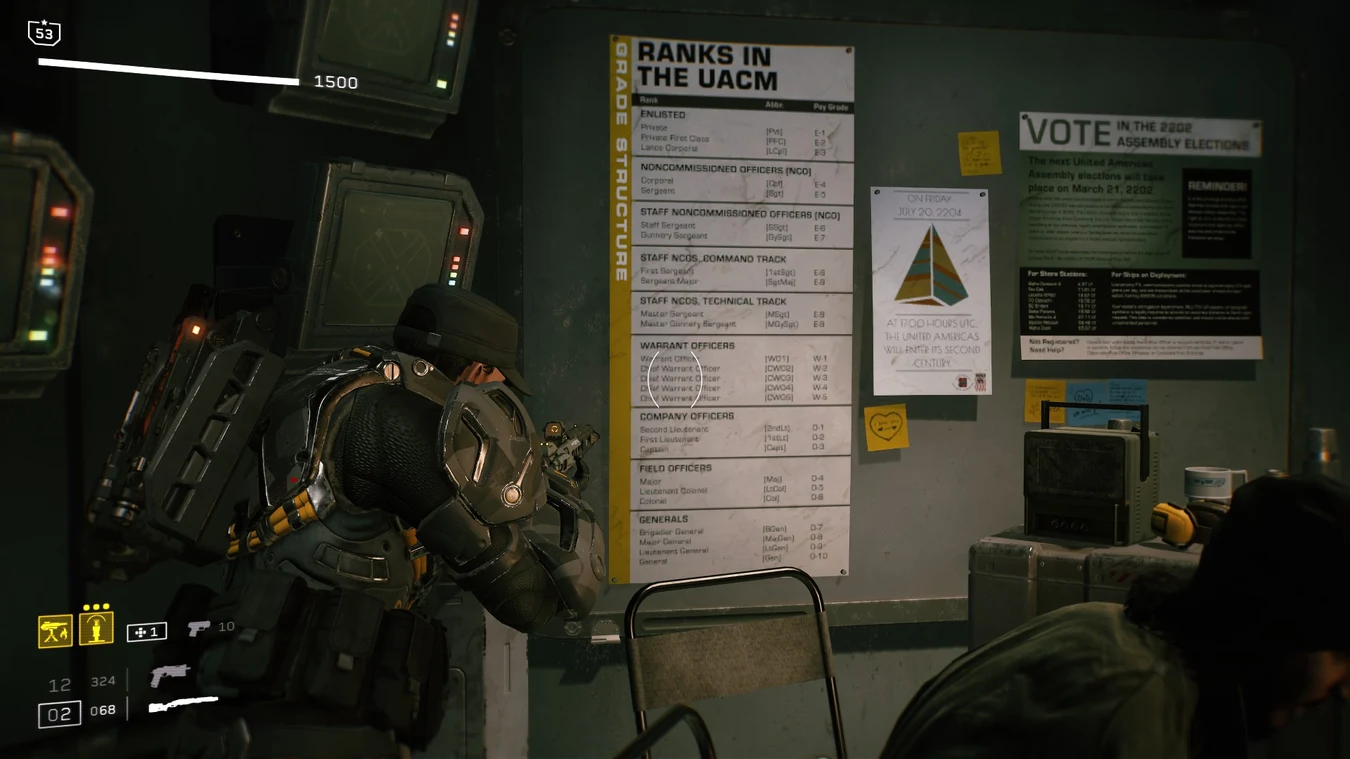
The Endeavor hangar poster is the cleanest printed grade list in modern games. It splits the Corps into enlisted, NCO, staff NCO, warrant, company officer, field officer, and general bands. At E-8 and E-9 it forks: First Sergeant and Sergeant Major on the command track, Master Sergeant and Master Gunnery Sergeant on the technical track.
That fork matches how the Operations Manual later describes overlapping operations chief billets for several senior staff NCO titles. Remember the poster is a 2202 UACM document. The titles below are the modern ladder, not the 2179 Tech Manual's job chart.
Enlisted: Private [Pvt] E-1; Private First Class [PFC] E-2; Lance Corporal [LCpl] E-3.
NCOs: Corporal [Cpl] E-4; Sergeant [Sgt] E-5.
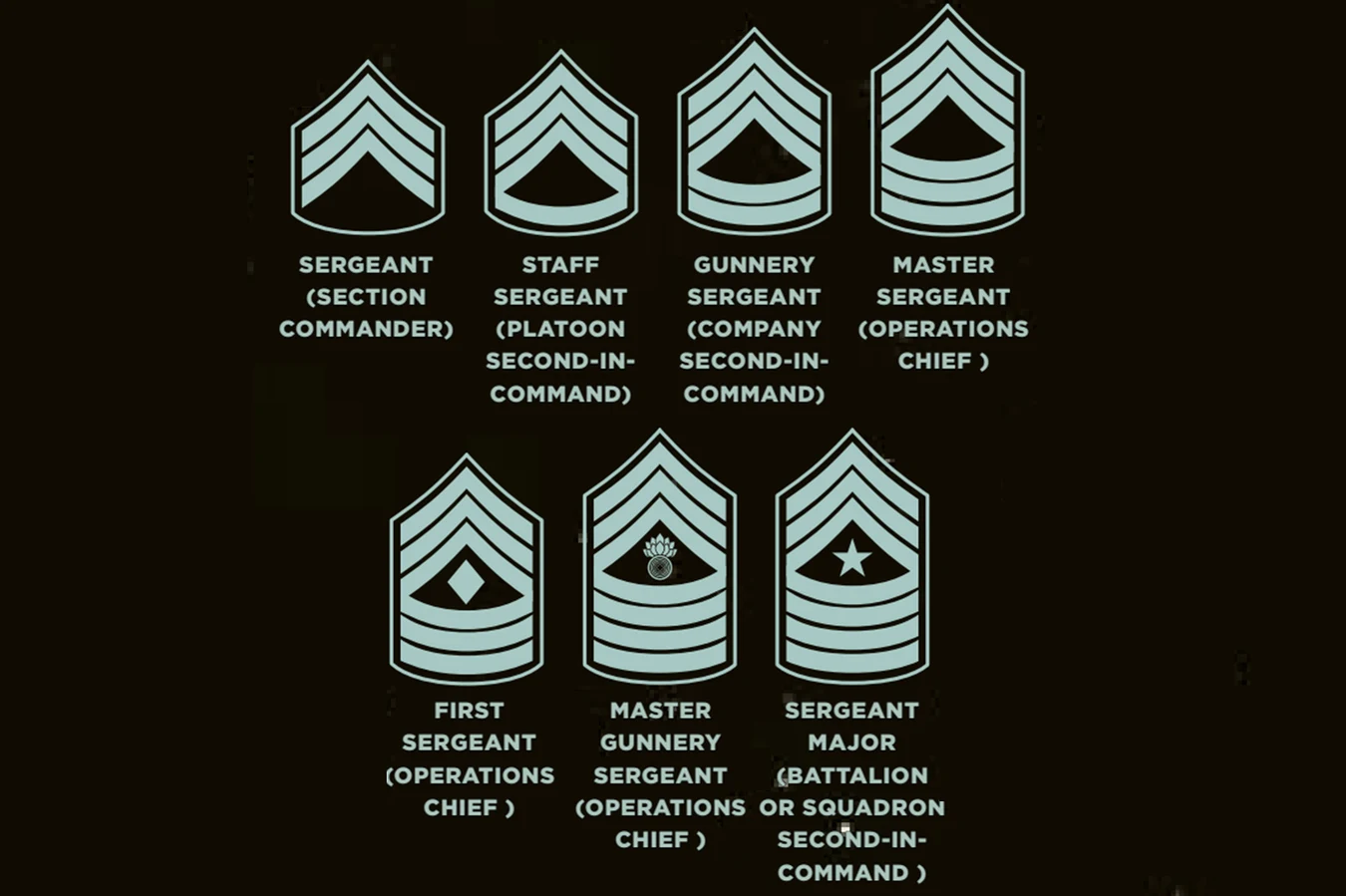
Staff NCOs: Staff Sergeant [SSgt] E-6; Gunnery Sergeant [GySgt] E-7; First Sergeant [1stSgt] E-8 / Sergeant Major [SgtMaj] E-9 (command); Master Sergeant [MSgt] E-8 / Master Gunnery Sergeant [MGySgt] E-9 (technical).
Warrants: Warrant Officer [WO1] W-1; Chief Warrant Officer [CWO2]–[CWO5] W-2 to W-5.
Company officers: Second Lieutenant [2ndLt] O-1; First Lieutenant [1stLt] O-2; Captain [Capt] O-3.
Field officers: Major [Maj] O-4; Lieutenant Colonel [LtCol] O-5; Colonel [Col] O-6.
Generals: Brigadier General [BGen] O-7; Major General [MajGen] O-8; Lieutenant General [LtGen] O-9; General [Gen] O-10.
The Operations Manual's Making Marines table attaches typical positions to almost every one of those titles: team member, team leader, squad leader, section commander, platoon or company second-in-command, operations chief, battalion or squadron deputy, platoon commander / pilot, company commander / pilot, staff officer, battalion or MAU commander, and the brigade-through-senior-general slots.
Refer to the Fireteam poster for pay grades. Refer to the Tech Manual and Operations Manual when you need to know who rides which vehicle. Refer to the licensed 1991 Leading Edge game when you want the early official alternate ladder that stops at Master Sergeant and Commander.
Leading Edge RPG Ranks
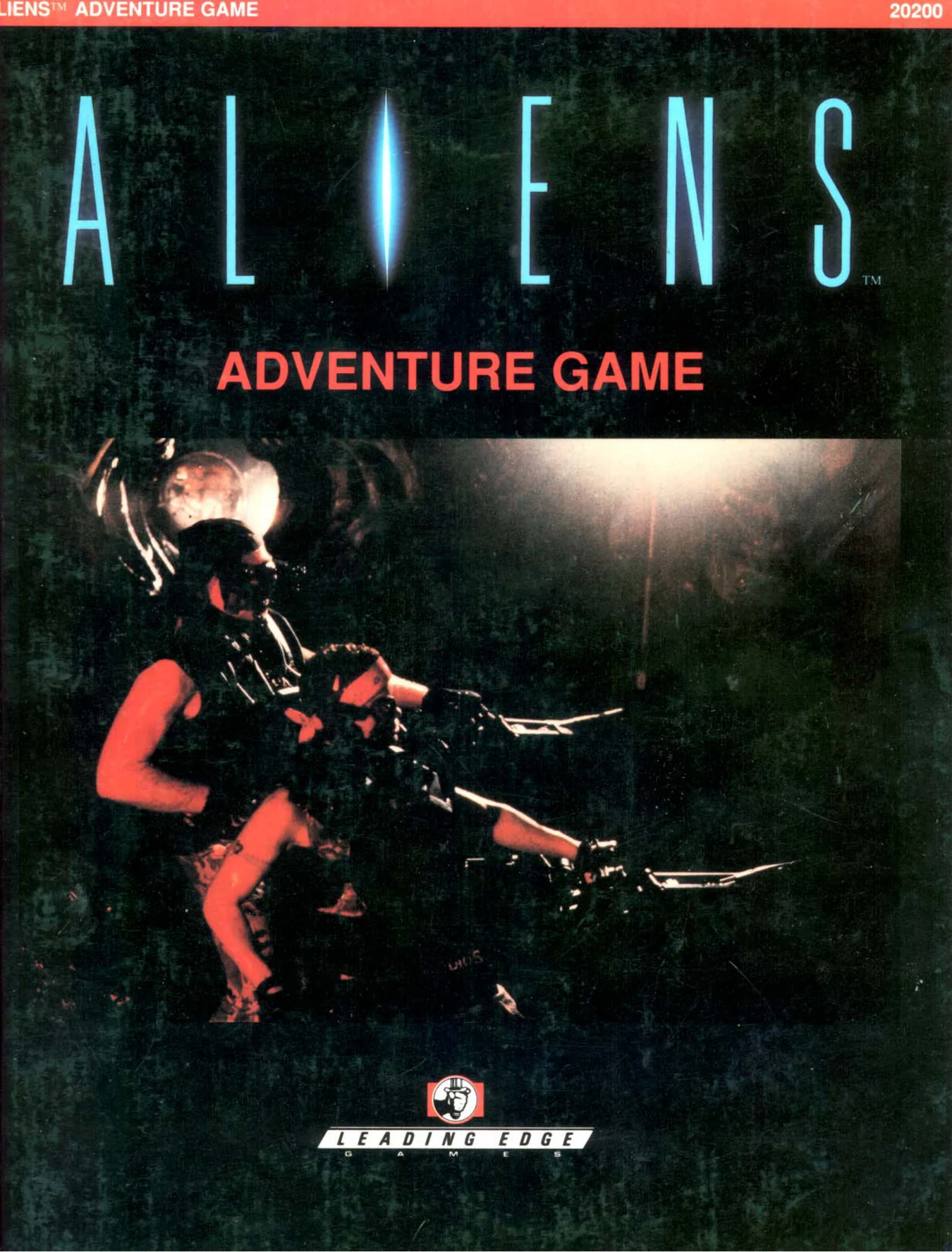
Fox-licensed Leading Edge Games published the ALIENS Adventure Game in 1991, four years before Lee Brimmicombe-Wood's Aliens Colonial Marines Technical Manual (1995) and long before Fireteam Elite. The rulebook does not cite or lean on that later Tech Manual. Its Marine careers and promotion table stand on their own, built from the film and Leading Edge's own design. Careers run on Merit Points earned through Active Duty years. Enlisted and Auxiliary characters enter as Private. Officers enter as Lieutenant.
When Merit Points hit the next threshold and a Learning Roll succeeds, the character advances one step with no skipping.
Infantry / Auxiliary: Private; Corporal (11 Merit Points); Sergeant (12); Staff Sergeant (13); Tech Sergeant (14); Master Sergeant (15).
Officers: Lieutenant (16); Captain (17); Major (18); Lt. Colonel (20); Colonel (22); Commander (26).
That list is the biggest early crack in the franchise rank picture. No Private First Class, no Lance Corporal, no Gunnery Sergeant, no First Sergeant, no Sergeant Major, no warrant track, no Brigadier or higher. Instead it inserts Tech Sergeant between Staff Sergeant and Master Sergeant, and crowns the officer side with Commander above Colonel.
Line Infantry deploy in squad-sized Strike Teams with Auxiliary backup, which is closer to a film squad than to the Tech Manual's full two-section platoon. Court-martial results can strip a Marine all the way back to entry grade: Private for enlisted, Lieutenant for officers.
The same book already argues about green officers. Regular Colonial Marine Officers are supposed to finish a Tour in Infantry and Auxiliary work before getting their own commands. Staff Officers come out of a newly created Colonial Marines Staff College on Earth, often with money and Corporate influence behind them, take four years of college training instead of the traditional six years in the field, and can hit the ready line as Lieutenants almost immediately. The text points at Lieutenant Gorman as that kind of officer. Later sources kept that green-Lieutenant pattern and mostly dropped Tech Sergeant and Commander.
Enlisted Ranks
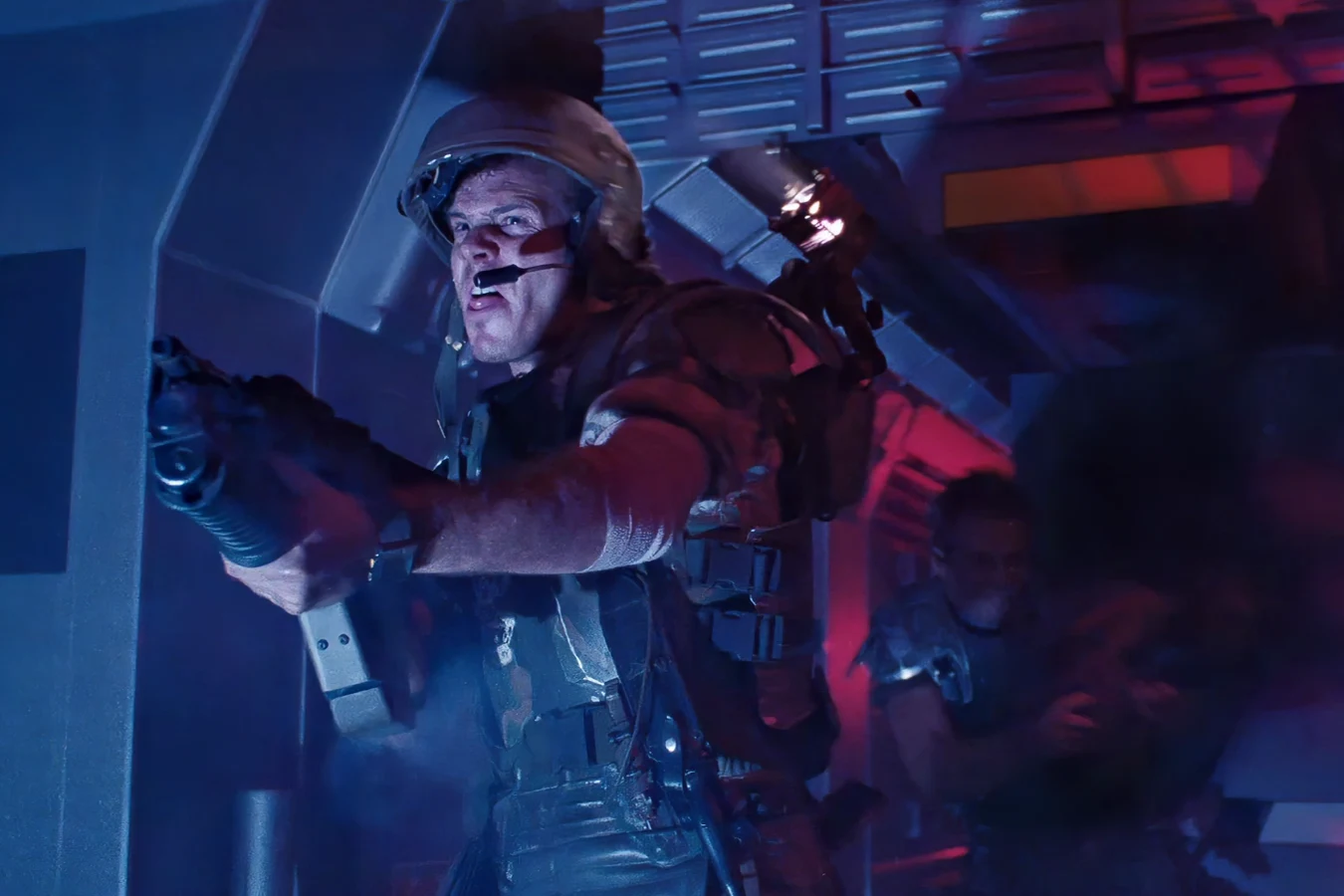
In the Technical Manual, a rifle squad is four Marines: one Corporal, one Lance Corporal, and two Privates or PFCs. They split into two-man fireteams on the buddy system. The Rifle Team carries a pair of M41 pulse rifles. The Gun Team pairs another M41 with an M56 Smartgun. That four-Marine setup is the smallest fighting brick the Corps expects to drop and still call a squad.
The Operations Manual lists Private and PFC as team members and Lance Corporal as team leader, which softens the Tech Manual's stricter four-man recipe without inventing new grade names. Leading Edge never used PFC or Lance Corporal at all. Its junior ladder jumps Private straight to Corporal.
On the Sulaco drop, the junior band did the work the manuals describe: combat tech PFC William Hudson, smartgunners PFC Jenette Vasquez and PFC Mark Drake, plus riflemen who never got long speeches. Game protagonists often start here too, from unnamed Privates to rookies still learning headset chatter and motion-tracker arcs. Boot lore from the Technical Manual fits that picture: high-school graduates clearing physicals and written tests, then discovering that field tech under shellfire washes out more recruits than the rappel tower.
Noncommissioned Officers
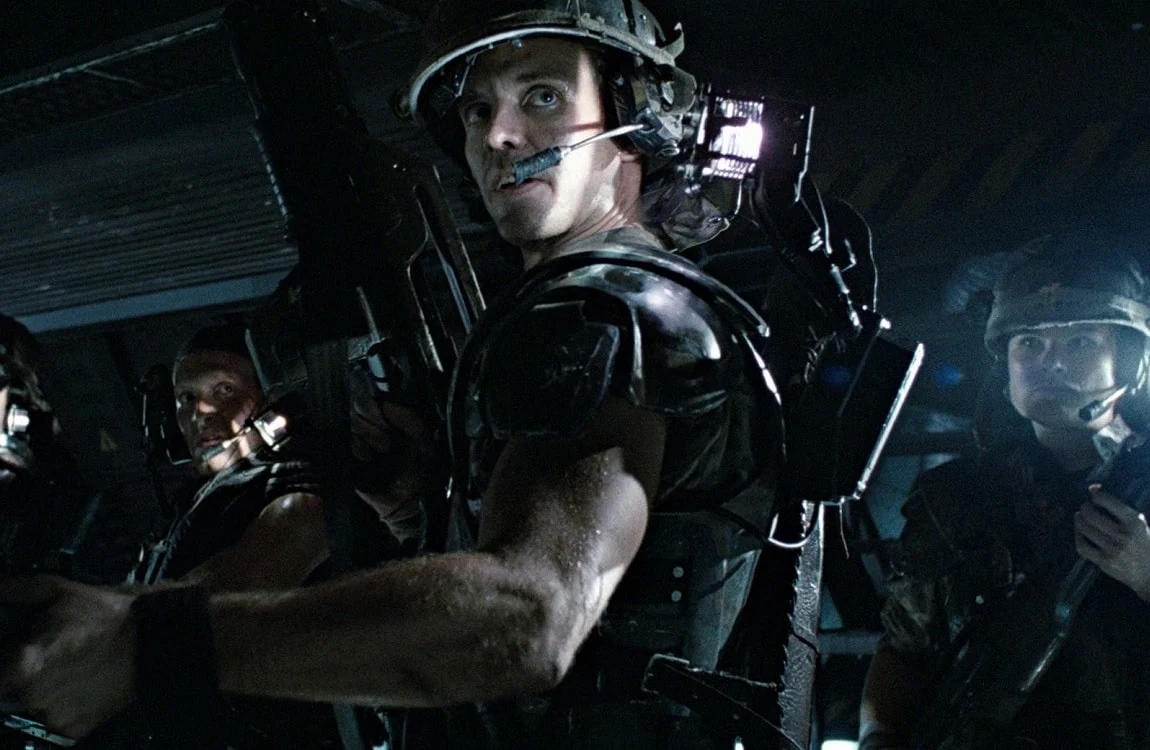
Corporal is E-4 on the UACM chart and squad leader in both the Tech Manual and the Operations Manual. Sergeant is E-5 and section commander: two squads, an M577 driver, and a UD-4 attached from the aerospace company for the drop.
The Operations Manual's section also names a support team (pilot and crew chief) and a tactical team in the APC TAC center, where a Sergeant or senior officer coordinates while the driver runs the vehicle. If the section Sergeant goes out with the squads, a gunner may fill the TAC seat instead.
Corporal Dwayne Hicks began as a fireteam leader and became working commander after Master Sergeant Apone vanished and Lieutenant Gorman was knocked out during the APC extraction. The Operations Manual's table advice mirrors that reality: Corporal on one fireteam, Lance Corporal on the other, Sergeant above the section, Lieutenant somewhere on the net, and the players deciding the next room once contact starts.
Staff Noncommissioned Officers
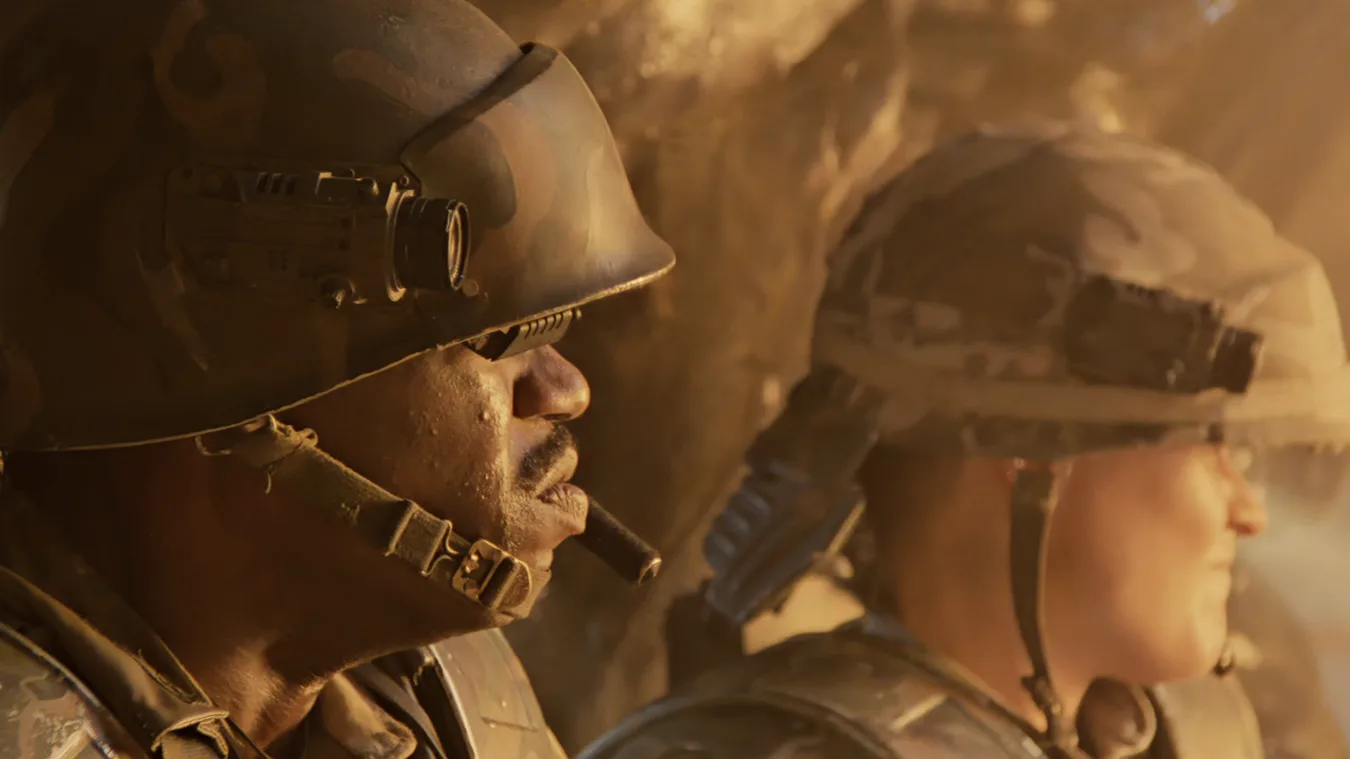
Staff Sergeant (E-6) and Gunnery Sergeant (E-7) are the grades above section fight and below commissioned company command. The Operations Manual's typical positions put Staff Sergeant as platoon second-in-command and Gunnery Sergeant as company second-in-command.
Above that, Master Sergeant, First Sergeant, Master Gunnery Sergeant, and Sergeant Major crowd into operations-chief and battalion or squadron deputy work, which is why Fireteam's dual E-8 / E-9 tracks matter: command path versus technical path at the same pay grade. Leading Edge never reached that fork. After Staff Sergeant it went Tech Sergeant, then Master Sergeant, and stopped.
Master Sergeant Al Apone is the film's staff-NCO case. The Sulaco hypersleep readout lists him as M/SGT, and later material such as Alien: The Weyland-Yutani Report keeps that grade even though the squad still calls him Sergeant in the field and his on-screen chevrons do not match cleanly. On the UACM chart that sits at E-8 on the technical track, above the E-5 section Sergeants. He moved the Sulaco contingent through Hadley's Hope while Gorman watched marine vitals from the APC, then led from the front in the atmosphere processor until the hive took him.
The Technical Manual already talks like this band runs the Corps' daily violence. Recruit stories quote two-meter Gunnery Sergeants emptying buses at Parris Island. Scout-sniper writeups put Gunnery Sergeants behind M42A scope rifles. Armor and weapons chapters keep GySgts as the people who know when a Smartgun harness is lying to you.
In Fireteam Elite, that same layer shows up shipboard: senior NCOs running fabricators, armories, and hangar discipline between LV-895 drops. The Operations Manual's 33rd MAU sample even names a battalion Sergeant Major under Lieutenant Colonel Hanrahan, which is exactly the SgtMaj billet on the Making Marines table.
Warrant Officers
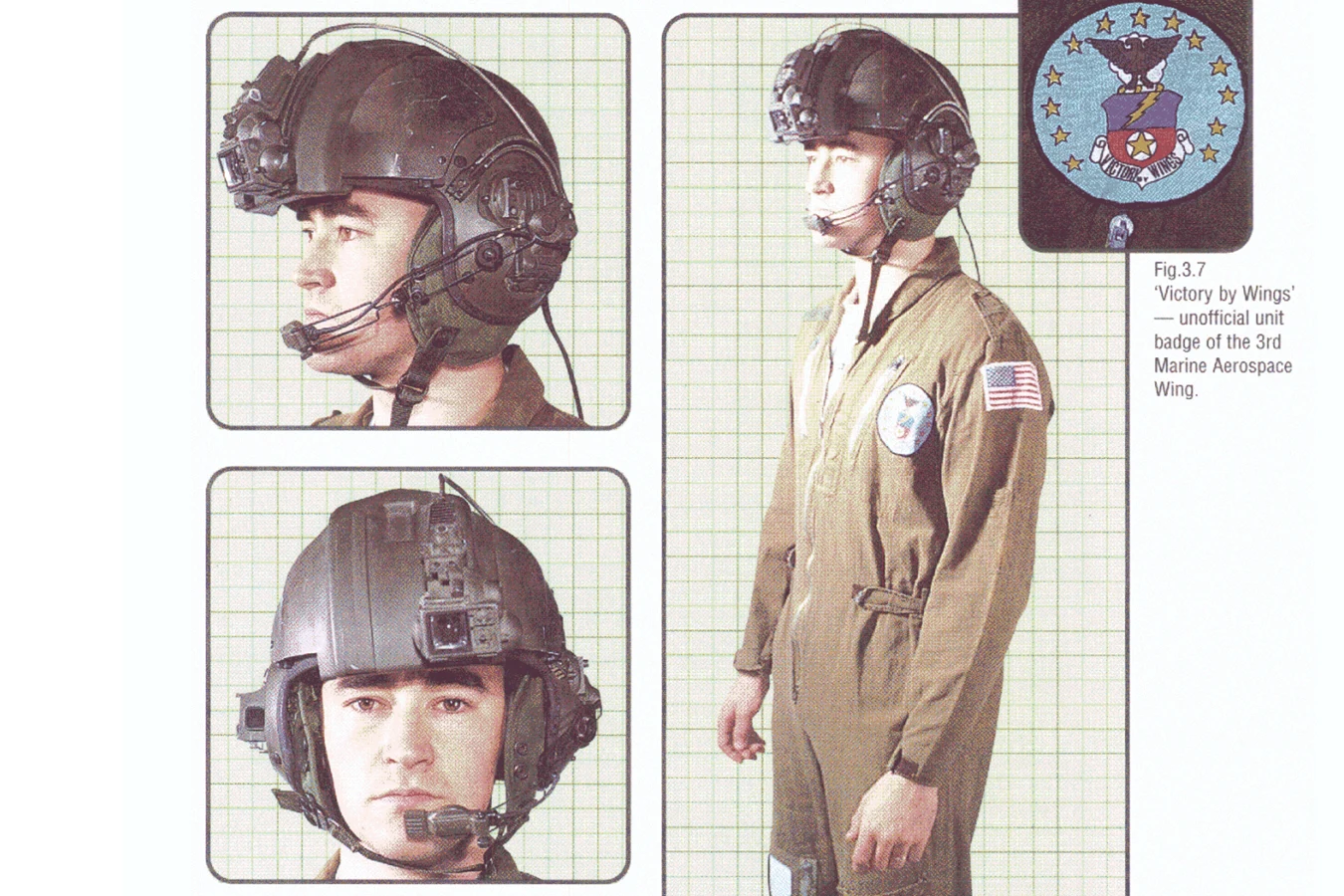
The Technical Manual's platoon TO&E is blunt: each section's UD-4 dropship crew includes a Pilot and a Warrant Officer. Elsewhere the same book quotes Marine aviators at Warrant Officer grade by name, so the W/O mark is not a one-off typo.
Fireteam Elite then prints the full modern ladder: WO1, then Chief Warrant Officers CWO2 through CWO5. The Operations Manual almost never builds a PC career around those five grades. It uses warrant-equivalent status for platoon adjutants, especially service synthetics, and lists Pilot as a billet officers can also hold.
Aliens refuses to match any of that cleanly. Corporal Ferro and Private Spunkmeyer flew the Sulaco's Cheyenne, which is funny next to a Tech Manual that wants warrants in the cockpit and an Operations Manual that also lets Lieutenants and Captains log pilot time. If you are reconciling sources, the safest reading is that dropship aviation can be warrant, commissioned, or (on camera) oddly junior enlisted, depending on which book or film is open.
Company Officers
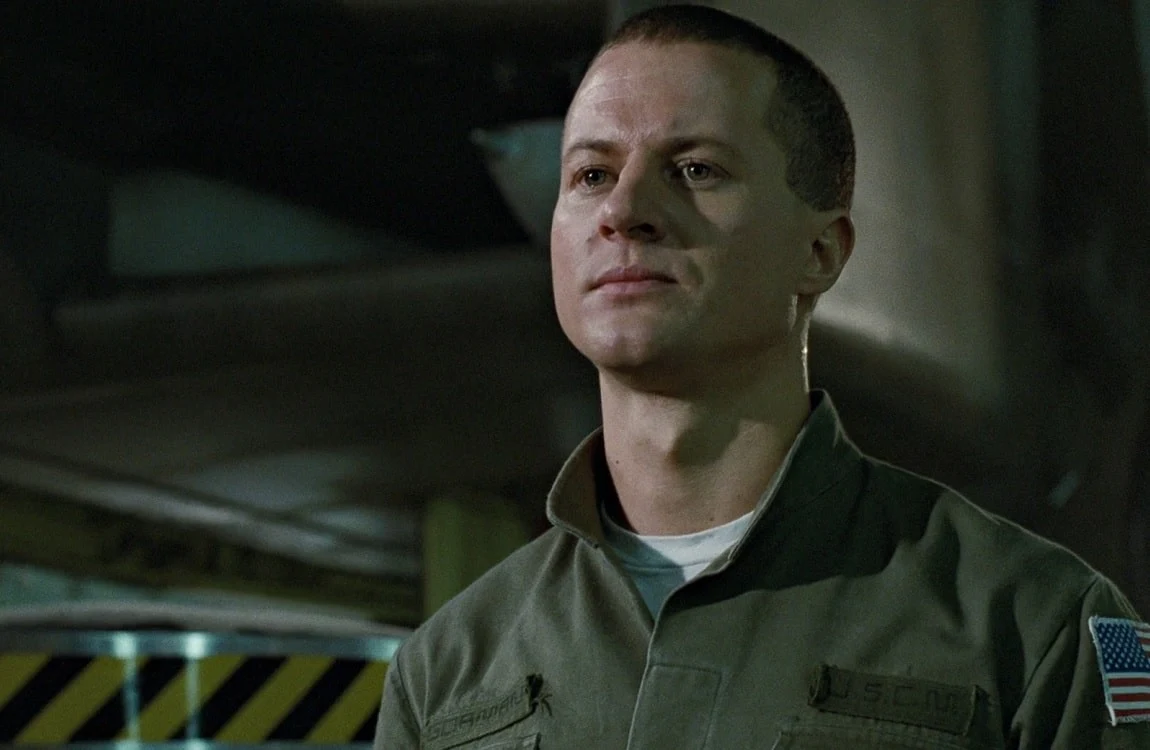
Second Lieutenant and First Lieutenant are O-1 and O-2. Captain is O-3. The Technical Manual puts a Lieutenant over two sections as rifle-platoon commander.
The Operations Manual allows Lieutenant or Captain in that seat, assisted by a junior officer or a synthetic adjutant, and lists both Lieutenant grades plus Captain as possible pilots as well as ground commanders. Company command in the Making Marines table sits with Captain. Rifle companies in the 33rd MAU sample are 86 Marines under a Captain with a Lieutenant as XO and a Gunnery Sergeant in the headquarters element.
Lieutenant Scott Gorman is the company-grade case everyone remembers: little combat time, locked to the APC's marine monitors, and still the commissioned commander while Apone and Hicks ran the ground fight. Leading Edge uses him as the Staff College example, an academy Lieutenant pushed into the field before a normal Tour hardened him. Expanded lore also suggests Burke wanted an inexperienced officer he could work around.
Other stories fill the same grades with harder veterans. Captain Jeremy Cruz ran the Sephora rescue of the Sulaco seventeen weeks after Aliens and died crashing a damaged dropship and Queen into LV-426 so his people could escape. Captain Paget held her troops together on Tartarus. Captain Glass fought from the combat ship Brilliant in Aliens vs. Predator: Duel. Company grade is where a green Lieutenant gets people killed, or a seasoned Captain spends a career trying not to.
Field Officers

Major (O-4), Lieutenant Colonel (O-5), and Colonel (O-6) sit above daily rifle-squad work. The Operations Manual's typical positions send Majors to staff jobs, Lieutenant Colonels to battalion or squadron command, and Colonels to Marine Assault Unit command.
The Operations Manual's sample 33rd MAU puts those billets on named officers: Lieutenant Colonel "Mac" Hanrahan on the battalion landing team, Lieutenant Colonel Eileen Morglas on dropship squadron DMLA-265, and Lieutenant Colonel "Bull" Griffin on the combat logistics battalion. The Technical Manual already treats Colonels and Lieutenant Colonels as the people who write doctrine and run units above the platoon diagrams.
In games and comics, field grades usually mean the senior Marine who owns the deployment, not a navy-style ship captain. Conestoga-class and similar troop ships run largely automated, so there is no separate "Captain of the ship" billet fighting the embarked Marine chain of command for who is in charge aboard. A Marine Captain is company grade. A Colonel still means the ground / expedition commander. Colonel Olivia Shipp was that senior officer for the UAS Endeavor during the 2202 LV-895 campaign, with the 33rd Marine Regiment / 11th Marine Division effort under her.
Major Van Zandt led marines off the Marlow onto BG-386 and died asking Private Rookie for a mercy kill after infection. Major McCain ran the Verloc mission to LV-1201 as a scarred veteran, the opposite of Gorman's green Lieutenant. Major Lee survived the Alien-Earth War storyline in Aliens: Genocide. In the arcade games, Major Dutch Schaefer kept that grade even after the series rebuilt him as a cyborg.
Generals
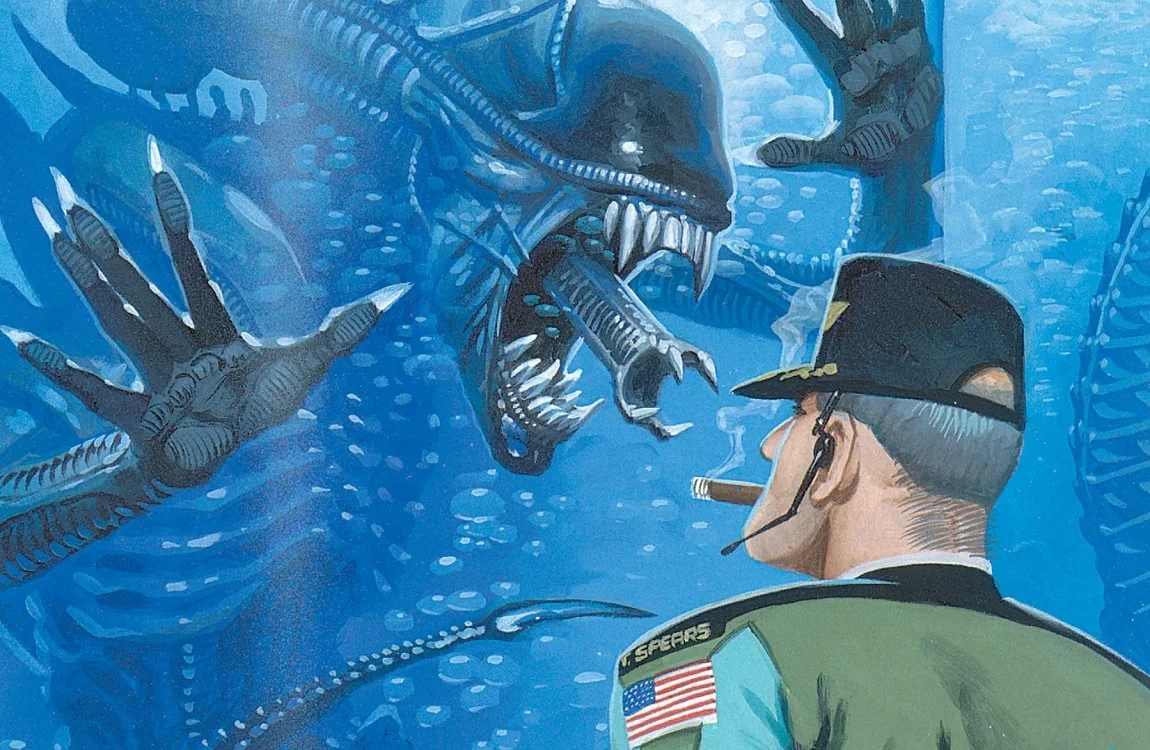
Fireteam Elite and the Operations Manual both climb Brigadier General, Major General, Lieutenant General, and General as O-7 through O-10. The Operations Manual's billets put Brigadier and Major Generals over brigades or divisions, Lieutenant Generals in high staff work, and Generals as senior general-grade officers.
The Technical Manual already writes in that register: Maj. Gen. Gayle B. Hancock at Officers Candidate School, Quantico, Brigadier General Mike Norrbom speaking for the 2nd Marine Brigade, and Brigadier General Teresa Jayes in later unit notes. Those names exist to sound like a real service with a flag bench, not to star in hive-clearing scenes.
Named story generals show up less often. By 2207 Olivia Shipp held general's rank on the Endeavor during the LV-558 campaign, after years as the ship's colonel. General Thomas Spears in Aliens: Nightmare Asylum turned a research facility into a personal Xenomorph project and fought Sergeant Wilks and Billie with enough authority to ignore ordinary chain-of-command brakes. General Bush in the Aliens vs. Predator arcade games played a similar role, fighting Predators and a robotic Dutch with a pistol and too much pull for anyone below him to stop. Stories rarely care whether that is Brigadier General or full General. They care that the character can order whole units into the mess.
Androids And Rank
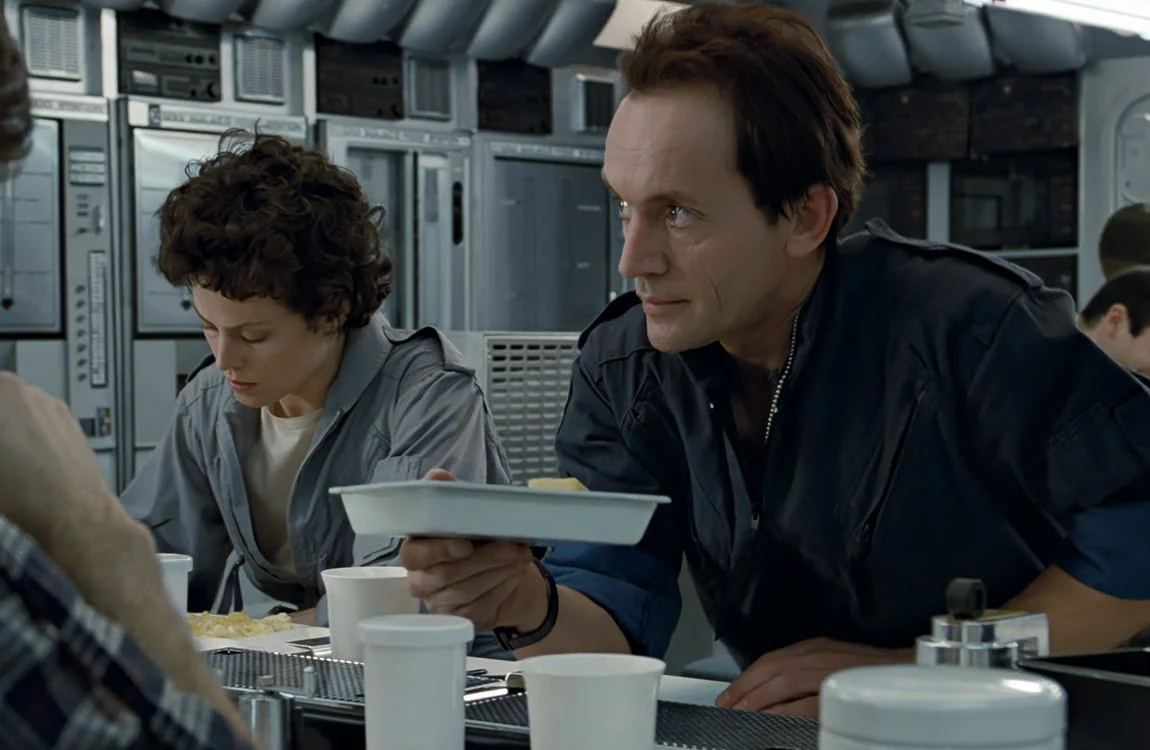
The Technical Manual does not hide the synthetic. It draws an Android beside the Platoon Commander, then explains why in its combat-support chapter. Marine androids deploy with line units as multi-role team members and mobile databases: drivers, pilots, medics, scientific advisers at platoon level and above.
Geneva Convention rules block weapons and uninhibited combat programming. Legally they are Corps property and can be ordered into hazards in place of humans, though unit cost and usefulness make that a stupid habit for any commander who wants the database to still work tomorrow.
The book also explains the human face: soldiers do not work well with inhuman-looking machines, so Marine synthetics are built to look like mature average adults, usually around forty, with passive, non-threatening personalities. Some studies inside the Manual even argue they stabilize small-unit dynamics as a neutral or parental presence. Grunts in the same chapter still mutter about company-built robots and watch their platoon synth like a hawk. Both attitudes are canon.
Bishop, Hyperdyne Systems 341-B, is the screen proof: Sulaco executive officer and science officer, knife trick in the mess, conduit crawl under the colony, torn apart by the Queen and still helping Ripley and Newt out. The Operations Manual updates the same billet as Command Adjutant or Android, sometimes with non-combatant rank equivalent to Warrant Officer.
Its sample synthetic Roy, a Hyperdyne 341-R assigned to 2nd Platoon, Kilo Company, advises Lieutenant Casados while Staff Sergeant Szymborska distrusts the machine. Count the android in the command team. Do not invent a Private stripe for it.
Rank In The Field
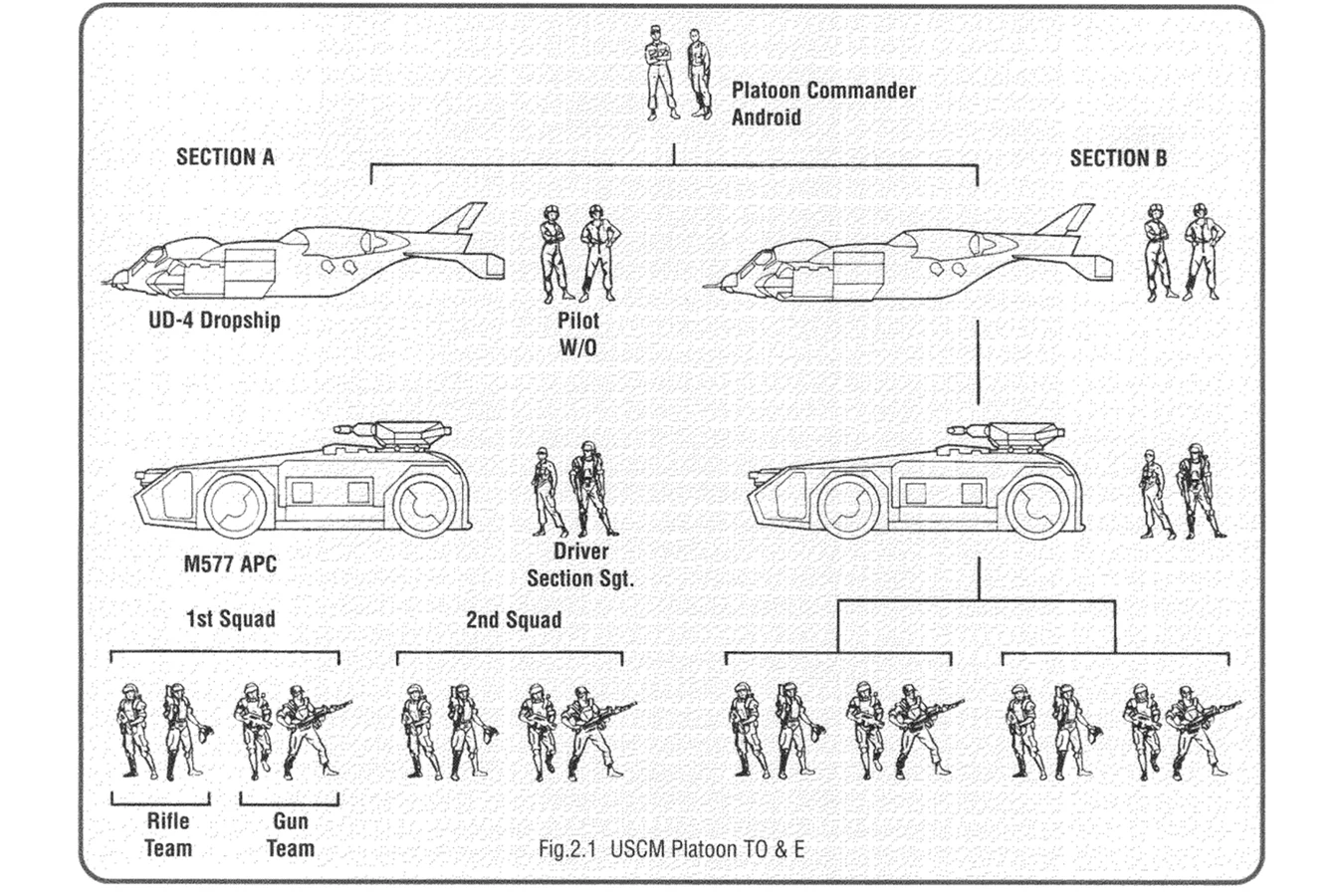
Stack the manuals and the numbers already disagree before anyone fires a pulse round. Technical Manual paper strength for a rifle platoon is about 25 Marines including APC and dropship crews, often less in practice, plus one or two synthetics for technical or scientific support. The Operations Manual's platoon is 24 Marines in two sections of twelve, plus commander and adjutant.
Both still describe the same silhouette: command team over two sections, each section with dropship, APC, and two squads, and Rifle and Gun teams inside the squads.
The Tech Manual also loads that platoon with organic support the films rarely have time to show: M240 flamethrowers, UA-571 sentry guns, M78 PIG phased-plasma guns or M5 RPGs, M83 SADAR rockets, an M402 mortar, and sensor gear for a thousand-meter detection frontage. Ranks exist to aim that package.
Platoon Commander and Android at the top. Section Sergeants and drivers in the APCs. Warrant Officers and pilots in the UD-4s. Corporals on the four-man bricks.
Colonial Marine teams in films and games cut that template down whenever the plot needs a smaller drop. LV-426 is the stress test everyone knows: Gorman on the biometric monitors, Apone on the sweep, Hicks inheriting survivors, Bishop still wired into command after human authority failed. The uniforms kept their ranks. The working net moved to whoever could still give an order worth following.
Aliens: Colonial Marines Progression
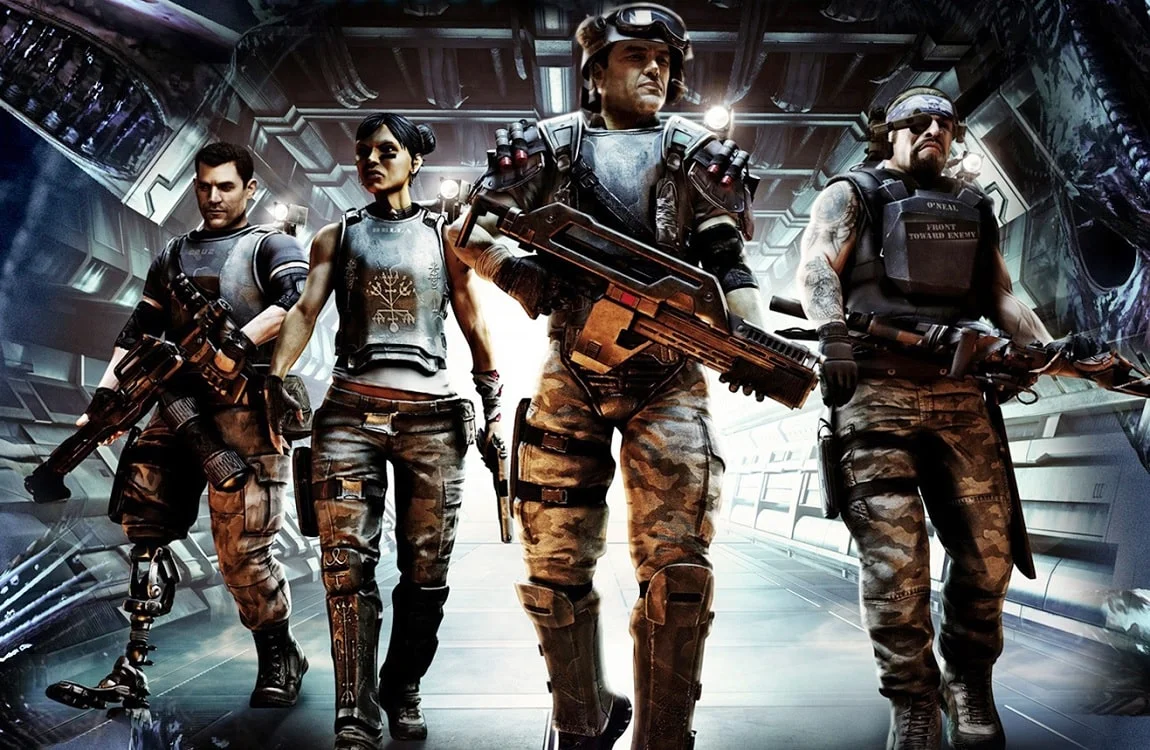
Aliens: Colonial Marines (2013) runs two different ideas of "rank" at once. In the story, the USS Sephora marines of the 118th Battalion wear ordinary lore grades: Captain Jeremy Cruz in command, playable Corporal Christopher Winter, squadmates like Private Peter O'Neal, and later a rescued Corporal Hicks. That battalion shipped roughly 400 soldiers to the Sulaco / LV-426 mess under the motto "Oorah to Ashes," and most of them died to Xenomorphs or Weyland-Yutani troops.
Separately, the game tracks player progression as Marine and Xenomorph ranks up to 60 each. XP comes from kills, challenges, and collectibles across campaign and multiplayer. Ranking up as a Marine unlocks weapons and spends Commendations on attachments, sights, and other loadout upgrades usable in both modes. Ranking up as a Xenomorph unlocks multiplayer abilities and loadout options instead. Those ladders are gameplay progression, not another Private-to-General USCM chart like Fireteam Elite's hangar poster.
That split is why the 2013 game is easy to mis-cite in rank debates, and why it should not be treated as a clean grade chart in the first place. Aliens: Colonial Marines is widely known for its inaccuracy: broken presentation of the franchise look, contested lore moves such as the Hicks retcon, and gameplay that never matched the marketing demos. Winter never becomes a Captain because you hit Rank 60. He stays a Corporal while your account unlocks pulse-rifle optics and challenge cosmetics. Cruz still dies as a Captain crashing a damaged dropship and Queen into LV-426 so the survivors can escape. Refer to the Sephora roster for ordinary enlisted and company-officer titles if you must. Leave the Rank 60 track in the shooter layer, not in the USCM paperwork.
Aliens: Infestation Ranks
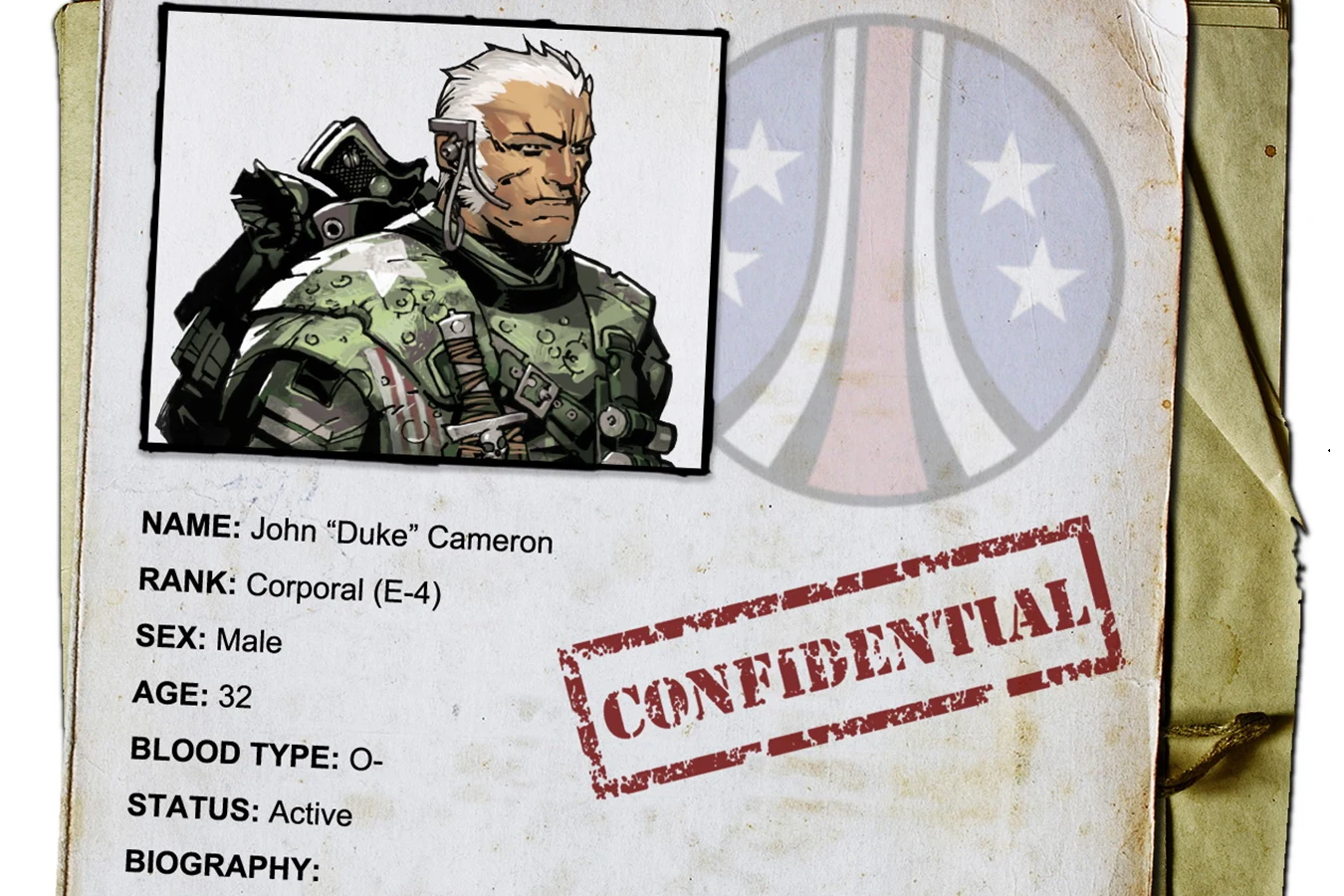
Aliens: Infestation (2011) sits on the other Sephora / Sulaco branch, eighteen weeks after Aliens, and keeps ranks as character labels rather than an XP ladder. Lieutenant Colonel Patrick "Stainless" Steele runs the boarding from a Cheyenne as mission control while Fire Team Fox rotates through a pool of about twenty uniquely written marines. The starting squad on the ground is Corporal John "Duke" Cameron, Lance Corporal Samantha "Homewrecker" Johnston, Private First Class Brock "Bear" Paulson, and green Private Buddy "Brando" Whistler. Recruits found later stretch that roster from more Privates and PFCs up through Sergeants and Staff Sergeant Jasper "Iron Sights" Watson, plus a rare named Marine warrant: Chief Warrant Officer Friedric "Rook" Marcus. Grades do not unlock loadouts or classes. A dead marine stays dead, and the replacement keeps whatever title the dossier already printed.
Aliens: Dark Descent Progression
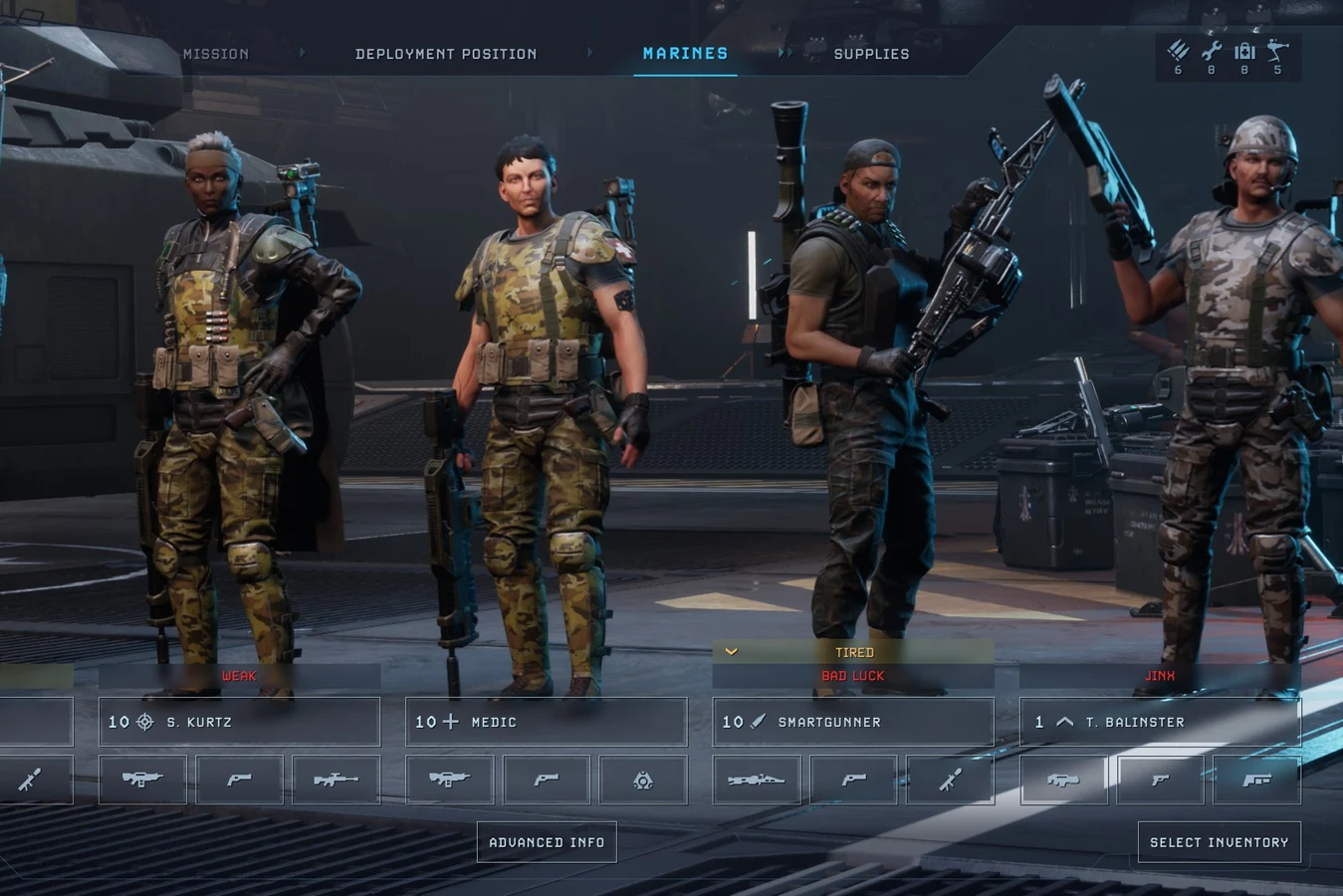
Aliens: Dark Descent (2023) does the same split with a different mechanic. On Lethe in 2198, Sergeant Jonas Harper and the stranded USS Otago marines still wear ordinary lore titles in the story while Maeko Hayes runs intelligence from the crash site. In the barracks, every recruit climbs a personal level track to a hard cap of 10. XP from deployments, and later Training Room drills, unlocks Common Attributes and upgrade slots along the way. At level 3 you specialize into one of five classes offered from a random pair: Gunner, Recon, Tecker, Medic, or Sergeant. Levels 6 and 10 add further Class Attributes on that path. Here Sergeant is a combat role, the squad's frontline leader for bravery and command points, not a step on the Private-to-General UACM chart. Harper stays a Sergeant in the narrative while your roster "promotes" into Smartgun Gunners and stress-managing Sergeants for the next hive push.
How Does It All Fit Together?
Part of why the sources refuse to line up is simple: they were written for different moments in the timeline. Leading Edge and the Technical Manual sit with Aliens around 2179, still under the USCM name. The Operations Manual is a mid-2180s Marine book, after Alien 3 but before the 2187 rename. Dark Descent's Otago campaign is 2198, already UACM. Fireteam Elite's UACM poster is a 2202 document from the Endeavor era. Expect the paperwork, acronyms, and even some billets to drift when the books are decades apart in-universe.
If you force one working picture anyway, it looks like this. The modern Corps uses a USMC-shaped ladder: Privates and PFCs in the fireteams, Lance Corporals and Corporals on the four-man bricks, Sergeants on the sections, Staff and Gunnery Sergeants above them, warrants and pilots on the dropships, Lieutenants and Captains on the platoon or company, field grades on battalions and MAUs, generals somewhere that does not smell like a hive.
An android sits with the command team as adviser, medic, driver, or pilot, not as a commissioned Marine. That is the Technical Manual's TO&E plus the Operations Manual billet table, with Fireteam Elite supplying the missing pay grades and the dual E-8 / E-9 tracks.
The mismatches come from those other books and games keeping their own rules. Leading Edge's licensed 1991 ladder is an official alternate view: it cuts out half the modern enlisted grades, invents Tech Sergeant, stops officers at Commander, and names Gorman as the Staff College graduate with too little field time. Aliens keeps Ferro and Spunkmeyer oddly junior in the cockpit and lets Hicks inherit a platoon without paperwork. The Operations Manual tells the game table that rank is a title once the mission starts. Fireteam Elite uses the post-2187 UACM name and finally prints W-1 through W-5. Gearbox's 2013 shooter adds yet another layer: lore grades on the Sephora roster, plus those Rank 60 XP ladders that only unlock guns and traits.
So the fit is practical, not perfect. Refer to Fireteam for the full modern grade list. Refer to the Tech Manual when you need to know who rides the APC, who flies the UD-4, and where the synthetic stands. Refer to the Operations Manual when you need typical jobs or a squad that ignores the Lieutenant. Refer to Leading Edge when you want that early official alternate ladder, Tech Sergeant / Commander titles, or the earliest RPG take on green Lieutenants like Gorman. Refer to the films and character-driven games for what happens after the radio dies. If two sources disagree on a cockpit grade or a platoon headcount, they probably both remain "true" inside their own book.
Conclusion
Colonial Marine ranks stay readable because they stay close to a real Marine ladder, and stay messy because no single book owns the Corps. Leading Edge printed the first licensed RPG promotion table, complete with Tech Sergeant and Commander. Fireteam Elite printed the fullest modern pay grades and the dual staff-NCO tracks under the later UACM name.
The Technical Manual lays out the rifle platoon: who rides the APC, which Warrant Officer flies the UD-4, and where the android stands beside the Lieutenant. The Operations Manual ties modern titles to those jobs, then tells player squads they can ignore the chain of command once the mission starts. On LV-426, a Lieutenant, a Sergeant, a Corporal, and a synthetic showed what those grades mean after the radio dies. Keep the chart that matches the source in your hand, and remember that field command can move without a new stripe on anyone's sleeve.
Sources
Main books and games that supply the grade charts, billets, and progression systems above.
Film
- Aliens (1986)
Books And RPGs
- ALIENS Adventure Game (Leading Edge Games, 1991)
- Aliens Colonial Marines Technical Manual (1995)
- Colonial Marines Operations Manual (Free League, Alien RPG)
- Alien: The Weyland-Yutani Report (Apone's Master Sergeant grade)
Games
- Aliens: Fireteam Elite (2021)
- Aliens: Infestation (2011)
- Aliens: Colonial Marines (2013)
- Aliens: Dark Descent (2023)
FAQ: Colonial Marine Ranks
Quick answers about USCM and UACM ranks, pay grades, warrants, androids, and how authority works in the field.
What is the lowest Colonial Marine rank?
The lowest enlisted grade on the Fireteam Elite chart is Private (E-1). The Technical Manual's rifle squad usually fills its junior slots with Privates or Privates First Class under a Lance Corporal and Corporal.
What is the highest Colonial Marine rank?
General (O-10) tops the Fireteam Elite UACM chart and the Colonial Marines Operations Manual officer table. Stories almost never need the fine steps between Brigadier General and General. They need a named flag officer with theater authority.
What is the difference between USCM, USCMC, and UACM?
Aliens, Leading Edge, and the Technical Manual use USCM / USCMC. After the Colonial Protection Act in 2187, the service was renamed the United Americas Colonial Marines (UACM). Fireteam Elite's 2202 poster uses that later name.
Is Sergeant Major higher than Master Gunnery Sergeant?
On the Fireteam chart both are E-9. First Sergeant and Sergeant Major sit on the command track. Master Sergeant and Master Gunnery Sergeant sit on the technical track. Same pay grade, different career path.
Do Colonial Marine warrants appear outside Fireteam Elite?
Yes. The Technical Manual puts a Warrant Officer in each section's UD-4 dropship crew on the rifle-platoon TO&E, and names Marine aviators at Warrant Officer grade elsewhere in the book. Fireteam Elite expands that into W-1 through W-5. Aliens: Infestation even fields a playable Chief Warrant Officer (Friedric "Rook" Marcus). Aliens still shows Ferro and Spunkmeyer flying at Corporal and Private.
Do Colonial Marine androids hold rank?
Not a human commission. The Technical Manual seats an android beside the platoon commander and classifies Marine synthetics as non-combatant Corps property: advisers, medics, drivers, and pilots. The Operations Manual sometimes labels a command adjutant synthetic with warrant-equivalent status.
Why did Master Sergeant Apone seem to run the LV-426 drop?
Lieutenant Gorman held formal platoon command from the APC TAC station. Apone was the senior staff NCO on the sweep, listed as M/SGT on the Sulaco readout even though everyone still called him Sergeant. When Gorman froze and later went down, Corporal Hicks took working command of whoever was left.
Does rank always mean command authority?
In the films and Tech Manual, yes on paper. In Free League's Colonial Marines Operations Manual, rank is often just a title tied to MOS and billet. Once the mission is underway, the player squad decides what it does.
Did Aliens: Colonial Marines have a rank system?
Two different things. Campaign characters use ordinary lore grades (Corporal Winter, Captain Cruz, Private O'Neal). Separately, the 2013 game tracked Marine and Xenomorph player progression up to rank 60 each for XP unlocks, which is a loadout ladder, not a USCM grade chart like Fireteam Elite's poster.
Does Aliens: Dark Descent use Colonial Marine ranks?
In the story, yes: Sergeant Jonas Harper and the USS Otago roster wear ordinary titles. In the barracks, marines level from recruit training up to a hard cap of 10, pick a class at level 3 (Gunner, Recon, Tecker, Medic, or Sergeant), and gain more class attributes at levels 6 and 10. That Sergeant class is a squad specialization, not another rung on the Private-to-General chart.
Why does the old Aliens RPG list Tech Sergeant and Commander?
The licensed 1991 Leading Edge ALIENS Adventure Game uses its own shorter promotion ladder: Private through Master Sergeant on one side, Lieutenant through Commander on the other. It has no PFC, Lance Corporal, Gunnery Sergeant, warrant track, or general grades. The later Operations Manual and Fireteam Elite do not keep Tech Sergeant or Commander as standard USCM titles.
Tag Categories: Colonial Marine Lore | Alien Lore