Aliens Adventure Game: 1991 Leading Edge RPG

Aliens Adventure Game is a 1991 roleplaying book from Leading Edge Games of Pasadena, built for the year of Aliens. Barry Nakazono did the primary design, David McKenzie wrote and designed with him, Toni Dennis handled illustration and graphic design, and Irene Kinzek edited and produced it. The paperback gives a full strike-team campaign: character careers, a corporate star map, equipment and ships, and a second Colonial Marine mission to Hadley's Hope after the film.
Book Overview
Leading Edge laid the book out in eight chapters, each split into numbered sections, with the main tables repeated and numbered at the back. Play needs at least three six-sided dice and a ten-sided die, read twice to make a number from 00 to 99. Fox licensed the film art, story, and characters for 1986 and 1991. Leading Edge held the copyright on the rules and game design, and printed the book from Box 70669, Pasadena, California 91117. The cover carries product code 20200.
The opening is a classified set of orders for Strike Team V3-106-1C2, a reconnaissance of the atmosphere processor at Hadley's Hope on LV-426, called Acheron. An earlier strike team took heavy losses and is under ICC quarantine, and High Command has locked the files. Weyland-Yutani will not explain the first mission. The new team is told to find out what happened to that team and to the colony, to reduce the threat, and not to shoot first at corporate troops who may be on the planet. The orders also warn that another corporation may be on the planet, and that a xenomorph may be present even though the old surveys listed no native life.
The rules are a shortened form of Leading Edge's Phoenix Command combat system, the same family as the company's Living Steel game. Chapter 8 prints conversion notes so those players can use the weapon and creature tables. Chapter 8 also points the gamemaster at Leading Edge's earlier ALIENS board game and its expansion, whose colony maps can stand in for rooms at Hadley's Hope. The Alien biology is written for this game, and the text says it does not have to match other Alien products or later films.
Characters And Ranks
A character starts at 18 and spends a year in basic training, then rolls years of active duty. A tour lasts six years. Primary scores are Strength, Intelligence, Will, Health, and Agility, either rolled or built from a point total. A Strength of 10 deadlifts about 200 pounds. Strength 18 deadlifts about 400. Secondary scores are Charisma, Leadership, Motivation, and Perception, on the same 3 to 18 scale. Skill ratings run Unskilled, Novice, Certified, Professional, Expert, Master, and Grand Master. One successful learning roll advances a skill through Professional. Expert takes two successes in a row, Master takes three, and Grand Master takes four.
Line infantry and auxiliaries enter as Private. Officers enter as Lieutenant. The promotion ladder is the one later charted with the Colonial Marine ranks: Corporal, Sergeant, Staff Sergeant, Tech Sergeant, and Master Sergeant on the enlisted side, and Captain through Commander for officers. There is no PFC, lance corporal, gunnery sergeant, or general grade. Gorman is the example of a Staff College lieutenant sent into the field before a full tour. Merit Points, earned when a learning roll succeeds, are what make a promotion possible. A Marine near the end of a six-year tour can retire into civilian work.
Basic training lasts four months and hands out Novice or Certified ratings in the skills marked for that branch. Specialist training takes another eight months for people who meet the characteristic and merit requirements. Close-combat and machine-gun specialists are the ones who train for a fight all year. Most Marines spend the year servicing equipment and keeping facilities running, then get one free learning chance on an extra skill. Garrison infantry who never make the line can be moved into a line slot at the end of generation so they can serve with the other players. Pre-generated Marines from the film, and a second set of Colonial Marine characters, are printed in chapter 8 so a table can start without rolling a career.
History And The ICC
The setting starts in the late twentieth century, when multinational corporations outgrew the nations that hosted them. Open war between rich states became too expensive, so those states fought through poorer countries instead. Two drives then opened space. The reactionless Displacement Drive made travel inside the Solar System cheap. The Jump Drive, built on the same idea, carried ships to other stars. Raw metal was a secondary goal, because the Solar System held enough of it. The stated aims were habitable planets, new knowledge, and life forms whose chemistry Earth laboratories could not match.
Five Earth-like worlds had been found by the time of the game, plus dozens of worlds that people could live on with help. Terraforming was underway on others. Colonies shipped unusual life, minerals, local goods, and, after a generation, trained workers back toward Earth. Corporate schools on the colonies produced trained workers, while Earth produced fewer of them. Each major corporation also maintained a small, well-equipped military, staffed in part by former Colonial Marines.
Nations and corporations then slid into a five-year stretch of limited wars. Few nuclear or biological weapons were used. Out of that fighting came the Interstellar Commerce Commission, a joint body of companies and nations, and the Colonial Marine Corps as its armed arm. The colonies had backed the corporations in the hope of independence. The ICC treated them as company property instead. Several colonies rebelled. The Corps, with corporate troops beside it, put them down one by one, because the ICC could replace losses and the colonies could not. Underground groups remained on most colonies. The only open holdout was Alexandria, screened by systems the ICC had not committed the forces to take.
Strike Teams And Missions
A standard strike team is a junior officer, two auxiliaries, eight to ten line infantry, and a synthetic. A company representative often rides along when the team is protecting that company's interests. The infantry stay together. Officers and auxiliaries change from mission to mission as corporate influence inside the Corps grows. The film's section is the model team, with full statistics in chapter 8.
By the game's present, the Corps is falling behind the companies that fund it. Weapons are not upgraded, ships face newer corporate designs, and losses from the colonial rebellions have not been replaced. Losing one strike team can leave a region unpatrolled for months or years. Peacekeeping work covers drug traffic, illegal nuclear and chemical weapons, smuggled life forms and technology, and riots. Old national loyalties and new corporate money both run through the same High Command, so a team can be sent against a target that is a rival of whoever paid for the order.
Each year of play the team draws an assignment: patrol, peacekeeping, contraband, a named colony, a named corporation, Tartarus, or hazardous exploration. A second table then picks the mission, from tactical assault and rear guard through bug hunt, colonial revolt, hostage rescue, and renegade military. A realistic year leaves the team idle about two thirds of the time. The book also lets the gamemaster ignore that and keep them in action. Bug Hunts are listed as routine against most xenomorphs, because few species can stand up to a strike team's guns. The Aliens are the exception, and they can inflict heavy casualties on a strike team.
Marine pay is calculated from skill ratings. One credit a month for each Novice skill, ten for Certified, a hundred for Professional, and a thousand for Expert or higher. Hudson in the book has one Professional skill, eight Certified, and eight Novice, so he draws 188 credits a month on top of room, board, and ordinary ammunition. A low-paid civilian service post pays about 1,000 credits a month, and a trained professional more than 2,500, but civilians pay for housing, food, and company services. Frontier prices triple on ordinary colonies and quadruple on terraforming and mining worlds. Passenger travel costs 700 credits per jump unit on a typical liner.
Mercenaries
Players who leave the Corps have two military paths. Corporate Retainers are outside a company's regular army, usually former colonials trained at home and then leased to a firm that will not trust them in any unit larger than a strike team. Their ordinary months pay like idle Marines. A combat month pays about twice a mercenary salary, and more if the mission is especially dangerous. Free Strikers are the leaders who refuse to join the company that beat their own. The winner lets them take some equipment and leave. They do not own spacecraft, so off-world work only comes if the employer hauls them both ways. Some bands become local warlords. Others are dropped at the site and never collected.
Contracts cover equipment, medical care, and transport, then deduct damaged company property. A team can finish a mission owing its employer, and the debt is worked off on a worse follow-up contract. Dropships supplied to mercenaries will leave them on the ground rather than land under fire. Illegal work is hired through Safe Houses, which hide the employer's name and pay promptly. If a Marine team is captured by a company fighting in the open, they are sent home after the crisis, because the companies need the Corps. Captured mercenaries can be ransomed, released, jailed, or killed, depending on whether they remain a threat.
The Star Map
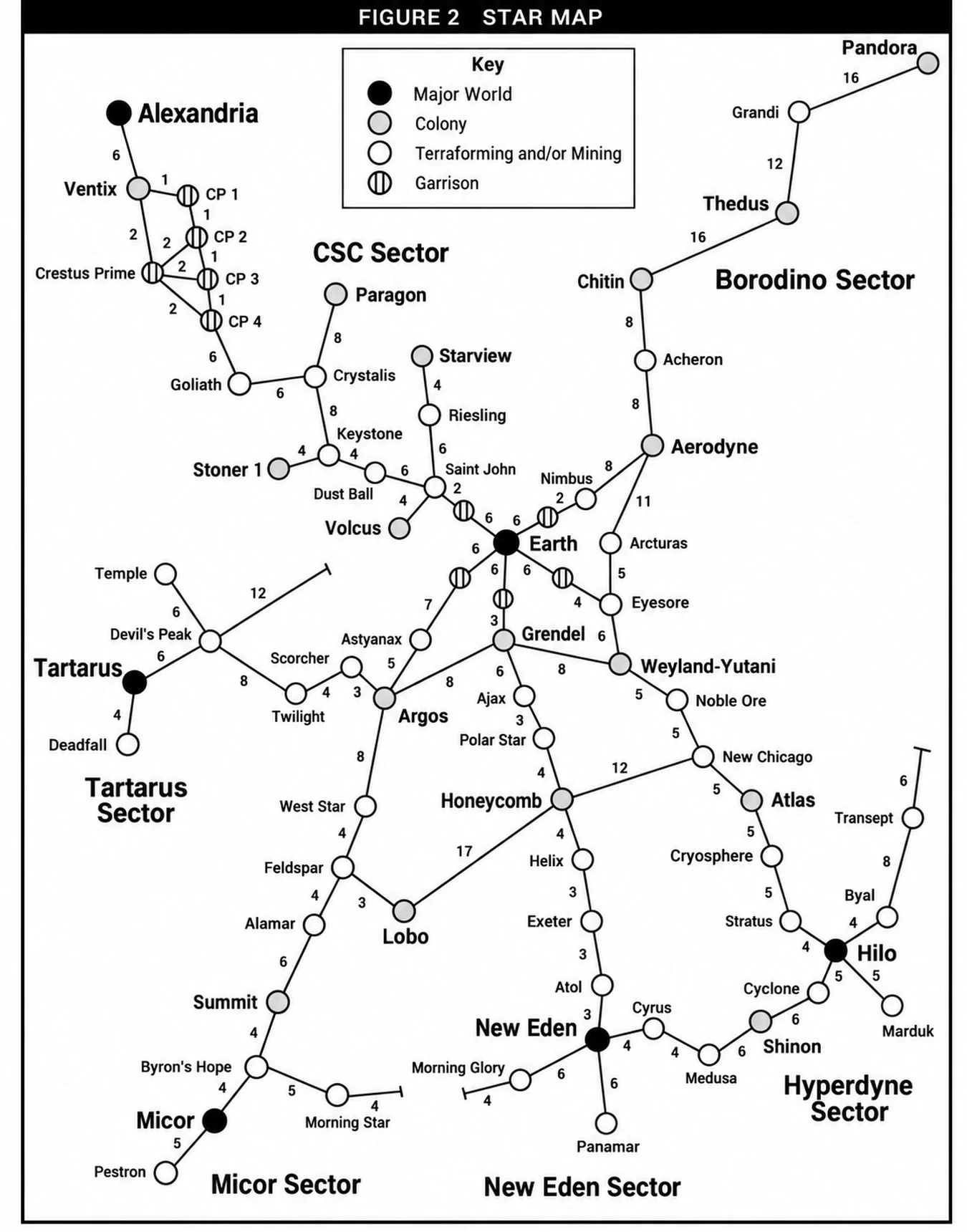
Earth held nearly 10 billion people. The nations were fading, and the corporations administered the colonies while large regions of Earth had no working government. The rich keep private armies. Billions live on subsidies or by preying on one another. Five major worlds, Alexandria, Hilo, Micor, New Eden, and Tartarus, carried populations from 2 million to 50 million, with high-tech industry and near self-sufficiency. Ordinary colonies ran from 30,000 people on Starview to 25 million on Aerodyne, and each had a spacecraft service base plus some manufacturing.
Terraforming and mining worlds are smaller, with little industry. Mining in this book includes harvesting unusual life as well as ore. Garrison systems have no inhabited planet, only deep-space sensors, system-defense frigates, and sometimes a secret laboratory, weapons range, or prison. Empty jump systems between the named worlds let even a Jump 1 ship cross the map, with a station near each entry point. Distances on the star map are counted in jumps of 5 light years. A 16 on the line from Chitin to Aerodyne means sixteen jumps for a Jump 1 ship and four for a Jump 4 ship. Coordinates for systems found before the ICC are public. Systems found later are company property, and their coordinates are secret.
CSC Sector
The Central Space Consortium opened the sector that runs up and left from Earth on the map, and then lost its best world when Alexandria seceded. Saint John, the consortium's first terraforming site, was abandoned after decades in toxic air and sulphur bogs. One atmosphere processor is being stripped, and leased research stations there study how life starts and changes. Rumors in the text say the rents on those stations paid for later work at Summit, Stoner 1, and Paragon. Volcus is a volcanic planet whose magma powers automated stations. Those stations beam energy to a space station and then to a domed colony of 200,000 on the major moon.
Starview is CSC's intended replacement for Alexandria, with 30,000 people under a particle cloud that leaves the surface in twilight. Filter masks make the air breathable, and full terraforming is expected to take another half century because the consortium is overextended. Dust Ball is a crater-mining moon whose impact minerals go into microcircuitry. Keystone fell from a peak of 500,000 people to 20,000 because unstable asteroids make terraforming pointless. The mid-size firm Antioch is studying whether it can buy the system and clear the debris. Stoner 1 keeps a living cavern of more than 10,000 square miles inside Stoner Mountain, behind airlocks, while the surface air is toxic. CSC builds much of its light manufacturing there.
Paragon has finished terraforming into a cold, windy world whose cities are underground. CSC runs it as a police state and is moving its headquarters and critical manufacturing there so another Alexandria cannot happen. Goliath is the blockade base facing the rebels: thin air, a population near 1 million, about 10,000 Colonial Marines, and patrols three jumps in each direction. The Crestus garrison worlds, Alpha through Delta, are orbital bases only. Crestus Prime, known only to senior Alexandrian officers, holds 30,000 military personnel and the cargo ships that recover damaged frigates. Ventix, closer to Alexandria, is an underground military colony of five bases, about 50,000 people each, linked by monorail.
Alexandria itself has about 30 million people, a hot dry climate, polar water, and industry on a par with a late twentieth-century nation, plus a government-owned space industry that is nearly self-sufficient. Only certain Displacement and Jump Drive parts have to be smuggled in. Citizens from 18 to 22 owe four years of military or public service, most of it technical work and terraforming, with a smaller number assigned to the armed forces. The ICC answer is sanctions and a blockade from Goliath, rather than an invasion. Smuggling through Crestus Prime and Goliath is a major industry.
Borodino Sector
Borodino was opened by a company that went bankrupt generations ago. Mid-size firms have been exploring it since, because no single corporation holds the sector. Two of its worlds are Pandora and LV-426. Nimbus is a gas giant with a Hyperdyne research station that drops probes into the atmosphere and recovers them. Aerodyne, formerly Chalmer 3, is a cold steppe world of 25 million and the company's headquarters. It builds spacecraft with Weyland-Yutani. Together with Hyperdyne they opened the Arcturus Loop, a trade route that skips Earth. Earth governments lost leverage, Colonial Marines were barred from the Loop, and drugs and restricted technology from Pandora moved along it.
Acheron is a harsh world in the middle of terraforming, rich in heavy metals, with the alien ship and its eggs. The colony's later state is in chapter 8. Chitin has a basalt crust and three excavated vaults holding 600,000 people. Aerodyne is moving older light industry there, and the local administration is looser than on the home world. Thedus is a small domed colony on the haul toward Pandora. Three communities were each built around a reactor that also fed an atmosphere processor. Power is short, the air is thin, the crime rate is high, and the settlement lives on ship repair.
Grandhi is a service moon of 15,000 people over the barren planet Sahara, more than four times Earth's size. Water, food, and air are mined or processed and carefully rationed. Pandora, at the edge of ICC space, has an unpleasant but breathable atmosphere, gravity near Earth's, and 4 million people crowded onto small landmasses while the rest of the world is ocean. Work there includes illegal genetics, biomechanics, and cybernetics, plus drugs made from native life. The drugs that have a market are smuggled inward, and the rest are used on Pandora. Arcturus, the one developed world on the Loop, holds about 25,000 people and the underground warrens of the Arcturians. Local leaders allow Marines only when a warren blocks expansion. Eyesore is an abandoned mine that can support about 400 people and handles crude repairs for ships on the Loop.
Hyperdyne Sector
Hyperdyne and Weyland-Yutani opened this sector together. Around the time the ICC formed, Hyperdyne sabotaged Weyland-Yutani exploration ships and took the lead, including the discovery of Earth-like Hilo. Weyland-Yutani later seized the world of Relitor and renamed it after itself, planting a tariff barrier on Hyperdyne's road to Earth. Hyperdyne answered with the Hilo to New Eden link and the long run from New Chicago to Honeycomb. The two firms have not fought in the open for years, and they share control of the Arcturus Loop. The world called Weyland-Yutani builds commercial spacecraft with Aerodyne and also builds the Corps' ships, and those contracts are its leverage on that Loop.
Hilo had climate and water and no native life, so Hyperdyne stocked it from Earth and other worlds. Six million people live there under the largest single corporate army in the ICC. A rebellion at the start of the colonial wars was crushed, the population was purged, and people who could not be convicted of capital crimes were sent to Shinon. Hyperdyne designs and builds most synthetics on Hilo. Its wealth is biotechnology first, with other industries in place so the company does not depend on anyone else. Shinon holds 480,000 people who cannot leave. Hyperdyne calls them free and trades critical supplies for light-industry output, but Shinon functions as a penal colony.
Secret sites fill the rest of the sector. Marduk is an orbital station rumored to test illegal synthetic programming. Byal works on biotechnology integration. Cyclone is an underground weapons and security laboratory of a few hundred people. Transept is the base camp for a hidden route Hyperdyne wants to cut through to Pandora, so it can steer that world's biotech work. New Chicago, an abandoned mining world, became a Hyperdyne fleet port of 30,000 civilians where almost any military hardware can be bought. Atlas is a radioactive asteroid with 12,000 people in three domes, sending shielded crews out for 90 days to mine hydrocarbons used in medicine and genetic engineering. Noble Ore is five titanium domes with almost no industry. Cryosphere is eight scientists in a distant orbit, and most ships pass the system without approaching the station. Stratus is a salvage camp on the ruins of a pre-ICC Hyperdyne garrison.
New Eden Sector
This was the first sector to yield an Earth-like world. The coalition that found it renamed itself New Eden/JV and used a structure like a small ICC, with an umbrella company, member firms that keep their own names, and votes based on wealth and growth. Employees can change firms inside the joint venture. Elsewhere in the ICC, leaving a company is difficult. New Eden had almost no native life, terraformed easily, and holds 200 million people. Other corporations treated the higher labor costs as poor management.
Grendel is more than 200,000 people in hundreds of small domes, and the center of a criminal network that Earth helped create by withholding Marines and destabilizing the government after Grendel let shippers bypass Earth. Drugs from Pandora move through it toward Micor. Ajax is almost empty after an atmosphere processor exploded, released radiation, and destroyed the colony. Thousands of lawsuits froze the world. A small station exists to walk inspectors and lawyers through the ruins. Honeycomb is 250,000 people in caverns on the New Chicago to Lobo route, leasing sealed corporate vaults the Corps is not allowed to enter. Illegal shipments have been traced as far as that maze, called the Labyrinth, and then lost. Most of the caverns have never been walked.
Helix auctions asteroid claims to crews who spend up to two years in the belts in ships of three to eight people. Contracts demand minimum production or the claim is forfeit, and smaller firms are expected to be sabotaged by larger ones. Exeter is two towns of about 20,000, losing its port business to Honeycomb. Atol is an acid-water world with no stable land, huge tides, and a station whose survey teams go down a few times a month. Polar Star is thirty scientists on a moon, more than ten years into a high-pressure synthesis contract for Micor, with a separate service base of 1,000 people and little contact between the two. Cyrus, Medusa, and Panamar are New Eden/JV terraforming steps on the road to Hilo. Panamar's thermogenic plankton, which builds hydrocarbons from heat rather than sunlight, is used in life-support gear. Morning Glory is the service base for a link toward Micor.
Micor Sector
The road from Earth to Micor stayed quiet through the colonial wars because its colonies were too weak to rebel. Rival companies from other sectors have since started moving in. Micor is the richest world in the ICC by how its inhabitants live: a terraformed Earth-like planet reserved for stockholders and retired national leaders who sold their countries' cooperation. The 800,000 people who run its industry live in a dome on the moon and work for a transfer down to the planet. Micor's universities on Earth recruit the students the company wants, lease them to smaller firms, and promise a house on Micor to the few who make a breakthrough. Rivals are feeding a drug trade into Micor and its moon to break that hold on trained scientists.
Lobo finished terraforming eight years before the game's present and has grown to 70,000 under a loose consortium called Tradex, based on Micor. Colonel Castel has turned the local police and troops into something like a personal army, tied to smugglers and to companies that want Tradex weakened. The ICC has refused to help the investigation. Argos is a dry colony of 100,000 on the road to Tartarus, prosperous on cargo and on a second economy of smugglers. Feldspar is a played-out mine turned into Micor's customs point, with space defenses run by Hyperdyne. West Star uses sixty people and remote robots to mine helium-3, the fusion fuel of the ICC, from the moons of a gas giant.
Astyanax is twenty people and a decades-long study of Brachous Slugs on a radioactive moon. After a security leak, owner Falcon Industries pulled its stock and hired troops. The slugs can repair damage to their own DNA, and Falcon wants that repair for human life. Summit was terraformed by 2,000 colonists from wealthy families after earlier owners left it undeveloped, and other corporations are moving in as the air becomes breathable. Byron's Hope is a cancelled Pindel Corporation project. A disaster there killed the head of the company and his senior advisers, and the new heads chose to spend the remaining money on Micor instead of finishing the world. Pestron has its first atmosphere processors in place. Morningstar is an exploration base whose funding Micor has cut, because a direct route to New Eden no longer suits Micor's rulers.
Tartarus And Other Life
Tartarus was found a generation before the game, habitable from the start, and owned by Biozone Alpha. Its day and night each last twenty years, because the planet's rotation is perpendicular to its orbit and the orbit takes forty years. Only one of three continents is in daylight and colonized. Settlements were built to migrate ahead of the dusk. As the first sites neared twilight, Harvesters came up from deep tunnels and began eating every organic thing, colonist included. A Harvester is over nine feet high and nearly twenty feet long, heavier than any land animal on Earth, armored like an armadillo, and guided mainly by sonar. Packs of several dozen fight each other for ground. A Carrier grows up to twelve Drones, boar-sized jaws that live only a few hours once they leave the Carrier and lock onto whatever they bite.
The Harvesters will finish the daylight continent within three years if they are not stopped. Some companies refuse to abandon communities that will see years of sun after that. No team has reached a Harvester cyst. Refugees have swollen Devil's Peak from about 10,000 people to 40,000. Biozone Alpha is out of ships and money, malnutrition and disease are spreading, and the Corps is expected whether or not relief arrives. Scorcher, a buried factory of 5,000 people on an airless world close to its sun, builds drive parts and prices ordinary goods at four times the Earth list. Twilight runs 15,000 people under volcanic smog, with robots floating on magma. Temple pairs two dozen metallurgists with nearly fifty of Hyperdyne's newest synthetics, including a test that moves memory from a synthetic into a human and instructions back the other way. Deadfall is a terraforming laboratory where former asteroid miners throw asteroids, and nuclear charges, at a quiet crust so scientists can watch volcanoes start. A Marine detachment and twenty ICC agents guard that work.
Other catalogued life is tied to industry. Arcturians are eyeless, human-sized, warm-blooded hive creatures with a queen, sonar, and amphibious young. Sonic barriers keep them off human towns. They collapse shafts and wait for lights to fail. Blackbody Coral from Saint John absorbs nearly all the light that hits it and is used as insulation on hard colonies. Morphers, five to ten pounds, shut down and rebuild as a water-breather, an amphibian, or an air-breather when the climate changes. Their DNA is a genetic-engineering specimen. Hyper-Algae from Alexandria's shallow seas dumps oxygen fast enough to make colonial life support cheap. Panamar plankton does similar work from heat.
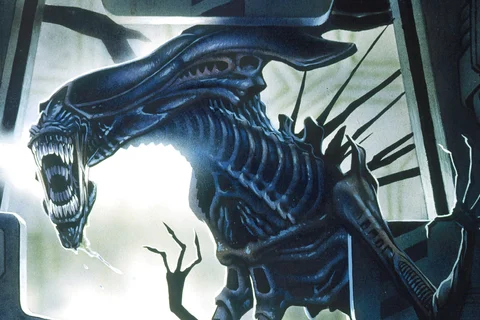
The Aliens
The book's history of the species starts with giant humanoids whose ship was forced down on Acheron. The crew were killed by the same creatures that later destroyed Hadley Station. An exploration craft heard the automatic warning and reported it. The cargo ship Nostromo was sent to investigate, as in Alien, and was lost with all hands as far as its owners knew. Decades later Weyland-Yutani bought LV-426, ignorant of the ship, and set atmosphere processors and a colony of more than 150 scientists, workers, and families. More than fifty years after the Nostromo, and more than twenty after the colony was founded, Ellen Ripley was revived. Almost no one believed her. Carter J. Burke believed enough to send colonists looking.
Russ Jorden took his wife and their children, Timothy and Rebecca, across hundreds of miles in a ground exploration vehicle. A Facehugger pinned him inside the ship. His wife dragged him out, called Hadley, and left the vehicle. The film's strike team found what happened next. The survivors are Ripley, Corporal Hicks, Rebecca Jorden, and the synthetic Bishop. Afterward Weyland-Yutani is debriefing them and trying to erase the mission, while other companies have heard rumors.
Eggs are polarized silicate, the same material as every stage's shell. A queen's egg weighs 60 pounds and can keep a Facehugger alive for centuries. An egg from any other adult Xenomorph weighs less than a quarter of that and lasts a few months. The Facehugger wakes to vibration from a creature of at least 30 pounds, leaps at about 16 miles an hour, and can cover 12 feet. A gas from the opening egg keeps neighboring eggs shut for about a minute. Once attached, it plants one or more embryos through a tube that can start at two feet and grow two feet a day. Implantation takes 20 plus 1 to 6 hours. The Chestburster needs two more days. Hypersleep stretches both clocks by a factor of twenty. A dead host can only yield Warriors, one per 30 pounds. A living host can yield a Sentry per 50 pounds, or a single Queen if the host weighs at least 100 pounds. The queen decides the type. If the host dies before the Chestburster emerges, the embryo becomes a Warrior anyway.
Pulling a Facehugger off tightens the tail around the throat, cutting it sprays acid, and killing it releases a lethal dose of paralytic. Safe removal is surgery of the hardest grade unless the team has done it before and has special tools. A failed operation takes the creature off alive and kills the patient.
A Chestburster starts a little over a pound and must eat twice its adult weight within three days or it dies: about a quarter hydrocarbons, half silicon-rich grit, and a quarter water. With enough food it is adult in a day. It can chew through an interior wall in about twenty seconds, using acid on metal. A Warrior stands about seven feet and weighs nearly 300 pounds. Eighteen stingers on the tail, each two inches long, inject a paralytic and keep secreting for hours. They grow back in a day. Tubes on the back shoot a web up to 18 feet that grips resin, and the same tubes can sling a human-sized victim. Warriors also lay one egg a day if they eat 15 pounds of mixed material, and they secrete the resin of the lair from the mouth.
A Sentry is a Warrior whose hands read and send tiny vibrations through resin and web, carrying the queen's orders out and reports back. It does not alter those orders. Away from the lair it leaves a web strand so the link holds. It passes commands by sound or by infrared patterns on the head. The Queen keeps growing through ten stages. Stage One fights and lays eggs like a Warrior, behind heavier armor. Stage Two takes 600 pounds of food, about four human-sized victims, then lays ten eggs a day and has only a 30 percent chance of dying when a damage roll says Dead. Each later stage costs more victims, adds ten eggs a day, and ignores one more fatal result. At Stage Ten she has a new queen implanted, then leaves with a handful of Sentries and Warriors to start another lair. If a queen is killed, the survivors try to implant a replacement in a living host and guard that host.
Metabolism in this book is electrical, carried by the acid blood, so a mature Alien does not need organic food merely to stay alive. It can take current from sunlight, static, a power line, or the field around machinery, which is why the creatures gather on human equipment. A dormant adult can wait decades or centuries. Non-fatal damage regenerates in half a day. They show no body heat on infrared sensors, but they see further into the infrared than humans and use heat patterns on the head to signal in vacuum. Smell tells them what a body is made of. Lairs are resin over a crater, a building, or a stand of trees. The resin blocks radio, camouflages a motionless Alien, and lets Sentries track every moving body inside. Warriors glue themselves to walls and ceilings with the same contact secretion that grips the web.
Equipment, Vehicles, And Ships
Standard combat fatigues include an equipment harness, a shoulder lamp, a helmet camera, passive infrared, and a medical transmitter. The power cell lasts 12 hours. A Field Radio reaches 100 miles and changes its codes so another unit cannot read them. Tracing or jamming one is a very hard communications task. The Motion Tracker combines sonar with air-density sensors, reads out to 180 feet, and fails in vacuum. Each corner or wall between the operator and the target makes the reading harder. An Intelligence Unit is a briefcase computer that matches faces, fingerprints, and crime files when the user has the authorization.
Body armor comes in light, medium, and heavy, worn over the fatigues. HARDCore armor, named for Hazardous Atmosphere and Radiation Detachment specialists, is a hydraulic steel suit under titanium plate, about 600 pounds, with 12 hours of power and 24 hours of life support, stretchable to 72 in an emergency. It recharges from an APC or a dropship. A spacesuit over the combat suit is rated for eight comfortable hours, 24 in an emergency, and for heat up to 500 degrees Fahrenheit. A vacuum suit is the lighter cousin, without deep-space radiation protection.
The standard sidearm is a pistol that shares ammunition with a submachine gun used for police work, because the submachine gun does not punch through walls. The pulse rifle fires 10mm light armor-piercing rounds with explosive tips and carries a 30mm grenade launcher. It is reserved for military work. The squad support gun is a gyro-stabilized machine gun with a heads-up display, the book's version of the smartgun. A sniper rifle, a shotgun, and a flame unit, also called an incinerator, fill the special-weapons list. The Flame Unit is restricted, and the ICC limits its use against humans. Sentry guns cover a cone or a full circle out to 180 feet, hold 60 bursts, and are illegal against human targets. Hand grenades, rifle grenades, a rare rocket launcher, and demolition charges with a thermite component are the explosives, and using them without approval triggers an inquiry.
Synthetics, also called artificial persons, ride with every Marine ship as backup pilot and navigator. Strength, Intelligence, and Agility are all 21, and they get 16 combat actions in a phase. Eight skills can be programmed at Expert and sixteen at Certified, changed only at a service base, in three days, for 50,000 credits. Behavioral inhibitors bar aggression, harm to humans, and disobedience. They cannot be given a weapon skill, and they will not pilot in a fight except to avoid one. A hit to the head can cripple the mind while the limbs keep trying the last order. Rumors of inhibitor-free assassin synthetics are noted, with no evidence given. Hyperdyne is the main maker.
The APC in this book is a turbine vehicle with its own oxygen, a range of 300 miles, life support for seven days, a driver, and 14 passengers. Top speed is 25 miles an hour off road and 80 on a road. The turret mounts a Light Disruptor and two light missile launchers, with 16 missiles aboard. A lase cannon in the nose is the anti-missile and anti-personnel gun. An automatic light mortar on the roof has 32 rounds. Small arms do not damage it. Front-line carriers include a command post that shows each Marine's camera, location, and vital signs. The ground exploration vehicle supports four people for four weeks in bad air, or twelve weeks where the air is breathable, with a one-way range of 300 or 800 miles depending on that air.
Aircraft use fusion generators and a gravity drive, and most of them can reach a low orbit. The generator wants a week of maintenance, costing 10,000 credits, every 25 days. The dropship is the military pattern. A Carryall uses the same drive and frame parts at a larger size, without armor, and can lift an APC plus four cargo pods when it is not fitted with guns. A Gunship deletes the cargo bay for a heavy disruptor, four light missile bays, two heavy missile bays, a chain gun, and a lase cannon, and is rated as a match for three dropships in atmosphere. A HARD shelter fills the same cargo slot as an APC and keeps four armored specialists for a week. A vacuum shelter keeps six people for a month.
A jump needs the ship to be above one fifth of light speed. The jump itself takes about a day, then both drives are dead for six days while they recharge, which leaves a ship exposed at the destination. Jump values run from 1 to 5, each step adding five light years. Everyone aboard must be in Hypersleep for the jump. If life support fails, only the commander wakes. The smallest jump-capable hull is the Recon Ship. Frigates such as the Sulaco are twice that size. Large cargo and military hulls are at least ten times a recon ship. Corporate frigates are the newer build. Colonial Marine frigates are the older one. A system-defense frigate deletes the jump drive and fills the space with weapons. Routine spacecraft maintenance costs 100,000 credits, takes a month, and can only be done at a service base, after every 25 weeks of use. Past that, the tables start producing stranded ships, dead power, and losses in jump.
Hadley's Hope Campaign
The movie scenario starts as the strike team enters Hadley Station. Players may change what the film's Marines did, but they are not allowed to know where the colonists are until they find out. The gamemaster is told to assume 150 Warriors, six Sentries, and one Stage Eight Queen in the lair, with about one major attack a day. Extra living colonists can be hidden so the team cannot simply level the colony. Pulse-rifle or machine-gun bursts near the reactor have a 3 percent chance each of critical damage, and a grenade there has a 10 percent chance. After critical damage, a percentile roll sets how many hours remain before the processor explodes. The players lose if the colony is destroyed, even if their characters live. In the film most of the team died, the colony was destroyed, and the Aliens were killed in the blast.
The campaign frame after the film uses a fresh team of about eight Marines, an officer, two auxiliaries, and a frigate. Ripley, Hicks, and Newt are in Weyland-Yutani quarantine so their testimony does not circulate. In orbit the team finds a company frigate and, on the ground, two dropship teams with xenobiologists. One team is at the colony and claims a radiation hazard. The other is at the alien ship, on radio silence. Before a firefight with them, a ground vehicle calls in. Six untrained colonists, armed with one submachine gun and two pistols, are out of fuel in broken rock a hundred miles out, with three Aliens that survived the blast hunting them.
Those colonists know about the giants' ship and the eggs, and they heard another Weyland-Yutani spacecraft leave the system a few days after the colony was destroyed. That recon ship, sent on the strength of Burke's notes, lost two soldiers to Facehuggers and took twelve unopened eggs. It is heading home on the Arcturus Loop. If the Marines miss it, Hyperdyne knows a military life form is in play. At Eyesore the Weyland-Yutani dropship hides the eggs and the two implanted soldiers. A Hyperdyne frigate has landed troops as well. One egg opens. The Marines arrive a few hours after Chestbursters come out of the two soldiers. Four hundred civilians and two corporate teams are on the outpost, help from either company is twelve days away, and the Corps has no patrol there. The same outbreak can be moved to Arcturus, where 25,000 people and the Arcturian warrens give the creatures hosts enough to raise queens.
A later thread sends the team into the giants' ship. Engineering tests cover the beacon, the power, and the bridge computers. A dormant lair of 200 Warriors and a Stage Ten Queen may wake. If the team reads the navigation coordinates, the map opens past Pandora onto the giants' own routes. The book leaves the gamemaster to decide whether those giants found the Aliens, bred them as a weapon, died out, or are at war with them on many worlds. Separate mission sketches include a hijacked prison transport whose hypersleep pods opened the criminals instead of the crew, and a version of that hijacking in which the prisoners are Alexandrian political leaders and the "accident" was sabotage.
Behind The Scenes
Nakazono and McKenzie designed Leading Edge's ALIENS board game in 1989, two years before this book. That game was a 32-page rulebook, a four-page summary, a 17-by-34-inch map, cards, counters, a ten-sided die, and plastic stands. The roleplaying book uses that same Marine-versus-Alien fight and adds careers and a sector map. Kinzek's production credit and Dennis's art credit are on the title page, along with thanks to Jason, Marissa, Corinna, Tim, Billy, friends in Chico, Fox, and Huttner Litho. Film stills, including the dropship crash, the medlab Facehugger, and the queen in the power loader, are printed through the chapters as captions between the rules.
Reviews in 1992 divided on the combat rules. Kevin Barrett, in Challenge 57, said the setting could supply military missions for other games. Rick Swan, in Dragon 183, wrote that character generation took many dice rolls, that the simplified Phoenix Command rules were still slow in play, and that the book has mission generators and the Hadley's Hope frame rather than a finished adventure. Lawrence Schick, in Heroic Worlds, described the game as position-based, close to a board game, with combat simpler than Living Steel. Catalog listings disagree on the page count. Bibliographies usually give 194 pages for the 1991 paperback. A dealer copy has been listed at about 192, and another at 196.
The book is not a source for the later Aliens Colonial Marines Technical Manual, and that 1995 manual does not cite it. Ranks, ship weapons, and the names of the sectors are Leading Edge's own reading of the film plus original colonies. Free League's Alien RPG is a separate license set in 2183, not a new edition of these rules. Free League's Tartarus, and the burrowing creatures associated with it, reuse the world this book invented for the Harvesters. Leading Edge's Thedus, three reactor towns on the Pandora run, is a different settlement from the later novels' mining port.
Conclusion
Aliens Adventure Game is Leading Edge Games' 1991 paperback for the year of Aliens, designed by Barry Nakazono and written with David McKenzie. It puts a Colonial Marine strike team on a corporate map from blockaded Alexandria to Pandora, then sends a second team to Acheron after Hadley's Hope is destroyed. The campaign continues with eggs on the Arcturus Loop, Chestbursters at Eyesore, and a route past the ICC if the team deciphers the giants' ship.
External Sources
Tag Categories: Alien Merchandise | Colonial Marine Lore | Alien Universe Reference Books