Alien RPG: Free League Rulebook And Setting Guide

Alien: The Roleplaying Game is Free League Publishing's licensed tabletop game for the Alien films, first issued as a 392-page hardcover on 10 December 2019 and revised as the 316-page Evolved Edition in 2025. Tomas Härenstam designed the Year Zero Engine rules, and Andrew E.C. Gaska wrote the setting in the year 2183, a few years after the Hadley's Hope loss and the closing of Fiorina 161. The book treats space truckers, Colonial Marines, frontier colonists, and company agents as expendable labor on the edge of charted space, then gives the Game Mother the nations, ships, and adult Xenomorphs that can kill them.
Book Overview
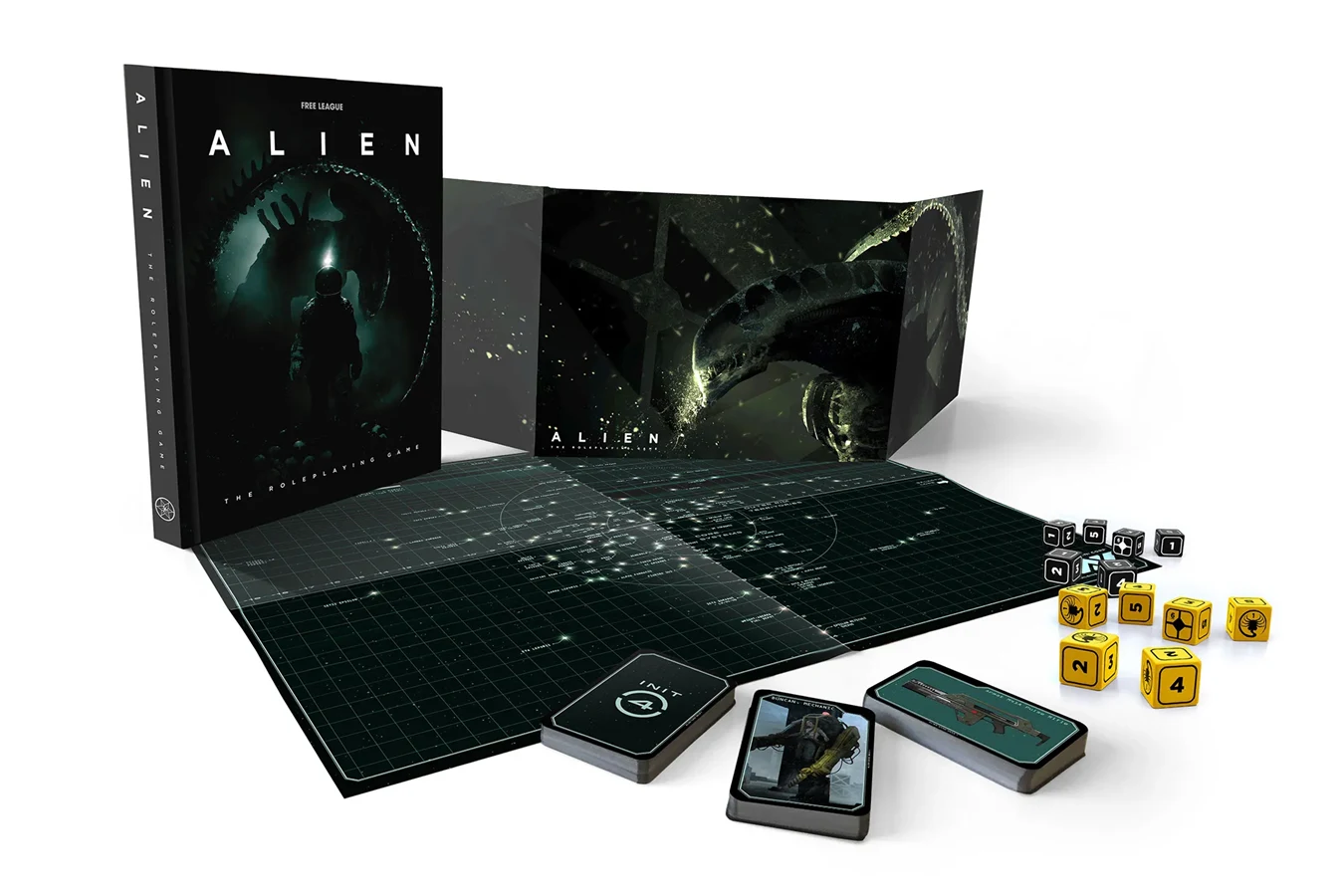
The Evolved Edition keeps the first book's chapter order and shortens the page count by moving the starter scenario out and tightening the layout. Chapter 1, Space Is Hell, sets the Frontier between the Outer Veil and deep space, then walks through the 2180s timeline and the four career families used later for campaigns. Chapters 2 through 5 cover character creation, the twelve skills, stealth and combat, and the gear lists. Chapters 6 and 7 handle living among the stars, ship combat, and how to run the Game Mother.
Chapters 8 through 10 are the setting spine: the star nations and mega-corporations, the mapped systems from Sol out to the Far Reach, and the alien species chapter that starts with the Engineers before the Xenomorph life cycle. Chapter 11 is campaign play, with job tables, a star-system generator, and three worked locations. The appendices add optional life paths, the Last Survivor solo mode, and a short conversion note for first-edition expansions. Earlier first-edition material stays compatible if talents, armor, ammo ratings, and Xenomorph statistics are updated to the Evolved lists.
Play uses six-sided Year Zero base dice and yellow stress dice. A six is a success. A one on a stress die can force a panic roll. The boxed accessories that shipped with the line include a four-panel Game Mother screen, a Stars of the Middle Heavens sector map, initiative and gear cards, black base dice marked with a success symbol, and yellow stress dice that put a Facehugger on the one face.
Timeline And The 2180s
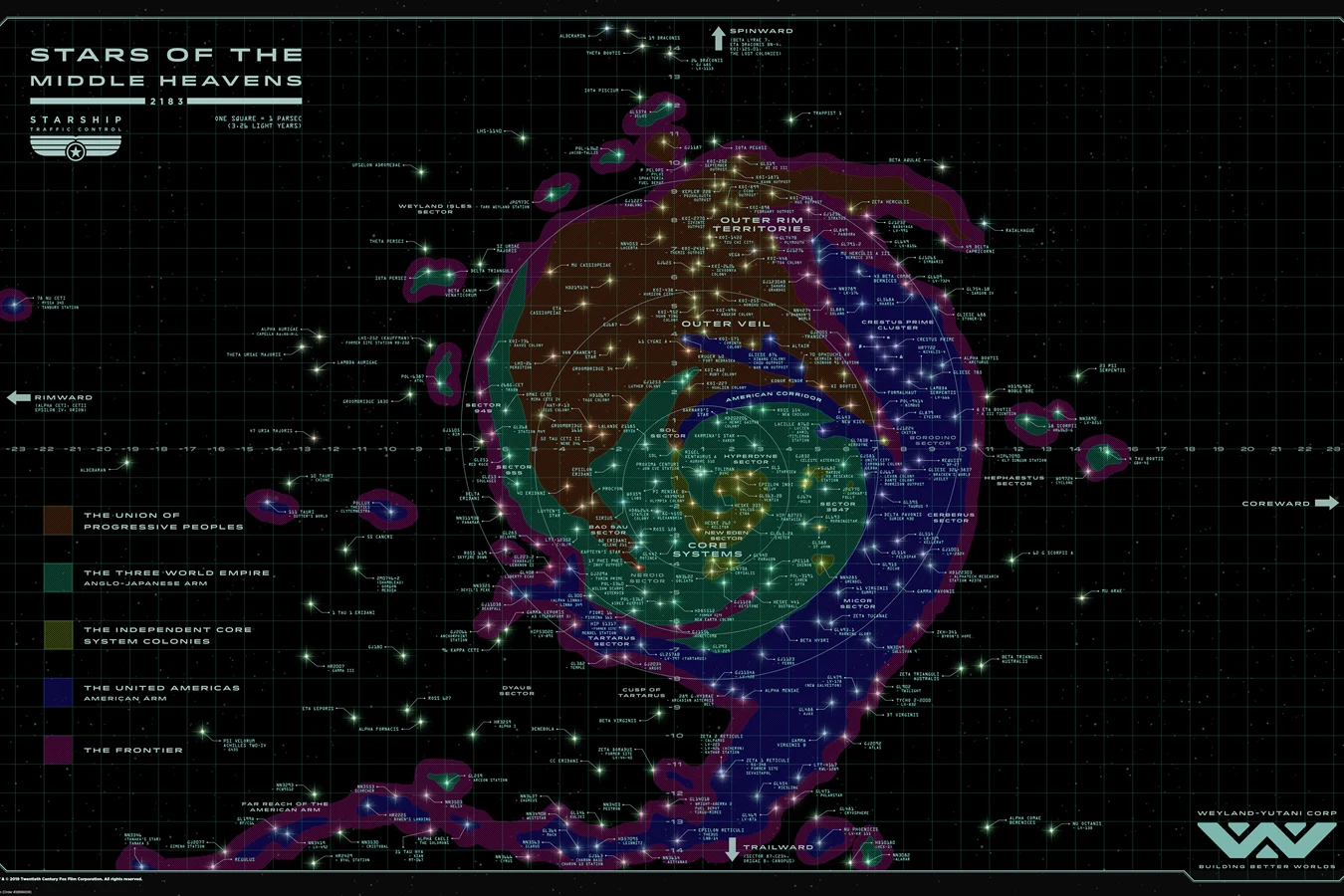
The book dates itself to the 2180s, only a few years after the atmosphere processor on LV-426 detonated, the USS Sulaco went missing, and the prison and lead works on Fiorina 161 closed. The endpaper map is labeled Stars of the Middle Heavens and is set in 2183, with one square equal to one parsec. Color blocks mark the United Americas, the Three World Empire, the Union of Progressive Peoples, the Independent Core System Colonies, and the Frontier. Sol sits near the core, and Zeta 2 Reticuli sits trailward on the Frontier edge with Calpamos, LV-223, and LV-426 marked beside Kathar Station.
Early Spaceflight
The printed timeline starts with Peter Weyland's 2023 address and the first David androids, then Luna terraforming in 2031 and the Heliades as the first faster-than-light explorer. HD85512 B became Earth's first off-world penal colony in the 2040s. The United Kingdom and Japan put settlements on Mars and Titan in 2039, and Weyland Corp seeded a breathable atmosphere on GJ667CC. The Three World Empire formed in the 2080s from the United Kingdom, Japan, and other states that already ran Weyland Corp and the Yutani Corporation.
Prometheus To Nostromo
USCSS Prometheus left in 2091 and was lost with Peter Weyland and Meredith Vickers, after which Yutani bought the ruined firm and created Weyland-Yutani by the turn of the century. The United Americas merged North, Central, and South America in 2103, the same year USCSS Covenant launched more than 2,000 colonists toward Origae-6. Civil war on Torin Prime and the loss of the troop carrier Archangel at Thedus pushed China and Russia into the Union of Progressive Peoples. USCSS Nostromo left Thedus in 2122, set down on LV-426, and was later destroyed after its third officer overloaded the engines.
Sevastopol To Tientsin
In 2137 the Nostromo flight recorder reached Sevastopol Station, the station fell into KG-348, and Mendel Station vanished. Three years later contact was lost with Seegson Station LV 44-40 and the Wright-Aberra Waystation, and the first Anchorpoint Station went up between the Core and the Outer Rim. Hadley's Hope was founded on LV-426 in 2157. The Tientsin campaign at 8 Eta Boötis A III in the 2160s ended without a winner for the United Americas or the UPP, and a colonial draft followed.
2179 And The 2180s
In 2179 the Narcissus was recovered, Hadley's Hope stopped answering Gateway Station, Colonial Marines on the Sulaco were sent in, the colony was wrecked in a thermonuclear blast, an EEV from the missing Sulaco crashed on Fiorina 161, and the first Anchorpoint suffered a reactor meltdown. The 2140s also list the loss of the Renaissance research station in the rings of LV-410, the world later used for Jackson's Star in Alien: Romulus. By the 2180s a new Anchorpoint was open, Robert Morse's banned book Space Beast was circulating, and Marines were being pulled off quiet colonies as the United Americas and Weyland-Yutani blamed each other for LV-426.
Game Modes And Themes
The Game Mother describes the universe and plays every other person and creature. Everyone else plays one character. The book splits that into cinematic play and campaign play, with Last Survivor added in Evolved as a third mode that needs no Game Mother.
Cinematic Play
Cinematic jobs are built like a film, meant for one session, with hidden personal agendas handed out at the start of each of three acts and a high chance that most of the cast will die. The first edition printed Hope's Last Day in the core book as a short cinematic taste set in the last hours of Hadley's Hope. Evolved moved that scenario into a separate Starter Set and points cinematic groups at Rapture Protocol or the older Draconis Strain trilogy instead.
Campaign Play
Campaign play keeps the same crew across many sessions. Players build their own characters, earn experience, and choose one of three frames: space truckers, Colonial Marines, or frontier colonists. Truckers haul cargo and refineries on a Model CM-88G Bison for about $400 to $960 a week, with hypersleep time paid at ten percent. Marines take orders from Corps headquarters on a Conestoga-class frigate for about $500 to $760 a week. Colonists survey, mine, and salvage on a Model CM-90S Corvus for about $500 to $640 a week.
Themes
Both modes share three themes the book names outright: space horror, sci-fi action, and a sense of wonder about old ships and questions of where humanity came from. Game Mother advice is eight short rules, including use the films, limit resources, stay in the shadows, raise the pressure, then let the table breathe.
Player Characters And Careers
Building A Character
A campaign character starts with fourteen attribute points across Strength, Agility, Wits, and Empathy, ten skill points, one career talent, a personal agenda, a buddy, a rival, starting gear, some Weyland-Yutani dollars, and a tiny signature item with no game use. Health is Strength plus Agility, halved and rounded up. Resolve is Wits plus Empathy, halved and rounded up, and it is the number used to hold off stress and panic. An android player character can take a plus three bonus to two attributes after those fourteen points, cannot push rolls, does not gain stress, never makes panic rolls, and takes damage on a different track.
The Nine Careers
The nine careers are Colonial Marine, Colonial Marshal, Company Agent, Kid, Medic, Officer, Pilot, Roughneck, and Scientist. A Marine keys on Strength, with Close Combat, Stamina, and Ranged Combat, and can walk in with an M41A Pulse Rifle, an M56A2 Smart Gun, an M314 Motion Tracker, G2 electroshock grenades, an IRC MK.35 pressure suit, or M3 plate. A Marshal keys on Wits and is written as the local law the Corps is too thin to provide, often with a .357 revolver, an Armat 37A2 shotgun, or a stun baton. A Company Agent keys on Wits and exists to close deals, watch rivals, and keep the little people working.
The Kid keys on Agility and is the only career built around a child or teenager on a colony or a ship. Medic and Officer both key on Empathy, one for Medical Aid and the other for Command. Pilot keys on Agility and Piloting. Roughneck keys on Strength, Heavy Machinery, Stamina, and Close Combat, and the book's worked example is Nat, a technician with a cutting torch, a compression suit, $300, and a photo of a dead partner. Scientist keys on Wits for Observation, Survival, and Comtech.
Agendas And Betrayal
Cinematic play assigns names, agendas, buddies, and rivals in the adventure text and forbids writing those agendas on the sheet. If a player turns on the group, the Game Mother can call player versus player, resolve that fight, then take the traitor as a non-player character and hand the player a spare cast member if one is left. The book tells tables to save that betrayal for the third act. Campaign play treats the same conflict as a group problem with no extra rule, and it awards extra experience when a character risks something for an agenda, a buddy, or a rival.
Skills, Stress, And Combat
The Twelve Skills
There are twelve skills, three per attribute. Strength covers Heavy Machinery, Stamina, and Close Combat. Agility covers Mobility, Piloting, and Ranged Combat. Wits covers Comtech, Observation, and Survival. Empathy covers Command, Manipulation, and Medical Aid. A skill can be rolled at level zero, using only the attribute and gear, and a new skill costs five experience points after a success or a shift of teaching.
Stress And Panic
Stress starts at zero and rises when a character pushes a roll or walks into terror. Pushing rerolls failures and adds a stress die. A panic roll compares a stress die plus the current stress level against Resolve, and high results run from a nervous twitch through frozen indecision into overkill or collapse. Time in a safe place, a stretch of downtime, or certain Marine talents can drop that number again. Mental trauma is what is left after panic that the table cannot laugh off.
Stealth And Combat
Stealth mode treats a ship or colony as zones and range bands, with crawlspaces, motion trackers, and group stealth as their own procedures. Combat draws initiative cards. Each round a character gets one full action and one quick action, or can give orders instead. Close combat is any attack at Adjacent range, including a pistol shoved into a face. Ranged combat tracks cover, friendly fire, full auto, and an ammo supply rating that is rolled after firing rather than counted round by round.
Armor soaks damage and can be eaten away. Critical injuries sit on a table that runs from blood in the eyes to a punctured lung that needs surgery. Stun damage, vacuum, explosive decompression, falling, zero gravity, fire, disease, and radiation each have their own short procedures. Synthetics ignore many of those hazards and fail in different ways when they hit zero Health. Evolved reworked armor, ammo, grenades, stuns, stealth, and panic from the 2019 text, and it added miniatures-play notes for tables that want figures on a map.
Gear, Vehicles, And Ships
Personal Gear
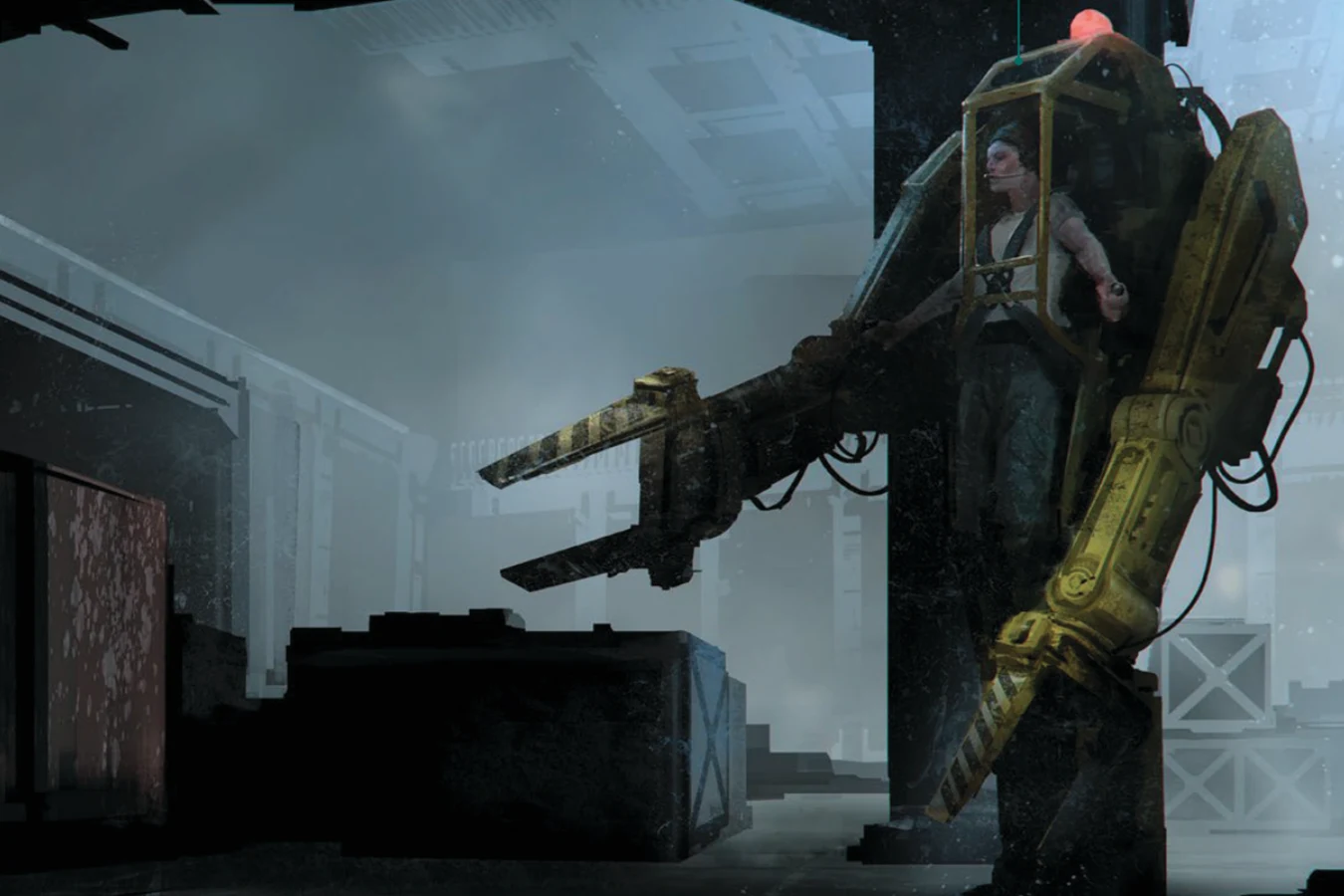
A person can carry a number of regular items equal to twice Strength. Air, ammo, and power are supply ratings rolled on stress dice, and the rating falls faster while it is still high. The weapon lists open with handguns and rifles, then other weapons, then suits, mainframes, data storage, vision devices, tools, medical kits, drugs, and food. Film kit stays in the tables: the M41A, the M56A2, the M240 Incinerator Unit, the M314 tracker, the P-5000 Powered Work Loader, and pressure suits with an air rating that will kill a wearer if the roll chain reaches zero.
Vehicles
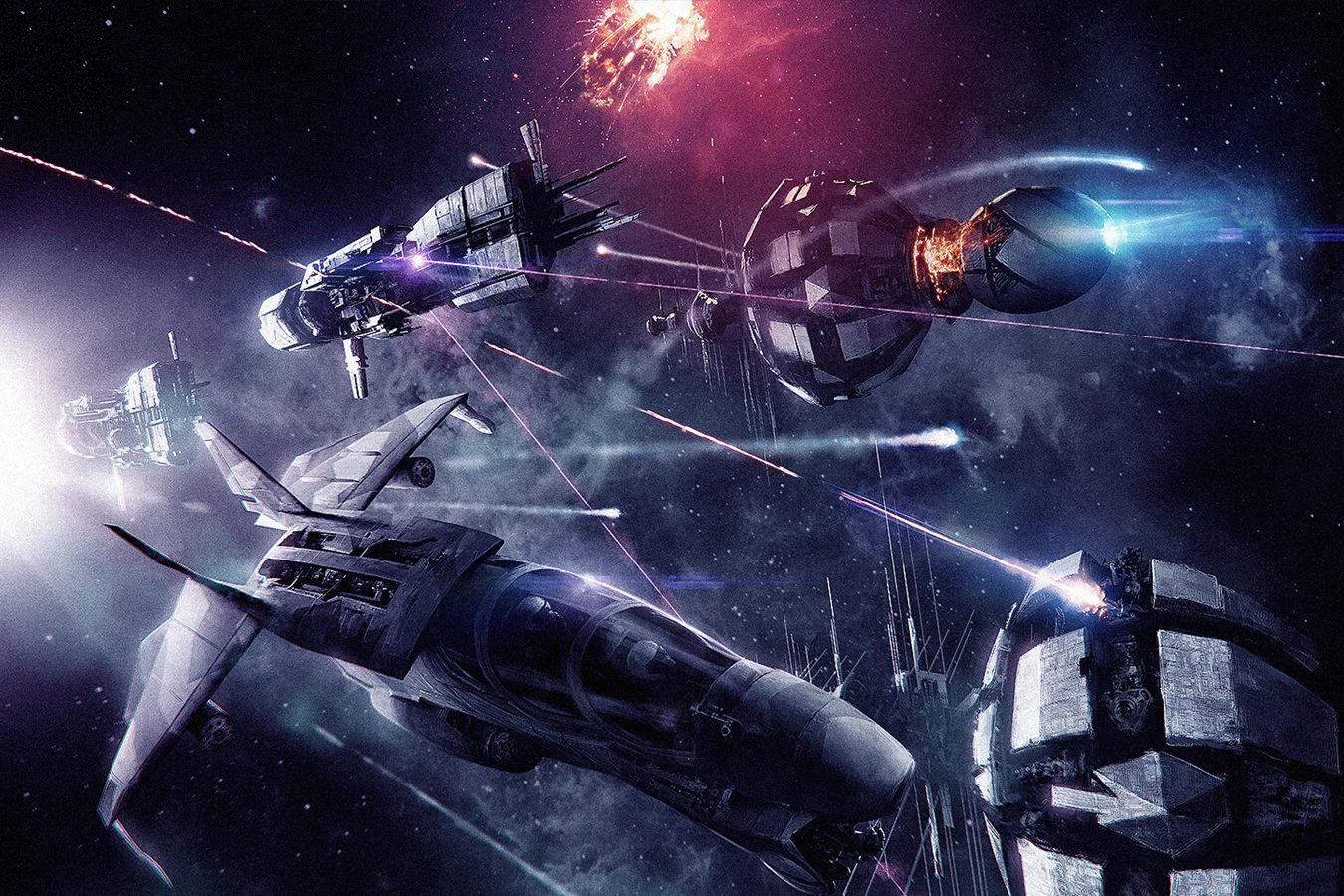
Ground and air vehicles include the Weyland NR-9 series, the Daihotai Series 8×8 tractor, the M570 series armored personnel carrier, an Aerodyne light VTOL, the UD-4 Cheyenne tactical dropship, and the Weyland-Yutani WY-37B cargo lifter. Spaceship combat is a five-phase stretch: command, sensors, movement, attack, and engineering, with crew seats, range segments, approach velocity, transponders, and a running-dark option that hides a hull from sensors. Ship damage and repair sit on their own tables, and a worked example follows the freighter Lyssa through two combat stretches against the Porphyrion.
Ships Of The 2180s
The 2180s ship list starts with the Starcub shuttle and the Model CM-93D Mule mining hauler, then the Model CM-90S Corvus salvage vessel, the Model CM-88G and CM-88H Bison tugs, the CYG-NS3 Star Clipper, and the Conestoga-class frigate. Evolved adds hulls and small arms from Alien: Romulus beside those older Lockmart and military types. A campaign group can begin already assigned a ship, or lease one if they are freelancers and spend later pay on repairs and modules. Hypersleep, gravity drives, and planetfall each get a short rules block before the class list.
Governments And Corporations
The book treats 21st-century governments as late to space and the companies as the ones that built the drives, the processors, and the first extrasolar towns before any law followed them off Earth. Nations later merged to claw some of that power back, but the text still puts a corporate officer behind most politicians.
Three World Empire
The Three World Empire formed in the 2080s from the United Kingdom, Japan, India, Indonesia, Papua New Guinea, Kenya, Fiji, and other states. Its name refers to Earth, Mars, and Titan, the first three inhabited worlds, and its extrasolar holdings are the Anglo-Japanese Arm. Weyland-Yutani holds the only non-state seat in 3WE parliament. The Empire keeps a navy and the Royal Marines Commandos, then hires company soldiers to fill the gaps the Commandos cannot cover.
Provisional Governor Vihaan Reddy runs the Frontier colonies from a comfortable compound and wants the United Americas off Linna 349. Notable 3WE worlds in the text include Corona Colony, Gorham's Folly, Fiorina 161, and Linna 349.
United Americas
The United Americas formed in 2104 under the Washington Treaty as a block of North, Central, and South America, with the United States military industry already in place for the Colonial Marines. United Americas Allied Command joins the USCMC, the Canadian Colonial Armed Forces, the Latin American Colonial Navy, the United States AeroSpace Force, and the Outer Rim Defense Fleet. Colonial Administration watches supply and vaccines, and the Colonial Marshal Bureau is its police arm, with an Interstellar Commerce Commission agent attached to every major office. The American Arm fills most of the Outer Rim, with key worlds at Bracken's World, Terraform 3, Morning Glory, and the Crestus Garrison Systems.
Colonel Aaron Percival of the 4th Recon Battalion, 7th Marines, works the Crestus Garrison System Delta and treats the Corps as overconfident and short on discipline. The USCMC has fought on nearly thirty extrasolar worlds in eight decades, keeps its own frigates and transports, and can still be ordered to guard Weyland-Yutani property because of Allied Command contracts. That last point is what sour platoon commanders in the text object to. The Aliens Colonial Marines Technical Manual uses the shorter label USCM for the same service the RPG writes as USCMC.
Union Of Progressive Peoples
The Union of Progressive Peoples formed in the early 22nd century from China and Russia, later joined by Vietnam, Germany, Spain, and other Asian and Eastern European states, as a socialist answer to the 3WE and the United Americas. It is resource-poor, refuses private corporations, and still fields the Space Operating Forces, whose kit includes AK-pattern pulse rifles and wrist-mounted AK suit guns on compression armor. The Ministry of Space Security is the internal and external secret police. Androids inside the UPP have never been citizens, only state machines, for more than sixty years.
UPP worlds in the text include New Kiev, Qi Xi III, 17 Phei Phei, Xiang Colony, and the Chiu and Wan An outposts. Because the Union never built atmospheric processors, it buries towns or raises domes instead of terraforming, which overfills the few naturally livable planets. Governor General Pham Dinh commands the Frontier colonies and treats the posting as a punishment near retirement. The Tientsin campaign about twenty years before the game year wrecked 8 Eta Boötis A III, and Weyland-Yutani later blamed a UPP nuclear strike for Hadley's Hope while also denying any bioweapon was there.
Independent Core System Colonies
The Independent Core System Colonies grew out of the 2080s Central Space Consortium, a tax dodge that later sold protection to any world that could pay. Weyland-Yutani, Seegson, Chigusa, Hyperdyne, and the Jǐngtì Lóng Corporation all hold planets there. Martin, a quiet android recruiter, is the Consortium's most successful colonial liaison and is written as close to a programming break because his promises are empty. New Eden Sector is the rich core cluster, with Volcus, Ventix, Grendel, Alexandria, Exeter, and St. John named, plus Frontier clients that include the Solomons and Anchorpoint.
Interstellar Commerce Commission
The Interstellar Commerce Commission inspects cargo and biologicals for Earth and for any colony of 200,000 or more, with headquarters on KOI 812.03, Ruby Colony, the largest spaceport in the Outer Veil. Weyland-Yutani owns and operates the ICC. Paul van Leuwen, the executive who chaired Ellen Ripley's Nostromo tribunal, later opened an ICC inquiry after Hadley's Hope and Morse's book, and he used company shuttles through Anchorpoint while that file stayed open. Every commercial crew still needs an ICC license, and the 2180s crackdown is written as a hunt for unlicensed life in the holds.
Weyland-Yutani
Weyland-Yutani is the British-Japanese combine that sells synthetics, ships, computers, weapons, mining, shipping, terraforming, and colonies, with a bioweapons laboratory on the side. Offices sit in Tokyo, London, San Francisco, the Sea of Tranquility, and Thedus, plus Alexandria in the ICSC. After cheaper, less safe processors in the 2130s, the company became the United Americas' main supplier of guns and hulls along the American Arm. Michael Bishop, director of special projects, hunts Plagiarus praepotens specimens from the corporate transport Patna at Anchorpoint after the Bishop series and the Fiorina 161 failure.
Dog Catcher teams are four commandos, two animal-containment specialists, a science team, and a chief surgeon, often led by an executive, in APEsuits with pulse rifles and capture gear. The book also points those teams at Engineer ruins and at orbital labs such as RB-232, the station from Alien: The Cold Forge, and Kathar Station.
Lasalle Bionational
Lasalle Bionational was founded in the late 2130s by former Weyland-Yutani vice president Brendan Lasalle after mass bio-research layoffs, then won contracts for radiation-resistant corn and a blight virus that could ruin an enemy harvest. Edina Lasalle later took the chair and kept a secret Xenomorph hive in the Taurus system while UPP spies sat in her offices.
Seegson
Seegson began as Sieg and Son in the 2030s, shared an FTL drive so Weyland would not own the only one, and later sold the A.P.O.L.L.O. mainframe and the cheap Working Joe androids with rubberized skin. Without an atmospheric-processor patent, the firm poured money into orbital platform colonies, then watched those stations empty after Weyland-Yutani started making worlds breathe. By 2140 most Seegson stations were for sale, which is how Sevastopol sat on the market in 2137. Director James Russell runs Frontier business from Anchorpoint, with home offices in London, Buenos Aires, Nagasaki, Luna, and the Solomons.
Other Companies
Smaller names in the company list include Alphatech Hardware, Gemba Systec, Kelland Mining, Koorlander tobacco, Souta Dry beer against Aspen Beer, Lockmart commercial hulls, and the Steer City Cattle Company on Terraform 3. Hyperdyne sits as an ICSC subsidiary of Weyland-Yutani for high-end synthetics and prosthetics. Jǐngtì Lóng is written as a rival in colonization and weapons research. None of those firms get their own chapter, but any of them can hire a crew or sit on the other side of a cargo job.
Charted Space And The Frontier
The Frontier
The Frontier begins on the leading edge of the Outer Veil, crosses the Outer Rim, and then runs into uncharted space. The Veil is the mineral belt between the Core and the Rim. The Rim is already thick with towns and Navy patrols. Settlers in the text compare the lawlessness to the old American West, with atmospheric processors making thin air, claim fights that pull Marines, and stations such as Anchorpoint used as neutral jump-off points.
Mapped Systems
Core Systems coverage starts in Sol, including Third Base, then New Eden with AG-4550 and Heske 337. The Outer Veil takes Sector 3847 and JPG-770, the Neroid Sector with POL-5362 and Fiori 16, and Bao Sau with 17 Phei Phei. Outer Rim entries include Borodino with Requist, Gliese 326-3827, and 8 Eta Boötis, plus Tartarus with GJ229A and GL300. The Frontier chapter then lists Gamma Leporis, Khadaji, Zeta Reticuli, and the Far Reach systems Alpha Caeli, Alpheios, Epsilon Reticuli, and Tanaka, with Sector 117 and Achilles beyond that.
Colony Life
Daily life on a station or a shake-and-bake colony is written as function before fashion: hired work, ICC papers, delayed mail, cheap media, and churches that range from ordinary services to the Practitioners of the Holy Immolation and the Church of Immaculate Incubation. Marshals and hired guns fill the holes left when Marine units are recalled. Space Beast, Morse's banned Fury 161 account, is the book's public version of a dragon in a prison, and millenarian groups treat that text as scripture. The rumor chapter also repeats stories of Engineer ruins, derelict giants, and whole colonies erased by plague or nuclear fire.
Engineers And Xenomorphs
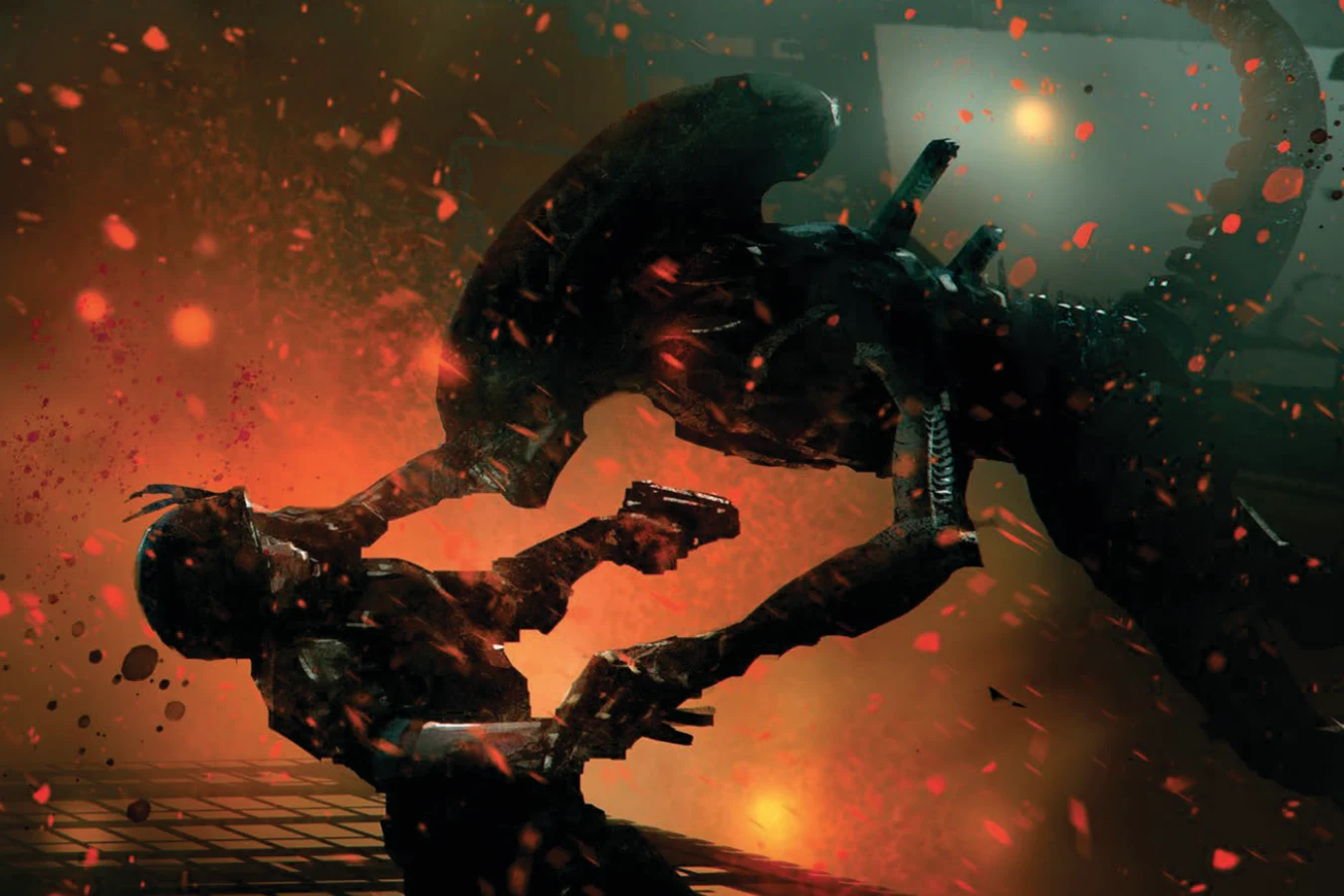
Engineers
The species chapter opens with the Engineers as a tall precursor culture whose ships look grown, not built. Juggernauts are horseshoe hulls with an ampule bay, hypersleep coffins around a pilot dais, and a holographic orrery that can lock a course on any mapped world. Mother Juggernauts are scorpion-tail docks that hang over Engineer cities. Dreadnoughts are listed as hypothetical knot-shaped battleships. Steatite ampules each hold four glass cones of Agent A0-3959X.91-15, the black goo later tied to the pathogen mutations from Prometheus.
Xenomorph XX121
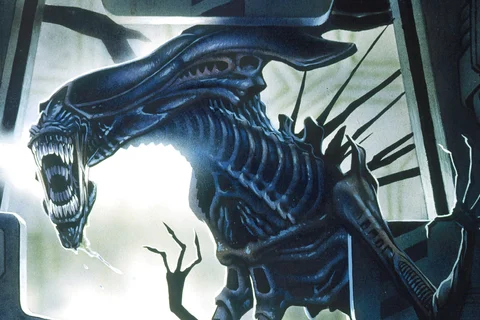
Xenomorph XX121 is split in the text into two working species that live together: the Facehugger Manumala noxhydria and the growing Chestburster creature Plagiarus praepotens. Older labels Internecivus raptus and Linguafoeda acheronsis are called inaccurate. Adult Xenomorphs replace tissue with polarized silicon armor, bleed concentrated acid, and can live in vacuum and extreme cold. Radiation is treated as two levels weaker than the table printed for humans, and darkness does not hinder them in stealth mode.
Xenomorph Life Cycle
Stage I is the Ovomorph, a Xenomorph egg 0.6 to 1.2 meters tall, either laid by a Queen or grown from a cocooned host in a 24-to-36-hour ovomorphing process. Queen eggs are hardier than converted ones. Stage II covers the common Facehugger, the slightly larger Praeto-Facehugger, and the Royal Facehugger that can implant a Queen and, in the book's hypothesis, a second protector. A facehug kills the host if it is pulled off without first being frozen, and a live implant becomes a Chestburster about one shift after the parasite dies.
Stage III lists the Chestburster plus the Bambi Burster and Imp variants. Stage IV is the Drone, Scout, and Stalker. Stage V is the Soldier, Worker, and Sentry. Stage VI is the Praetorian, the Crusher, and the Queen. Stage VII and beyond is left open for later caste growth. A lone Drone that has no hive will crush skulls, wrap hosts in resin, and start that egg conversion until a Queen can appear.
Neomorphs
Neomorphs are the book's name for the parasite the USCSS Covenant crew met on Planet 4 in Sector 87, after Agent A0-3959X.91-15 mutated native fungal and insect life. Listed as Plagiarus celerius, they reach a host through Tachinidae tabellarium motes released from fungal egg sacs, not through a Facehugger. The host dies when a Bloodburster tears out, grows into a four-legged Neophyte, then stands as a 2.1-meter eyeless adult with gray-white skin, a spiked tail, and yellow blood that is not acidic. Adults burn out in about 24 hours, and fungus on the corpse starts new sacs. The book treats them as less intelligent than Xenomorph XX121 and as a sterilizer meant to finish whatever the black liquid left alive. Praetomorphs sit in the Facehugger notes as a related strain, the same line later called a Protomorph.
Tartarus Harvesters
Tartarus Harvesters are six-legged burrowers about six meters long that wrecked the colony on Tartarus. They are nearly blind, navigate by sonar, and crush plants, bone, wood, rock, and most metals in a circular mouth that feeds six stomachs. They do not hunt living prey, but anything standing in a feeding zone is eaten, and they can breathe air that is too rich in carbon dioxide for humans. A Lasalle Bionational executive shipped them to other Frontier mines as living drills. They escaped and wrecked those colonies too. Mothers carry boar-sized young under the armor, and the only soft target is the underbelly.
Lion Worms
Lion Worms are the top predator on the jungle world Zagreus, 1.8 to 3 meters long, covered in gold cilia, eyeless, with ears down the body and a cluster of nostrils in a razor beak. They burrow only through soft earth and wait for live prey. Poachers have smuggled them past ICC quarantine and sold them as pets to corporate buyers. An escaped worm can breed fast enough to wreck a colony's ecology. Colonists on Zagreus collected the worms' own pheromones so that two of them would treat each other as invaders and fight.
Other Extrasolar Animals
Tanakan Scorpionids live in the deserts and underground lakes of Tanaka 5. They have more in common with prehistoric sea scorpions than with Earth desert scorpions, swim as often as they walk, and carry venom that can kill a human quickly unless an antidote is given. Collectors still milk that venom for medical use. The Swarm of LV-KR 115 is a cloud of space locusts that ate a company's self-replenishing crops until pesticides wrecked the world, then turned up later as dormant clouds adrift between stars. Ship cats, dogs, and synthetic animals are listed as ordinary Frontier company, not as combat pieces.
Campaign Play And Tartarus
Campaign Tools
Campaign tools include a star-system generator, main-world tables for size, air, temperature, terrain, colony size, orbitals, factions, and allegiance, plus job generators for cargo runs, military missions, and expeditions. Each job block has an employer or sponsor, a bonus, a destination, and a complication, then plot twists, star-lane encounters, surface encounters, colony encounters, and a shore-leave table. The book tells the Game Mother to keep a Marine squad small and to put the player characters in the seats that make the decisions, not in a full paper-strength platoon. Three starting maps are offered: Tartarus Sector, Jackson's Star, and Novgorod Station.
Tartarus Sector
Tartarus sits on the rimward-trailward edge of the Outer Rim, named for the Greek prison of the dead. The United Americas planted Torin Prime there in 2104 and never fully held the sector. The Outer Rim Defense Fleet is described as a thin colonial militia, the Three World Empire still wants worlds back that Marines occupied during civil unrest, and the UPP is quietly backing rebels and dropping its own towns. Argos is an ICSC commercial hub kept separate from the new Anchorpoint, which sits just rimward of the sector as the gate to the Far Reach.
Tartarus Systems
Public files and hidden files are printed side by side for more than a dozen systems. Ross 619's Skyfire Down is a United Americas and Lunnar-Welsun prison of 100,000 convicts with an orbital yard, and the 3WE has agents inside the population. Khadaji's Wells is a water outpost the United Americas took in 2154, and the water carries a microbe that causes hallucinations. Torin Prime remains a police state after the J'Har revolt, with GR161 still used for dissidents, and the J'Har preparing another rising. NN3325 is listed as barren while Devil's Peak stays hidden.
Gamma Leporis holds Steer City, a Lasalle Bionational farm that feeds the sector, and both the 3WE and the UPP want it, the latter with Lasalle's own blight virus. Liberty Echo on GL408 is the United Americas naval headquarters and also hides a Weyland-Yutani bioweapons lab that already has XX121. Linna 349 invited Marines in during a revolt ten years before the game year and never got them to leave. HIP53020's Pala Station looks empty on the public chart while Weyland-Yutani digs Engineer ruins and a Juggernaut, watched by a 3WE colony. HIP51317 still holds Mendel Station, forty-five years after it was listed destroyed, with hypersleeping survivors, Xenomorphs, and research still aboard.
Tartarus colony on GL257AB was wrecked, refounded in 2170, and is now in the Prospector Wars among Harvester country. Argos on GJ2034 is the ICSC talking shop none of the star nations like. Rodina in Beta Virginis failed under its star, and the UPP is keeping others off the rest of the system. Delorme on GL285 is a rebellious United Americas colony a USCMC nuclear strike erased. Temple on GL382 hides a religious order, and Deadfall on GJ11038 has sent no word in fifty years. Sector notes also flag a coming Frontier War, a 3WE play, a UPP push, a second J'Har revolt, and ordinary trucking and labor fights.
Jackson's Star And Novgorod
Jackson's Star
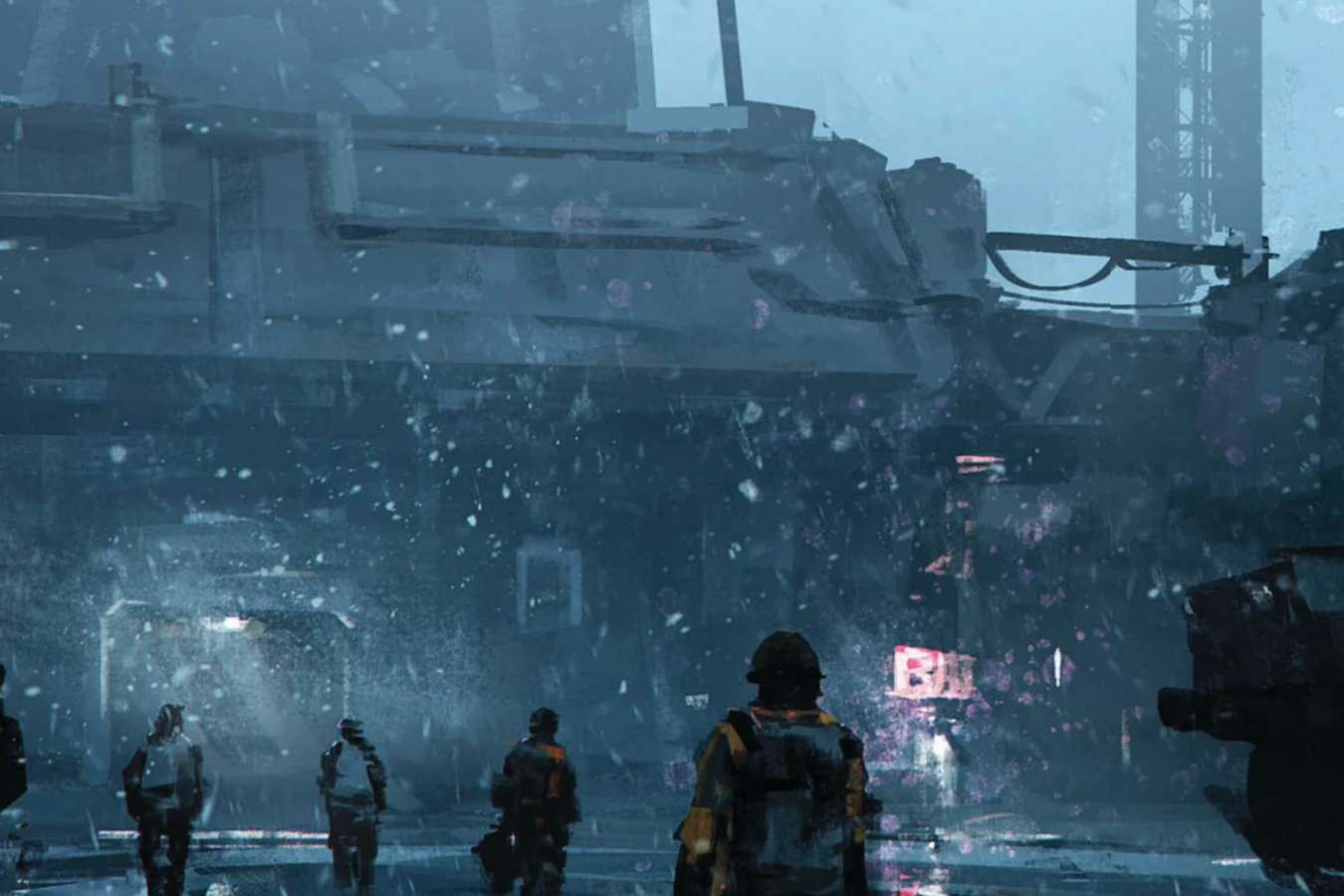
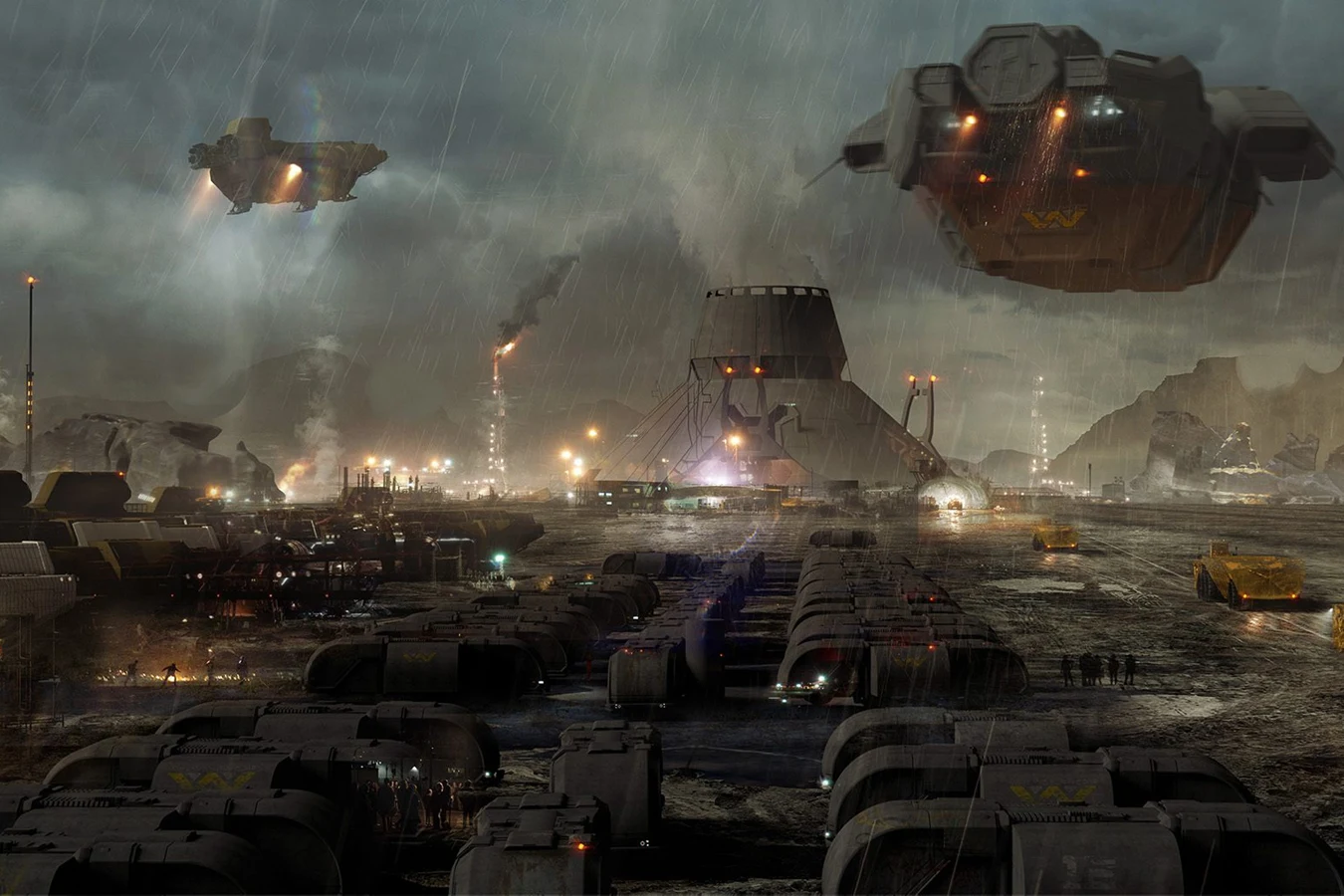
Jackson's Star is the Evolved Edition's worked mining colony on LV-410 in the Alpheios system, in the Far Reach of the American Arm. Jackson's Resource Development Group found the world, and Weyland-Yutani opened the town in 2133 to pull iron and rare metals. Thick cloud kept sunlight off the surface, airborne microorganisms made workers sick, and the company extended contracts when Earth stopped sending volunteers. Processors later cut that sickness, families stayed, and children grew up in rain, hail, and permanent dark.
Four mines feed crushed ore to Model CM-93D Mules, which climb to a Tesotek refining platform that a commercial tug then tows toward the Core for up to a year. The printed map puts C2 and G4 nearest the town, with trailer-park housing, cargo pads, a spaceport control tower, north and south processors, and three Market Streets of bars, cafes, shops, and supervisor housing. Colony Affairs sits on Central Market Street behind armored glass and handles labor, pay, health, and franchise stores. Orange arc lights stand in for sun over plastic-coated vegetable gardens and enclosed hothouses.
That write-up is the tabletop version of the Romulus colony, shifted into the 2183 campaign present rather than the 2142 film year. Adventure hooks in the same pages use contract fights, ore theft, processor failures, and whatever a Game Mother pulls from the Tartarus tables.
Novgorod Station
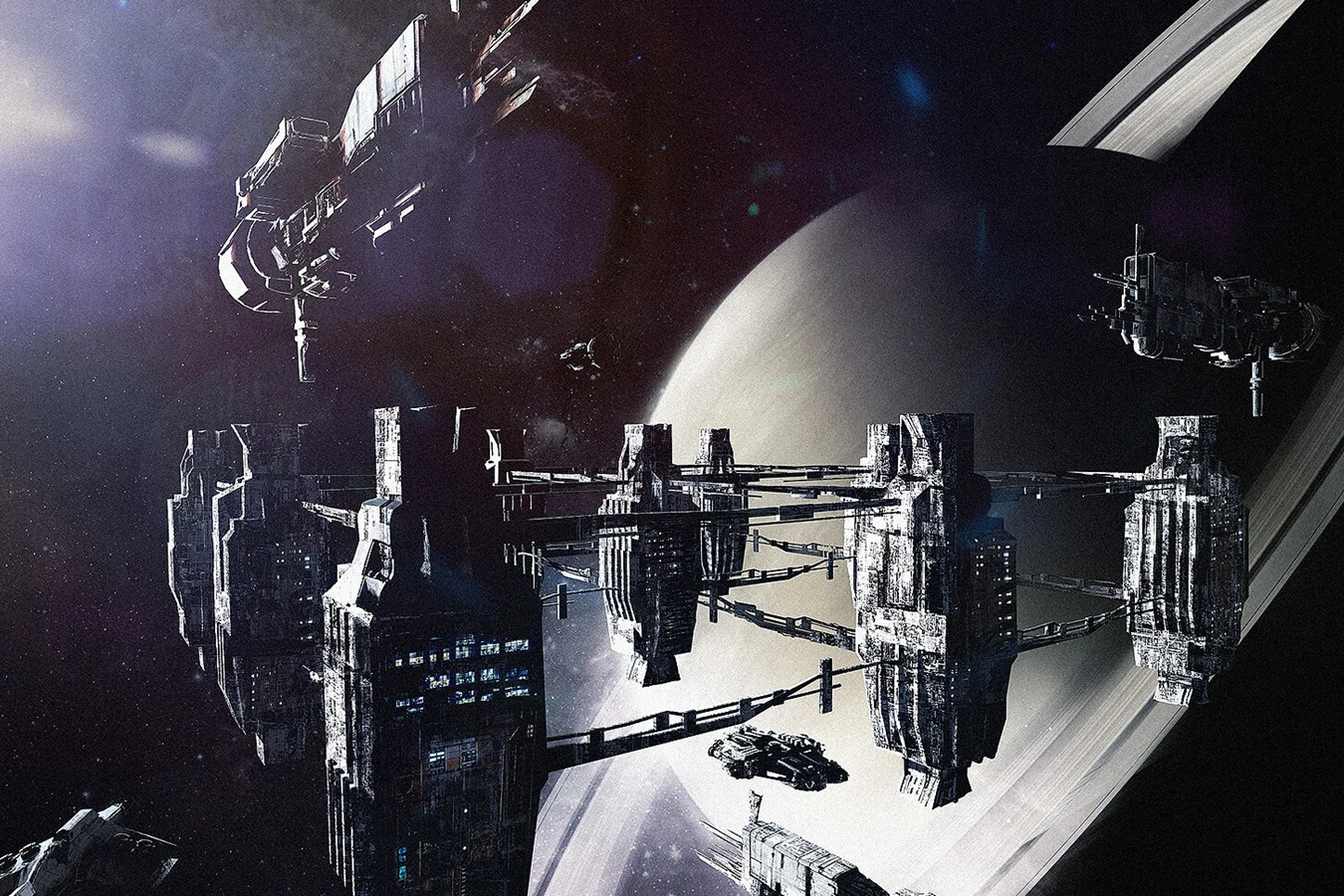
Novgorod Station is the third starter map, ICC registration 1709556, a 10,000-ton Seegson transfer spire over Alpha Fornacis with 140 crew, room for 40 visitors, and hard docks for two ships. A debris disk of tungsten and trimonite rocks keeps survey boats busy, and the book says the same ten-deck layout can be renamed as Junction, Korosten Terminal, Thetis, Platform KT3, or Carlisle.
A Deck is engineering, with a 3.1-gigawatt deuterium-tritium plant, liquid-hydrogen tanks, and potassium coolant. B Deck holds cargo, an EVA lock, a Marshal office with four cells, and St. Luke's four-bed clinic. C Deck is the concourse and the only level passengers may use. D Deck is life support and a sealed hydroponic garden that is there to scrub air, not to look at. E through J climb through habitation, the lower and upper towers, science labs, and comms, with A.P.O.L.L.O. wall terminals that take an ID card and double as video phones.
Last Survivor And Life Paths
Last Survivor
Last Survivor is the Evolved solo mode, written so one player can run a short, ugly story without a Game Mother. Character creation follows the normal career rules, with an extra general talent and a bias toward Hardened, Survivor, Seen It All, and similar picks. An android is called out as a strong solo choice because it ignores stress and panic. Experience comes from finishing objective timers rather than from the usual end-of-session questions.
Mission starters are grouped by trucker, Marine, colonist, and company-rep jobs: a silent colony, a salvage hulk, escort duty, a meteorite with something inside, or a labor uprising on an orbital. Mother Analysis tables answer yes-or-no and more complex questions when the player needs the world to talk back. Danger timers, survivor timers, and objective timers replace the absent Game Mother's clock. Solo stealth uses encounter timers, noise, motion trackers, and scavenges, then drops into the normal combat rules or a shortened space-combat version when a fight starts.
Life Paths
Life paths are an optional appendix of about eight pages that replace free attribute spends with origin, early life, a life event, career terms, a psych evaluation, and final touches. A human or android choice sits at the front of that track. The book presents the path as a way to grow a character who already has scars before the first session, not as a required replacement for the fourteen-point method. Conversion notes at the back tell first-edition tables to swap old talents, reset armor and ammo, and use the new Xenomorph statistics.
Editions And Expansions
2019 Core And Evolved
The 2019 core book was a 392-page full-color hardcover launched the same day as Chariot of the Gods, custom dice, a Game Mother screen, and map packs, and demand forced an early reprint. It won the Gold ENNIE for Best Game in 2020. Evolved keeps first-edition expansions legal. New pages add life paths, Last Survivor, Tartarus as a full campaign map, the Jackson's Star write-up, Romulus weapons and ships, zero-gravity rules, miniatures support, and the revised stealth, stress, armor, ammo, grenade, stun, and space-combat procedures. Standart Impressa UAB printed the first Evolved run in 2025 under a 20th Century Studios license. Unbound print-plus-PDF copies sold beside the standard hardcover.
Hope's Last Day
The first edition printed Hope's Last Day in the core hardcover as a short cinematic set in the last hours of Hadley's Hope. Five workers try to leave LV-426 alive: Janice MacWhirr, Morgan Hirsch, Hannah Singleton, Sonny Sigg, and the synthetic Holroyd. Evolved cut that adventure from the 316-page rulebook and moved it into a redesigned Starter Set with custom cards, dice, and tokens. Cinematic tables that used the 2019 book still have the same job in the hardcover they already own.
Chariot Of The Gods
Chariot of the Gods is the first cinematic module in the Draconis Strain Saga, a 48-page Andrew E.C. Gaska scenario that shipped in the original Starter Set and was later sold on its own. The crew of the USCSS Montero, a Lockmart CM-88B Bison hauling fuel for Weyland-Yutani, wakes from hypersleep to a distress call from the old science ship USCSS Cronus. Company contract rules require them to investigate or forfeit the payday. The module is written for space truckers and company staff, not a Marine squad, and the Starter Set map carries deck plans for both hulls.
Destroyer Of Worlds
Destroyer of Worlds is the second Draconis Strain boxed set and switches the table to Colonial Marines for three to five players plus a Game Mother. A scratch section at Fort Nebraska on the ice moon Ariarcus is sent after four Marines who went missing on the eve of a UPP move. The box keeps the three-act cinematic structure and hidden-agenda cards, and it ships a double-sided map of the Ariarcus colony and the Fort Nebraska space-elevator base, seven pre-generated characters, and custom gear cards.
Heart Of Darkness
Heart of Darkness closes the Draconis Strain line for three to five players. Andrew E.C. Gaska wrote the cinematic as a standalone job that also finishes the Cronus thread. A Weyland-Yutani science team is sent to the plasma-collection platform Erebos, a station beyond the Frontier that hangs over a black hole in the 26 Draconis system, after vital signs appear where none should be.
Rapture Protocol
Rapture Protocol shipped with the Evolved wave in 2025 as the first cinematic of the Jeremiah Saga, written to stand alone or open a three-part line. Three to five players take the crew of the starfreighter USS Fidanza on a resupply run to the remote industrial colony Jeremiah VI. The boxed set includes a scenario book, a double-sided map of the Fidanza and the Jeremiah mining base, five pre-generated characters, agenda and NPC cards, tokens, and handouts. A matching miniatures set of twenty hard-plastic figures sold beside it.
Colonial Marines Operations Manual
The Colonial Marines Operations Manual is the campaign hardcover for Marine play, first issued for the 2019 rules and later given an Evolved interior layout without a full rewrite. The Evolved printing is 252 pages. It covers USCMC history and organization, expanded grunt creation, new weapons and vehicles, a Frontier War campaign frame, six missions that can be run in any order, and a closing endgame. The black-projects chapter also covers Dr. N.L. Babak's XX121B biodrones, a drone-stage weapon with a six-day expiry that sometimes failed. It is a tabletop operations text for the RPG, not a reprint of the Aliens Colonial Marines Technical Manual. Digital modules for the line followed on Roll20 and Demiplane, with Foundry and Alchemy listed as later platforms.
Building Better Worlds
Building Better Worlds is the matching campaign hardcover for colonist and survey play, also later given an Evolved interior layout. The Evolved printing is 256 pages. It adds a colonization history, two new archetypes, gear and ships, 36 mapped worlds including the Far Spinward Colonies, an extrasolar species catalog, colony-building tools, and the Lost Worlds sandbox of seven expeditions. The core book sends long-form colonist tables there instead of reprinting them.
Titan Novel Scenarios
Three short cinematic tie-ins were bound into Titan novels rather than sold as boxed sets. Fallout shipped with Alien: Colony War, EVAC with Alien: Inferno's Fall, and Trojan Horse with Alien: Enemy of My Enemy. Each uses the core rules and the novel's setting rather than a new boxed map pack. A deluxe Game Mother screen also shipped in the Evolved wave.
1991 Adventure Game
The 1991 Aliens Adventure Game from Leading Edge Games is a different license, a 194-page Phoenix Command relative focused on the Aliens year and a second Sulaco strike team. Free League's book does not reprint those tables. It is the second official Alien tabletop roleplaying game, not a new edition of the 1991 rules. Collectors who want both are looking at two separate systems and two separate setting dates, 2179 and 2183.
Behind The Scenes
Writing And Design
Tomas Härenstam is Free League's lead designer and the person who adapted the Year Zero Engine, first seen in Mutant: Year Zero, to Alien. Andrew E.C. Gaska, working through BLAM! Ventures, wrote the setting and served as continuity consultant, the same novelist later credited on Heart of Darkness and other cinematic books. Additional setting and rules text came from Paul Elliott, Dave Semark, Matthew Tyler-Jones, Nils Karlén, Kosta Kostulas, and Brandon Bowling. Shawn Tomkin and Matt Click wrote the Last Survivor solo rules.
Art And Maps
Martin Grip was lead artist. Johan Nohr handled graphic design and layout, with more art from Gustaf Ekelund, Col Price, and Nohr himself. Colm Geoghegan of Creepy Duck Design painted the original cover of a lone astronaut under a Xenomorph. John R. Mullaney drew ships and vehicles, and Axel Torvenius shared weapon art with Mullaney. Clara Fei-Fei Čarija, Gaska, Nohr, and Christian Granath are credited for stellar cartography, with maps also from Miska Fredman and Stefan Isberg.
License And Thanks
Joe LeFavi of Genuine Entertainment managed the brand for 20th Century Studios. Dan Algstrand ran prepress, Daniel Lehto handled customer support, and Anna Westerling ran events. The special-thanks list includes Ridley Scott, Josh Izzo, Aaron Percival, Harry Harris, Scott Middlebrook, Creative Assembly, Gearbox Software, and Dr. Brad Tucker. Playtesters ran from Free League regulars such as Marco Behrmann and Nils Karlén's groups through a long public list printed in the credits.
Conclusion
Alien: The Roleplaying Game is Free League's 2019 Year Zero Engine hardcover for the Alien films, revised in 2025 as the Evolved Edition. Gaska's 2183 Frontier gives the table Marines, truckers, and colonists, then closes the book on Tartarus Sector, Jackson's Star, Novgorod Station, and a solo Last Survivor mode for a player who has no Game Mother. The expansions keep using that same map.
External Sources
Tag Categories: Alien Merchandise | Alien Universe Reference Books