Prometheus (2012): Plot, Cast, And Production

Prometheus (2012) is a science fiction horror film directed by Ridley Scott and set in the wider Alien universe. The story followed a Weyland-funded expedition to LV-223, where a team of scientists and crew members searched for the beings they believed created humanity. What began as a mission of discovery turned into a catastrophic encounter with ancient bioengineered horrors, hidden motives, and the origins of threats tied to the larger Alien mythos. The film expanded the franchise by shifting attention away from Xenomorphs alone and toward humanity's relationship with the mysterious Engineers. It served as a prequel-era entry that explored creation, faith, artificial life, and the dangerous consequences of seeking forbidden knowledge.
Film Overview
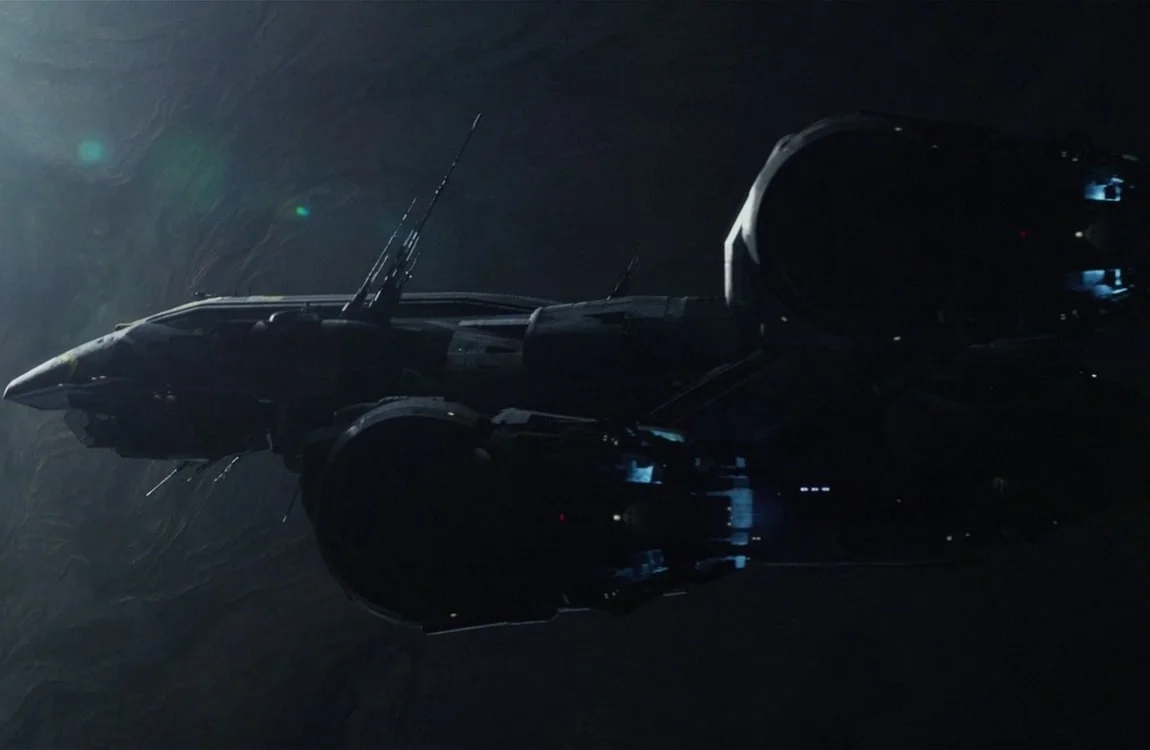
Released in 2012, Prometheus marked Ridley Scott's return to the franchise world he helped establish with Alien in 1979. Rather than functioning as a direct Alien prequel, the film broadened the mythology by examining ancient civilizations, corporate ambition, synthetic life, and the possible creators of humanity. The expedition aboard the USCSS Prometheus reached LV-223 after archaeologists discovered matching star maps in several ancient human cultures. There, the crew discovered ruins, biological weapons, and evidence that the mission's true purpose extended far beyond scientific exploration. The film combined cosmic mystery, body horror, and existential questions while laying groundwork that later continued in Alien: Covenant.
Plot Summary
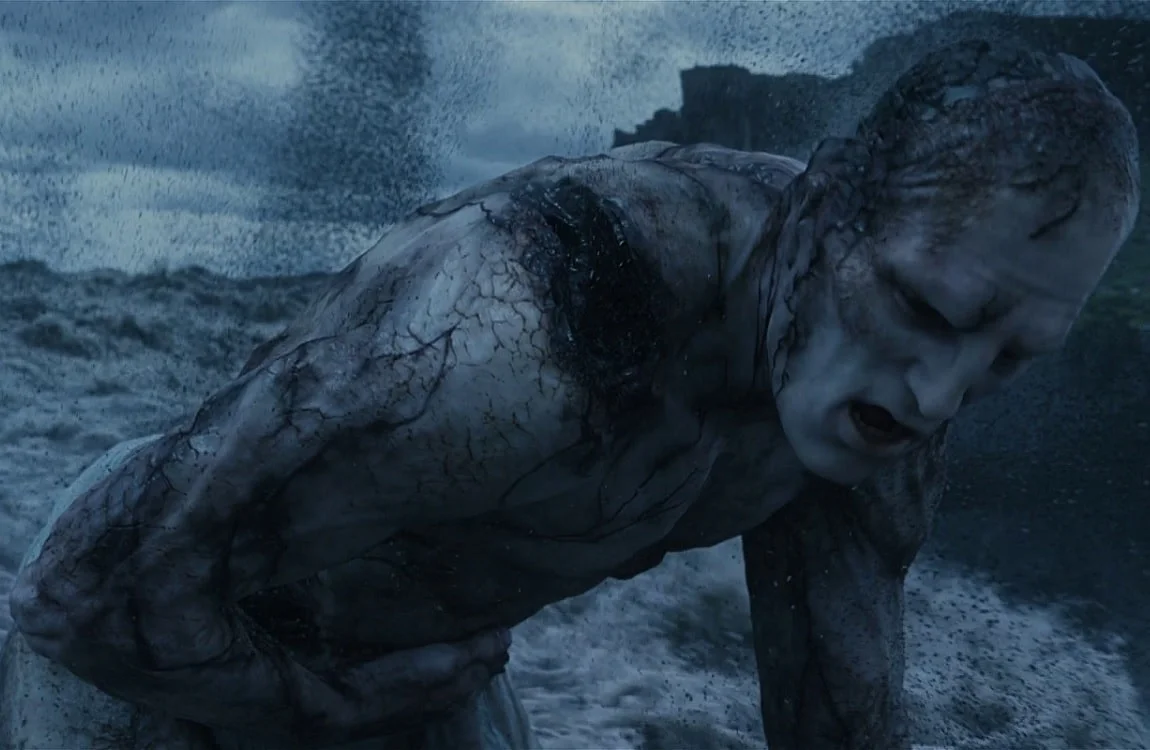
A horseshoe Engineer ship left one of its kind on prehistoric Earth, on the rocks above a high waterfall. That Engineer set aside his cloak, raised a ceremonial cup, and drank a dark fluid that attacked him from within. His skin split, his body lost its shape, and he fell into the river. In the water the remains came apart down to the strand, then knitted into new living matter. That sacrifice was the beginning of human life on the planet.
In 2089, archaeologists Elizabeth Shaw and Charlie Holloway opened a cave on the Isle of Skye in Scotland and found a painted star pattern that matched maps left in several early human cultures. They read those images as an invitation from humanity's creators, not a warning. The Weyland Corporation funded a deep-space expedition on that claim. The research vessel Prometheus left Earth with scientists, security staff, corporate officers, and the android David.
David stayed awake for the two-year crossing, running the ship and studying the languages he would later need. He also reviewed Shaw's dreams while the rest of the crew slept. Prometheus reached LV-223 at Christmas in 2093. Meredith Vickers presented herself as the company officer in charge, and a holographic briefing from Peter Weyland told the waking scientists that he was dead and that the voyage was meant to find the beings who made mankind. Shaw and Holloway then laid out the maps that had brought them there.
After they landed beside a vast artificial mound, Shaw, Holloway, David, and a first team crossed the surface and went in through a broken gate. Fifield's mapping spheres showed cleaner air deeper in, so the party took off their helmets. Holographic records played Engineers running from a threat about two thousand years earlier, and a door took the head off one of them. The team reached a hall with a giant stone head and rows of urns filled with a black mutagenic fluid. They carried that severed Engineer head back toward the ship as a storm closed in.
The storm cut the party off from the ship. Biologist Millburn and geologist Fifield stayed in the structure after they lost the others. The urn room warmed, the black fluid leaked, and small worms in the damp changed into a Hammerpede. Millburn reached for the creature, which broke his arm, forced itself down his throat, and killed him. Acid from the Hammerpede burned through Fifield's helmet, and he fell into the leaking fluid.
In the lab the severed Engineer head was dated to about two thousand years and briefly reanimated before it burst. David had taken a drop of the black fluid from an urn during the first descent. Holloway treated any price as acceptable if it meant meeting their makers, and David put that drop in his drink. The infection showed in Holloway's eyes the next morning. When the party tried to bring him back aboard, Vickers held the airlock and burned him.
Shaw had been told she could not conceive, and she had spent the night with Holloway before his infection showed. A scan then found she was carrying a rapidly growing organism. She broke free of the med bay and locked herself into the Pauling MedPod in Vickers's module. The booth had been set up for a male patient, so she overrode the settings, forced a cesarean, and cut out a Trilobite. She stapled the wound and left the creature sealed in the module.
A mutated Fifield came back to the hangar, killed several of the remaining crew, and was brought down with fire and gunfire. The survivors then learned that elderly Peter Weyland had traveled in the ship in secret, in stasis. Vickers was his daughter, and he wanted the Engineers to give him more life. Captain Janek treated the mound as a weapons depot built to wipe out a world, not a temple.
David had found a buried hangar under the mound, a last living Engineer in a stasis pod, and a navigation display that marked Earth. He led Weyland, Shaw, and Ford onto that ship and woke the Engineer. The Engineer killed Weyland and the others around him, then tore David's head from his body. Shaw fled the deck.
The Engineer set a Juggernaut on course for Earth with a hold full of the black fluid. Captain Janek stayed on the bridge with Chance and Ravel and rammed Prometheus into the departing ship. Meredith Vickers ejected in the lifeboat module and was crushed when the wrecked Juggernaut rolled across the ground.
Shaw reached that landed module and found the Engineer there. She opened the MedPod and released the grown Trilobite, which pinned him to the deck. A Deacon then tore out of the Engineer's chest. Shaw recovered David's severed head from the wreck, started another Engineer ship under a nearby mound, and left LV-223 for the Engineers' homeworld, looking for why humanity had been made and then marked for destruction.
Cast And Characters
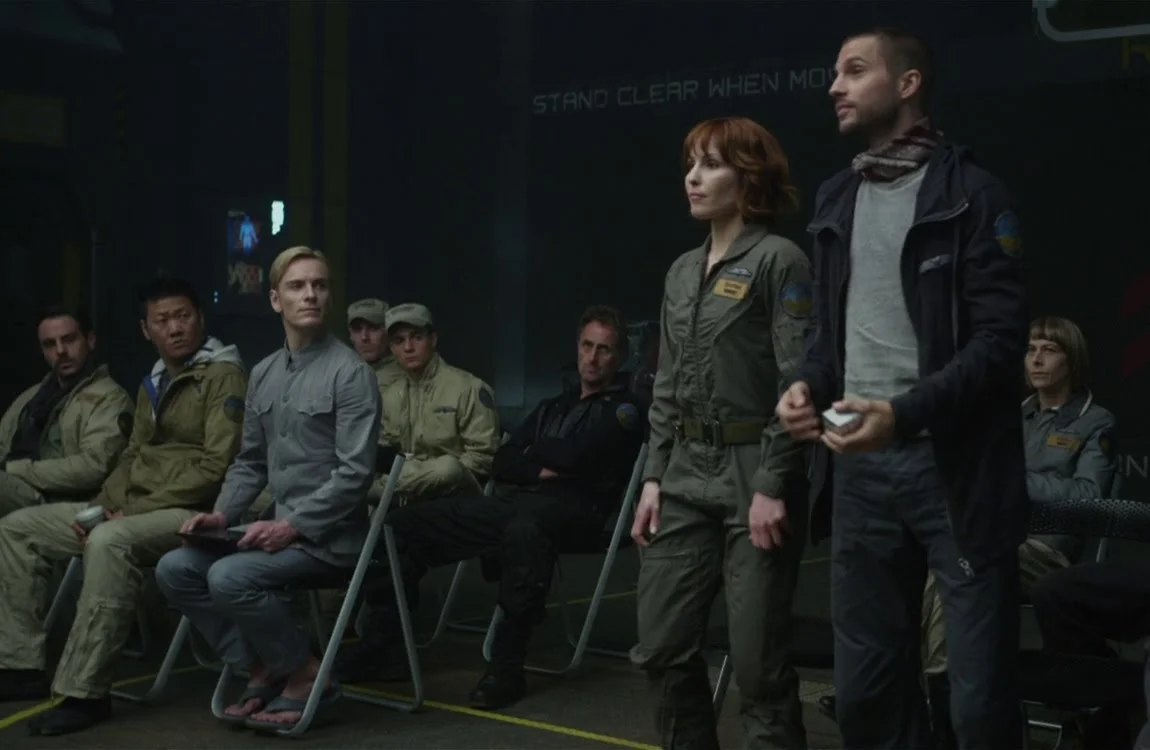
Prometheus featured scientists, corporate personnel, explorers, and synthetic characters whose motives often conflicted as the mission deteriorated. The film centered especially on Shaw, David, and Weyland, while the Engineer presence gave the story its larger mythological weight.
- Elizabeth Shaw (Noomi Rapace) - Archaeologist who found the star maps with Holloway, cut a Trilobite out of herself in the MedPod, and left LV-223 with David's head for the Engineer homeworld.
- David (Michael Fassbender) - Weyland's android. He stayed awake for the crossing, put the black fluid in Holloway's drink, woke the last Engineer, and left the moon as a severed head.
- Charlie Holloway (Logan Marshall-Green) - Archaeologist who believed humanity had been invited. David infected him after the first descent, and Vickers burned him at the airlock.
- Meredith Vickers (Charlize Theron) - Company executive and Peter Weyland's daughter who oversaw the mission, refused Holloway at the lock, and was crushed by the rolling Juggernaut after she ejected.
- Peter Weyland (Guy Pearce) - Founder of Weyland Corporation who traveled in secret, in stasis, hoping the Engineers could extend his life. The last Engineer killed him on the Juggernaut deck.
- Janek (Idris Elba) - Captain of the Prometheus. He treated the mound as a weapons site and rammed the ship into the departing Juggernaut with Chance and Ravel.
- Millburn (Rafe Spall) - Biologist who stayed in the pyramid during the storm and was killed when a Hammerpede forced itself down his throat.
- Fifield (Sean Harris) - Geologist whose mapping spheres opened the mound. He fell into the black fluid and came back mutated to attack the hangar.
- Ford (Kate Dickie) - Medical officer who examined the Engineer head in the lab, then went with Weyland to wake the last Engineer and was killed there.
- Chance (Emun Elliott) - Bridge pilot who stayed with Janek when the captain chose to stop the Juggernaut, and died in that collision.
- Ravel (Benedict Wong) - Bridge pilot who ran the helm with Chance and remained aboard for the ramming run that destroyed Prometheus.
- Jackson (Branwell Donaghey) - Mercenary on Weyland's security team. He went into the Juggernaut to wake the Engineer and was killed there.
- Shaw's Father (Patrick Wilson) - Appeared in Shaw's recorded dreams as a missionary who died when she was a child. David reviewed those memories during the crossing.
- Sacrificial Engineer (Daniel James) - The Engineer who drank the dark fluid at the waterfall on prehistoric Earth and whose remains seeded human life.
- The Last Engineer (Ian Whyte) - Last survivor in the buried ship. He killed Weyland's party, set course for Earth, then died when Shaw released the grown Trilobite.
LV-223
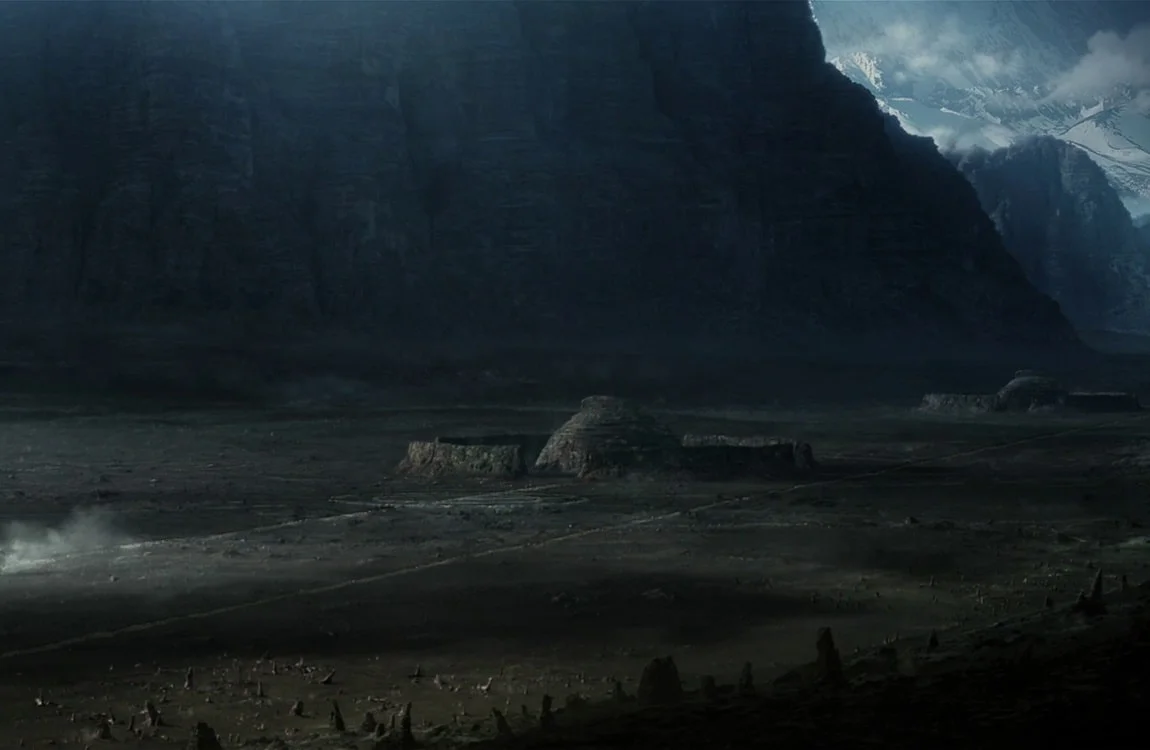
LV-223 served as the film's main setting and appeared as a bleak world of storms, ruins, underground chambers, and buried secrets. The moon functioned as an artificial site filled with evidence of scientific work, death, and military-scale danger. Its monumental architecture, giant stone head, urn chambers, and dormant spacecraft defined the film's visual identity. As more of the structure was explored, LV-223 appeared less like a place of revelation and more like a tomb containing unstable biological weapons. LV-223 was orbiting the same planet, Calpamos, as LV-426 from the first two Alien movies.
Place In The Alien Timeline
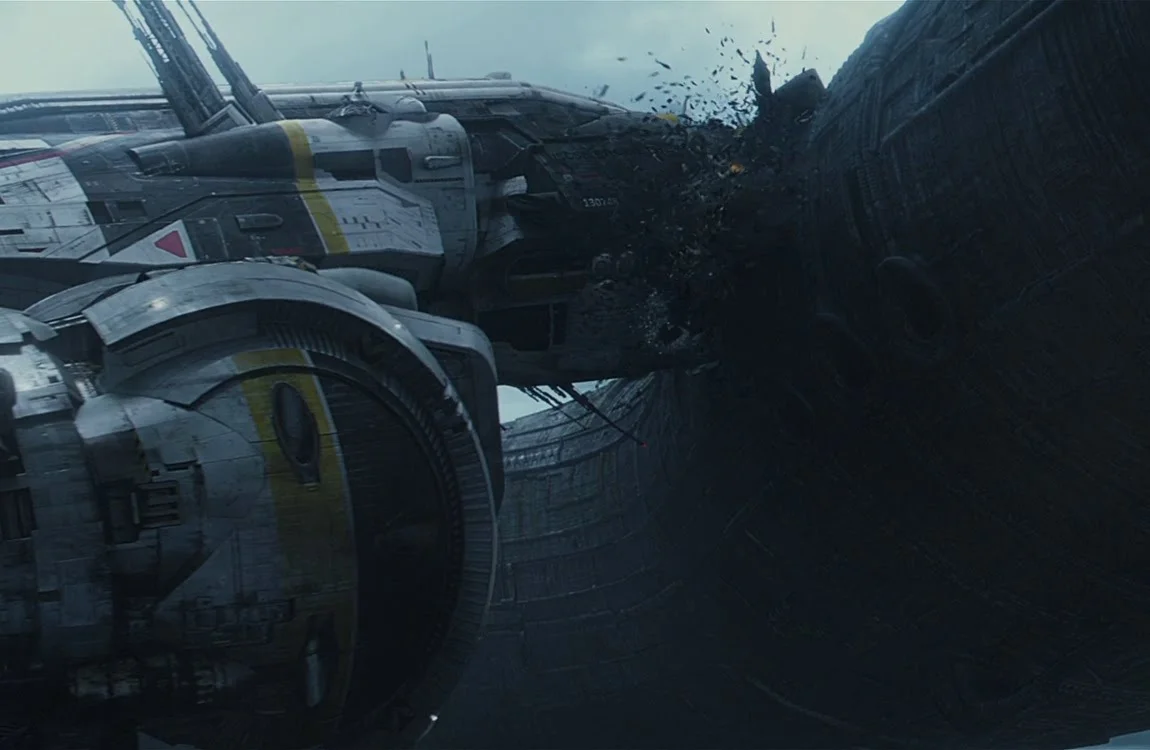
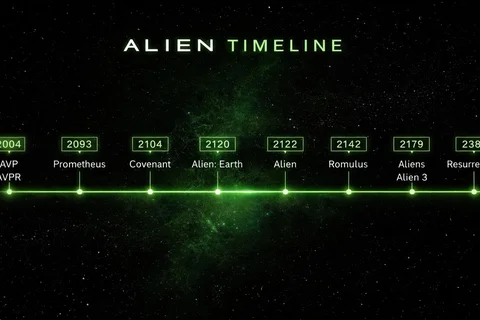
Prometheus took place during Christmas in 2093, decades before the events of Alien (1979). It introduced the Engineers, expanded the role of Weyland, and explored early experiments connected to the future of the Alien universe. Shaw left LV-223 with David's head after the wreck, and the Nostromo answered its call on LV-426 in 2122. Its events led directly into Alien: Covenant, which continued the story of David and the Alien prequel timeline ten years later.
Production
Writing
Ridley Scott started from the giant pilot fused to the chair in Alien. He treated that figure as a worn space suit rather than a skeleton, and he wanted to know what cargo such a ship would carry, where it was going, and why. Those questions pointed him toward a load of chemical and biological weapons, and toward a crew that would go looking for the answers. He hired Jon Spaihts to write what many people then called an Alien prequel, set mostly on LV-426 and using familiar creatures.
As the script developed, the familiar Alien became less important, and a race of giant humanoids who had visited Earth took the center. Scott drew that idea from Erich von Däniken's books about ancient visitors, and from large figures standing over smaller people in Maya, Inca, Egyptian, and Hawaiian art. Spaihts named those beings Engineers, and Scott kept the word. After Damon Lindelof rewrote the draft, the story left LV-426 for another world and stopped being a straight walk into the Nostromo egg chamber.
Scott treated the Xenomorph as used up after four films, including a scene that locked it in a glass cage. He moved the threat to a species a few million years ahead of humans, able to seed life, terraform a planet, and wipe one out. The Space Jockey in the chair remained the image that started the film.
Development
Scott asked production designer Arthur Max to start work on the untitled Alien prequel about six months before the studio greenlit the film. Max had designed Gladiator, Kingdom of Heaven, and Robin Hood for Scott. He had little science-fiction film work beyond a few commercials, including a 1985 Coca-Cola spot that first put him with Scott. He pulled unused H.R. Giger, Ron Cobb, and Chris Foss drawings from the Academy of Motion Picture Arts and Sciences library, then spent about a month with illustrator Steven Burg on first sketches for the studio.
Those pages showed a ship first called Magellan, a Weyland Mars terraforming job, an orbital station, and a do-it-yourself surgical booth Scott named the Auto-doc, an idea left over from Alien. Max later brought in Ben Procter, Steven Messing, David Levy, vehicle designer Daniel Simon, Neville Page, and Carlos Huante. On the team's first working day he screened Alien on the large Zanuck screen at Fox so the lighting, scale, and textures were clear.
Max did not want to copy the Nostromo look. Scott wanted the 1979 design language taken apart and rebuilt as something cleaner and more mechanical than Giger's organic work. The writers sat with the art department while the script was changing, and many of the sets came out of that exchange. Max also looked at NASA and European Space Agency hardware, Russian craft, Chesley Bonestell paintings, and Robert McCall's work for 2001: A Space Odyssey.
Casting
Noomi Rapace played Elizabeth Shaw. Costume designer Janty Yates tried futurist, Star Trek, diagonal, and Eastern looks on her before settling on a pilot outfit closer to Sigourney Weaver's gear. Michael Fassbender played David with a slightly androgynous look taken from Lawrence of Arabia and early David Bowie. Charlize Theron played Meredith Vickers, and her last London shooting day put her in the cargo hold with a flamethrower.
Guy Pearce played Peter Weyland under prosthetic old-age makeup that took about five hours in the chair. The production never locked a number, but the character sat near one hundred years old. Ian Whyte and Daniel James wore the bulky Engineer suits. Whyte had played Scar Predator in Alien vs. Predator 2004. The finished Engineer faces were digitally cleaned so the performers could be read through the prosthetics.
Filming
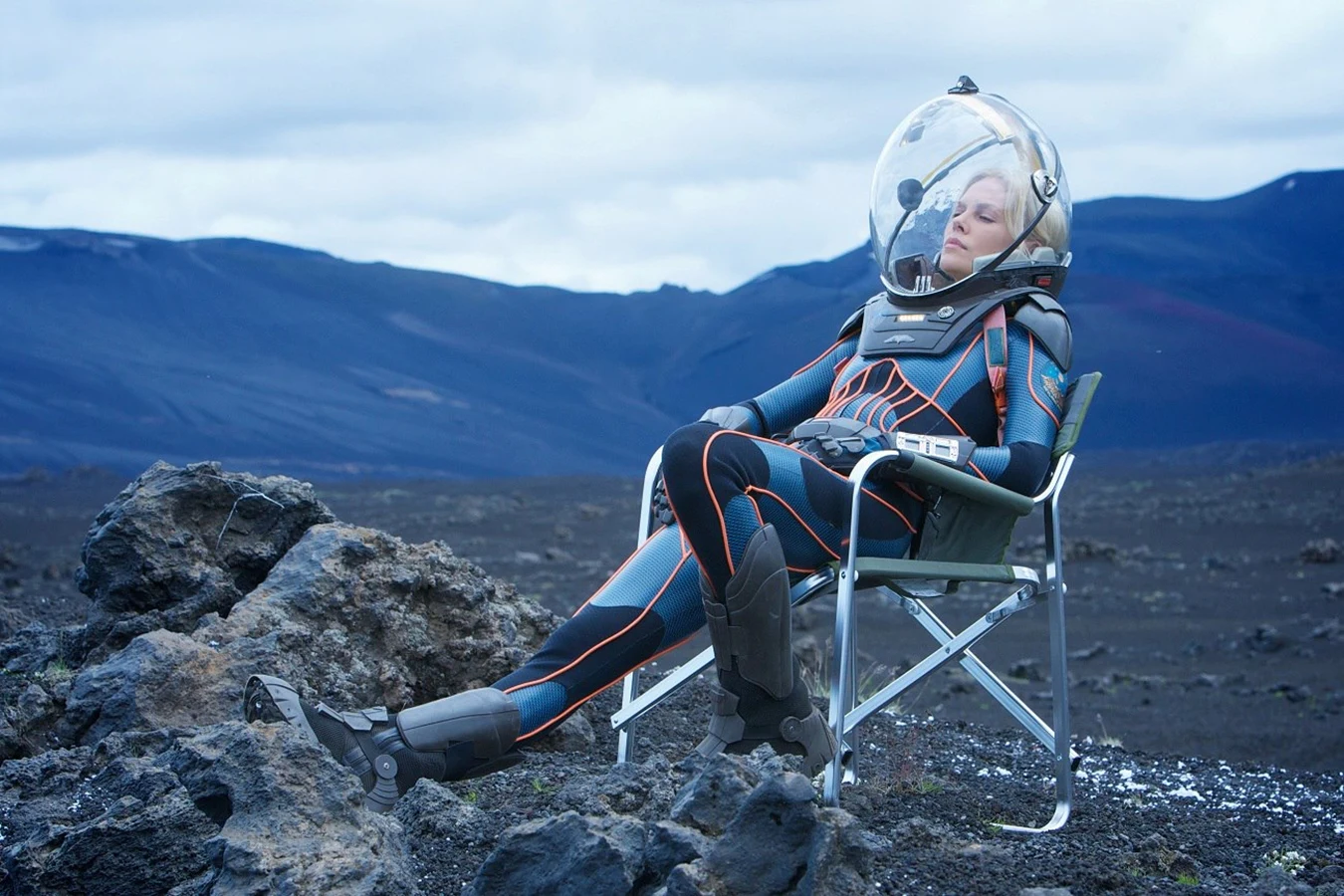
Morocco was the first plan for the planet exteriors, after scouting in Scotland, Jordan, and Iceland. Unrest in North Africa after the 2010 Arab Spring moved that work to the highlands around the volcano Hekla. Shooting there began on 11 July 2011, on grey and black volcanic ash and lava. Dettifoss stood in for the opening sacrifice. Scott used about fifteen minutes of Iceland footage. January 2012 pickups included the Isle of Skye cave where Shaw and Holloway find the star map.
Principal photography began on 21 March 2011 and ran 82 days on a budget of about $120 to $130 million. Interiors were shot at Shepperton and Pinewood Studios across eight stages. Max had to spread about sixteen sets through five of those stages and enlarge the 007 Stage by more than 30 percent. Cinematographer Dariusz Wolski shot the whole film in 3D on 3ality Atom rigs with Red Epic cameras, which added about $10 million. Scott filmed 360 degrees on those stages, so the art department dressed every wall. The dark Alien grading was applied after the shoot because 3D needed bright sets. Rapace worked on fewer than six green-screen shots.
Prometheus And Ship Design
Burg designed the ship's exterior when the vessel was called Magellan. Scott went back to an unused Cobb drawing of a modular tug whose cargo pods could be chained like railway cars. The finished Prometheus was meant as a deep-space exploration mothership, not a worn ore hauler like the Nostromo. Max built a coded 3D cross-section so Scott could plan how the bridge, hangar, lab, crew quarters, and mess connected by lifts.
The interiors stayed octagonal, like the 1979 mess and science lab, but larger and more advanced. The first clear walk through those corridors was David's route while the crew slept. Max wanted the longest possible halls so the ship read as huge. The two-level bridge came from another unused Cobb Nostromo concept that Fox had rejected as too big. Scott wanted the mothership bridge to have scale. Max and Scott replaced Cobb's projection screens with a faceted wraparound windscreen, like a stealth bomber canopy, so the captain could look down on a planet. They tested foam-core consoles and rubber-ball throttles before building the set on engineering bellows that could shake the whole room for atmospheric entry.
Vickers's quarters mixed a terrace apartment with a luxury yacht and held the Pauling MedPod. Max took the plastic interior from a still of William Cameron Menzies's 1936 film Things to Come in the Shepperton archive. The rooms also used Swarovski chandeliers, a Fazioli piano, and a holographic window that could show Earth or the view outside. The module was a lifeboat as well, with its own engines, retro-rockets, air, and distress beacon. When the Juggernaut struck the Prometheus, that module separated and landed on its own. The MedLab and MedPod came from talks with Imperial College London's surgical department, which was then working on remote battlefield surgery kits.
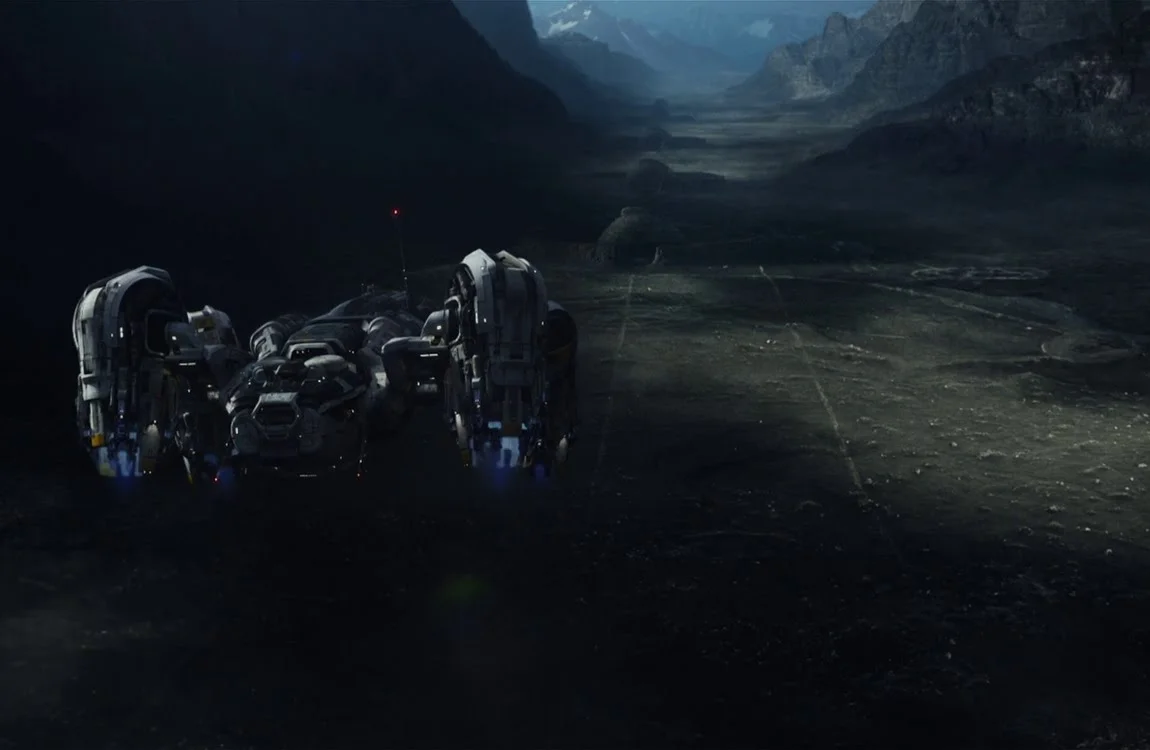
Scott wanted the ship to come down and drop its cargo straight onto the surface. Burg gave it Harrier-like pivoting engines and landing legs that held the hull about 30 to 45 metres up, so containers could be winched down. Max built a full-size landing leg on the Pinewood backlot and rubberized it so stunt coordinator Rob Inch could run the storm sequence around it. Scott asked for ion engines with a cooler blue flame. The ice-fragment look of the original Nostromo lift-off was copied by shooting rain through bright black light with high-speed cameras.
Costumes
Janty Yates had orders to avoid NASA's puffy suit and the 1979 landing-party look. Scott also rejected ultra-future uniforms. The crew clothes were meant to look informal and close to one another. For the EVA suits he liked the tight silver NASA underlayers of the 1960s and later bio-suits with cooling tubes on the outside, which gave the actors more movement than a bulky shell.
Scott designed the oval helmets, more egg-shaped than a standard dome. Yates's shop fitted LEDs so faces could be lit, two fans in a rear battery pack to keep the visors clear, microphones so the actors could hear Scott and each other, a strong lamp on top, and HD cameras on the sides with a transmitter and recorder on the back. The side cameras began as dummies, then Scott asked for working units. Set decorator Sonja Klaus had display EVA suits built only to be seen. Scott later kept one in his London office and one in Los Angeles.
Vehicles
Max hired former Bugatti and Volkswagen designer Daniel Simon to start the Rover from real driveable chassis rather than hover craft. Scott asked about antigravity vehicles. Max turned that down as too close to Star Wars. Concept artists David Levy in Los Angeles and Marc Homes in London traded files every twelve hours until the closed Rover mixed wheels and tracks. Each finished Rover took eleven weeks on a four-wheel-drive chassis of more than sixteen tonnes, bought in the Czech Republic and shipped to England. The vehicles ran about ten metres long, three metres high, and three metres wide.
Bronze wheel covers came from an early helmet idea that used a gold-bronze coating as both shield and solar panel. Those covers were fibreglass, then metal-coated in a vacuum chamber so they would shine on the Iceland ground. The open ATVs were built from scratch as working machines that could reach about 80 km/h. Inch found them hard to drive, and jumping the cargo-bay ramp broke the suspension. The throttle was limited when actors were aboard.
The Pyramid
The mound's final dome came from a Giger sketch of ovoid hills that Max found in the 1979 archives. Giger's version read like a swollen organic bladder. Max kept the outline and made it look more like rock and machine, so a viewer would not be sure whether the shape was a building or a landform until the crew's metal scans forced a landing. The entrance combined a real Iceland slope with a set on Pinewood's 007 Stage, the largest in the United Kingdom. A 45-metre incline led to a low ceiling of rock debris and a louvered door with missing panels, which is how the crew first got in.
The pyramid entrance set ran about 150 metres long and 75 metres wide. Max had to push about a third of it onto the backlot and roof that extension, making a stage inside a stage. He treated the interior as something Earth's classical buildings might have copied, because the Engineers had visited Earth. A 1960s arcology idea from Paolo Soleri's Arcosanti project in New Mexico gave him a reason the crew could remove helmets at the center. The structure was meant to gather sunlight and condense water. Fifield's mapping Pups began as elaborate science-fiction drones. Scott cut them down to simple spheres that the actors could handle.
Ampule Chamber
Scott's first brief for the urn hall was a cathedral with a Sistine-style ceiling of creation, ruin, and judgment, plus an altar that felt ceremonial without matching a known religion. Max borrowed the 1979 egg chamber, then laid the room out as a mandala around a hub and later stretched that circle into an ellipse. Giger-like rib-cage corridors and plant-like columns led to a giant Engineer head at the center, after Scott asked for a statue that celebrated the species. The head mixed Michelangelo's David, the Statue of Liberty, Elvis Presley, and the straight brow-to-nose line of fourth-century Greek sculpture. Scale came from Egyptian royal portraits, with added script so it would not read as a simple bust.
An arched relief of a Giger-like crucified creature sat on the altar as a nod to the 1979 Alien. Set decorator Klaus built Scott's urns from two of his references: gold found in a Nazi cache, shaped like a cigar with a glass end you broke, and a piece of Roman glass with a butterfly-wing texture. Raku potter Rob Sollis spent four months in a Pinewood workshop making about seventy ceramic urns, 40 to 91 centimetres tall, with a metal finish and alien text engraved by Andrew Woodard. Units that opened for David's inspection held shaped luffa and a thick black fluid.
Engineers And The Juggernaut
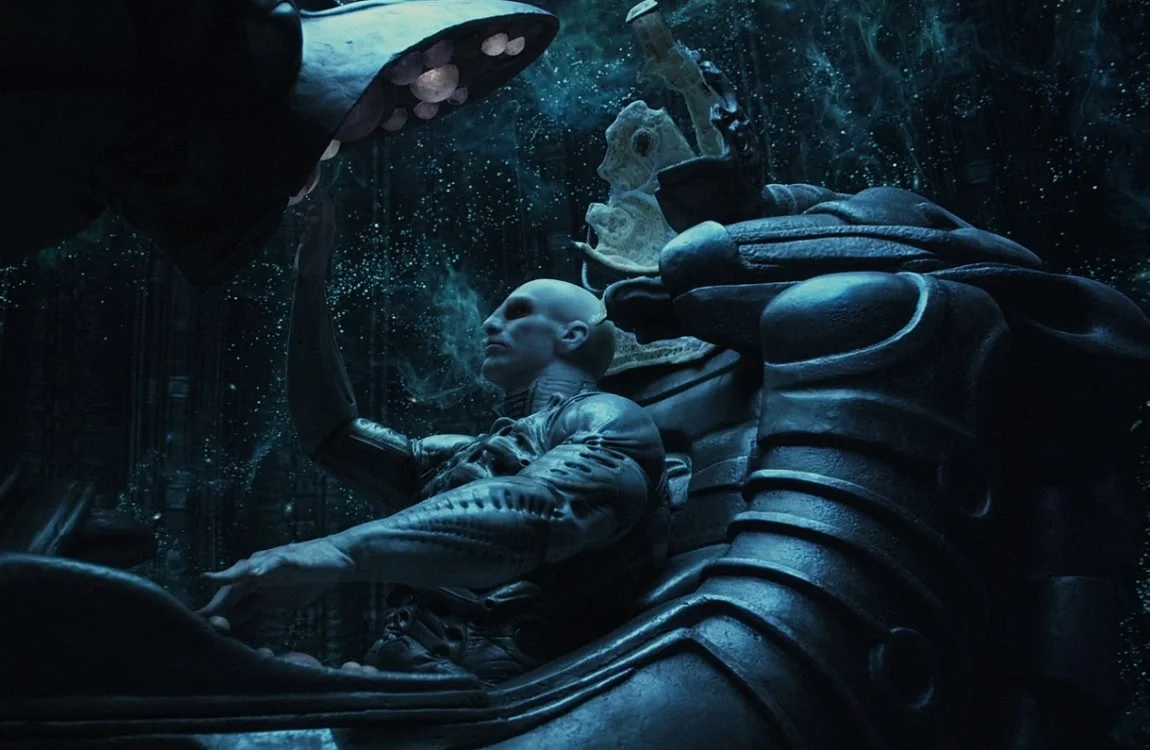
Max pictured the Engineers as Greek titans: human in shape, larger in proportion. He photographed Michelangelo's David in Florence and passed those pictures to Page with studies of the Statue of Liberty and Elvis, because Scott wanted a continuous brow and nose rather than bodybuilder muscle. Suited Engineers averaged about 2.75 metres, so the sets dwarfed the human cast. Neal Scanlan's shop built full-size Engineers in protective suits and cable-worked hands, then dropped those puppets. Performers in the suits were filmed and scanned, then folded into digital versions.
Steven Messing designed the exo-suit from Giger's 1979 work. Page designed the inner body as a mix of Russian cosmonaut and samurai, a second skin rather than a worn garment, with tubes that could lock into hibernation pods. Scott treated the 1979 Space Jockey as that helmet, petrified after centuries, not an elephant-headed creature. Portal writing mixed old Persian and pre-Sumerian marks so linguists would not read a joke in the glyphs. The medical scanner table, where an Engineer helmet is cut open, came from the Nostromo lab's wall-mounted examination bench.
The Engineer ship was nicknamed the Juggernaut. It started from the horseshoe wreck in Alien. Scott wanted the hull to roll like a doughnut at the end, so the art department changed the shape to a torus about 350 metres across and 75 metres high, more than twice the Prometheus. Surface detail came from Giger drawings, pushed further than the 1979 miniature. David found the hangar by following a failed Pup through tunnels. Scott's brief put more hangars under the other mounds, which implied a fleet.
The hibernation deck used transparent lotus-like pods with invented script. The crew nicknamed that dark, coffin-lined room Lenin's Tomb. The control desk followed the horseshoe layout of an Art Deco Wurlitzer organ. Messing found a shell shape for the oversized pilot seat. When that seat rose from the floor it read like a missile silo. The holographic orrery used controls Scott wanted to feel like jellyfish when touched.
Creature Effects
Scanlan and Conor O'Sullivan led the creature shop. Scott wanted practical builds wherever a camera could see them, which brought cable and servo work back onto the stages. Huante kept the new organisms pale and embryonic instead of Giger black. The Hammerpede, named by the crew from hammerhead and centipede, grew from the black fluid when the urn room warmed. Scanlan based it on translucent sea animals whose veins and organs show through the skin, then stretched a thin hide over a pearlescent skeleton so it read like a cobra under light.
When the Hammerpede broke Millburn's arm, Scanlan used a mechanical arm for Rafe Spall, and Scott worked the puppet off camera. The burst from Millburn's mouth used a dummy on its back and a creature on a filament, matching the surprise of the Chestburster scene on the Nostromo. Scott did not tell Kate Dickie, who played Ford, what would happen. Her scream in the take was the real shock, and she fell. Fifield sat between the Hammerpede and the Deacon in the shop's genetic line. Huante's first versions were more alien than human. A basic makeup test on Sean Harris was enough that they kept his face and warped it, using elephantiasis as the real-world reference. The crew nicknamed the result Baby Head. Inch set Harris on fire for the last scene and had to remind him to say when the heat became too much.
Shaw's aborted organism was called the Trilobite. Early designs looked like an octopus or squid. Page found the fused-tentacle embryo. Scanlan built an animatronic and a silicone dummy of Rapace, painted to match her skin, so operators under the dummy could push the creature from inside. The adult Trilobite mixed a Cambrian fossil Max bought as a reference, a future octopus from Moebius's The Long Tomorrow, and pale squid and octopus specimens in formalin. A giant squid in yellow formalin at a nineteenth-century medical school in Florence gave Scott the colour he wanted. Scanlan's shop built full-size adult Trilobites for Scott to shoot beside a digital version.
Scott named the final creature the Deacon because its pointed head looked like a bishop's mitre. Scanlan tracked the mix as Shaw and Holloway, then the Trilobite, then the Engineer. Messing's designs used foal births and a mare's placenta for the skin. The shop also used a shark whose jaws unfold from inside the skull, and an anglerfish. They sculpted a 1.2-metre Deacon over a weekend with Scott, then built a birth-sac version and a rod puppet in smooth metallic finishes close to mercury and silver.
Music
Marc Streitenfeld recorded a 90-piece orchestra at Abbey Road. He wrote some cues backwards on the page so the players performed them in reverse, then digitally flipped the recording. Harry Gregson-Williams added two extra tracks.
Post-Production
Most ground plates for the crash were shot in Iceland. Skies, backgrounds, the rolling Juggernaut, and the falling lifeboats were digital. Practical wreck pieces of both ships sat on location and were extended later. Messing built the Juggernaut pilot room as a 3D model that construction then traced, and he painted NASA, Iceland, and Wadi Rum aerials into the descent.
A viral TED talk set in 2023, staged by Scott and Lindelof and directed by Scott's son Luke Scott, put Weyland on stage with the Prometheus myth and the line "If we can, we should." Early scripts had also sent Shaw and Holloway to a terraformed Mars to meet Weyland in person. The finished film kept that landscape only as a window view behind a holographic briefing.
Legacy
Prometheus recast the unnamed 1979 derelict pilot as an Engineer, put the black goo on LV-223, and left Shaw flying toward the Engineer homeworld with David's head. David then continued that work in Alien: Covenant. The Deacon burst from the last Engineer after Shaw's Trilobite attack.
Novelization
Taibundo published a Japanese paperback of Prometheus in August 2012 in its Linda Books line, adapted by 鈴木詠崇 from the Jon Spaihts and Damon Lindelof screenplay. No English novelization appeared. The 255-page book followed the expedition to LV-223 but dropped the opening Engineer sacrifice on Earth. It closed with Shaw finding David's head on the ceiling of the overturned Juggernaut. She cut one of three cords in his neck, David confirmed he had put the black fluid in Holloway's drink, and she bargained for a flight to the Engineers' homeworld.
External Sources
Tag Categories: Alien Movies | Prometheus Movies