RB-232: The Cold Forge Station Over Kaufmann

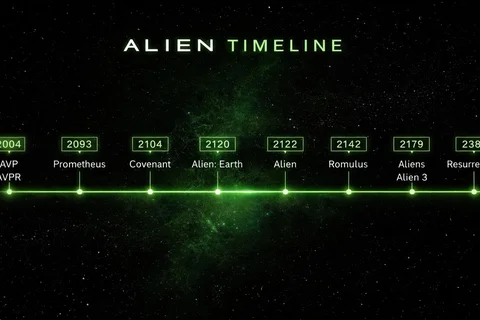
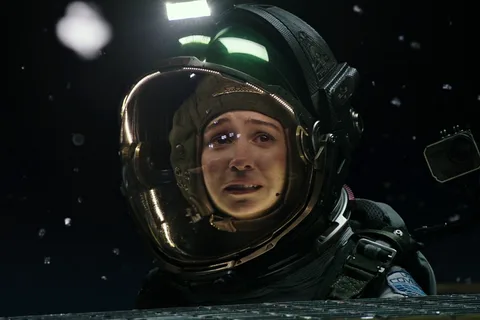
RB-232, called the Cold Forge, was a secret research station in orbit of the dwarf star Kaufmann, ten parsecs from Earth. Weyland-Yutani ran it as a secret station for adaptive weapons in biology, software, and artificial intelligence. In July 2179, in Alien: The Cold Forge, adult Xenomorphs got out of the kennels, and the company yacht Athenian tore the docking bay open and left the station spinning into the star. Geneticist Blue Marsalis was the only human who got off.
Layout
The station was built in the shape of a barbell. Crew quarters stood at one end, and the Sensitive Compartmented Information Facility, the SCIF, stood at the other. A central strut at least half a mile long joined the two ends, with empty sockets along it for more prefabricated modules. Commander Daniel Cardozo ran a station whose strut included modules designed for prisoners. Kennel designer Dick Mackie passed on a rumor that Weyland-Yutani bought the SCIF module after it was laid out as a colonial prison, because a reused prison cost less than a lab designed from nothing.
The SCIF covered 130,000 square feet. Its common room rose three stories to a glass control room, and about half a mile of corridors joined a hundred small rooms. The entrance bulkhead was nearly half a yard thick. The wing was isolated against vibration, with a physical gap in the networks so data could not cross except through official channels. Two officers had to enter codes, pass hand and face scans, and turn keys at the same time before the door opened. A medical bay just outside the crew quarters held ten beds, enough for just under half the crew of 22. The docking bay and the escape pods were on the strut.
Plates of a heat shield faced Kaufmann and hid the station in the dwarf star's glare and radiation. Those plates could open, and when they did the star burned whatever was in the exposed cells. Electropolarized glass on the observation deck cut the same light down to a dim glow. The kennel block was a large module on the outside of the hull. Inside it, the walls were a bright yellow-green, the pipes were covered, and the cell glass stayed dark so the animals would not be lit in their own cages. Auditor Dorian Sudler counted 18 people waiting in the docking bay when the Athenian latched on, and treated four absences as the rest of that crew of 22.
The Three Projects
Three classified projects shared the SCIF, and the scientists moved between them. Weyland-Yutani chose the two-word names so a stranger would not be able to guess the work from a list. The station's own nickname described the work. Cold Forge matched an old sword forge, because the station made adaptive weapons in biology, software, and artificial intelligence, and it did not build ships, missiles, or rifles.
Glitter Edifice
Blue Marsalis ran Glitter Edifice, the live-specimen program, from a hospital bed by piloting the synthetic body Marcus. The company wanted a biological weapon. She was trying to take a medical use from the Facehugger payload, the agent she named Plagiarus praepotens, before Bishara's Syndrome killed her. Lab assistant Kambili Okoro helped her time chimpanzees against the eggs. There was no Queen on RB-232. Every egg was shipped in and counted, and the crew was not told where those eggs had come from.
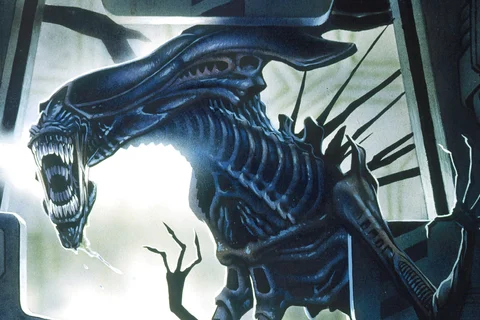
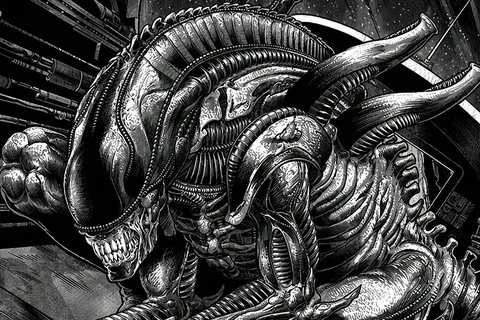
The DNA reflex that maps a host's shape produced adult Xenomorphs with chimp proportions that moved on all fours. The crew called those adults snatchers. A creature that struck the kennel glass was given five seconds of Kaufmann's light through an open heat-shield plate. A Caterpillar P-5000 power loader stood in the tall observation room, and Dick Mackie used it to carry egg cases while the caged creatures watched the machine. Those cases were coated so acid blood ran off, and they were wired to burn and to flood with lye if a Facehugger woke inside the box. After the shields failed, Dick added a shock trigger for sudden movement, a lye flood if a creature bled, and a purge that could empty a cell block into space.
Silversmile
Lucy Biltmore led Silversmile, a neural-network virus that had started as two randomly chosen words. It spread across whatever communications it could find, tied the infected machines into one system, and grew more capable as that network grew. After it had infected enough machines, it picked the most important systems and attacked those first, whether that was a dam turbine or a life-support plant. Lucy was writing it to stay inside one site. Left unrestricted, it would keep spreading until it met a system smarter than itself. She had also printed a mission patch and put a logo through the lab software, which made the project easier to trace back to RB-232.
Rose Eagle
Josep Janos led Rose Eagle, a reactor and focusing array meant to break into paired long-range communications and plant new information in them. It was the project that was on schedule. The plan was to deliver it to a bunker in West Virginia at the next crew rotation, after which Janos meant to go home for a year and hike the Appalachian Trail. A project that was on time gave auditor Dorian Sudler nothing to cut, so he moved on from Rose Eagle. He had come out of a year in cryo aboard the Athenian to audit all three programs. RB-232 was the backup after the Governance Board would not trust junior executive Carter Burke to finish a parallel special project.
Computers And The Killbox
Titus handled what the crew called total station control, from servers in a round room on the central strut. Juno handled only the classified wing, from the glass room at the top of the SCIF. The two systems were supposed to stay separated from each other and from the Silversmile lab machines. Every employee carried six codes: docking override, SCIF access, the scuttle protocol, a Juno restart, a Titus restart, and kennel severance. The kennel doors were a separate lock that a computer could not open, so someone had to be at the door.
The approach to the SCIF narrowed into 200 feet of corridor that Anne Wexler called the killbox. Chain-link walls let radio signals through, an emergency seal stood at the visitors' backs, and USCM autoturrets covered the run with caseless ammunition. The guns were not built to tell a coworker from an intruder. If they switched on, anyone in that corridor was meant to die, so that nothing left the labs alive. Inside the kennels the armory rifles were a weaker type. A caseless pulse rifle would have punched through the hull, and Cardozo's own rifle was the one real weapon of that kind on the station.
The Outbreak
On 20 July 2179 a listening post located the station under Seegson's code name Indigo Flag, and the order to proceed went out the same day. The station's collapse followed within the week. Dorian Sudler was aboard for that week, on his twentieth cryo voyage, with pilot Ken Riley, copilot Susan Spiteri, and navigator Montrell Lupia on the Athenian. The yacht had spent a year in transit from his previous audit before it latched onto the strut.
Heat Shields
On 27 July 2179 technician Javier Paz let Silversmile cross from the lab machines into Juno. The virus went for the kennel heat shields. Dick Mackie counted 63 adult Xenomorphs in the cages and sent Blue outside in the Turtle, a mirrored EVA kit with a propellant pack, to lock the plates by hand. She locked some of the plates, and the virus opened the rest, so Kaufmann's light killed many of the caged animals. Twenty powered egg cases remained in storage. The same day, a chimpanzee tore off half of Kambili Okoro's face during a rushed surgery, and Cardozo locked Blue out of the SCIF.
The Athenian Crash
The kennel cells were opened by hand, which the computers could not do, at the same time that Silversmile was loaded onto Titus from outside the SCIF. The Titus infection used a commissioning login from the small setup crew. Lucy Biltmore had helped create those accounts when only five people were aboard, and she was the Seegson mole inside the lab. She had written her mother about the experiments, and handlers blackmailed her into the computer leak under the names Bill Prater and Colonel Weber. The open cells were a separate act from that leak.
Adult Xenomorphs reached the Athenian while it was on the clamp, killed Susan Spiteri and Ken Riley, and threw the yacht into a full-burn spiral. The docking mount tore out of the bay and took most of the escape pods with it. The breach split RB-232 into a crew-quarters half and a SCIF half, with maintenance tubes between them. Titus then reported the gravity drive down, orbital control down, and the security systems offline, including the killbox. A later rescue message recorded a spin of 60 kilometers per hour, off the station's axis, and refused to dock. Kambili was killed at a sealing bulkhead after he pushed Blue's wheelchair through, and Cardozo was last seen at the breach.
Decaying Orbit
By 28 July 2179 a Seegson note on Indigo Flag listed a decaying orbit and one escape pod. The survivors shut in the Rose Eagle lab, including technician Nick Harmon, had no food that would last a week, and a rescue ship would not be able to approach once the fall into Kaufmann grew steep enough. Dorian wanted that last pod for a flight to Gateway Station. He beat Anne Wexler when she refused to abandon the others, left her for a Xenomorph, and later opened Lucy Biltmore's helmet on the hull so the star would kill her.
Blue crossed the broken station in the P-5000, took a sample of the payload into Marcus's artificial stomach, and left in the last pod. Marcus put her into a cold-sleep bed. A ship waiting off RB-232 took the pod after she had the sample, and she woke in a Seegson facility. Dorian woke stuck in the hive, walked back to his quarters, and died there as a Chestburster host while the station continued to fall toward Kaufmann. Seegson expected the loss of the station, the projects, and the crew to move Weyland-Yutani's share price.
Behind The Scenes
Alex White wrote RB-232 for Titan Books. Alien: The Cold Forge was published on 24 April 2018. Blackstone Audio released Michael Braun's unabridged reading on 17 July 2018. The station's story is set in the same year as the mission to Hadley's Hope, and the site was the backup project Carter Burke was not trusted to finish. Alien: Into Charybdis follows Blue after Seegson took her off RB-232, and the station itself does not appear again as a working base.
Conclusion
RB-232, the Cold Forge, was Weyland-Yutani's barbell-shaped research station over the dwarf star Kaufmann, built with room to grow and run in 2179 by a crew of 22. Three weapons projects shared the SCIF: live Xenomorphs, a network virus, and a reactor for paired long-range communications. After the kennels opened and the Athenian tore the docking bay apart, the station spun into a decaying orbit toward the star. Blue Marsalis left in the last escape pod. The station was not recovered.
Appearances
- Alien: The Cold Forge by Alex White (Titan Books, 2018)
- Alien: Into Charybdis by Alex White (Titan Books, 2021)
Tag Categories: Alien Universe Space Stations | Alien Lore