Corinth Bloch: The Painter Who Sought The Xenomorphs

Corinth Bloch was a celebrated painter and sculptor and the man at the center of Alien: Perfect Organisms. As a boy he escaped a deadly outbreak on the mining world AF-617, and the experience left him obsessed with the hidden horrors of the galaxy. After years as the companion of industrialist Roman Fade, he stole company secrets and flew alone to the quarantined colony of New Providence to study the Xenomorphs. There he drugged his would-be rescuers, offered them to an egg, and sent Cynthia Goodwin to film the hive Queen before dying in the colony hangar.
Biography
Childhood On AF-617
Corinth Bloch was born on 9 July 2159 on AF-617, a helium mining world in the Neroid sector. His father was a miner and his mother, Molly, tended the only bar on the planet. They never married but lived together in a small metal apartment that his mother tried hard to make cozy. Bloch later described his first nine years as perfectly ordinary for a colony child. His teachers were Working Joe androids, and he played hide and seek in the ventilation shafts with friends. He drew no more than other children and showed no early sign of artistic talent.
That changed when his father's crew drilled into a cavern filled with breathable air. Probe footage showed a giant stone head surrounded by rows of black vases, and when the ten-year-old Corinth watched the tape at the mining office, he spotted a humanoid figure set into the wall behind it. Bloch found it the most beautiful thing he had ever seen. That night he dreamed of the chamber, and the next day he filled almost an entire sketchbook with drawings of the head and the figure, wearing his black crayon down to a nub. His mother worried about nightmares, but he welcomed them.
The Outbreak
The next day Seegson corporate ordered a crew into the cavern, and Bloch's father never came back. The mine boss brushed the boy off, but his father's friend Streitenfeld secretly gave him an unedited copy of the expedition tape. It showed the miners collecting intact vases after his father touched a quivering black sludge spilled from broken ones, and then a huge, shapeless creature swallowing his father in the dark. Bloch was fascinated rather than frightened. Soon afterward the colony geologist, Doctor Hixson, who had been examining the vases, vanished, then returned to her daughter's door horribly changed.
When Hixson attacked the camera during a video call with her terrified daughter, Molly Bloch packed a bag and called her old friend Alice Goodwin, whose hauler Chariot was in port. Mother and son walked through the colony tunnels toward the hangar because the lockdown had stopped the trams. Near the docks a mutated former miner lay in wait. Molly shoved it away to give her son a chance, and the creature beat her to death while he ran. It caught him just short of the ship's ramp, but Alice shot it with her shotgun and pulled him aboard as more of the changed colonists mobbed the hull.
Rescue Aboard The Chariot
The Chariot took off over the protests of air traffic control, and the medbay found nothing wrong with the boy. He had lost the tape and his drawings in the escape, which grieved him almost as much as the loss of his parents. Alice tracked down his mother's sister, Lucy, in the New Eden sector and delivered him to her on the wealthy world of Welkin. Before he left the ship, Alice warned him never to speak about what had happened on AF-617, since the corporations disliked loose ends. His official story was that his parents had died in mining accidents. Bloch kept that promise for many years.
Life On Welkin
Aunt Lucy and her husband, Reuben, were very rich, and Bloch moved into a mansion with maids, a chauffeur, and a bedroom larger than his old apartment. He was polite and grateful, but he never grew close to either of them. He kept drawing, began painting and sculpting, and grew frustrated that nothing he made captured what he had seen as a child. He was later sent to Pena Academy, an expensive boarding school built to resemble an old Earth private school, where he kept his head down. For a long time he tried to live as an ordinary, comfortable teenager.
As a teenager he wrote a history paper praising Duncan Fields, a twenty-first century dreamer whose followers, the Earthsavers, had tried to stop the colony ship Covenant from leaving for Origae-6 in 2103. His teacher, Doctor Fell, accused him of glorifying terrorists, and he nearly revealed his own past before remembering Alice's warning. He was sent to counseling. Bloch learned to give adults the easy answers they wanted, but he later saw the episode as proof that his childhood had been a religious experience, a glimpse behind a curtain that set him on a road toward darkness.
Failure And The Jackalope
After graduation, Bloch persuaded his aunt and uncle to fund two years of art in place of university. He spent six months in luxury, made friends in the art world, and worked very little. Every gallery rejected his portfolio. At the last one, a gallery called Rebirth on Alexandria, the owner Mabel told him the work was technically flawless but lacked anything true, and that a comfortable life had dulled his art. The eighteen-year-old took the criticism to heart, drank alone that evening, and then went straight to the docks to sign on as a laborer.
Bloch spent the next year working aboard a cargo hauler called the Jackalope under Captain Nathan, who could not understand why a rich young man wanted such a job. He kept his identity and his money but stopped making art. Among the crew he learned what poverty meant in a galaxy run by corporations, and he also learned to fly. In port on Torrin Prime, a street preacher named Zachariah sold him an underground book called Space Beast, which described the dragon that had killed the prisoners of Fiorina 161.
The book was written by the convict Robert Morse, and it was the first evidence Bloch had found that other people had met creatures like the ones from his childhood. Its account of the monster, Ellen Ripley, and the cover-up by Weyland-Yutani differed from what he had seen on AF-617, but it convinced him that the dark mysteries of the galaxy were real. Something clicked into place for Bloch while reading it. He bought his way out of his contract, returned to Welkin, and devoted himself to art again.
Rise To Fame
Using his uncle's money, Bloch rented a studio and worked alone for six months. Alongside the head, the vases, and the creature that took his father, he painted the downtrodden colonial workers he had lived among. Galleries that had rejected him now competed for his work, and his debut at a Welkin gallery called Visions sold out within a week. Critics hailed him as a voice for the voiceless, and even Aunt Lucy admitted the paintings were both ugly and beautiful. He became a leading figure of the Modern Colonial school, known for religious-flavored scenes of colonial life.
For years he alternated between solitary work and lucrative shows, living simply and spending his money mainly on travel. He chased rumors of quarantines, ancient ruins, and strange infections across the galaxy, often finding only ordinary plagues or being turned away by Colonial Marine frigates. He noticed that such stories never spread far and concluded that the corporations were burying them. His paintings were usually oil on oak panels, and he sculpted in clay. One painting, Supplies, showed tiny stylized workers unloading crates on a stormy, barren world beneath a looming atmosphere processor.
OTBD And Roman Fade
Frustrated by his lack of progress, Bloch finally showed his darkest work in public under the title OTBD, the Earthsavers' motto, which stood for out there be demons. He chose it to provoke Weyland-Yutani after discovering that every record of the cult and its prophet had been erased. Reviews were mixed, but the opening drew the usual crowds, and among them came Roman Fade, an older self-made industrialist who bought the largest painting in the show, Destiny. Bloch was instantly attracted to him, and the two spent a blissful weekend together at Fade's mansion.
At the end of that weekend Fade revealed that he had been sent by Weyland-Yutani, which had linked Bloch to AF-617 and wanted him silenced. The company could ruin him and his family or have him killed, Fade explained, but there was another option. If Bloch moved in as his companion and never repeated anything like OTBD, Fade's value to the company would protect him. Bloch suspected that Fade was tied to the demons of the motto himself. Seeing no real choice, he accepted, and he later described the arrangement as the moment he became Fade's property.
Bloch lived in Fade's mansion for about twelve years, painting safe portraits of colonial life that critics called stale but that still sold. He kept his own fortune untouched, spending Fade's money instead, and his nightmares of dark, wet figures in onyx tunnels never stopped. Around the fifth year, Fade stopped locking his office. Bloch bought stalkerware from a hacker and, in the middle of their twelfth year, installed it on Fade's computer while Fade was sick. For months the software recorded only routine business, until a message from a man named Alvarado mentioned Project Providence.
Project Providence
The message asked Fade for five Ovomorph samples to be sent to a colony on the next supply run. Bloch learned that the colony was New Providence on DSJ-1020, a young agricultural world, and watched as Fade ordered his own employees at a remote station to prepare the eggs for pickup by Weyland-Yutani. Later reports described a planned outbreak of the creature the company called XX121. When DSJ-1020 vanished from the official records, Bloch concluded that the experiment had begun and decided to go there himself.
He bought a small ship that one person could fly, named it Gnosis, and paid a captain named Flavio to carry it to the system aboard his hauler Fortune's Dawn. He refused to pay for a ride home, seeing the trip as a holy pilgrimage with no assumptions about the outcome. To learn how the quarantine worked, he seduced a junior Weyland-Yutani executive named Morton, who supplied colony blueprints and the roster of the guard ship. Bloch found someone aboard who could be bribed, wrote his confession to Fade, and left.
Alone At New Providence
Bloch landed Gnosis in the colony hangar without trouble and found every colonist already dead. The emergency shelter, which had its own power, food, and ventilation, was closed but unlocked, and colony logs showed that the company had remotely locked the colonists out when the outbreak began. He settled inside and used the colony cameras and three company androids, including one named Ryder, to observe the creatures, since the Xenomorphs usually ignored synthetics. When he sent an android toward the Queen, it was torn apart after capturing only a few frames.
For weeks he painted the Xenomorph life cycle in a pop art style, with close-ups of the inner jaw, eggs, and full figures against bright backgrounds, and began an unfinished portrait of the Queen. He learned from stolen company files that Queens were thought to reach humans through dreams. When the Chariot survivors approached the colony, he saw the swarm on his cameras and used the loudspeakers to guide Goodwin to the shelter door, where Sam Kurzel had already taken refuge. Their technician, Harris, died outside.
Bloch welcomed Goodwin and Sam with food, showers, and a private message from Fade that she had carried on a chain. The message promised forgiveness, but Bloch knew Fade would never let him keep his paintings. He showed the visitors his studio and recognized in Goodwin a fellow dreamer, since her lifelong nightmares resembled his own visions. When Sam pushed him to leave, Bloch asked only not to be forced, and Goodwin refused to coerce him. He then suggested they rest, having already drugged their tea with honey.
The Egg
Bloch's androids strapped Goodwin, Sam, and Bloch himself to upright gurneys around a single egg. He admitted that he had lacked the courage to face an egg alone and wanted to witness an impregnation, so he let it choose among the three. His androids, built by Weyland-Yutani, appeared to have a loophole in their programming where Xenomorphs were concerned. When Sam began screaming, Goodwin screamed louder, and the facehugger took her. Bloch watched every detail with wide eyes. Earlier he had told the frightened captain that terror was part of the experience he was offering.
After the androids moved Goodwin to the medbay, Bloch offered a deal: if she filmed the Queen, they could leave, and a surgeon might remove the embryo. He fitted her with a helmet camera, guided her by radio through the hive, and directed her to film the Queen from several angles, speaking of the sublime with religious awe. Goodwin called him a coward for gambling with other lives. On her return he asked her to hide his art from Fade, and she agreed. Goodwin and Sam then loaded his paintings into a truck bound for the hangar and Gnosis.
Death In The Hangar
Goodwin drove the truck through the colony as a swarm gave chase, and Ryder opened the hangar doors for them. While Goodwin powered up the ship, Bloch stood at the foot of the ramp and stretched his arm toward a Xenomorph crouched on the truck. Goodwin tackled him as it leapt and shielded him with her body, since the creatures would not harm a host. When she asked whether he wanted to live, he answered that he would accept death if God willed it.
Goodwin then ordered the paintings left behind, arguing that the creatures would not destroy them and that he could return for them one day. Bloch refused to leave his work and stepped past her toward the creature with his arms spread wide, like a supplicant. The Xenomorph raked his face, pulled him close, and drove its inner jaw through the back of his skull as he murmured a final word. Sam dragged Goodwin aboard and flew Gnosis off DSJ-1020, leaving Bloch's body and his last paintings in the hangar of New Providence.
Personality And Traits
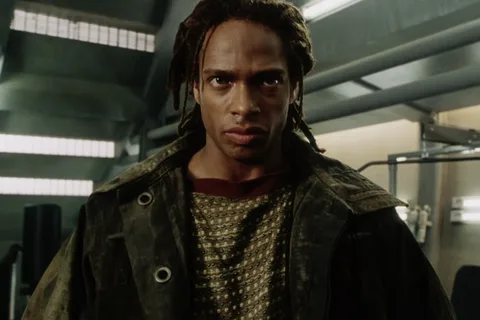
Bloch was intense, charming, and deeply private, with a lanky build, long hair, and dark eyes. From the age of ten he treated horror as revelation, describing his encounters with the unknown as glimpses behind a curtain and a dark secret at the heart of all things. He spoke of the Xenomorphs as perfect organisms and of the Queen as the most beautiful thing he had ever seen. His art was driven by that obsession, and he openly called his trip to DSJ-1020 a holy pilgrimage. In his confession to Roman he admitted that his reasoning sounded like the logic of a madman.
He could also be manipulative and cruel. He deceived Fade for months, seduced Morton to obtain secrets, and drugged and endangered the people sent to rescue him. Yet he lacked the courage to face the egg alone, a weakness Goodwin named to his face. He felt real guilt about profiting from the poor he painted and often criticized the corporations that ran the galaxy, yet he hoarded his own fortune. In the end he valued his paintings and his search for meaning above his own life, and he died reaching toward the creature he worshiped.
Relationships
Roman Fade
Roman Fade was Bloch's lover, keeper, and eventual victim. They met at the OTBD opening, and their first weekend together felt like real love to Bloch before Fade revealed his corporate mission. For about twelve years Bloch lived with him under an arrangement that protected his life at the cost of his freedom, and he came to doubt whether he could love someone he feared. His final confession, written to Fade, still called him his love even as it explained why he had betrayed and robbed him. Fade, for his part, spent a fortune trying to bring him home.
Cynthia Goodwin
Bloch met Goodwin only when she reached the shelter, although he had never forgotten her mother or the Chariot. He recognized her as a kindred spirit, praised her deductions, and told her that her nightmares might be connected to the Xenomorphs. That kinship did not stop him from betraying her, drugging her, and letting the egg choose her. She called him a coward, yet she agreed to save his art and then risked her life shielding him in the hangar. He could not understand why she would save him, while she concluded that the secret he chased was simply to live and care for others, something Bloch never grasped.
Alice Goodwin And His Family
Alice Goodwin saved Bloch's life on AF-617 by shooting the creature that had pinned him and flying him away from the outbreak. She found his aunt, delivered him to Welkin, and warned him to keep quiet, a warning he obeyed for decades. His parents were pragmatic people who loved each other in their own way. His father vanished in the cavern, and his mother died shielding him at the hangar. Bloch admitted that his grief was muted by dismay at losing the tape of the cavern, and he later felt more distance than love toward his aunt Lucy and uncle Reuben, despite their generosity.
Notable Works
Supplies showed colonial workers dwarfed by a starship, a domed colony, and an atmosphere processor. Transfiguration, a sculpture from his last public showing, depicted a realistic laborer bent forward with a distended, asymmetrical head and a face twisted in agony, as if something were fighting to emerge. Another painting, Anticipation, showed a dragon-like beast coiled to pounce in front of a long corridor ending at a single door, while Destiny, bought by Fade, showed misshapen figures watching a ship lift off inside a hangar. His final works on DSJ-1020 included pop art studies of eggs, jaws, and full-grown Xenomorphs, along with the unfinished silhouette of the Queen.
Behind The Scenes
Corinth Bloch was created by Shaun Hamill for Alien: Perfect Organisms, published by Titan Books on 28 October 2025 in the United Kingdom and 18 November 2025 in the United States. Roughly two fifths of the novel consisted of his first-person dossier, which Goodwin read in installments during her march, so his backstory reached readers through his own voice. The dossier revealed that Fade had personally supplied the eggs used in Project Providence, a detail that framed his own role in the outbreak.
The book contained several inconsistencies around Bloch. Fade called his childhood world Source Falls, a colony on the Outer Veil, while the dossier named it AF-617 in the Neroid sector. Fade spoke of ten years together while the dossier counted twelve. Fade's file described light-colored hair, but in person he had long salt-and-pepper hair. Goodwin also remembered the sculpture Transfiguration as having a distended chest, although the first description gave it a distended head. The cavern with its giant head, vases, and black sludge was never explained.
Conclusion
Corinth Bloch was the boy Alice Goodwin saved from AF-617 and the artist that experience created. His obsession carried him from a mining colony to wealth, fame, and a gilded life with Roman Fade, then to a lonely pilgrimage to New Providence. There he finally saw the Queen through another person's eyes, after sacrificing that person to get the footage. He died refusing to abandon his paintings, and his last works remained behind on the quarantined world with his body.
Appearances
- Alien: Perfect Organisms by Shaun Hamill (Titan Books, 2025)
Tag Categories: Alien Universe Characters | Alien Lore