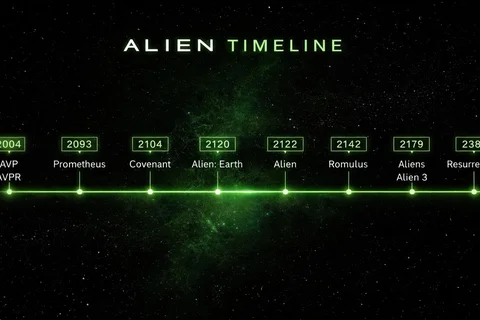
LV-991 was a water world later renamed Hasanova after Iran's National Data Corporation bought it at a blind-bid UPP auction. In 2184, in Alex White's novel Alien: Into Charybdis, the data colony Hasanova Data Solutions sat on an atoll around Lake Peacock, over a 400-meter lava-tube shaft the crew called Charybdis. A Colonial Marine raid under Captain Kylie Duncan and a Xenomorph outbreak wrecked that colony.
Name And Survey
The survey mark LV-991 followed the same Life Viable catalog used on worlds such as LV-426. After Iran's National Data Corporation won the world at a Union of Progressive Peoples auction, it asked the International Astronomical Union to change the registry name to Hasanova Data Solutions. Approach beacons then advertised that corporate name. People on the ground shortened it to Hasanova.
In the 21st century, Weyland Corp scientists first mapped the central shaft as a stable lava tube. Later UPP hydroelectric plants sat on the same hole. Iran built the data colony last, under Hasanova Colony Corporation, after the country joined the Independent Core System Colonies. The United Americas then embargoed the site, and Hasanova stock took a hit.
Surface And Lake Peacock
Brackish water stretched in every direction around a small rocky atoll. The sky stayed cloudy and grim. The lake was large enough that visitors treated it as an ocean, but colony water scientists kept the name Lake Peacock, or Daaryacheh-e Tavus in Farsi. Extremophilic bacteria lived in that water. When they died, their fats broke into pink foam near the islands.
Swells on the Long Walk, the cable bridge from the processor to the colony, could rise three stories, with gusts around thirty knots. Kamran Afghanzadeh warned the McAllen crew not to cross that bridge on foot. Pumice covered the open ground around the later landing zone. Citroen hovercraft from the motor pool ran out to the surrounding islands when the weather allowed.
Hasanova Data Solutions

The modern colony sat on the atoll as a claimed data center for Iran's Independent Core System Colonies. Three towers held daily work: Solutions for offices, Network Ops for routing, and the Human Centre for quarters and leisure. Low Lilypads took private craft and small shuttles. Only one pad was rated for the McAllen tow ship USCSS Gardenia. Alcohol, recreational drugs, and pornography were forbidden on the premises.
The oldest working plant was the Hasanova Atmospheric Processing Station, or HAPS, almost thirty years older than the modern towers. When the hydroelectric works went offline, a backup called HAPS-E was meant to carry the load. A Decade crawler took visitors through that processor maze, then across the Long Walk into the colony. The Thunder Ring was a two-story wall of ALON windows built into the atoll rock, sloped to push lake water into the mouth of Charybdis.
Gold alloy inlays in those floors came from water purifiers in the Vault of Heaven. Bacteria in the exchangers ate toxic metals and left about a ton of gold a year. The Data Cannon, a long-range communications array, hung over the shaft between the towers. Data storehouses lined the Spiral down the shaft, with more planned farther down. McAllen Integrations arrived in 2184 to commission climate and network systems, including NovArc SiteSys.
Charybdis And The Halo Arrays
Crew called the central hole Charybdis, a starship-sized aperture that swallowed lake water for four hundred meters of pipes and industrial gear before the flow vanished into a maelstrom. Sensors flushed into that whirlpool lost signal. The company cancelled an exploratory geology study after the embargo, even though the colony sat on top of the shaft. A path called the Spiral wound down the unfinished inner wall toward the Halo B pilings.
Halo A was the upper venting array, set at calibrated angles. Hydrogen sulfide built up around the maelstrom, where falling water trapped the gas and dragged it into the planet. When the air in the Maw dropped below a breathable mix, Halo A blasted surface atmosphere down the hole and pushed toxins into the sky. Halo B was a deeper precaution for storehouses that had not been built that far down.
Safety lead Kamran held design leadership on Halo B when his mentor Reza Hosseini and worker Mitra were lost. Hydrogen sulfide flooded their worksite, and their boat went into the whirlpool. Greeting the American contractors was supposed to be Reza's job after that.
Ghasreh Shab And The Pathogen Vault
Highland island Ghasreh Shab held older Weyland work, connected through the shaft to the atoll installation. Broker Thien sold Hasanova a Red Silk packet called the Ginza File, a list of old Weyland sites compiled by Yutani. Burst traffic from Tagh-e-Behesht lined up with voids Reza had mapped near Halo B, and with that file. CTO Tiran Shirazi then moved Halo B pilings onto those buried ruins.
Kamran and programmer Cheyenne Hunt later entered a hidden lab on a nearby island. That room had been built when the world had no breathable atmosphere, in a pre-Russian layer of the site. A Xenomorph took Kamran's arm there. Blue Marsalis cut the arm away to keep the infection from spreading. The deep vault under Ghasreh Shab held a fluid that behaved like the black goo from the Prometheus films, separate from the eggs Blue had brought on UAEV Blackstar.
The 2184 Outbreak
American officers approved the secret raid Cannery Grim in December 2183, after McAllen filed travel papers. Network tech Noah Brewer later sent a distress call that named American hostages. Duncan's Midnighters landed from the assault carrier USS Benning with advisor Sora Matsushita, treated the McAllen crew as captives, and packed more than three hundred colonists into the storehouses. They boarded the resin-coated Seegson hull Blackstar, took frozen eggs, and caged the speaking Xenomorph that used the name Marsalis.
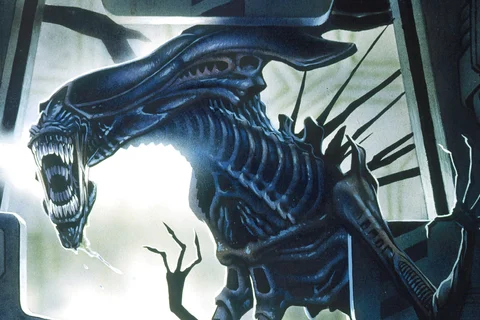
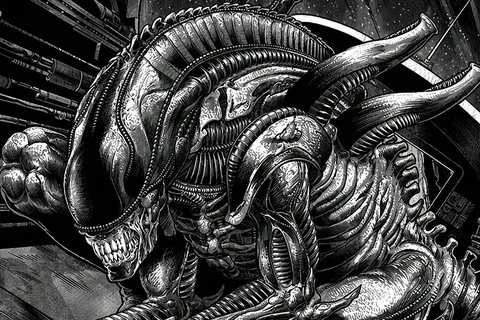
Duncan opened the storehouse doors on a timer so adult Xenomorphs grown from those eggs would kill the locked people and hide the raid. Corporal Russell Becker later sent stolen security cores from the Data Cannon onto the public EntaCOMM network. Hasanova had no Queen. The hive on the atoll used the Facehugger-to-adult Xenomorph cycle from the stolen eggs. The Benning later marked the whole orbit a no-fly zone.
Aftermath
Kamran tackled Duncan into the vault fluid. Flight officer Mary Fowler shot the larval shapes that came out of the captain. Blue led Kamran and Mary across that lake and up the slope above Blackstar, then died on the pumice. The Seegson synth Rook, calling himself Father, launched Blackstar and put the two survivors in an escape pod toward ICSC space. They woke at Exeter Colony. American lawyers argued that Hasanova had been an illegal bioweapons camp outside protected space.
The hearing treated Kamran poorly and treated Mary's testimony little better. The ICSC Board of Ministers then voted for war on the United Americas. New attorney general Theresa Weisenberger handed that declaration to Ambassador Marko Woods while attacks on American weapons plants were being prepared.
Behind The Scenes
Alex White set Alien: Into Charybdis on LV-991 for Titan Books, in a 560-page hardcover published on 23 February 2021 as the sequel to Alien: The Cold Forge. Disaster geologist Mika McKinnon checked the red rock and the shaft physics. Stephen Granade checked orbital and mass numbers, as he had for The Cold Forge. Cover art by Marco Turini put an adult Xenomorph on one of the colony towers.
Iranian cultural readers Saba Keramati, Melory Mirashrafi, and Pezhvok Joshgani checked names, food, and speech. White used the old name Charybdis for the lava tube and gave the purchased world the corporate registry name Hasanova Data Solutions. The novel is the only story that uses this designation.
Conclusion
LV-991 was the survey name for the water world later sold as Hasanova. In 2184 its data colony sat on Lake Peacock over the Charybdis shaft, then came apart in Duncan's raid and the outbreak that followed. Kamran and Mary left on a pod toward ICSC space after Blue died on Ghasreh Shab.
Appearances
- Alien: Into Charybdis by Alex White (Titan Books, 2021)
Tag Categories: Alien Universe Planets | LV Planets | Alien Universe Colonies | Alien Lore