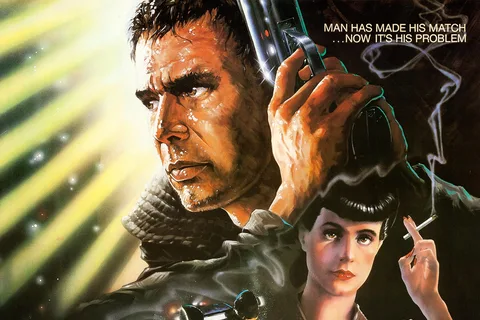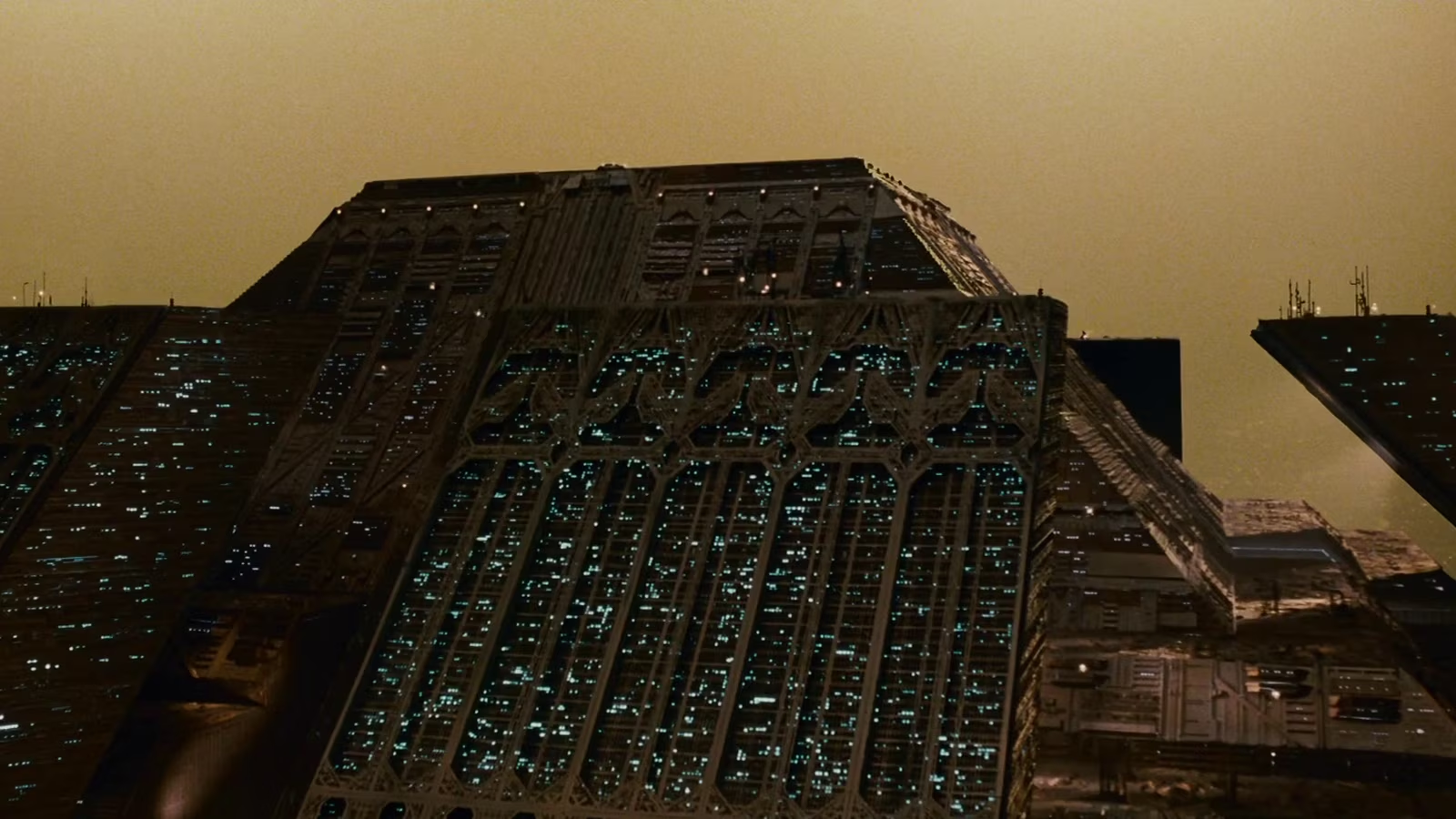

The Tyrell Building was the headquarters of the Tyrell Corporation in Los Angeles, a stepped pyramid hundreds of stories high where Eldon Tyrell lived and built his replicants. Blade Runner showed two identical pyramids rising over refinery fires outside the city, though only one model was ever built. Spinners landed on its roof, Tyrell kept his office and bedchamber near the summit, and laboratories filled the levels below. The building fell into ruin after the 2022 Blackout, stood beside the towers of the Wallace Corporation in 2049 and returned in the trailers for Blade Runner 2099. In the novels of K. W. Jeter, it was blown apart.
The Tyrell Pyramids
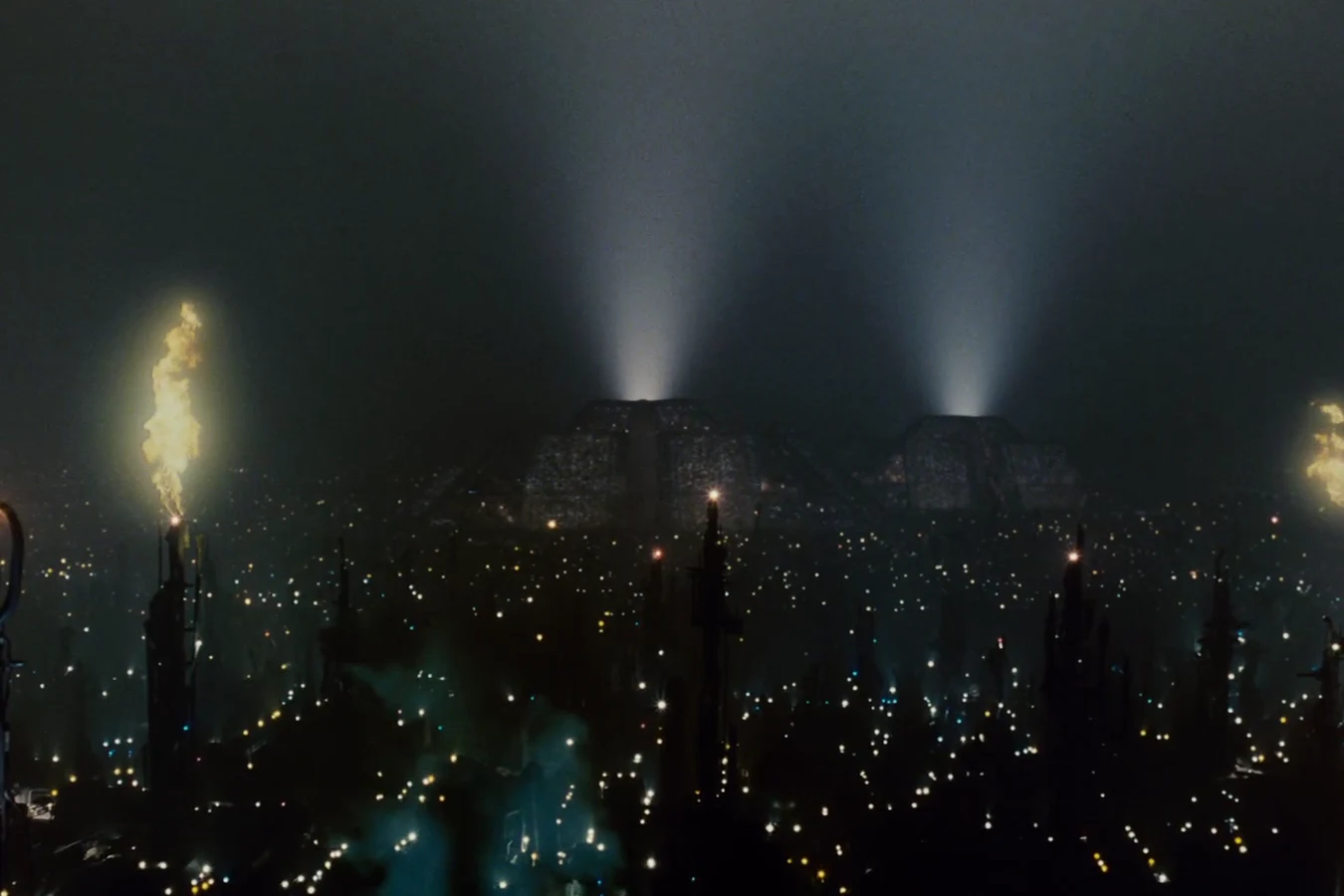
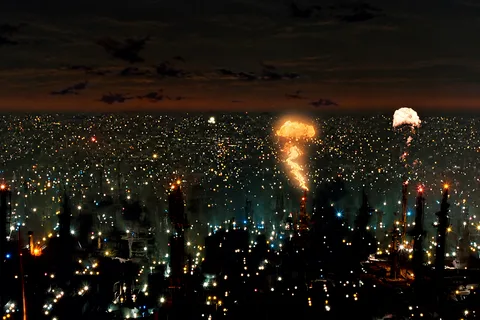
The opening of Blade Runner flew over what the crew called the Hades landscape, a plain of refineries and flare towers on the outskirts of Los Angeles. Two pyramids rose out of it, each sending beams of light up into the smog. Paul M. Sammon's book Future Noir described them as "titanic twin edifices", Mayan-like ziggurats hundreds of stories high. The film never said which of the two held Tyrell's rooms, and most later stories spoke of a single pyramid. Its known rooms came from a handful of visits by blade runners, replicants and executives, from the roof down to the factory floors.
Location
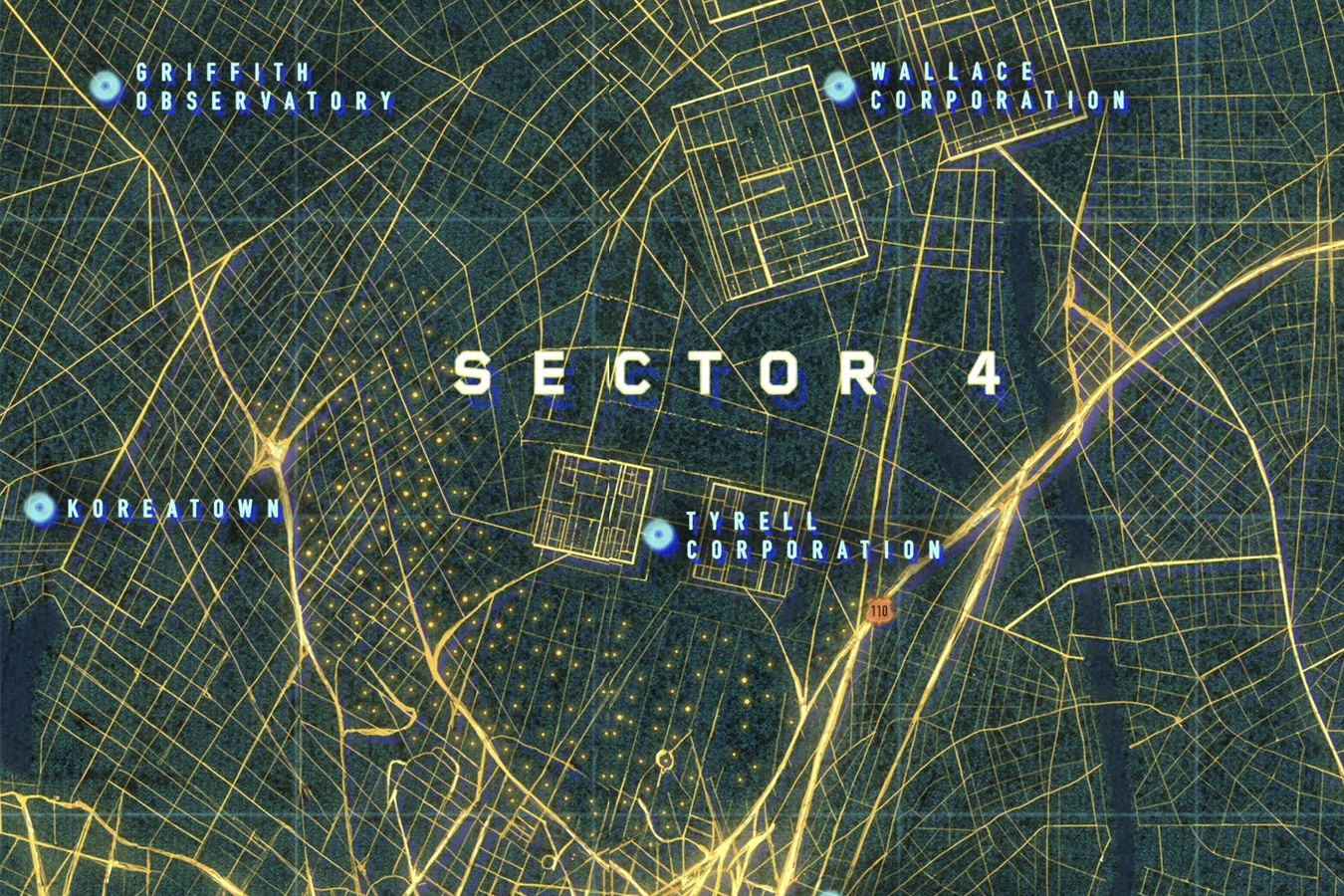
The map of Central Los Angeles in Blade Runner: The Roleplaying Game placed the Tyrell Corporation in Sector 4, the Industrial District, just north of the city centre. It drew the site as two square compounds side by side, with a field of tiny lights spreading out to the south. The much larger grounds of the Wallace Corporation spread out directly to the north, with Griffith Observatory to the northwest and Koreatown to the west. A freeway marked 110 curved past the eastern side of the site, and beyond it a dark channel traced the line of the Los Angeles River.
To the south, past a tangle of freeway interchanges, the map marked Chinatown and DNA Row, with the Los Angeles Convention Center off to the southwest. Further on came Animoid Row, Hawker's Circle and Piss Alley, which the game also counted as part of Sector 4, and LAPD Headquarters beyond them. The Core Rules called the sector the heart of the whole replicant industry, with Wallace as "the sun around which that interstellar system revolves." Wallace kept its own heavily armed security force there, and the book noted that the LAPD had no real say in Sector 4.
Rooms And Levels
Roof Landing Pad
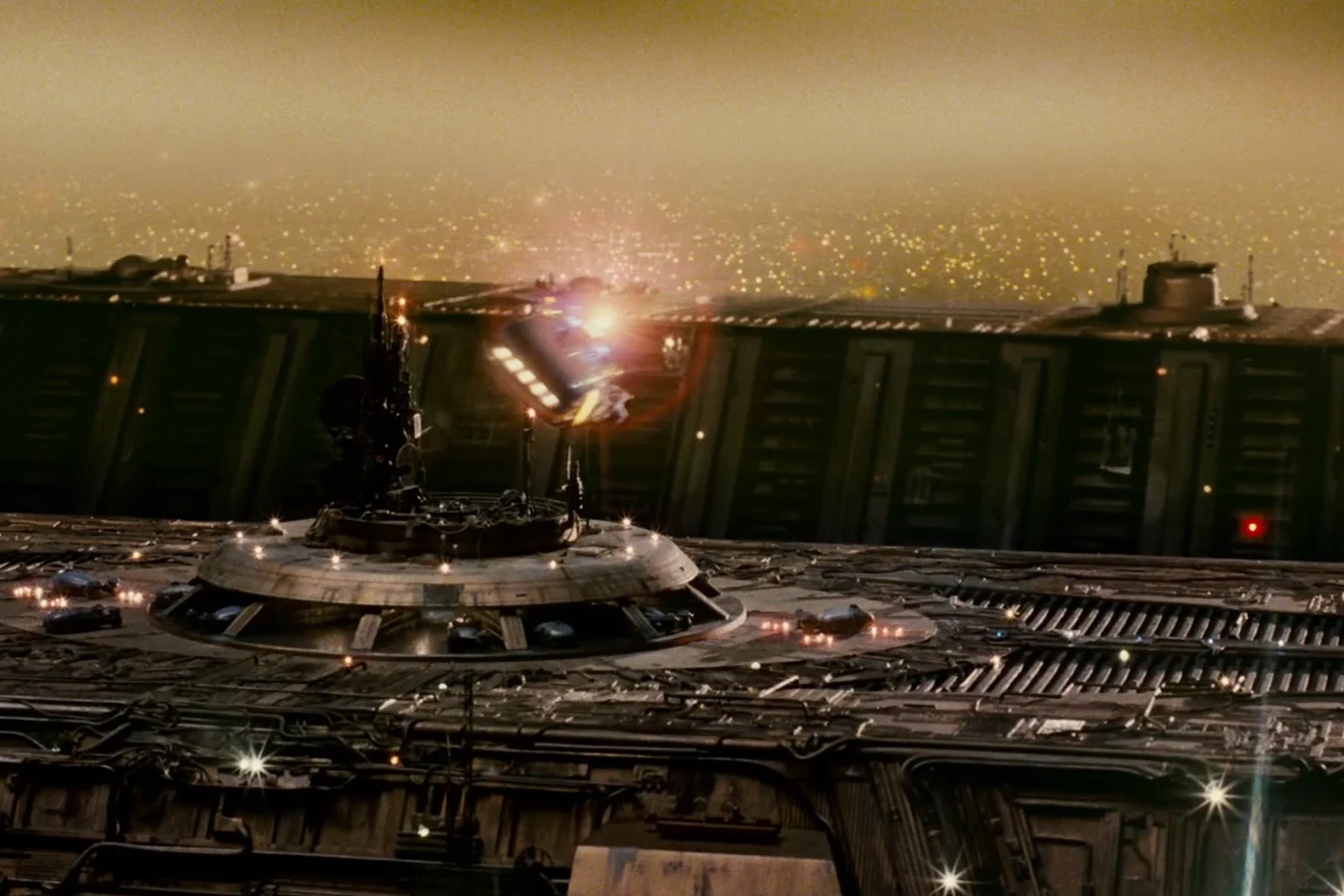
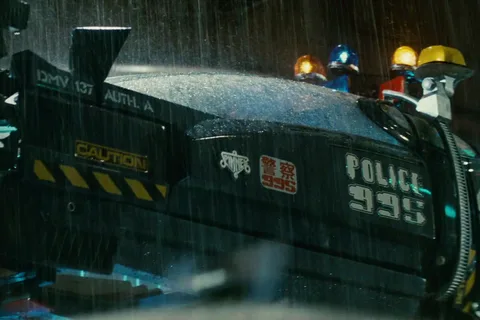
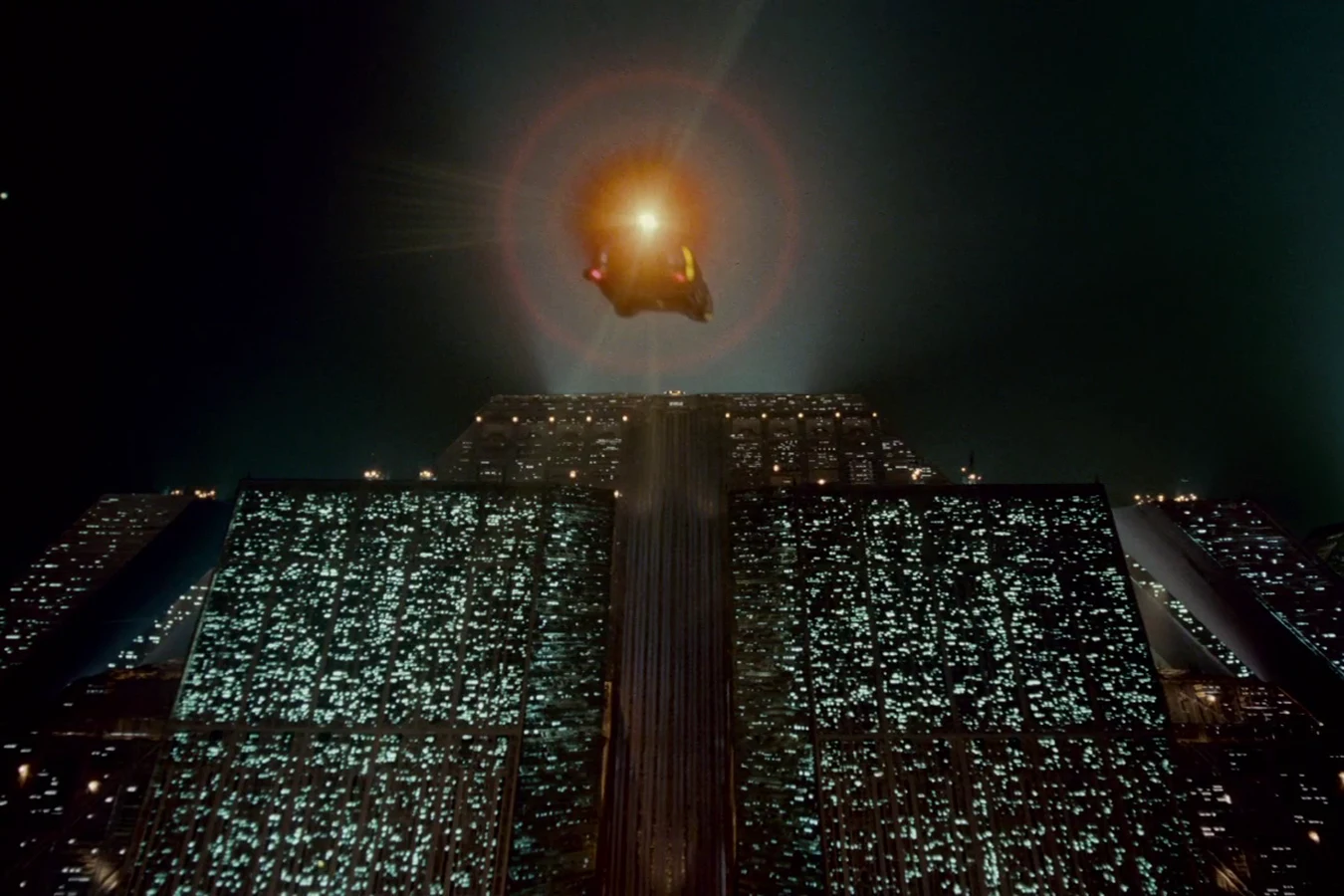
Rick Deckard flew to the building in a police spinner when the company asked to see the Voight-Kampff test at work. The car climbed past the lit face of the pyramid and set down on a broad pad on its flat summit. Lights ringed the roof, and the haze over the city lay far below it. From the pad he went inside to the top floors, where Tyrell received visitors. Future Noir noted that the effects crew built a separate insert model of the pyramid face, with a flat top section standing in for the roof of the Tyrell Building.
Tyrell's Office
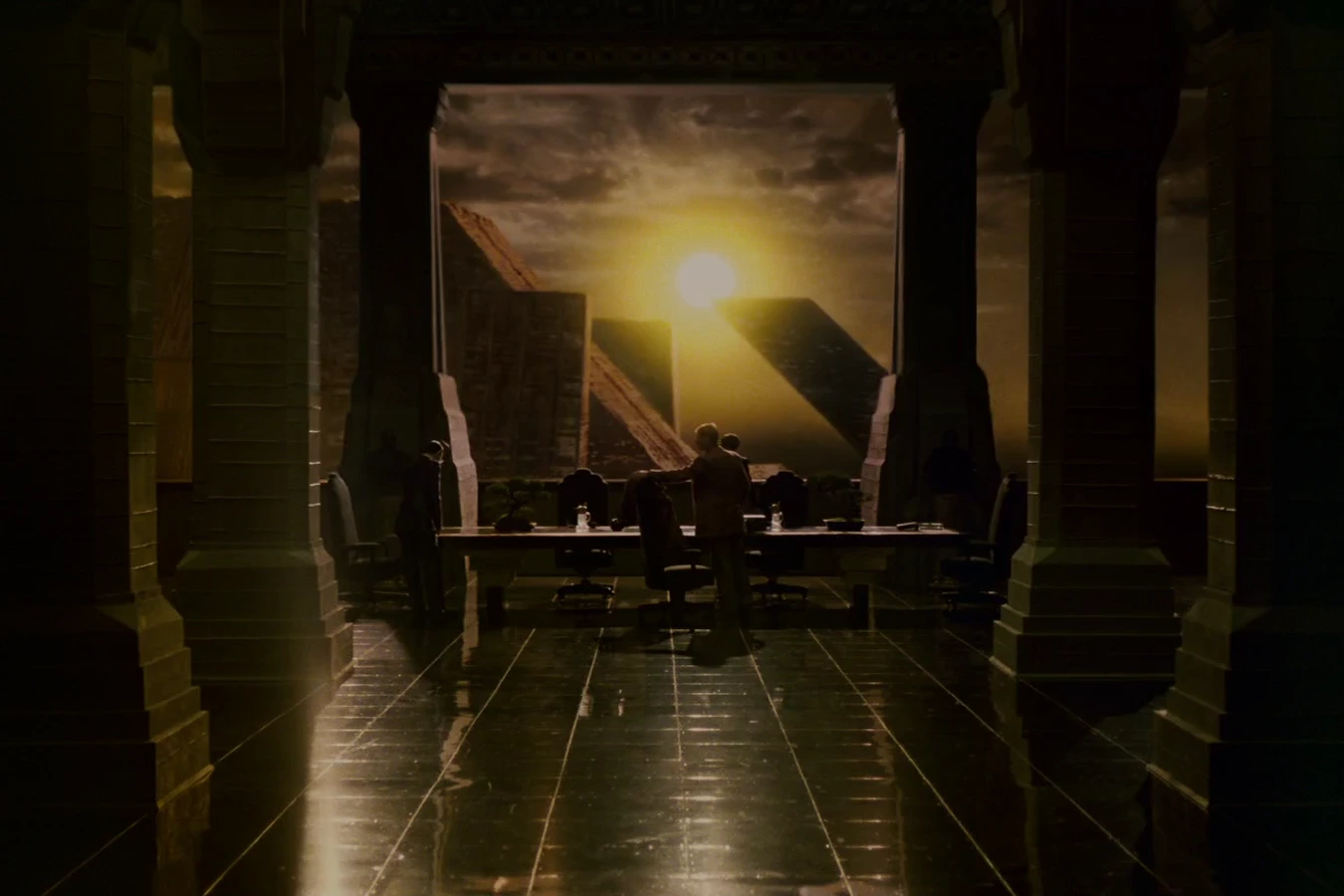
Tyrell's office was a dim hall of stone columns near the top of the pyramid, with a long table, bonsai trees and a window several floors high. Through it, the sun shone over the stepped tops of the pyramids. As Deckard set up his machine, great blinds slid partway down the window to cut the glare. Here Rachael met Deckard, and Tyrell's owl flew across the room. Tyrell had Deckard try the test on Rachael before telling him that she was a replicant who did not know it. The test took more than a hundred questions, far more than usual. Production designer Lawrence Paull built the room in raw concrete and granite to echo the Tyrell pyramid outside.
The Interview Room
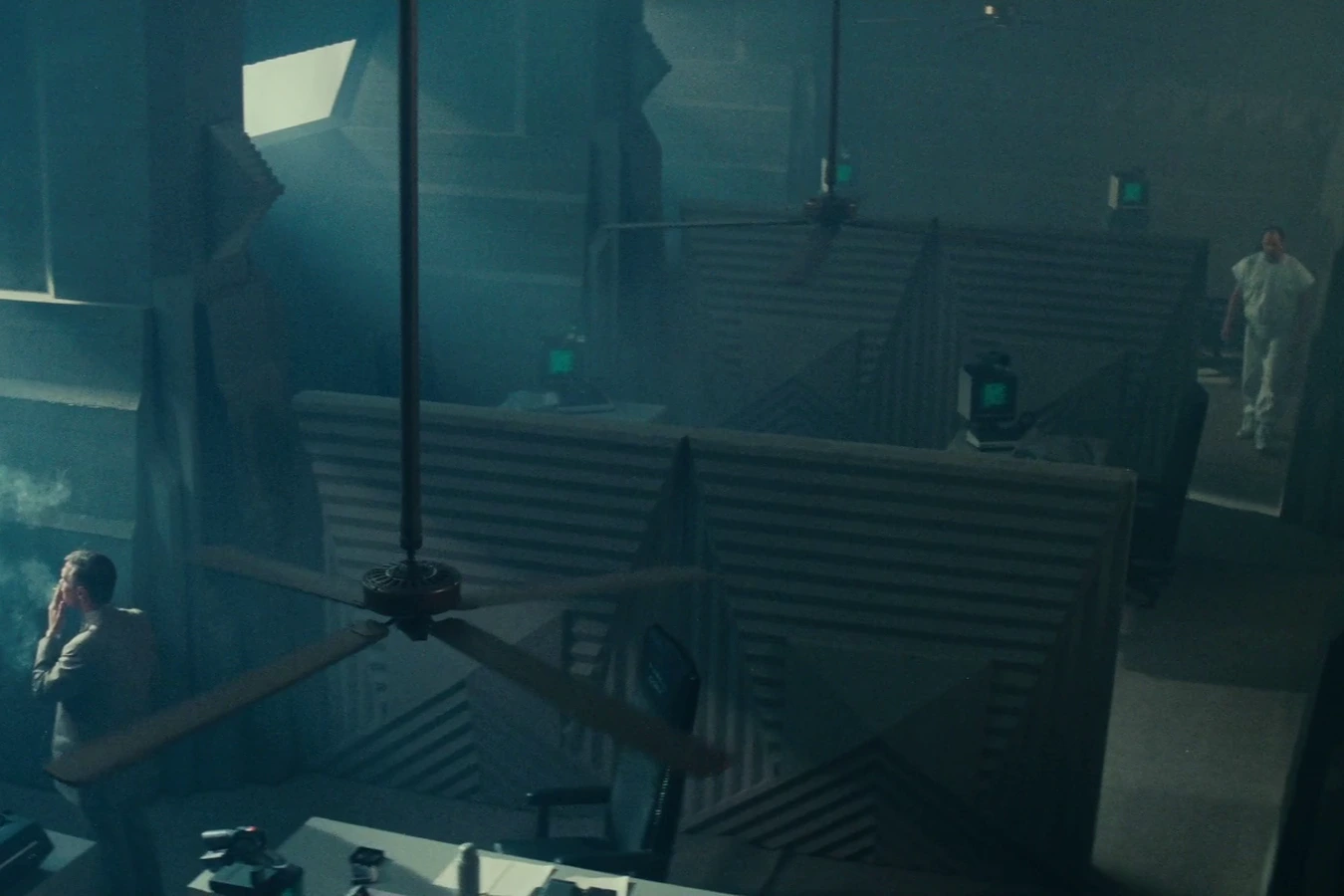
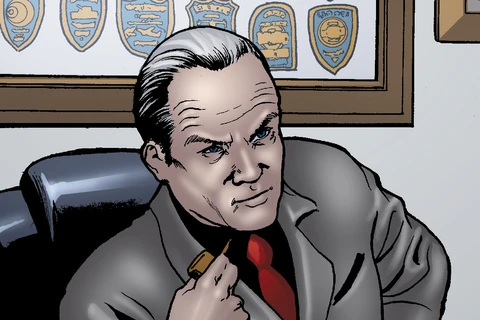
Three nights before Captain Harry Bryant briefed Deckard, escaped replicants tried to break into the Tyrell Corporation, and two were fried running through an electrical field. In case the others tried to get in as employees, he had the blade runner Dave Holden run Voight-Kampff tests on the new workers. Holden worked in a plain, office-like interview room under a large ceiling fan. His next subject was Leon Kowalski, a waste disposal engineer six days into the job. Leon stalled over a tortoise lying on its back in the sun, and when Holden asked about his mother, he said, "Let me tell you about my mother," and shot him.
Bedchambers
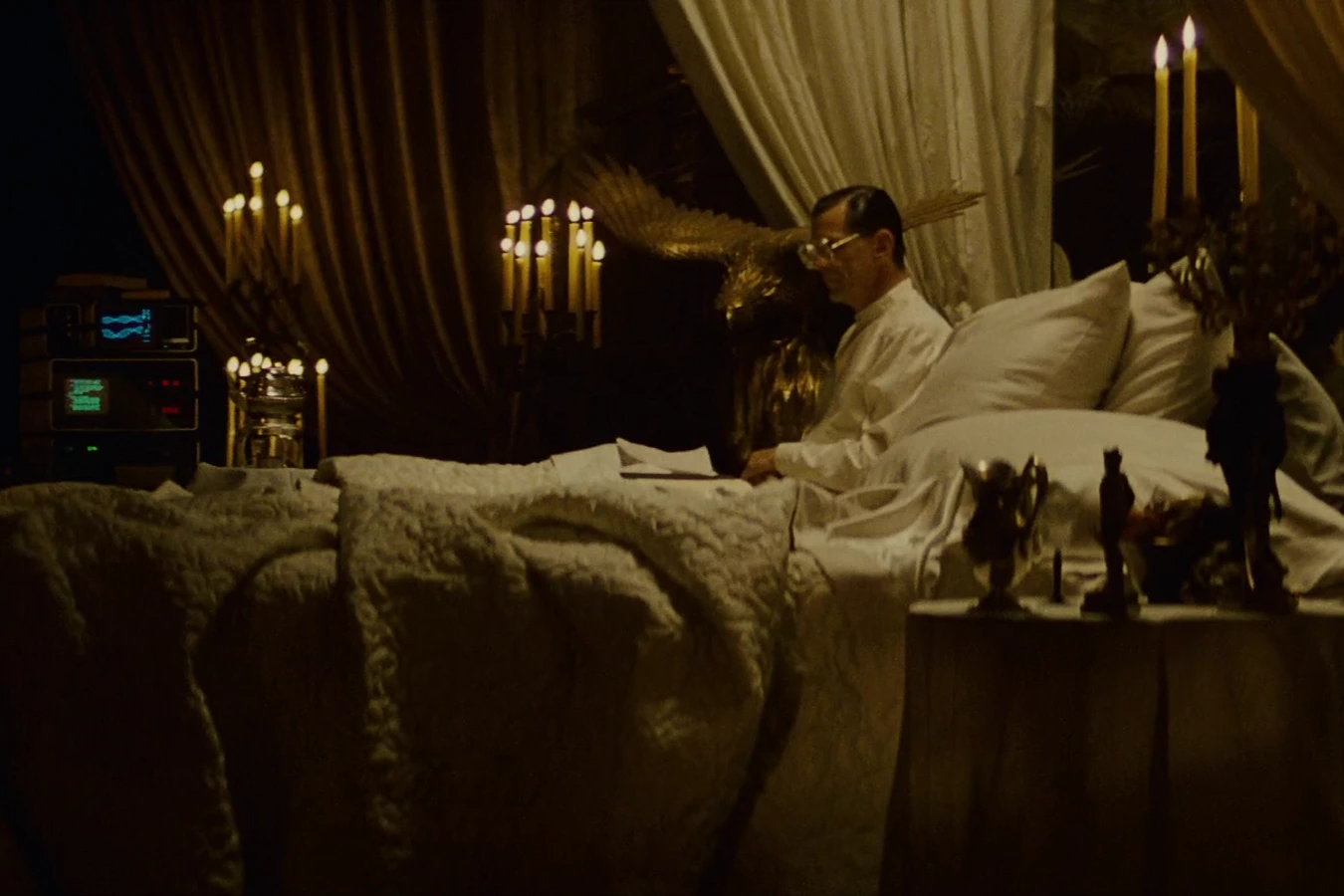
Tyrell slept in a vast bedchamber near the summit, lit by banks of candles, with a canopied bed, draped columns and small gilded statues. He was awake late at night, playing chess against J. F. Sebastian by video, when Sebastian rode the private elevator up with Roy Batty. Batty asked his maker for more life, and Tyrell told him that it could not be done. The replicant kissed him and then killed him with his bare hands. Batty went back down alone in the elevator, and the bedchamber became the place where the Tyrell Corporation lost its founder.
Main Entrance
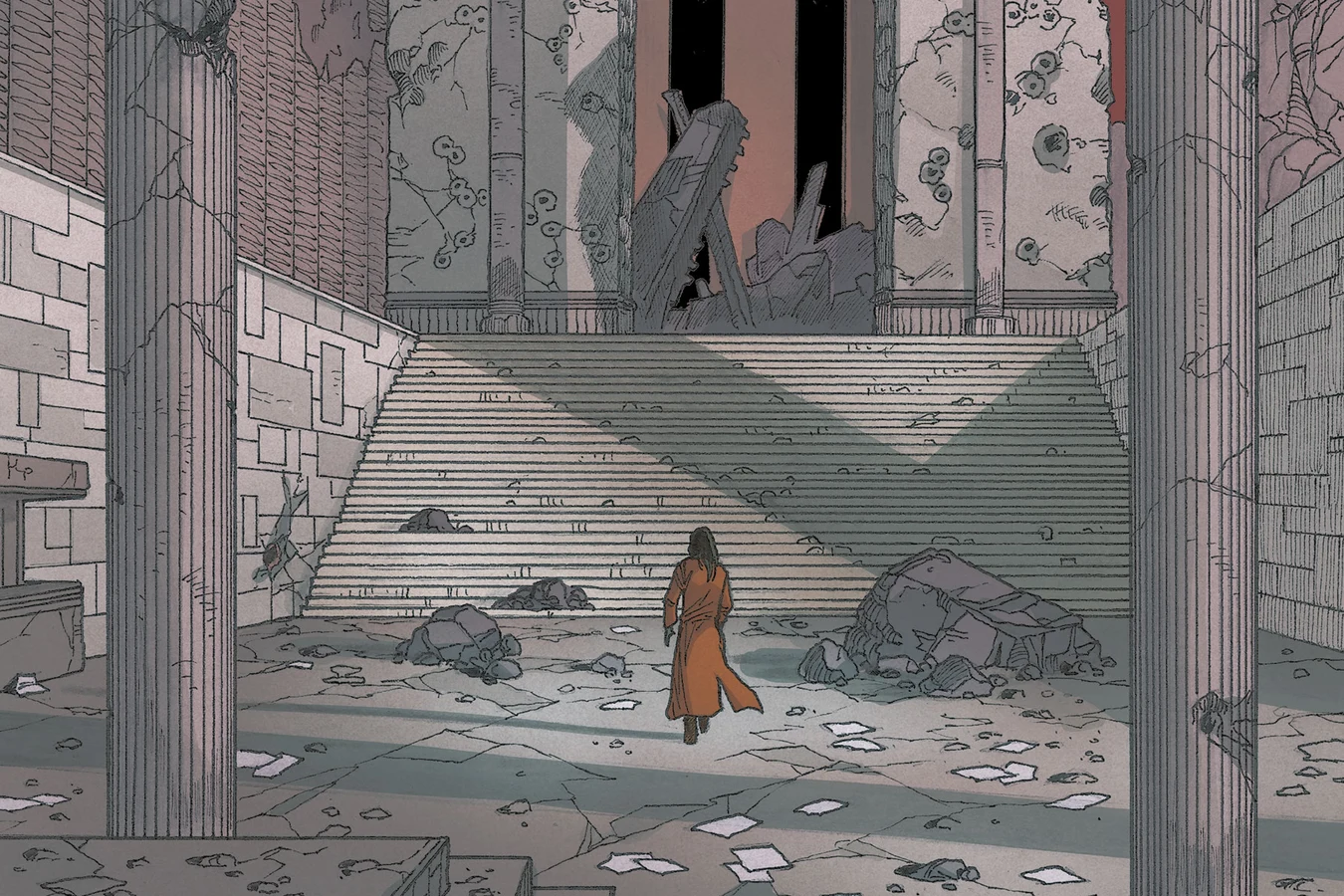
The ground-level entrance appeared in Blade Runner 2019, the Titan comic about the blade runner Ash Ashina, after Ash came back to Los Angeles years after the Blackout. She climbed a wide flight of steps between tall cracked columns toward a doorway whose doors had been torn loose. Bullet holes scarred the stone, and papers lay scattered across the plaza. In her own words, the cops no longer bothered with patrols, because there was nothing left to protect. Just inside, a security office had been wrecked, its monitors smashed and its walls marked with blood and claw scratches.
The Lobby
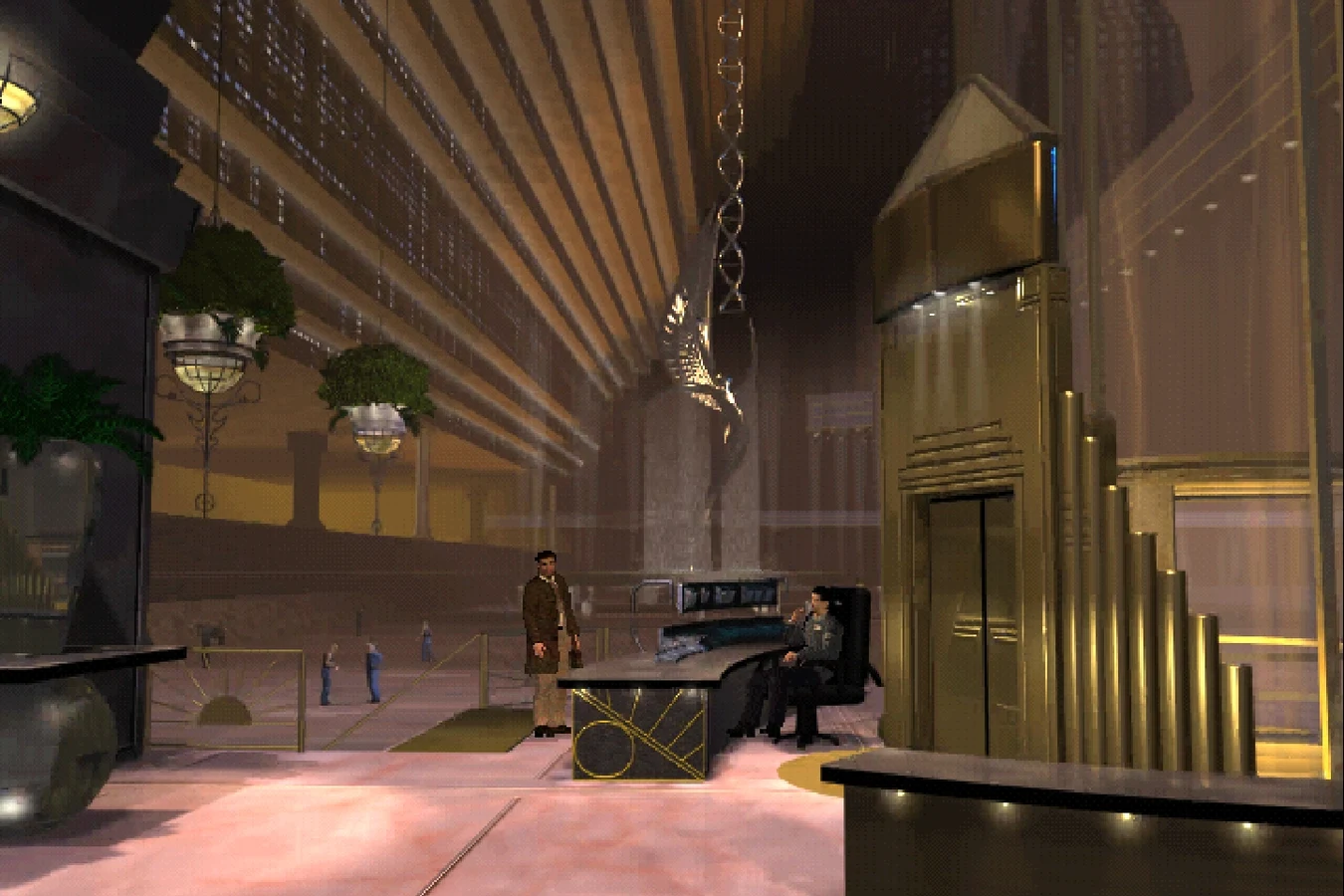
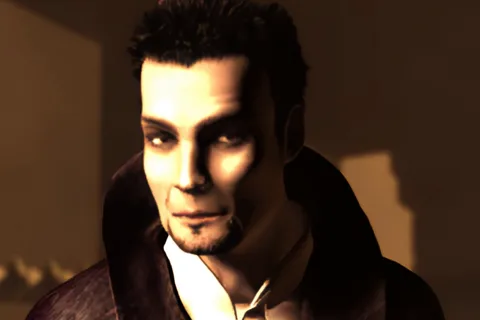
The lobby was a key location in the 1997 Blade Runner game by Westwood Studios. It was a tall hall of golden light with hanging planters, a double helix sculpture and a brass elevator beside the guard's desk. Ray McCoy came there to investigate the murder of Marcus Eisenduller, the Grav Test Chief Engineer, whose lab stood in the East Wing. The guard sent him upstairs and played security footage that showed the killer's face. In the virtual reality game Blade Runner: Revelations, the lobby of 2023 was filled with relics and with portraits of Eldon and his niece Lilith Tyrell.
Replicant Labs
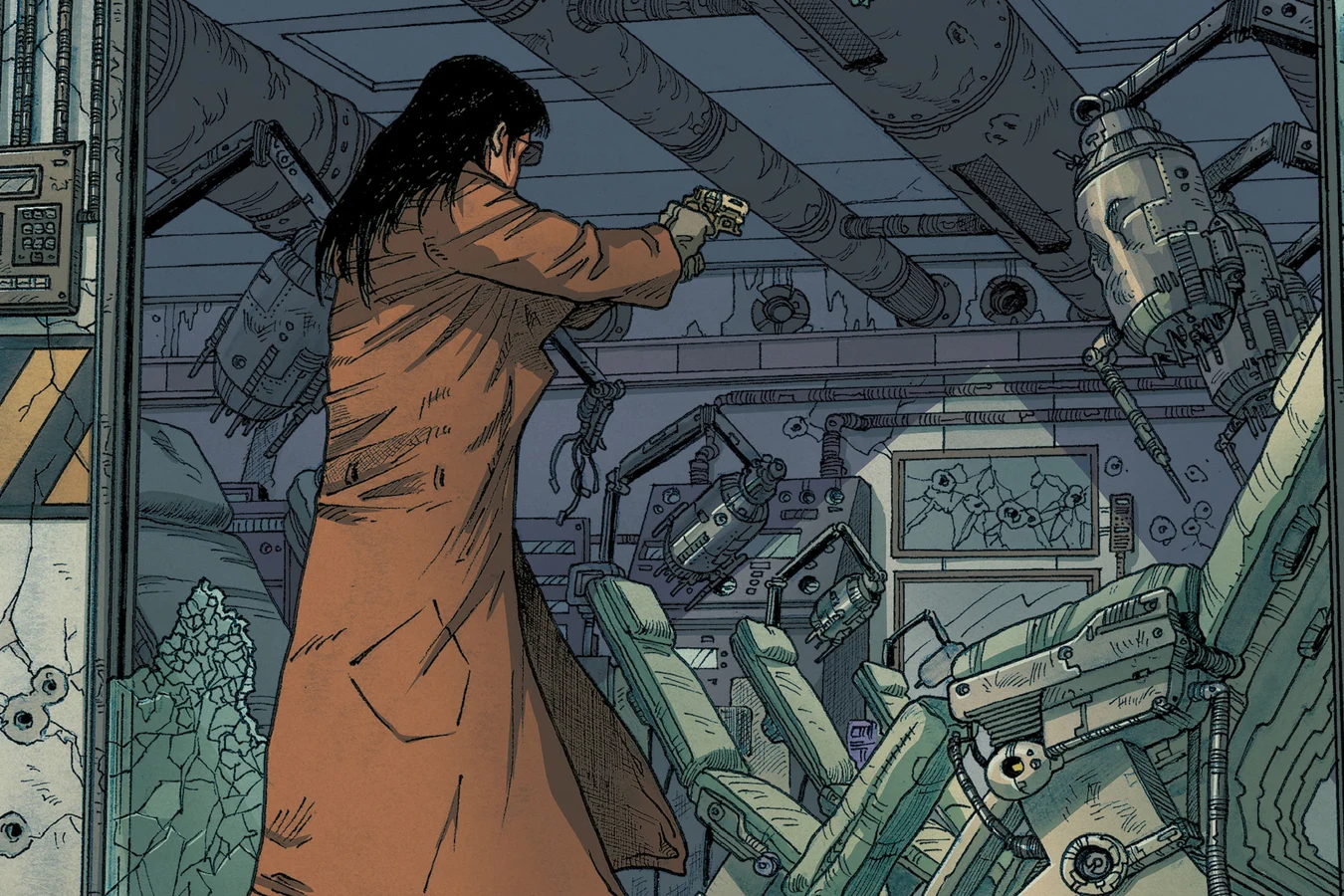
Deeper inside, Ash found the laboratories where the company had once made replicants, now a wreck of hanging robot arms, toppled frames and broken screens. In her narration, the ghosts had moved in after Tyrell died and the Blackout struck. A bald replicant and a gang of feral replicants attacked her, and a scientist named Fost pulled her into a sealed lab and locked them out. Fost still believed that he worked for Eldon and called the building the garden and the soil.
Offices
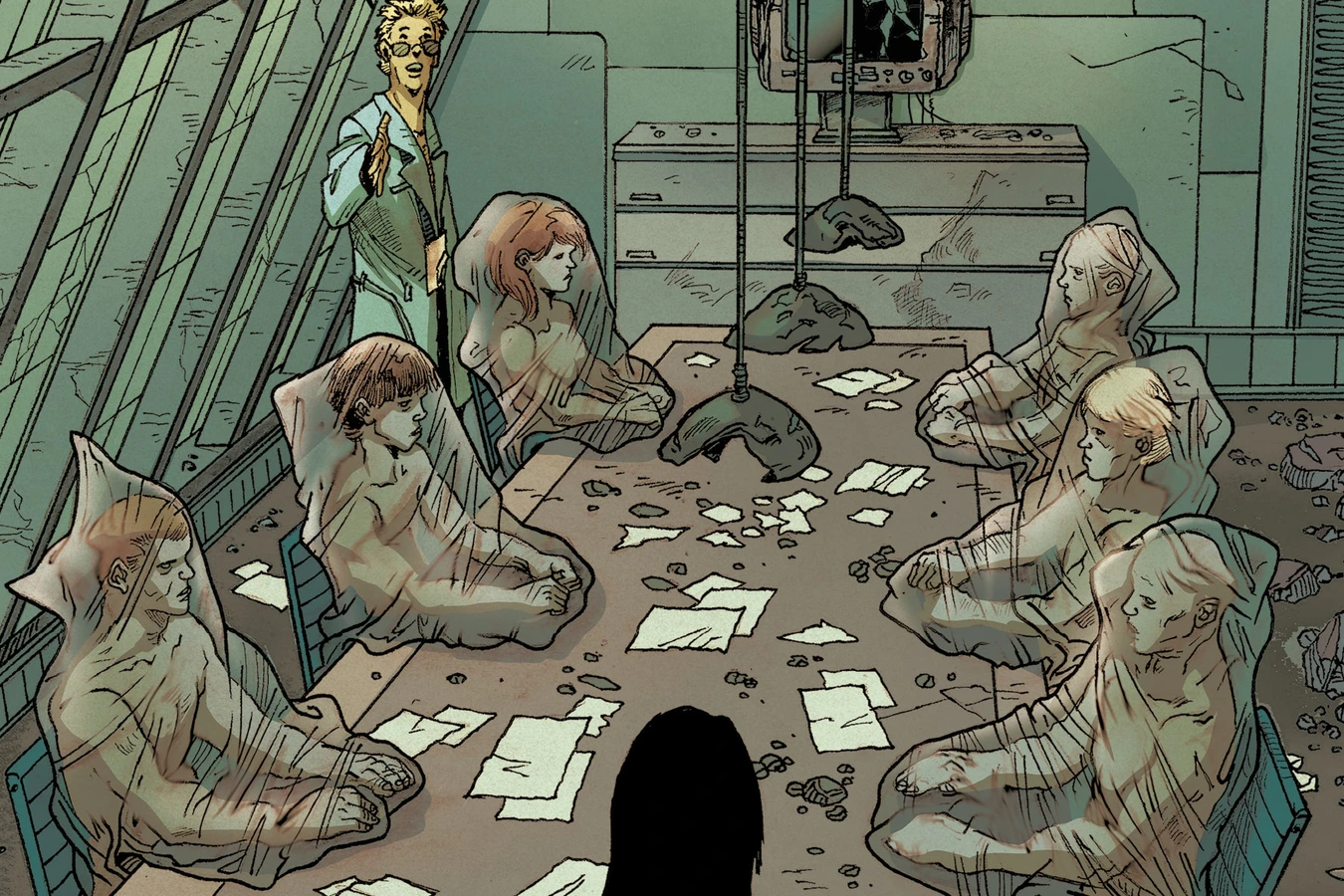
Blade Runner 2019 also showed one of the old offices, a long room beneath a wall of slanting windows. Papers, dust and chunks of fallen plaster covered its conference table, and a cracked monitor hung above a row of cabinets at the far end. Around the table sat unfinished replicants wrapped in clear plastic sheets, slumped in office chairs as if waiting for a meeting to begin. Fost introduced them to Ash, who was posing as Ms. Kady, and the captions called them replicants that were never delivered, left rotting. Lamp arms dangled over the table from the ceiling, and rubble lay heaped along the far wall.
Under The Building
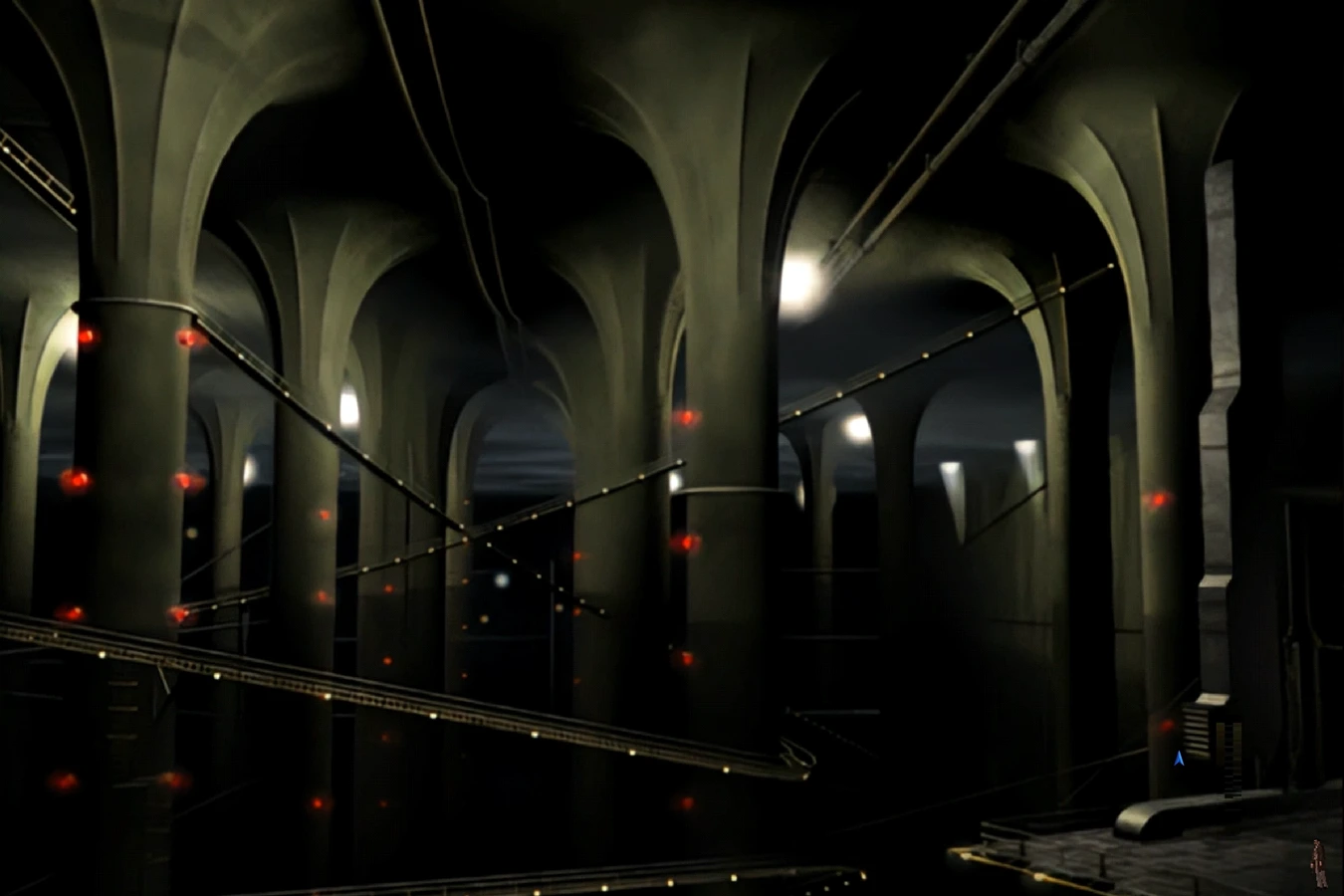
In the 1997 game, a ladder at the back of the Tyrell reception led down into the city's underground, a maze of sewers and old tunnels beneath Los Angeles. The chamber under the building was a vast hall of arched concrete columns, crossed by pipes and catwalks and lit by small red lamps. Ray McCoy could climb down there and follow the tunnels on to a narrow bridge, the camp of a homeless man and the hidden lab of the twins Luther and Lance beneath DNA Row. In the final act of the game, McCoy would no longer climb back up into the building.
History
The history of the building came from many stories rather than one. Titan's comic Blade Runner: Origins showed it being finished in 2009, and the 1982 film showed it at the height of the company's power ten years later. The comics, the anime and the roleplaying game followed it through the Blackout, the bankruptcy and the takeover by Niander Wallace. Blade Runner 2049 kept it standing beside newer towers, and the 2099 series brought it back eighty years after Tyrell died. The Blade Runner timeline places these stories in order.
Construction
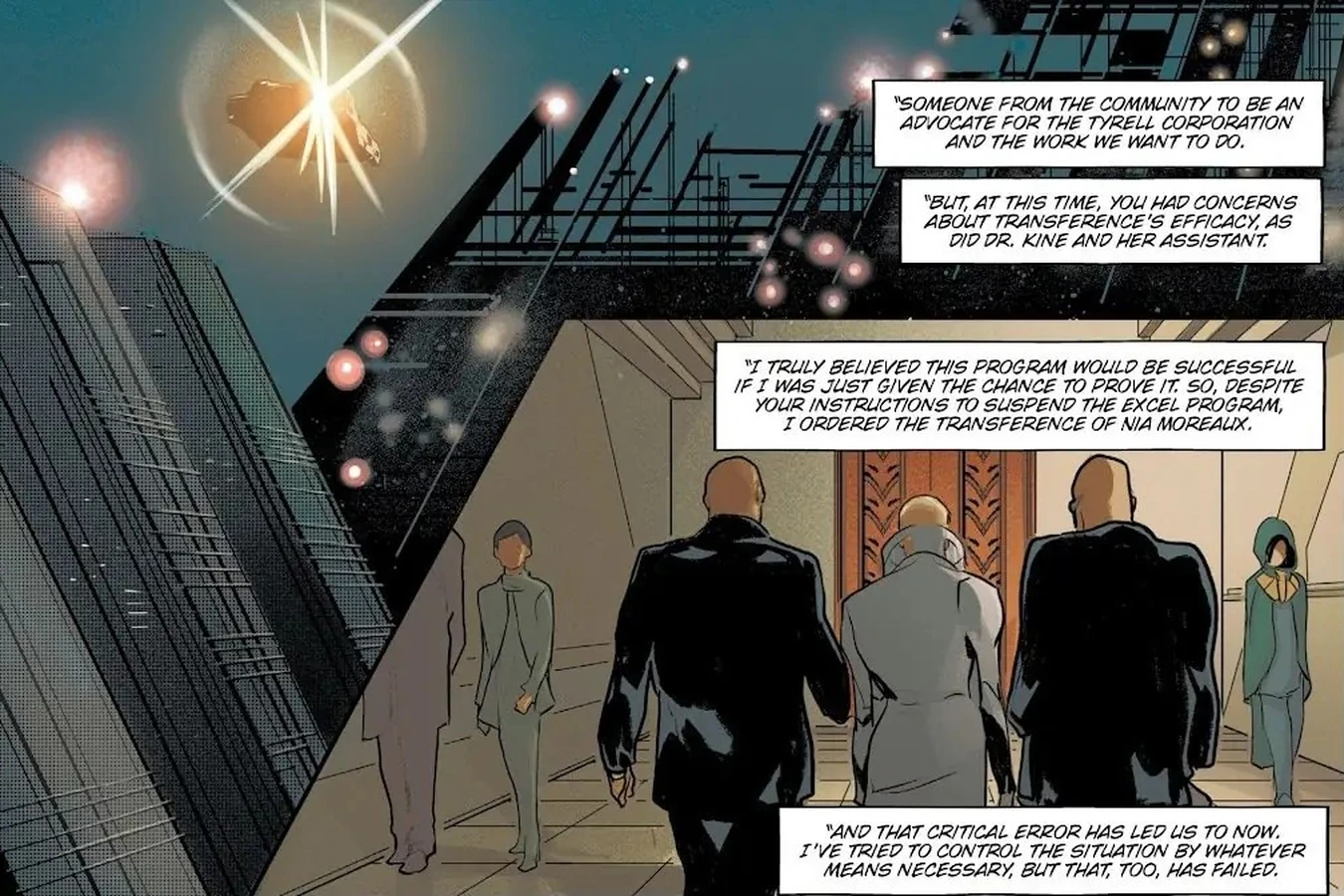
The Origins comic, set in 2009, showed the pyramid before it was complete. In the tenth issue, its summit was still an open lattice of steel girders with warning lights at the corners as a spinner flew past. Below the unfinished top, Eldon already kept a candlelit office with a carved screen, a couch, a chess set and his owl. Ilora Stahl, the voice he had chosen to speak for the firm, came to him there and took the blame for the damage her militia had done in Sector 6-B. He told her that she had put him in quite the position.
Tyrell's Heyday
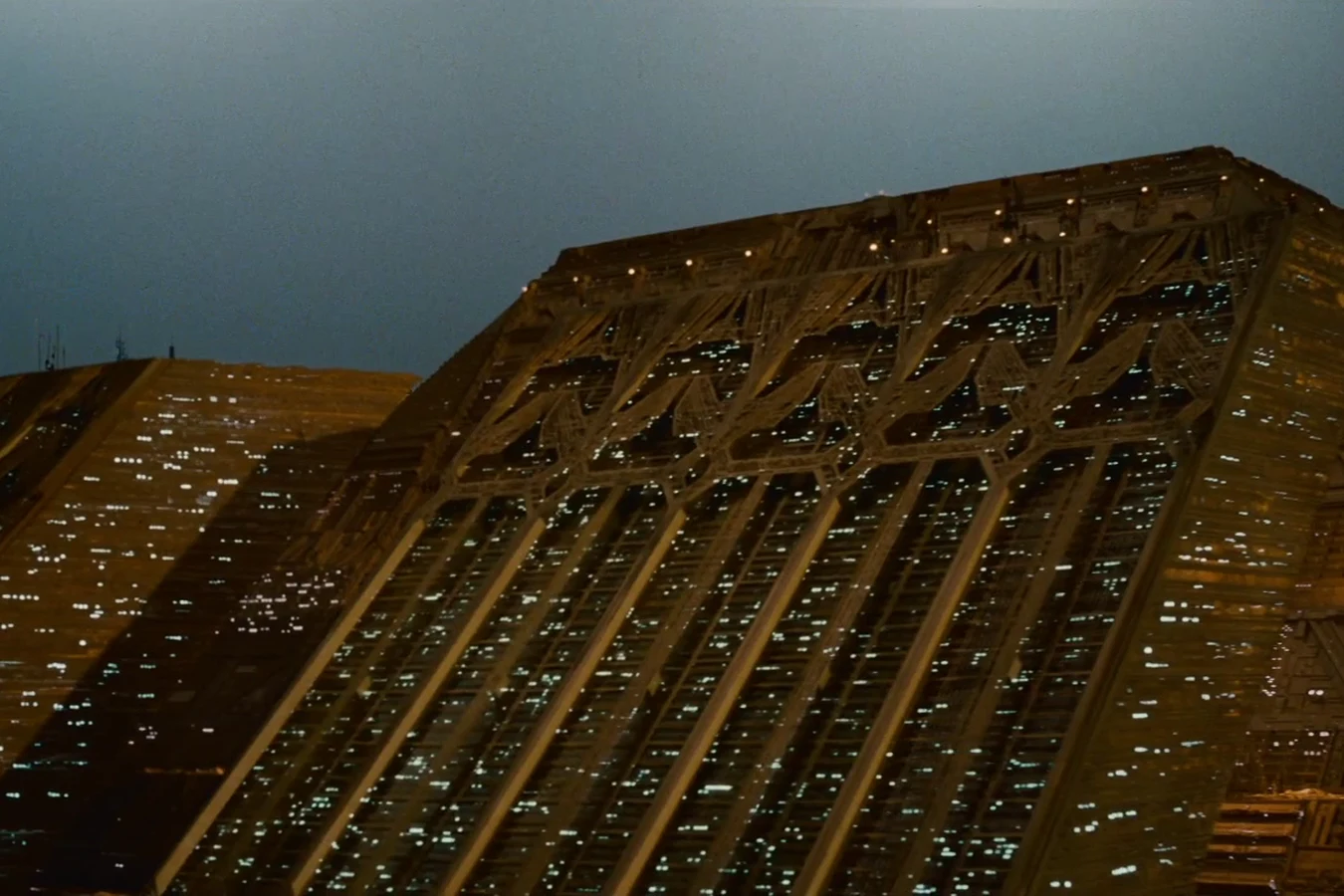
In 2019, the year of Blade Runner, the pyramid was the most powerful address in Los Angeles. The company had moved robot evolution into the Nexus phase, and its motto was "More human than human." Leon had taken a job at Tyrell and shot the blade runner Dave Holden during a test in an interview room inside the pyramid. Batty and his group came to the city to reach their maker, and they finally got to the top through Sebastian. That night ended the heyday of the building, and the company passed to Eldon's heirs.
The Blackout
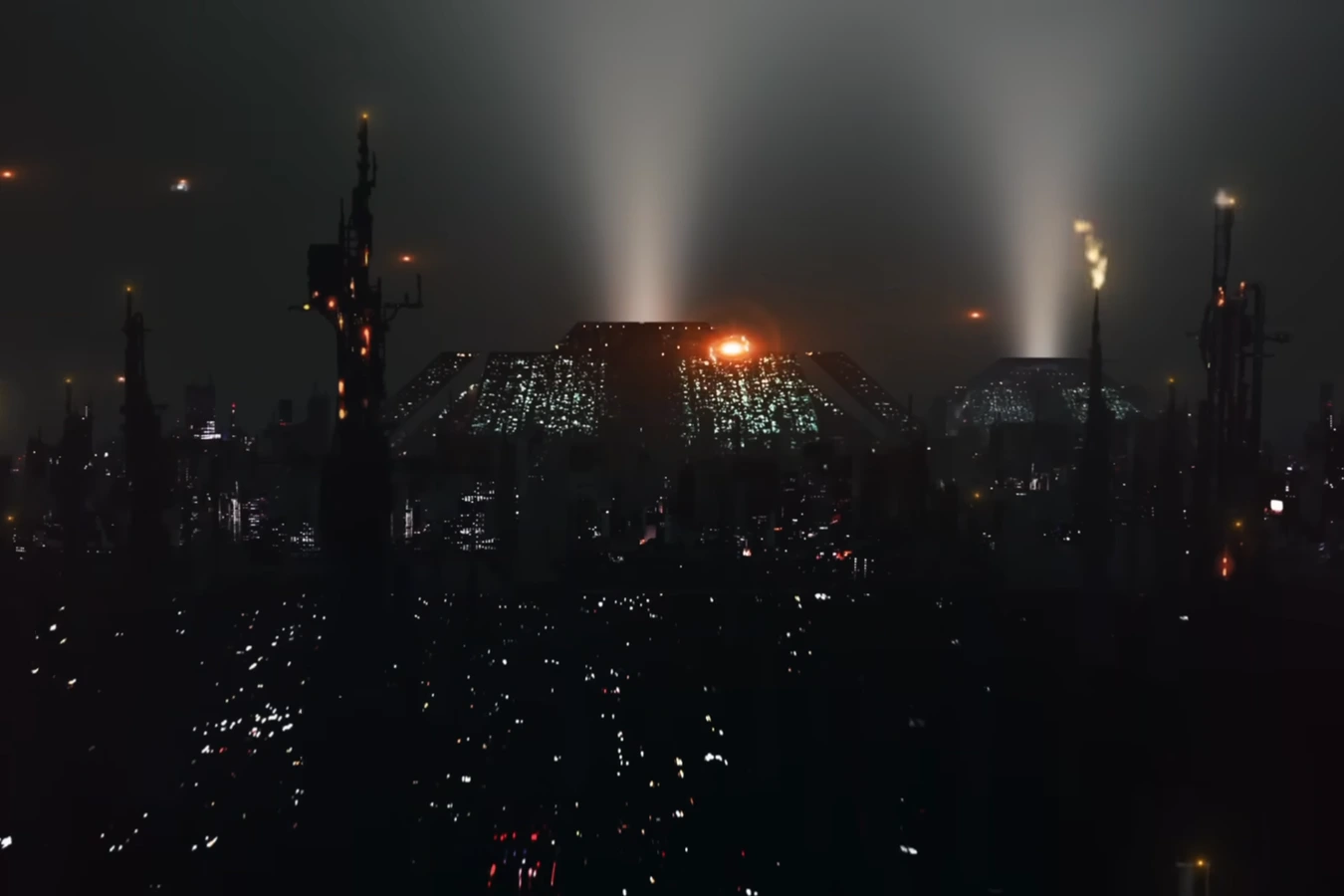
By 2022 the pyramids still stood over Los Angeles, and the anime short Blade Runner Black Out 2022 showed them at night on the eve of the attack, with pale beams rising from their tops into the smog. Soon after, a replicant attack shut down the city in the event later called the Blackout. The tenth issue of Blade Runner 2019 recalled that the attack destroyed the Tyrell Corporation servers and wiped out the records of who was artificial. With old man Eldon gone, nobody was left to stop a ban on replicant production, and the company soon went bankrupt. The building was left standing, but the company that had filled it was finished.
Fall Into Ruin
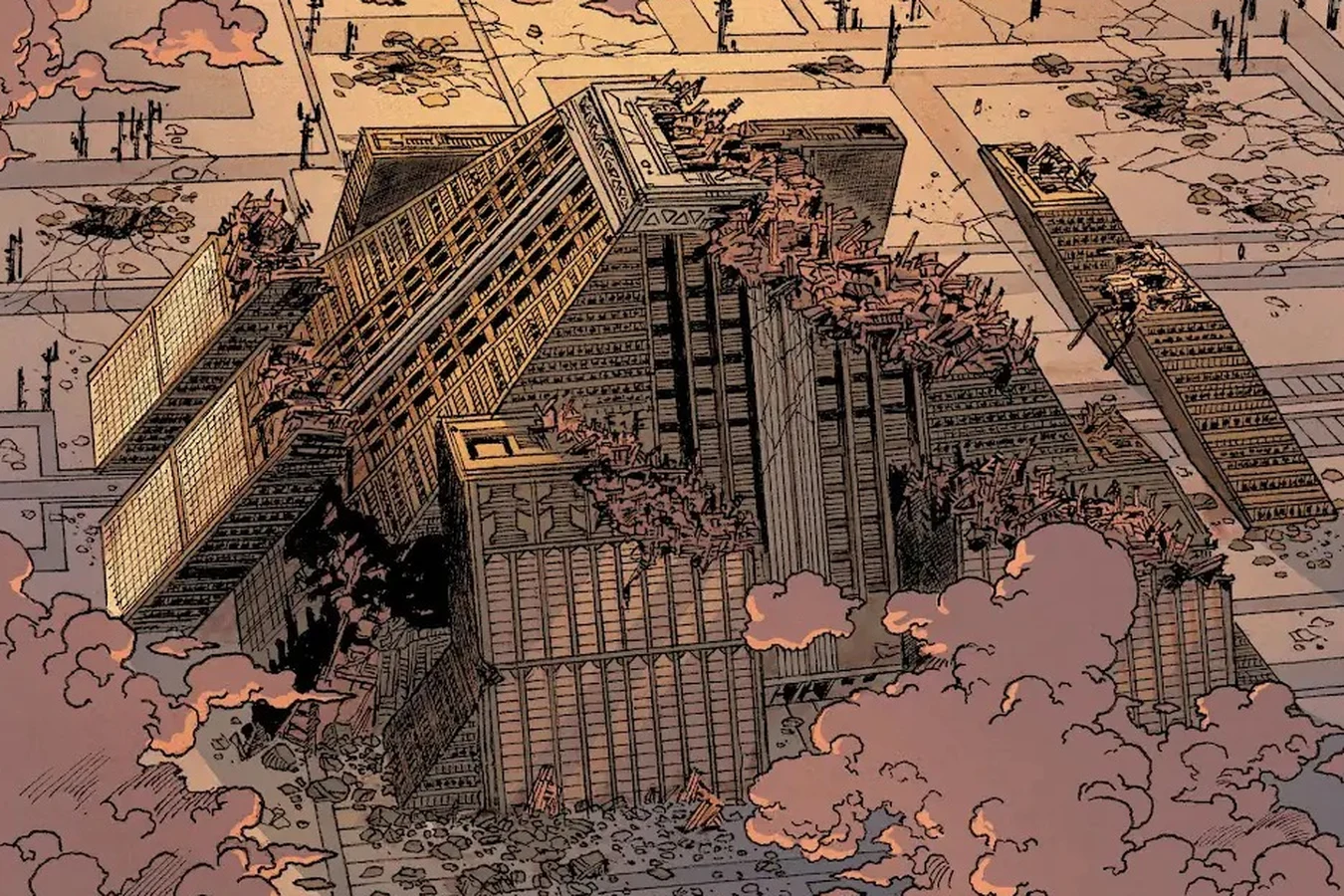
With the company bankrupt, the pyramid was left to decay. Blade Runner 2019 showed it from above as a field of broken slabs and twisted girders, its slanted towers snapped and the streets around it choked with rubble and smoke. Feral replicants roamed the halls, and the police no longer bothered to patrol a place with nothing left to protect. When Ash flew her old spinner over it in the ninth issue, she called it a monument to progress, and then folly. In Blade Runner 2039, the ruin still held a pendulum swinging over a stone well and the private sanctum where Tyrell had been murdered twenty years earlier, kept as a monument to his hubris.
Wallace's Takeover
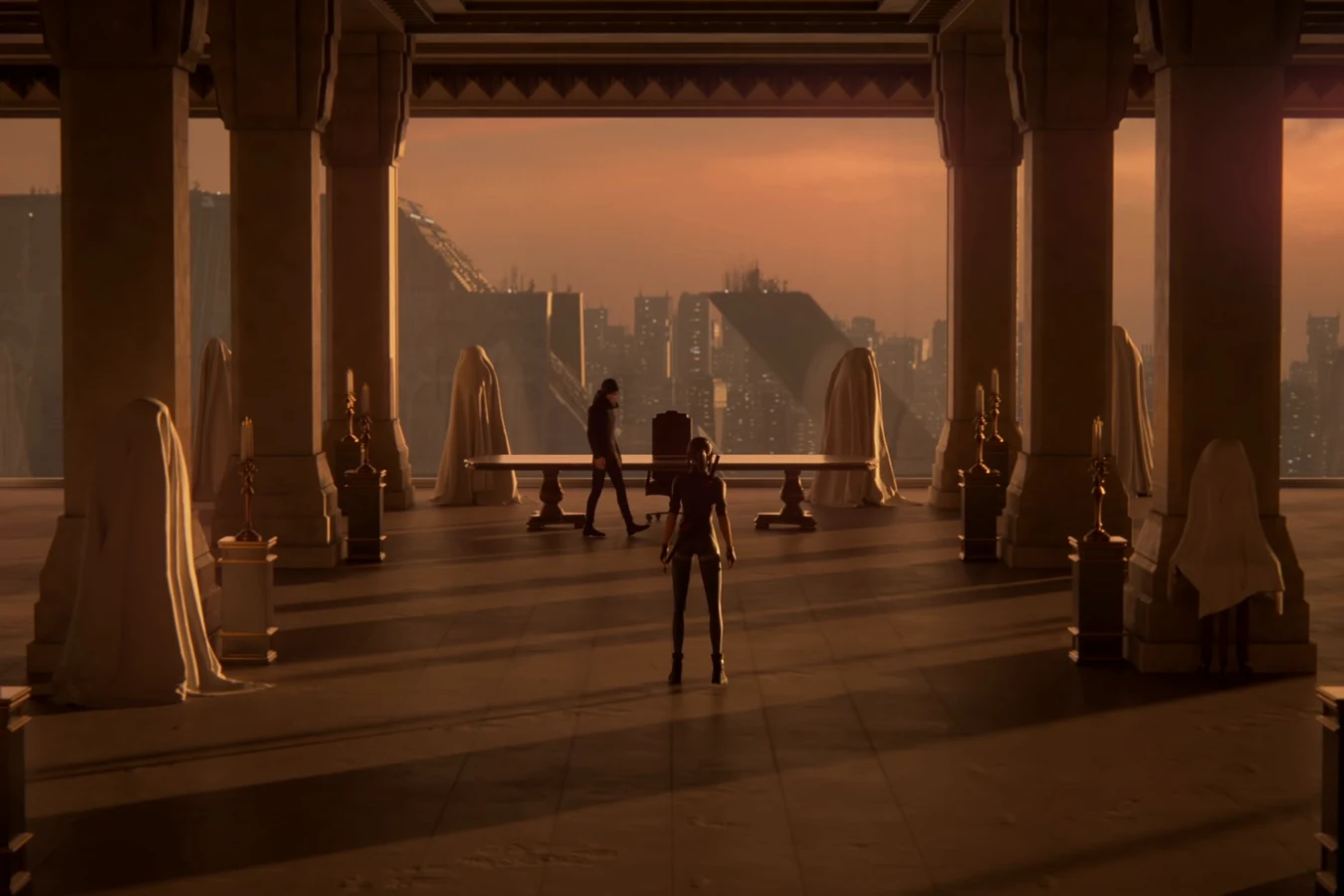
After the bankruptcy, Wallace bought what remained of the company, and the pyramid became part of the Wallace Corporation. In Blade Runner: Black Lotus, set in 2032, Elle entered the old pyramid and found Wallace Jr. waiting in its sanctum. The roleplaying game, set in 2037, said that the pyramid had once been the heart of the city but was now just one of many Wallace plants and office buildings in Sector 4. Wallace's new headquarters, still years from completion, was already the largest building in the city and dwarfed the pyramid nearby. Decades earlier, bioengineers had crowded into the pyramid-adjacent slums of Old Chinatown, which grew into DNA Row.
Beside The Wallace Towers
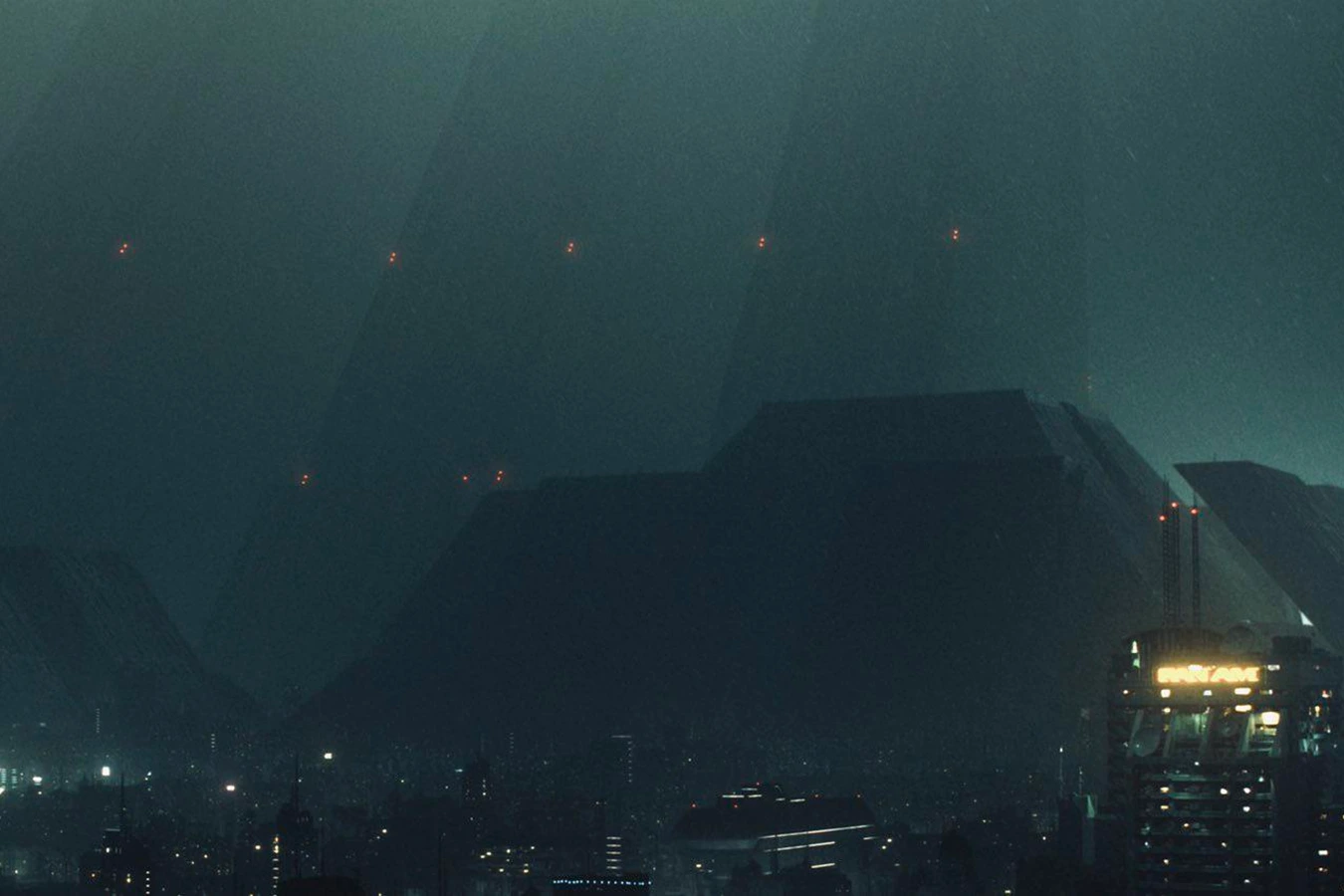
By the time of Blade Runner 2049, three monumental Wallace towers rose over the Los Angeles skyline. The Art and Soul of Blade Runner 2049 described them as towering insolently over the Tyrell buildings, the headquarters of a company whose protein fed the world and whose factories made replicants and digital companions. In the film, the dark stepped pyramid stood at the foot of the towers with its slanted wings still in place. Niander Wallace had bought the replicant patent from the Tyrell Corporation, and he displayed the older Tyrell prototypes as a symbol of his power.
The Pyramid In 2099
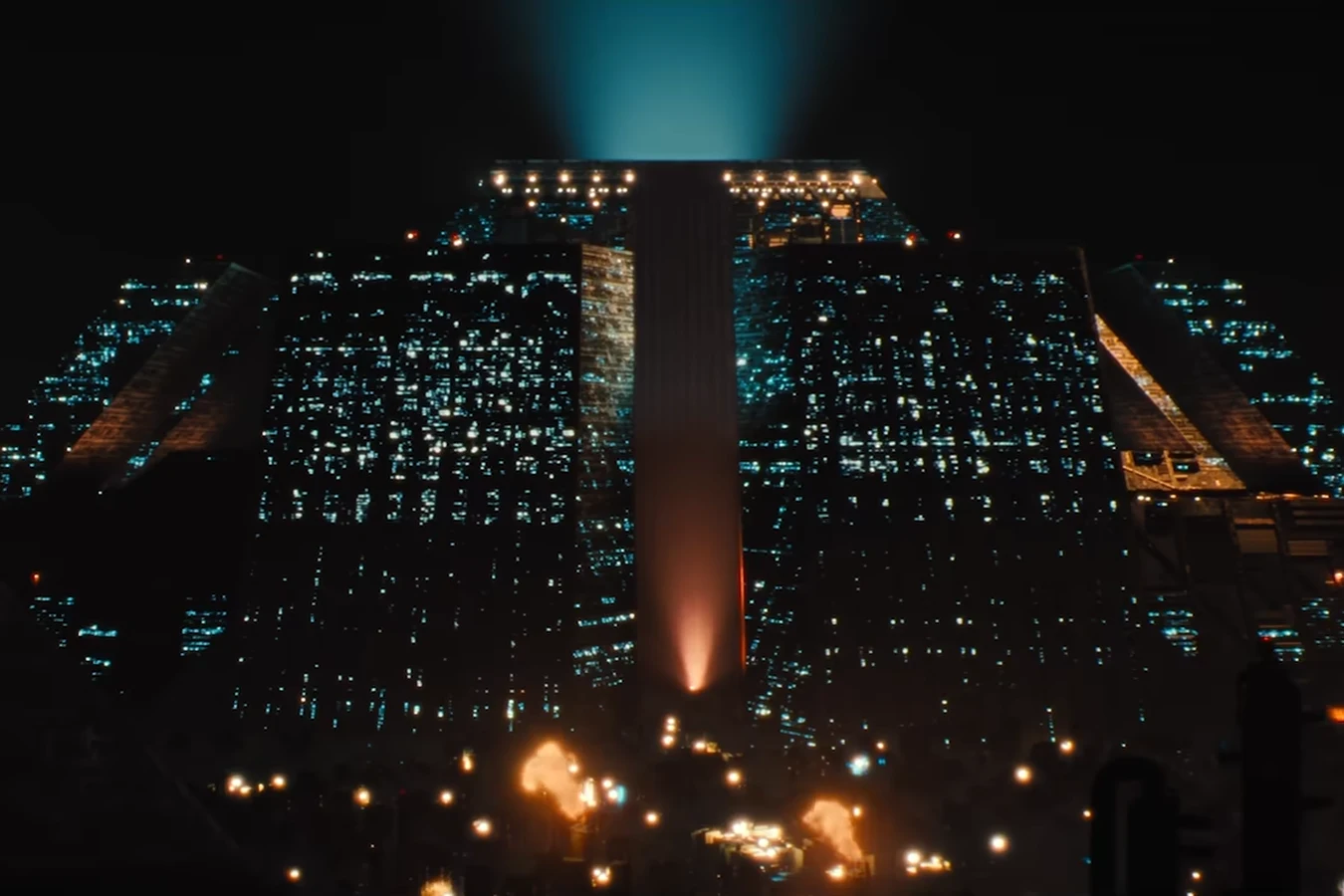
The pyramid returned in Blade Runner 2099, the Prime Video series set eighty years after the first film. The trailer released at New York Comic Con on 10 October 2026 showed it at night, with its windows still lit and a blue beam rising from the summit. The final trailer of 9 November 2026 showed it again at dusk, its slanted towers dark against an orange sky. Neither trailer said who owned the building in 2099 or what went on inside it. The series was set to premiere on 25 November 2026.
Cora And Olwen Visit
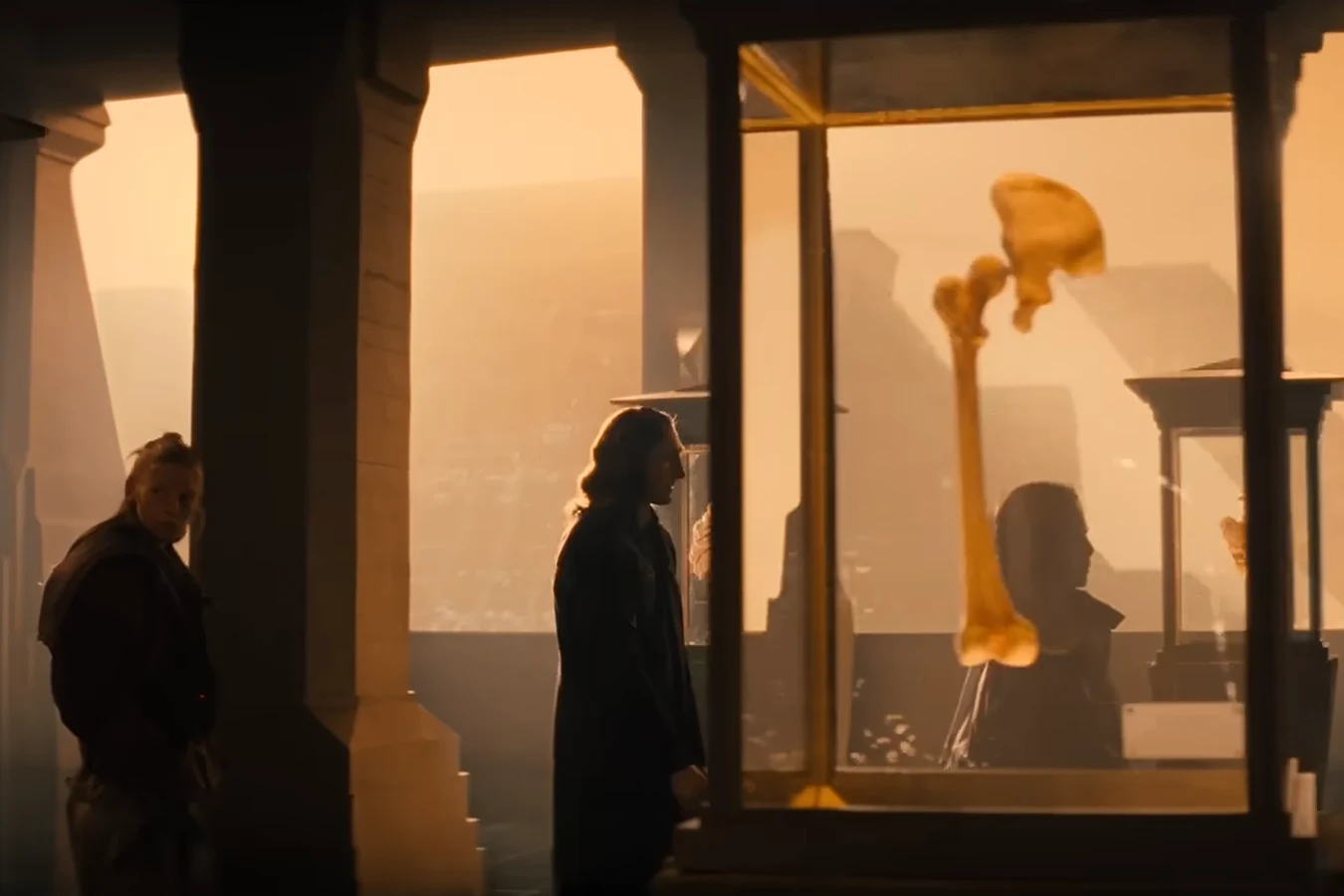
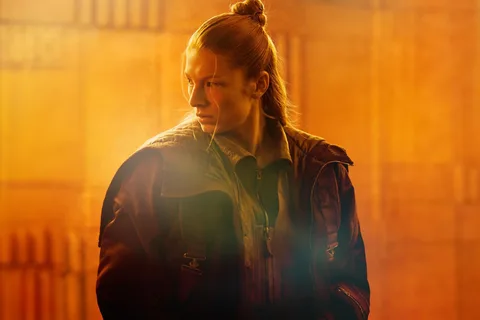
Another shot from the same trailer showed two women walking through a hall of glass display cases, one holding a giant amber bone. The slanted towers of the Tyrell complex filled the windows behind them. They appeared to be Cora, played by Michelle Yeoh, and her partner Olwen, played by Hunter Schafer. Their case followed 28 missing replicants and a man rumored to know a cure for all of them. The trailer did not say whether the gallery was inside the pyramid or in a tower nearby.
Possible Destruction
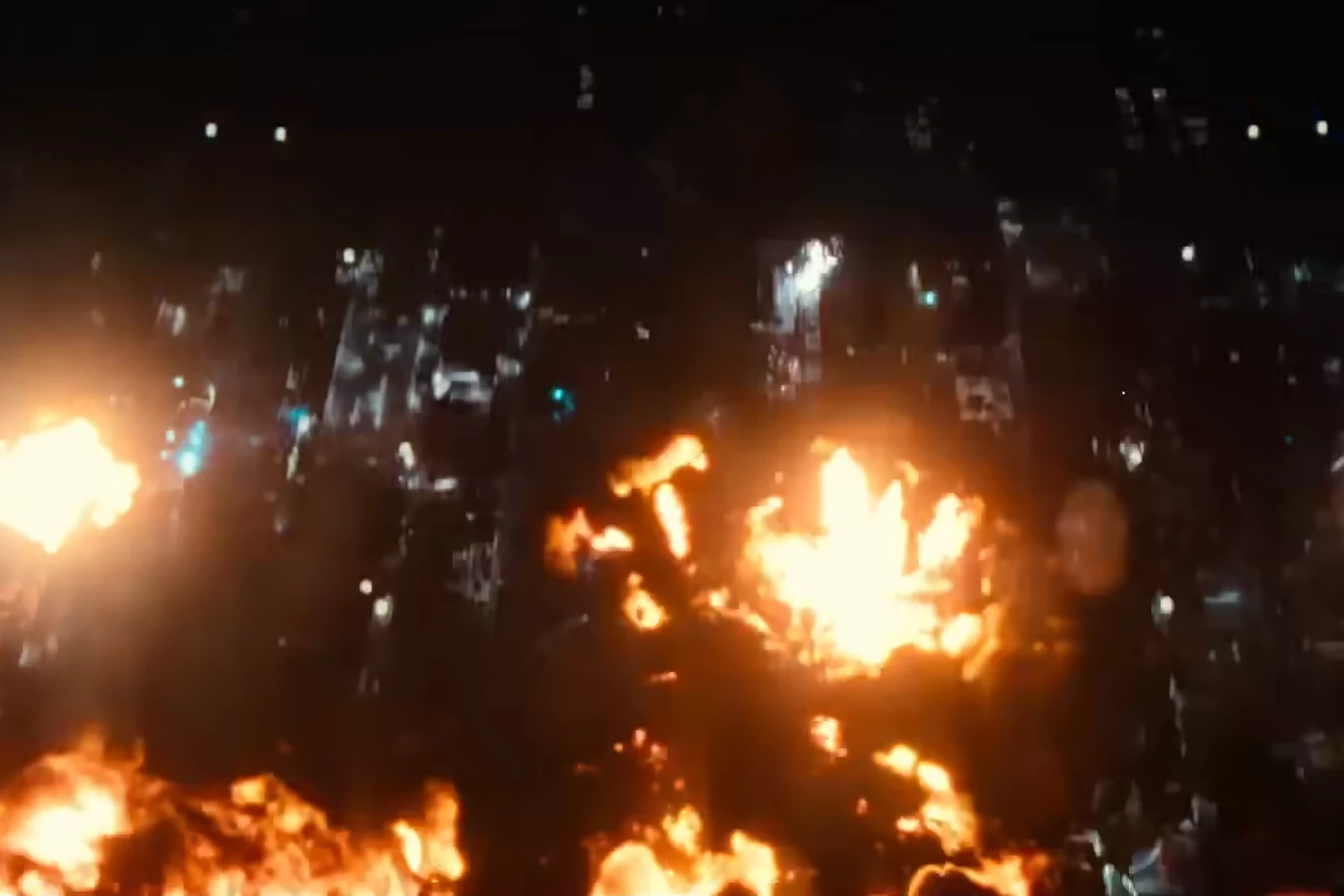
Near its end, the same trailer cut to an aerial shot of explosions tearing across a grid of blue-lit buildings. The shot did not clearly identify its target, so it was not certain that the Tyrell complex was the building being destroyed. Prime Video promoted the final trailer with the line "Whatever you can build, you can destroy." If the pyramid did fall in the series, it would follow the novels of K. W. Jeter, where the whole complex was blown apart in 2020.
Rosen Association Building
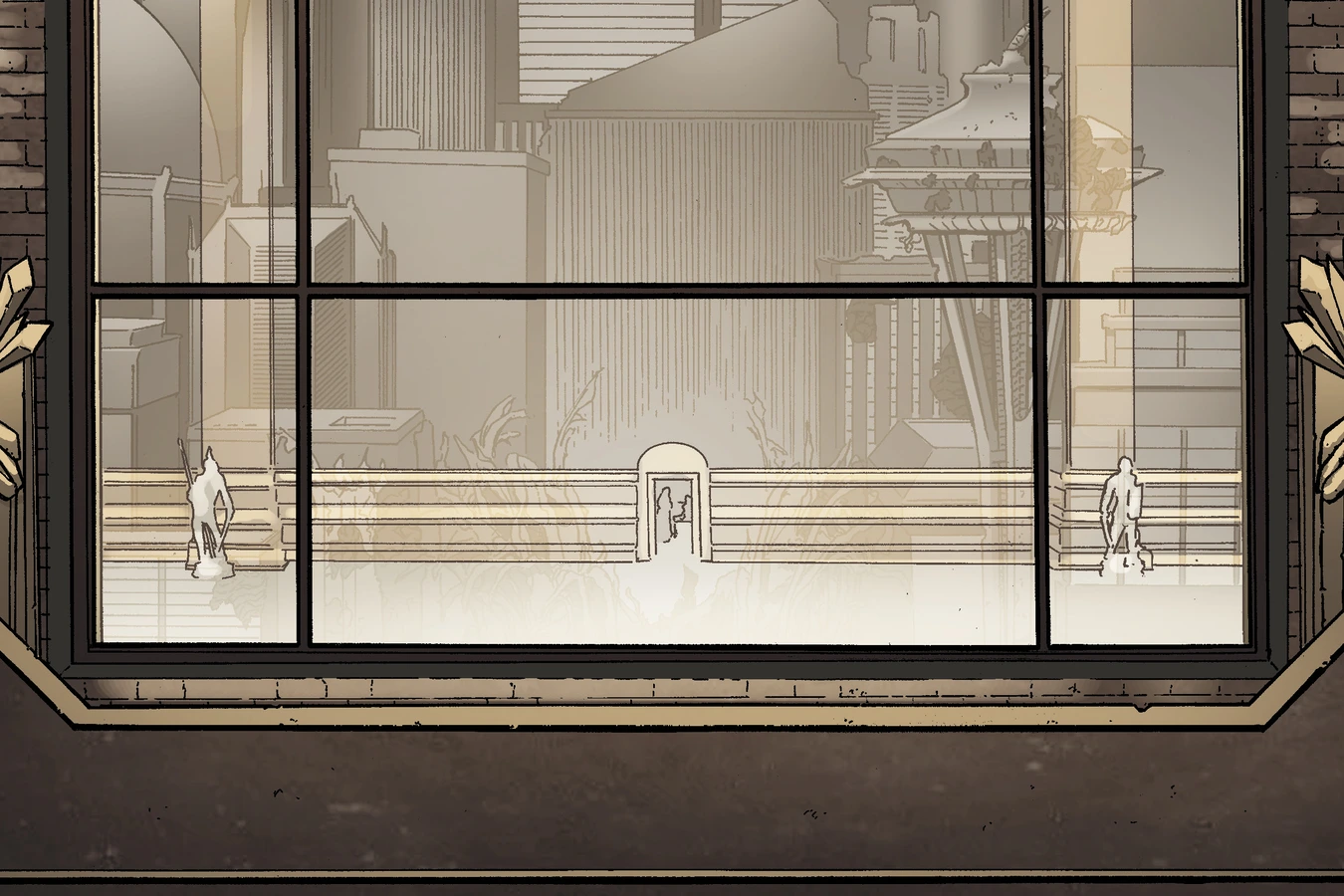
Philip K. Dick's novel Do Androids Dream of Electric Sheep? had no pyramid. Its android maker, the Rosen Association, worked from the Rosen Association Building in Seattle, and Deckard flew there to test his scale on the new Nexus-6. Dick never described the outside of the building, its shape or its height. He wrote only that Deckard landed his police hovercar on the roof, where Rachael Rosen met him beside pens of living animals guarded by men with machine guns. Inside, the Rosens led him down a brightly lit corridor to a chic room furnished like a living room.
Rachael told Deckard that she rarely left the building, because police roadblocks made the risk too great. Eldon Rosen added that the company manufactured nothing on Earth. The BOOM! Studios comic kept Dick's words and gave the clearest view of the building from inside. It set the bargaining over the owl in front of a great arched window with a crown of gilded spikes, looking out on a pale skyline with a tower much like the Space Needle. Some towers elsewhere in the comic had sloping, pyramid-like shapes, but neither the comic nor the novel named any of them as the Rosen building.
K. W. Jeter Novels
Four Slanted Towers
In Blade Runner 2: The Edge of Human, Jeter described the headquarters as a complex rather than a lone pyramid. Four towers slanted in toward each other around a truncated pyramid, which Sarah Tyrell compared to "the petals of a cubist flower that hadn't fully opened yet." She called it a city in itself, surrounded by the larger mass of Los Angeles. The replicant manufacturing units formed the base and core of the complex, under reinforced skylights. Eldon's private suite and the executive landing deck, which he had rarely used, stood at the top, and Sarah sealed his suite after his death.
Built To Implode
The U.N. had required a way to destroy the complex when it was built, so explosive charges were set into its substructure and walls. Sarah explained that everything was "designed to implode, to fall in upon the center," which was why the towers slanted toward each other. The so-called red button was really an overlapping series of commands keyed to Eldon's voice, and it had never been keyed to hers. In the end the U.N. sent the command series itself, and the explosions climbed the towers while Deckard was in the private suite. Dave Holden lifted him off the roof in a freight spinner as the last tower fell.
From the air, Deckard saw that a gigantic square had been cut out of the center of Los Angeles. It now looked like "the mouth of a ground-level volcano," with flames and twisted girders where the towers had stood. Sarah had wanted this ending, since destroying her uncle's empire was the next best thing to killing him. Official records listed her among the dead, and the Tyrell Corporation lost its home. The novel's version went much further than the films, where the pyramid was still standing decades later.
The Ruins
In Blade Runner 3: Replicant Night, the blast had reduced the corporation "to a ziggurat of twisted girders and smoldering rubble," killing dozens of people or perhaps hundreds. Sarah remembered the great vaulted windows of the executive suite and assumed that the hole had been filled in or turned into a squatter ghetto. The Tyrell loyalist Wycliffe told her that the headquarters complex and the pyramid were all gone. Inside that pyramid, he said, murder had been the way to get ahead. On an orbital film set in Outer Hollywood, a studio rebuilt a copy of the old interview room.
Iris In The Ruins
In Blade Runner 4: Eye and Talon, the blade runner Iris Knaught found the ruins as a gap in the skyline, still rising nearly as high as the buildings around them. The streets nearby had emptied, and it was the first empty place she had ever seen in Los Angeles. Her guide Vogel led her through tunnels in the jammed slabs to a chasm full of broken machinery. He called it the real heart of the late Tyrell Corporation, where the assembly lines for every replicant model had run. Half-formed bodies still lay among the equipment.
Eldon's Sealed Quarters
Climbing higher through the rubble, Iris and Vogel reached a tilted wooden door into Eldon's private quarters, still lit by candles, with ivory fabrics and the owl's empty perch. Vogel explained that the rooms were wrapped in a steel cage on breakaway joints. When the complex blew, steel barriers nearly half a meter thick had dropped over the windows "like guillotine blades." A separate oxygen supply meant that Eldon could have survived the blast with a few bruises. A hidden door led to his private theater, where Vogel showed Iris a film of the Blade Runner story.
Behind The Scenes
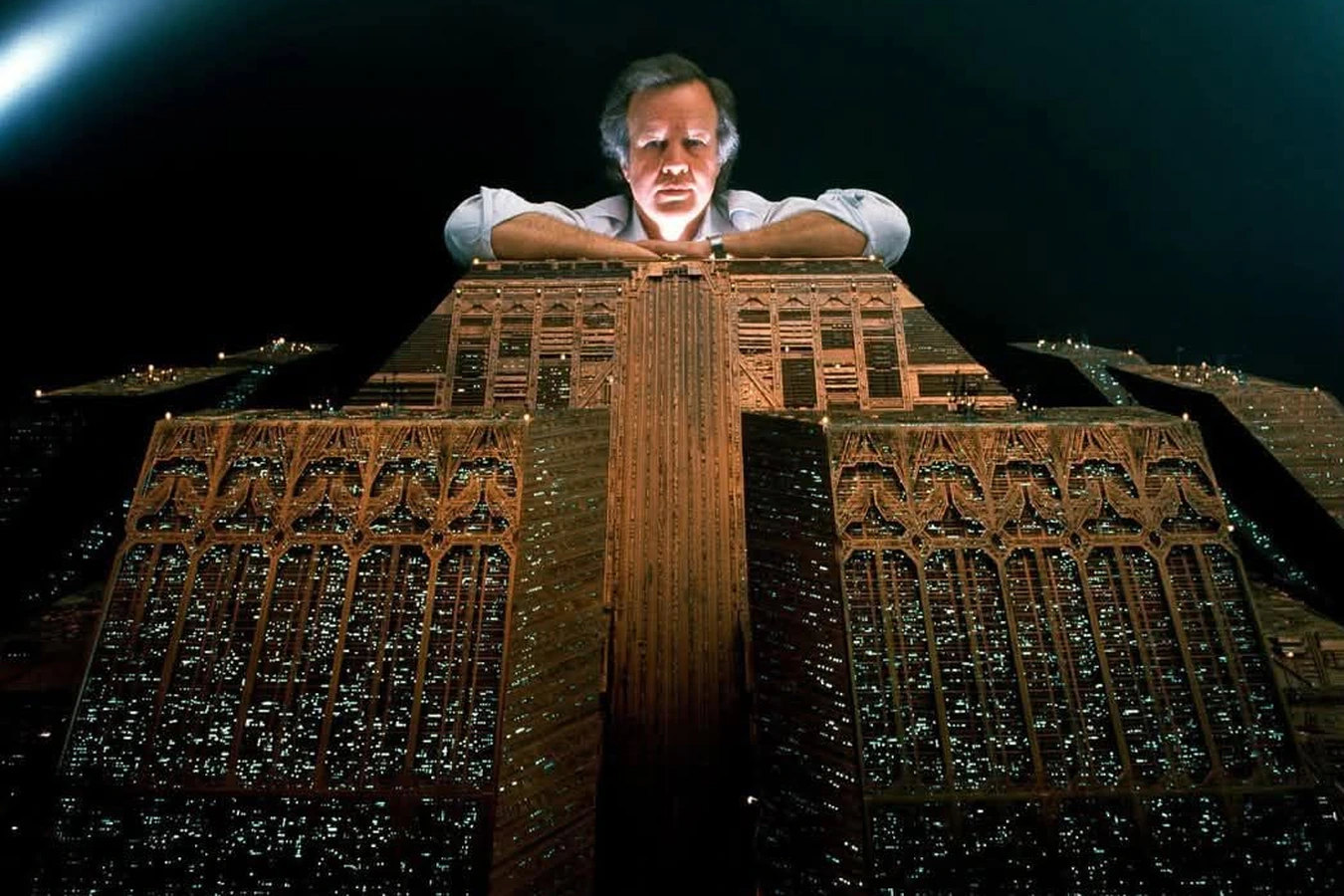
The pyramid was built by Entertainment Effects Group, the effects house run for the film by its special photographic effects supervisor, Douglas Trumbull. Model maker Mark Stetson credited the design to EEG effects designer Tom Cranham, working from Trumbull's input. The building was meant to be well over a mile high, 600 to 900 stories depending on who was asked, so the crew settled on a scale of about 1/750. The finished miniature was about two and a half feet high on a nine-foot base, with acid-etched brass buttresses and a cast polyester core threaded with fiber optics.
Only one pyramid model was ever built, and Stetson said that optical sleight of hand duplicated it on screen. The opening shot, which the crew nicknamed the Hades landscape or Ridley's Inferno, was a forced-perspective tabletop miniature only thirteen feet deep and eighteen feet wide, modeled on refineries in El Segundo and Torrance. The pyramids were filmed separately and matted into those shots after repeated motion-control passes. For the most distant views, still photographs of the model became backlit transparencies, lit by bent neon tubing inside slim Plexiglas boxes. Effects supervisor David Dryer said that at that distance nothing gave the trick away.
The pyramid was the first major effects sequence filmed, and Trumbull shot a few straight takes of the model before his work on Brainstorm ended his daily involvement. Dryer joined in April 1981 and stayed until the effects shoot wrapped late that year. A larger "Pyramid insert model", four feet high and five feet wide, carried a flat roof section, a miniature interview room with turning fans, three-inch motorized elevator cars and a long narrow window that stood for Tyrell's office and bedroom. Stetson said the bracing on the elevator cars formed two Ms, for their builder Michael McMillian.
Production designer Lawrence Paull made Tyrell's office one of the largest of the film's 47 sets, eighty feet square with twenty-foot columns, and its scene was the first filmed, from March 9, 1981. He first wanted marble, then used raw concrete and granite to echo the pyramid, in a style he called neofascist or "Establishment Gothic." The view through the window was planned as a front-projected plate of the model, but the result disappointed Trumbull and Ridley Scott. Syd Mead designed every matte painting in the film, and Matthew Yuricich repainted most of the office above the actors' heads, while John Wash animated the rising sun.
For Blade Runner 2049, the designers spent a year working out what kind of building could overshadow "the iconic Tyrell ziggurats," according to The Art and Soul of Blade Runner 2049. An early concept of three angled towers forming the letter W was dropped, because Denis Villeneuve wanted a more subtle and mysterious presence in the skyline. The final design was three sea blades meant to stand for 10,000 years against rising water. Weta Workshop built them as a 1/600 scale miniature, and Alex Funke said that even at that scale it was four meters tall.
Conclusion
The Tyrell Building began as a single model doubled on film over a burning industrial plain. Eldon Tyrell lived and died at its summit, Ash walked through its ruins, and Wallace raised taller towers beside it. Jeter blew it apart in his novels, while Dick's book replaced it with a Seattle building he barely described. The trailers for Blade Runner 2099 still showed it standing eighty years after Batty rode the elevator to the top, though an explosion across the city left its future open.
Appearances
- Do Androids Dream of Electric Sheep? by Philip K. Dick (1968), as the Rosen Association Building
- Do Androids Dream of Electric Sheep? comic adaptation (BOOM! Studios), as the Rosen Association Building
- Blade Runner (1982 film)
- Blade Runner 2: The Edge of Human by K. W. Jeter (1995)
- Blade Runner 3: Replicant Night by K. W. Jeter (1996)
- Blade Runner (Westwood Studios, 1997 game)
- Blade Runner 4: Eye and Talon by K. W. Jeter (2000)
- Blade Runner Black Out 2022 (2017 short)
- Blade Runner 2049 (2017 film)
- Blade Runner 2019 (Titan Comics)
- Blade Runner: Origins (Titan Comics)
- Blade Runner 2039 (Titan Comics)
- Blade Runner: Black Lotus (2021 series)
- Blade Runner: Revelations (2023 VR game)
- Blade Runner: The Roleplaying Game (Free League)
- Blade Runner 2099 (2026 series trailers)
Tag Categories: Blade Runner Lore