Do Androids Dream: Novel Plot, Characters & Lore

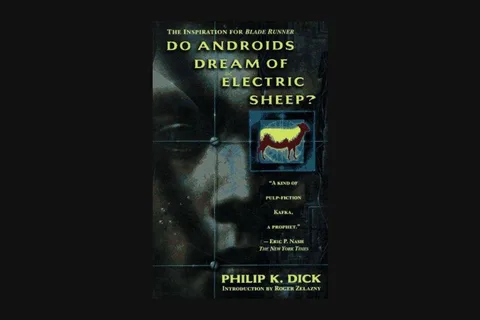
Do Androids Dream of Electric Sheep? is a 1968 novel by Philip K. Dick, published by Doubleday in March of that year. It follows San Francisco bounty hunter Rick Deckard on 3 January 1992, after World War Terminus left Earth under radioactive dust. Deckard hunted escaped Nexus-6 androids for bounty money while his wife Iran, special J. R. Isidore, the religion of Mercerism, and a rooftop electric sheep filled out a day that Ridley Scott later filmed as Blade Runner.
Plot Summary
Deckard Tends An Electric Sheep
A Penfield mood organ woke Deckard on the morning of 3 January 1992. Iran refused to rise. Her schedule listed a six-hour self-accusatory depression, set after she shut off a Buster Friendly commercial and heard the empty apartments through the walls. She treated that despair as a healthy reaction to a half-empty Earth, with an automatic 481 reset three hours later. Deckard dialed 594 on her console, a pleased acknowledgment of his judgment, then dialed himself a fresh attitude toward the day's work.
He put on an Ajax Mountibank lead codpiece and went to the covered roof pasture. An electric black-faced Suffolk ewe chewed on an oat circuit and fooled the other tenants, who never asked if a neighbor's animal was real. Radioactive dust hung in the morning air, weaker than in the first years after World War Terminus but strong enough to create new specials from regulars. Monthly exams by San Francisco Police Department doctors kept Deckard inside the legal breeding tolerances. Government ads ran the same line: emigrate or degenerate. The U.N. pushed anyone who could pass a medical exam toward the colony planets and gave each emigrant an android servant. Deckard stayed on Earth for the bounty money.
Barbour Will Not Sell Judy's Colt
Neighbor Bill Barbour had a real Percheron mare named Judy, newly pregnant from State Animal Husbandry Board plasma. He treated a sale as immoral. Sidney's January supplement listed Percheron colts in italics, meaning no stock at the five-thousand-dollar price. Men with algae plants and inside contacts could keep two or five animals. Deckard could not buy what the catalogue did not have.
His real sheep, Groucho, had died of tetanus after a scrap of baling wire in the hay. The replacement hid a control panel under its mane. Owning any animal, even a fake one, was how people proved they could feel what Wilbur Mercer asked of them. Iran cared about that more than Deckard wanted to admit. He wanted a large living animal and needed several thousand-dollar bounties to buy one from Sidney's Animal & Fowl Catalogue.
Isidore Lives Among The Kipple
South of the city, in a suburban building that had once held thousands, John Isidore shaved to government TV ads for Mars and New New York. He drove a pickup for the Van Ness Pet Hospital, a false-animal shop run by Hannibal Sloat. He had been a special for more than a year. The dust had damaged his genes, and a failed mental faculties test had given him the street label chickenhead. Specials were barred from Mars and written out of the human line. Sloat, too old to emigrate and gray from years of dust, paid him to haul broken electric pets, which Isidore treated as a kindness.
Silence in the ruined rooms felt like a living pressure. Useless objects, junk mail, and dead appliances piled up as kipple, a clutter that seemed to reproduce itself until a building drowned in it. Isidore treated it as a law, like bad money driving out good. He gripped the black empathy box in his living room, left the room, and fused with Mercer on the barren hill among other living users. A thrown rock cut his arm for real. When he came back, a TV set sounded on a lower floor. Residents left that building and no one replaced them, so the set was the first new life he had heard there. He took a cube of margarine downstairs as a welcome gift, determined not to let the new tenant learn he was a chickenhead.
Deckard Stops For The Cleveland Ostrich
On the way to the Hall of Justice, Deckard stopped at animal row to stare at a heated ostrich in a clear-plastic cage. The bird had just arrived from a Cleveland zoo. It was the only ostrich on the West Coast. The price sat beyond a bounty hunter's cash, thirty thousand dollars in Sidney's if the listing was even in stock.
He reached Lombard Street a quarter hour late. Inspector Harry Bryant sent him to Dave Holden's office at nine-thirty. Holden, the department's chief hunter, lived on Nob Hill and had been fine the night before. A laser track ran through his spine. He was in Mount Zion Hospital for at least a month, waiting for an organic plastic spinal section to take hold.
Bryant Assigns The Remaining Six
Secretary Ann Marsten had read the Rosen spec sheets. A Nexus-6 brain unit could select among two trillion constituents and ten million neural pathways, and in less than half a second it could take one of fourteen reaction postures. Bryant had called the Soviet W.P.O. that morning, hoping Moscow would file a complaint with the Rosen factory representative East. Police agencies had protested since the specs landed in August 1991, just as they had howled when Sudermann's T-14 units reached Earth in 1989. The Pavlov Institute's original Voigt test had closed that gap. Intelligence tests would not catch a Nexus-6. The remaining field tool was the Voigt-Kampff scale, which watched eye-muscle and capillary reaction for a failure of empathy.
Eight Nexus-6 androids had killed their way off a settlement near New New York on Mars. Holden had retired the first two, Anders and Gitchel, then taken Polokov's laser while giving the test. Bryant wanted Deckard in Seattle first, to prove the scale worked on a Rosen sample, before he touched the remaining six names.
Rachael Rosen Fails The Empathy Test
The Rosen Association built those brain units on Mars under colonial law. Rachael Rosen met Deckard on the Seattle roof among live animals the firm could afford, including a raccoon named Bill and an owl called Scrappy. Sidney's listed no owls at any price. Uncle Eldon Rosen sat her in the test chair and later presented her as a human niece raised on the ship Salander 3, with nine other adult crew. The gauges tagged her as android. They offered him the owl and had his failure on tape, a threat aimed at the only test his work depended on.
He sat her down for one more question and stroked the department briefcase. He called the leather one hundred percent human babyhide. The needles jumped, but only after a pause that should not have been there. Eldon admitted they had programmed her completely. She was legal Rosen property, a sales unit for prospective emigrants, not one of the eight escapees. Toward the end she had guessed. The owl was artificial. There were no owls. Deckard left knowing he had seen a Nexus-6 for the first time, and that six more waited in San Francisco.
Polokov Attacks As A Soviet Cop
Max Polokov was working as a scavenger for the Bay Desert Area Scavengers Company and pretending to be a deteriorated special. He did not show up at the Daly City plant or at his Tenderloin apartment. Deckard went home first. Iran had redialed the depression and barely heard that he had made no money. Rachael phoned from Seattle and offered to hunt with him. He hung up.
A man calling himself Sandor Kadalyi of the Soviet W.P.O. landed early, claimed a liaison role, and climbed into Deckard's hovercar with a Mars-built laser whose trigger stayed in his other hand. Deckard recognized Polokov from Holden's carbons, fired a .38 magnum into the brain box, and called Bryant. The first thousand-dollar bounty was his. Iran, deep in the scheduled despair, barely registered it.
Luft Sends Deckard To Mission Street
Opera singer Luba Luft was rehearsing Mozart's The Magic Flute at the War Memorial Opera House. The Voigt-Kampff questions slid off her. She pulled a laser and called the police as if he were a sex offender. Officer Crams treated the complaint as routine and took Deckard's gun.
Crams booked him into a Mission Street Hall of Justice that Deckard had never seen. Outgoing vidphone calls looped back inside the building. Inspector Garland, listed on Holden's carbons as an insurance underwriter, sat behind the desk and treated Deckard as the android. The station had its own bounty department, its own forms, and no path back to Lombard Street.
Resch Kills Garland In The Station
Human bounty hunter Phil Resch worked in that building and kept a real squirrel named Buffy. Deckard used the squirrel, and Resch's feeling for it, as a first check that the man might be human. A bone-marrow analysis then confirmed Polokov was a robot. Garland drew a laser rather than let the two hunters leave with that result.
Resch killed Garland at the desk. He walked Deckard out in handcuffs as cover, then headed back toward the opera house for Luft. The Mission Street station had been an android loop built around Garland. Resch had spent three years hunting under it without knowing.
Luba Luft Dies At The Museum
They found Luft at an Edvard Munch exhibit looking at Puberty. Deckard bought her the collected prints with his own money, including The Scream. In the museum elevator Resch shot her in the stomach. Deckard finished her and later burned the book. Luft's voice had ranked with his old tapes, and the killing left him able to register empathy for a specific android.
Resch wanted the faster Boneli Reflex-Arc Test run on himself. Deckard ran Voigt-Kampff instead. Resch tested out human. The elevator death stayed with Deckard longer than the bounty.
Isidore Meets Pris Stratton
The new tenant first gave her name as Rachael Rosen, then corrected it to Pris Stratton. She had never heard of Buster Friendly and owned no empathy box. After the first fear passed she treated Isidore with a vacuum-cold dislike. He tried to hide that he was a chickenhead.
Buster's show ran twenty-three hours a day, with a religious sign-off for the twenty-fourth, and guests such as Amanda Werner appeared so often that Isidore could not see how they found the hours. The show also poured onto the colony planets. Buster chipped at Mercerism in small jokes, and Isidore took that as a fight for people's minds. A tenant who had never heard the program did not fit any Earth he knew.
Horace Dies In The Repair Truck
At work that day Isidore picked up a cat he thought was electric. Repairman Milt Borogrove and Sloat confirmed it was a real animal named Horace. The cat died in the truck on the way back to Van Ness. Isidore took the death as his failure.
Mrs. Pilsen ordered a Wheelright & Carpenter replica so her husband would not have to know. The shop built disease circuits into the fake so a later short would look like organ failure. A real cat had been rarer than most of the electric stock they repaired.
The Batys Hide In Isidore's Building
Pris put the Mars escape in front of Isidore: seven friends, bounty hunters, a thousand dollars for each retirement. Roy Baty and Irmgard Baty arrived after a card from her, bringing news that Polokov, Garland, Luft, Anders, and Gitchel were gone. Roy had been a pharmacist near New New York on Mars and had stolen mind-fusing drugs, including silenizine, after he failed to copy Mercerism. Irmgard had sold skin creams.
Roy wired a panic-broadcast alarm through Isidore's carpet and used the special as cover because a chickenhead was not on any retirement list. Irmgard and Pris voted to stay. Roy voted to kill Isidore and leave. The stay vote won, and the three androids settled into the empty floors around him.
Deckard Buys A Nubian Goat
Bryant paid the three bounties for Polokov, Garland, and Luft. Deckard put the whole sum down on a black Nubian doe from animal row, large enough to step him into what the salesman called the goat class. Barbour congratulated them from the next pen and offered a future trade of Judy's colt for kids. Deckard wanted to name the doe Euphemia. Iran treated the goat as the end of her depression and as proof they no longer had to hide the false sheep.
She pulled him to the empathy box in gratitude. Mercer gave Deckard no salvation, only the need to go on with a task that violated him. A rock cut Deckard's ear. Bryant then called with a tail on the last two androids at conapt building 3967-C, the empty suburban pile where Isidore lived.
Rachael Stops The Hunt At The Hotel
Deckard called Rachael to the St. Francis, the only halfway decent hotel left in the city, because he did not think he could face Roy Baty alone. Holden's sheet listed Roy as aggressive, given to drugs, and the organizer of the escape, a man who had tried to force a Mercer-like group mind on androids that could not fuse. Pris was the same Nexus-6 subtype as Rachael. The association had sent her to watch what gave a Nexus-6 away, then to report changes for a future Nexus-7. She had gone to bed with bounty hunters nine times to take them off the list. Only Resch had gone back to the hunt afterward.
Deckard almost lasered Rachael on the flight toward the suburbs, then turned back and left her at the hotel with the hovercar. She expected him to fail the rest of the list. He went to building 3967-C anyway, on foot from the nearest point he could reach.
Buster Friendly Exposes Mercer
Isidore found a living spider in the dust and brought it upstairs as a gift. Pris and Irmgard cut its legs off with cuticle scissors while Buster's long-promised special filled the room. Researchers had enlarged Mercer's gray sky, found brushstrokes, tracked a former effects man named Wade Cortot, and interviewed an old bit player, Al Jarry, in a tottering house on Lark Avenue in East Harmony, Indiana. The rocks were soft plastic, the blood was catsup, and Jarry had wanted whisky. Buster called Mercerism a swindle staged for the empathy boxes. Irmgard treated Buster as another android, hidden from the human audience.
Isidore drowned the ruined spider and slipped into the tomb world he always feared, a waste of bones and kipple. Mercer met him there, agreed that the exposé was true from the androids' distance, and handed back a spider with its legs restored. An alarm then rang through Roy's wiring. Someone was in the building.
Deckard Retires Pris On The Stairs
Outside the empty conapt, Isidore carried the spider Mercer had restored down the dead garden path and set it in the only patch of weeds still growing in the dust. Rick Deckard found him there with a flashlight, identified himself as a San Francisco Police investigator, and asked which of the thousand apartments held the last three androids. Isidore would not give him the floor. He told Deckard that killing them would cut the hunter off from Mercer, then named the Van Ness Pet Hospital when Deckard saw he was a special and put the laser away. Deckard went into the building without him.
On the next floor a figure in the hall said it was not an android. Mercer stepped into the light, said the work had to be done, and pointed back down the stairs: the hard one of the three was coming up behind Deckard. Pris Stratton climbed toward him with a laser, in the wrong clothes for Rachael but with the same face, and rushed him with her arms out. Deckard fired as she closed, and the android came apart as the tube bounced down the steps. Mercer had already left the hall. Deckard then rapped on the apartment door, stammered Isidore's name, the pet hospital, and Hannibal Sloat, and asked to watch Buster on Pris's set. The door opened on two shapes in the dark. Irmgard Baty waited behind the frame with a laser Roy had passed her.
Deckard Retires Irmgard And Roy Baty
Roy Baty tried to shut the door and fire from the dark. Deckard let the first beam pass, told him that shooting had ended any claim to a Voigt-Kampff test, and stayed on his feet when Roy fired again and ran deeper into the apartment. Irmgard Baty asked why Pris had not stopped him. Deckard told her Pris had been another Rachael copy and shot her as she held the laser Roy had slipped her. Roy cried out from the other room, and Deckard killed him there. That made six Nexus-6 units in one day, near the record Franklin Powers had set in Chicago on older McMillan Y-4 types.
Isidore came to the door in tears. He had seen Pris on the stairs before he reached the apartment. Deckard told him not to look, found the phone, and called Harry Bryant, who said a patrol car would collect the three bodies. Isidore would not take an empty apartment in Deckard's building. He planned to leave 3967-C and live deeper in the city, where more people remained. Deckard left him there and went home under the same dust that had covered the morning hunt.
Rachael Pushes The Goat Off The Roof
Iran met him on the roof, shaken in a way he had not seen in their years together. The Nubian doe was dead. About half an hour earlier a thin dark-haired girl in a fish-scale coat and mail-pouch purse had pulled the goat from its cage and pushed it off the edge while Barbour was up there. Barbour had brought Iran up and they had called the police, but the animal was dead and the girl had not hidden her face. Deckard knew it was Rachael Rosen and that she had wanted him to know. He did not go after her.
Iran asked what he thought of Buster's broadcast that Mercer was a fake. Deckard took the hovercar north instead, away from San Francisco, toward empty land near the Oregon border. He set down on a hillside of dust and stones, failed to reach Dave Holden at Mount Zion Hospital, and walked until a real rock hit him in the groin. He treated that climb as fusion with Mercer, done alone and without an empathy box.
An Electric Toad Comes Home
Beside the car he saw movement in the grit and opened Sidney's. The listing for toad, every variety, read extinct. After the donkey, the toad was the animal closest to Mercer, and it could live away from water. Deckard dumped a spare fuel pump from a cardboard box, tied the toad inside, and flew about seven hundred miles south to San Francisco. Iran turned it over against her dislike of the cool skin and found a control panel in the belly.
Deckard took the news without looking for whoever had left the fake in the dust, and treated electric animals as alive in their own thin way, the same as Isidore's spider. Harry Bryant gave him the day off. Iran put him to bed on a 670 mood-organ setting so he could sleep, then ordered a pound of artificial flies that actually buzzed, plus a tongue adjustment, so the toad would keep working on the roof beside the false sheep.
Mercerism And The Empathy Box
Mercerism was the public religion of Dick's Earth and colonies. A user gripped the handles of a black empathy box, left the room, and joined Wilbur Mercer on a climb that other living users shared at the same moment. Rocks struck the climbers. Some older people died of the strain. Mercer had been found as a child on a raft, raised by Frank and Cora Mercer, and punished for a time-reversal gift that brought dead animals back. Killers then burned that gift out of him with radioactive cobalt and dropped him into a tomb world of bones.
Androids could not fuse. That failure sat under the Voigt-Kampff test and under Deckard's claim that an escaped Nexus-6, a solitary predator with no animal feeling, was one of Mercer's Killers. Buster's broadcast later proved the climb was a cheap sound-stage loop starring Al Jarry. The fusion did not stop. Mercer later confirmed to Isidore that the androids were sincere and still wrong about what the experience did. He pushed Deckard to finish a hunt that felt wrong, because every living creature would face that same break with itself.
Electric Animals And Kipple
After the owls fell, a living animal became proof of empathy and status. Sidney's listed prices in italics when no stock existed. Deckard's building hid electric copies behind hospital-marked repair trucks. Isidore's shop built disease circuits into fakes so a short looked like organ failure. The dead cat Horace and the electric toad at the end sit on the same line: people needed something to care for, even when the care was a maintenance cycle.
Kipple is Dick's word for the junk that takes a deserted room, then a floor, then a planet. Isidore treated it as a law, like bad money driving out good. He treated Mercer as the only force that climbed the other way. The abandoned peninsula south of San Francisco, the fake Mission Street station, and the Oregon dust field are all stages of that slide.
The Eight Nexus-6 Androids
Holden's original list named eight escapees from a settlement near New New York on Mars. They came in one group, used synthetic identities, and stayed in contact through Garland's Mission Street station. Roy organized the flight and stole mind-fusing drugs, including silenizine, after he failed to copy Mercerism. Pris first lived on those drugs, then on smuggled pre-colonial pulp about canals and jungle Venuses that Mars never had.
- Anders and Gitchel were retired by Dave Holden before the novel's day began.
- Max Polokov shot Holden, posed as scavenger and then as Sandor Kadalyi, and was killed by Deckard's .38 in the hovercar.
- Garland ran the Mission Street station as a police inspector and was lasered by Phil Resch.
- Luba Luft sang Mozart in public, believing a stage career would hide her, and died in the museum elevator.
- Pris Stratton hid with Isidore, matched Rachael's subtype, and died on the conapt stairs.
- Irmgard Baty and Roy Baty died in Isidore's apartment after Roy fired first.
Key Characters
- Rick Deckard was a San Francisco Police Department bounty hunter who retired six Nexus-6 androids in one day, lost the goat he bought with that money, and came home with an electric toad.
- Iran Deckard was his wife. She scheduled depressions on the Penfield, loved the goat, and ordered artificial flies for the toad so he could sleep.
- J. R. Isidore was a dust-damaged special who drove for Van Ness Pet Hospital, hid the last three androids, and left the empty building after Pris died.
- Rachael Rosen was a legal Nexus-6 owned by the Rosen Association. She failed the Seattle test, slept with Deckard at the St. Francis, and later killed the goat.
- Eldon Rosen ran the Seattle office and tried to void the Voigt-Kampff scale by seating Rachael as a human niece.
- Harry Bryant was Deckard's inspector. He sent the Seattle trip, paid the bounties, and forced the night raid on building 3967-C.
- Dave Holden was the senior hunter. Polokov lasered his spine, and he spent the novel in Mount Zion Hospital.
- Phil Resch was a human hunter who had worked three years under androids, killed Garland and helped kill Luft, and tested out human on Voigt-Kampff.
- Roy Baty was the escape's leader, a former Mars pharmacist who built the panic alarm and died after Irmgard.
- Irmgard Baty sold beauty aids on Mars, voted to trust Isidore, and fired on Deckard from the apartment door.
- Pris Stratton moved into Isidore's ruin, cut the spider, and died on the stairs in Rachael's face.
- Luba Luft was a Nexus-6 opera singer whose voice Deckard ranked with his old tapes, and whose death made him register empathy for an android.
- Max Polokov was the android who crippled Holden and almost killed Deckard under a Soviet-police name.
- Buster Friendly hosted a twenty-three-hour show with guests such as Amanda Werner, mocked Mercer for months, and revealed the Jarry hoax. The androids treated him as one of their own.
- Hannibal Sloat and Milt Borogrove ran the false-animal hospital that employed Isidore.
- Bill Barbour owned Judy the Percheron and watched the goat die from the next roof pen.
Differences From Blade Runner
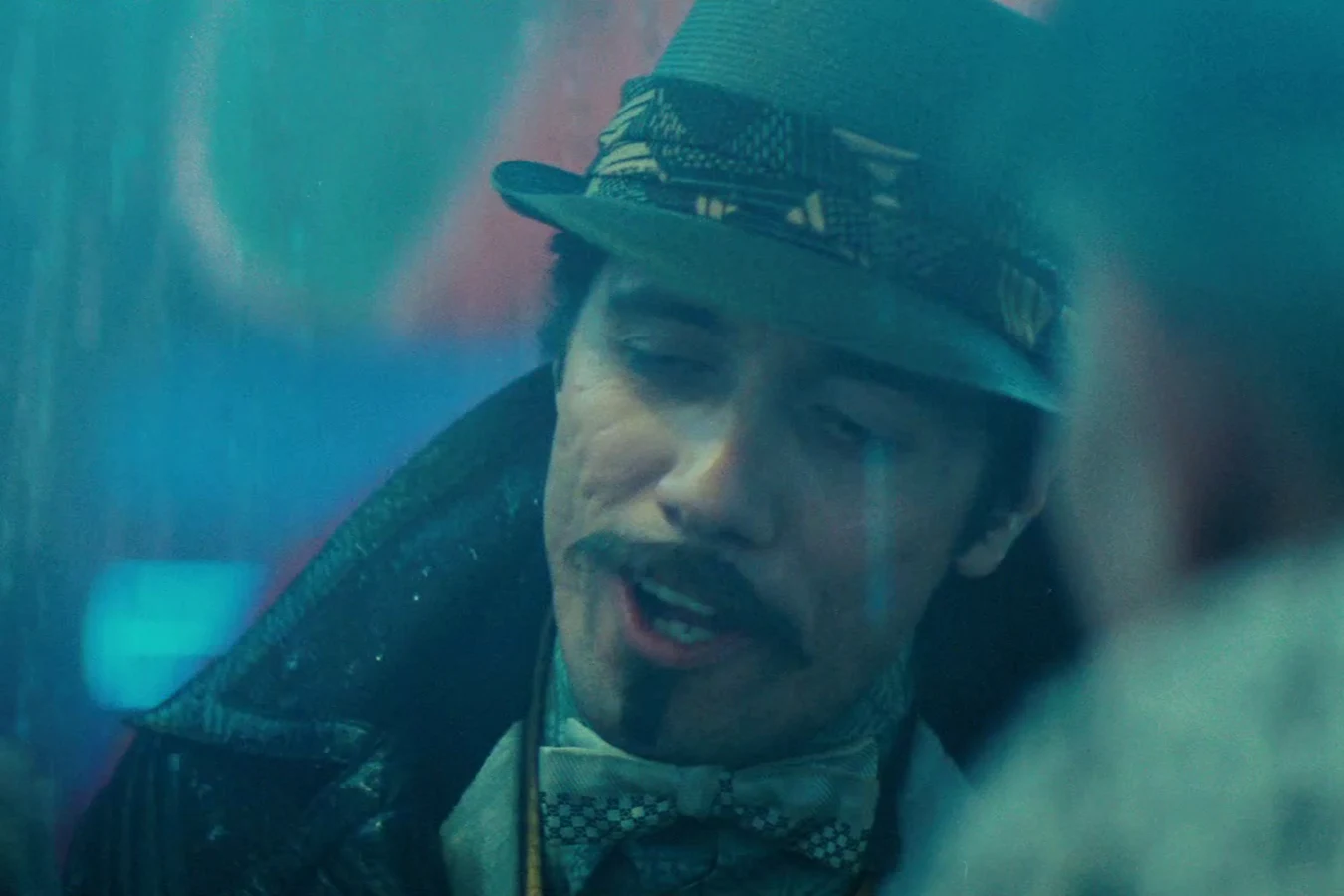
Scott's 1982 film keeps Deckard, Rachael, Roy, and a hunt for escaped manufactured people, then changes almost every room around them. Dick's day is San Francisco on 3 January 1992, gray with radioactive dust, from the Lombard Street Hall of Justice to the empty peninsula south of the city. Most people have left for the colonies, so the streets are thin and whole buildings stand empty. The film is crowded Los Angeles in November 2019, wet with neon and packed sidewalks. Some later printings of the novel moved that winter to 2021 after the film's year had passed. The 1968 text, and the copy this page follows, stays in 1992.
Dick spelled the escape's leader Roy Baty. The film spells him Roy Batty, drops Irmgard, and pairs him with Pris. The book's androids are Nexus-6 products of the Rosen Association, retired for a thousand-dollar bounty. The film's replicants come from the Tyrell Corporation and live under a four-year limit that the book gives Rachael as a general android fact, not a Tyrell fail-safe.
Mercerism and Buster Friendly are the public culture of Dick's Earth. The empathy box, the shared climb, and Buster's twenty-three-hour show, including the exposé that Mercer was a bit player named Al Jarry, have no equivalent in the first film. Kipple is Dick's word for the junk that fills those deserted rooms and then whole floors. The film never uses it. Sidney's catalogue and the electric animals sit in that same missing center. J. F. Sebastian later takes some of Isidore's isolation, without the chickenhead test or the Van Ness truck.
The novel treats Deckard as a human bounty hunter. He is married to Iran, takes monthly police medical exams as a regular, and administers Voigt-Kampff rather than sitting it. Nothing in the book hints that he is an android. The film leaves that question open through Gaff's origami and Ridley Scott's later comments. Deckard's arrest at the fake Mission Street Hall of Justice, an android loop built around Garland, is a book subplot the film does not have. Gaff and Cityspeak belong to the movie alone. The film also leaves Deckard single, drops the goat and the toad, and ends on a rooftop run with Rachael instead of a kitchen order for artificial flies.
The word blade runner is not in Dick's text. Hampton Fancher and David Peoples took it from Alan E. Nourse's 1974 novel The Bladerunner and William S. Burroughs's 1979 treatment, then attached it to Deckard's police work. Dick saw rough cuts before he died in 1982 and praised the film's world even where it left his plot behind.
Editions And Adaptations
Doubleday's first hardcover ran 210 pages in March 1968, bound in gray cloth, with a Harry Sehring jacket and a first-edition statement plus gutter code J5 on the last page. Rapp & Whiting issued the first British hardcover in 1969. After the film, Del Rey and Ballantine sold the text under the Blade Runner title, then restored Dick's name on later trade paperbacks, including the 1996 Ballantine edition that remains widely reprinted. Gollancz put the book into its SF Masterworks line, and Library of America collected it in 2007 with The Man in the High Castle, The Three Stigmata of Palmer Eldritch, and Ubik.
Ridley Scott's Blade Runner reached theaters in 1982 and sold later printings of Dick's novel under that film title. Denis Villeneuve's Blade Runner 2049 followed in 2017 as a film sequel, not a second Dick book. K. W. Jeter wrote authorized Blade Runner novels that continue the movie, not Electric Sheep, including Replicant Night and Eye and Talon.
BOOM! Studios Novel Adaptation
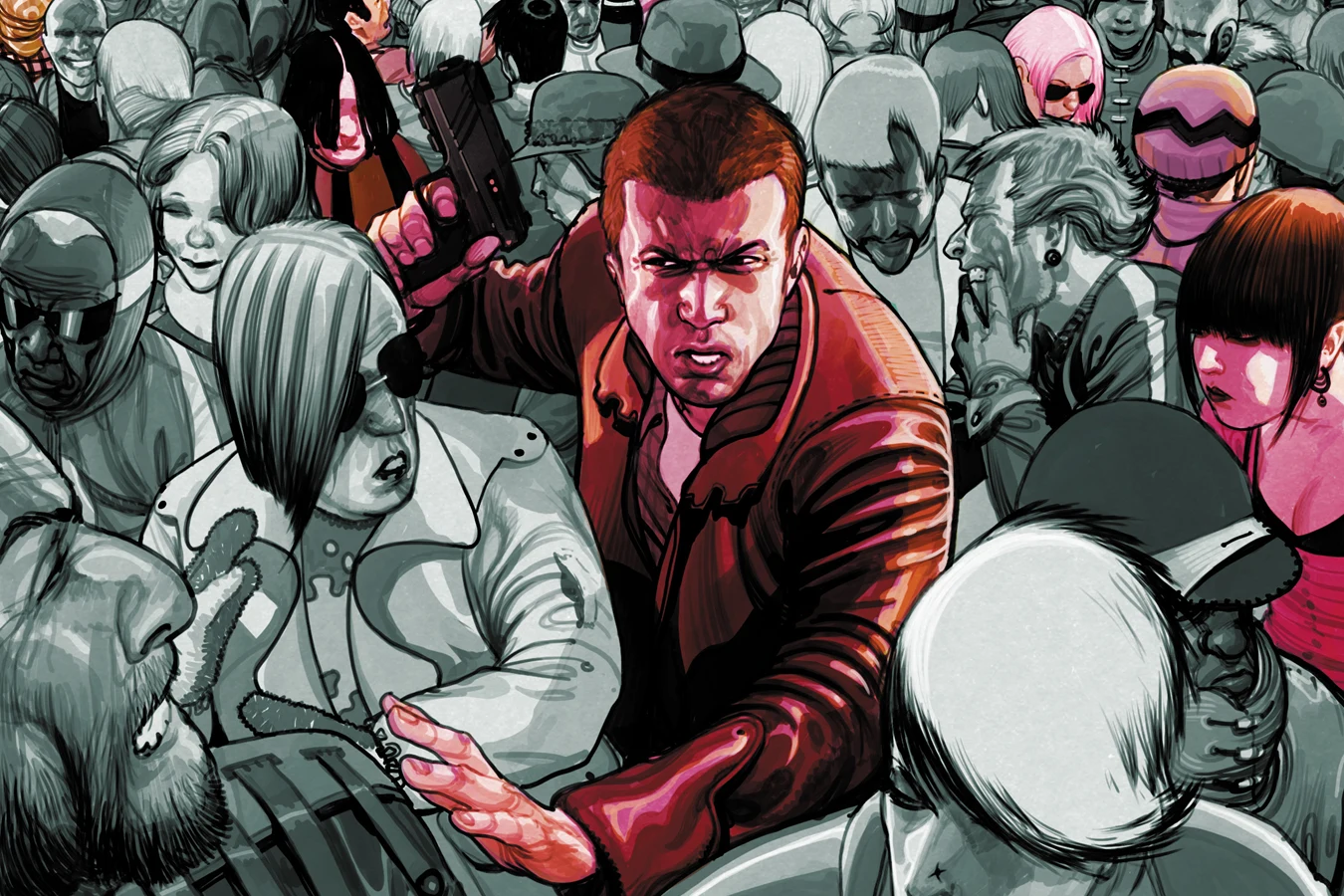
BOOM! Studios published a 24-issue monthly series from June 2009 to May 2011, with Electric Shepherd Productions, the Philip K. Dick estate company. Tony Parker drew the adaptation, Blond colored it, and Richard Starkings lettered it. The balloons and captions used Dick's prose rather than a shortened script, and Ian Brill and later Bryce Carlson edited the issues. Parker drew dusty San Francisco and the Nexus-6 from the novel, not Ridley Scott's Los Angeles.
BOOM! collected the run in six hardcovers as the monthly issues came out, four issues in each volume, and finished that set in 2011. The series was nominated for an Eisner Award for Best New Series. In 2015 the publisher issued the first complete omnibus of all 24 issues, with a cover by Mondo artist Jay Shaw and essays by Jonathan Lethem, Ed Brubaker, Warren Ellis, and Matt Fraction.
Behind The Scenes
Dick finished the manuscript by 20 June 1966. Working titles included The Electric Toad, Do Androids Dream?, The Electric Sheep, and The Killers Are Among Us! Cried Rick Deckard to the Special Man. The empathy box and Mercerism first appeared in his 1964 story "The Little Black Box." He dedicated the novel to Maren Augusta Bergrud (10 August 1923 to 14 June 1967), with a Yeats epigraph about a ghost walking the lawn. The book was a 1968 Nebula Award nominee.
The first printing was small, on the order of two thousand copies, which is why that Doubleday hardcover is scarce. Judy-Lynn del Rey steered the 1982 movie-tie-in paperback. In the novel, Deckard's schedule page for 3 January 1992 is the date stamp this text follows. Some post-film resets moved that winter into the 2020s so the future would stay ahead of the reader.
Conclusion
Do Androids Dream of Electric Sheep? is Philip K. Dick's 1968 Doubleday novel about Rick Deckard. It covers one January stretch in dusty San Francisco, from an electric sheep on a roof through six Nexus-6 retirements, a dead goat, and an electric toad Iran found was fake. The novel ends with Iran ordering artificial flies for that toad, and Ridley Scott's film kept Deckard's name while moving the hunt to Los Angeles.
External Sources
- Do Androids Dream of Electric Sheep? at the Internet Speculative Fiction Database
- Do Androids Dream of Electric Sheep? at Wikipedia
- Publication history at philipdick.com
- BOOM! Studios comic adaptation
Tag Categories: Blade Runner Lore | Blade Runner Books