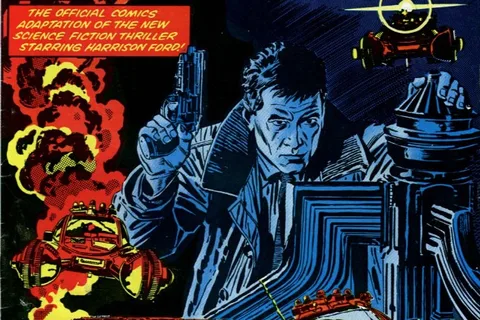
Do Androids Dream of Electric Sheep? (BOOM! Comic)

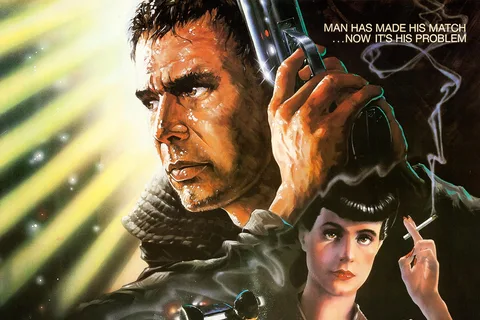
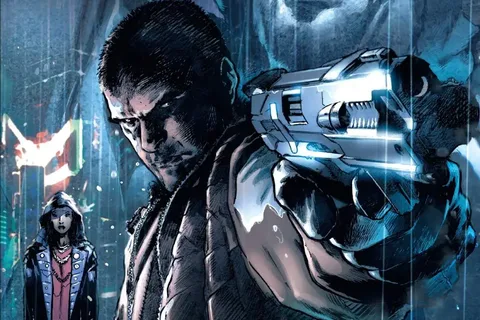
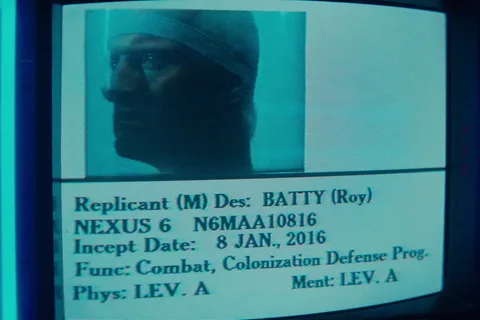
Do Androids Dream of Electric Sheep? is a 24-issue BOOM! Studios comic published from 2009 to 2011 that sets the complete text of Philip K. Dick's Do Androids Dream of Electric Sheep? beside Tony Parker's art. Every line of the novel appears in captions and balloons, from Rick Deckard's morning quarrel over the mood organ to the electric toad at the end. It is the book that inspired Blade Runner, drawn as San Francisco after World War Terminus rather than the film's Los Angeles. BOOM! also published the prequel Dust to Dust, and both sit with the other Blade Runner comics, collected over six volumes and a later omnibus.
Plot Summary
The Mood Organ
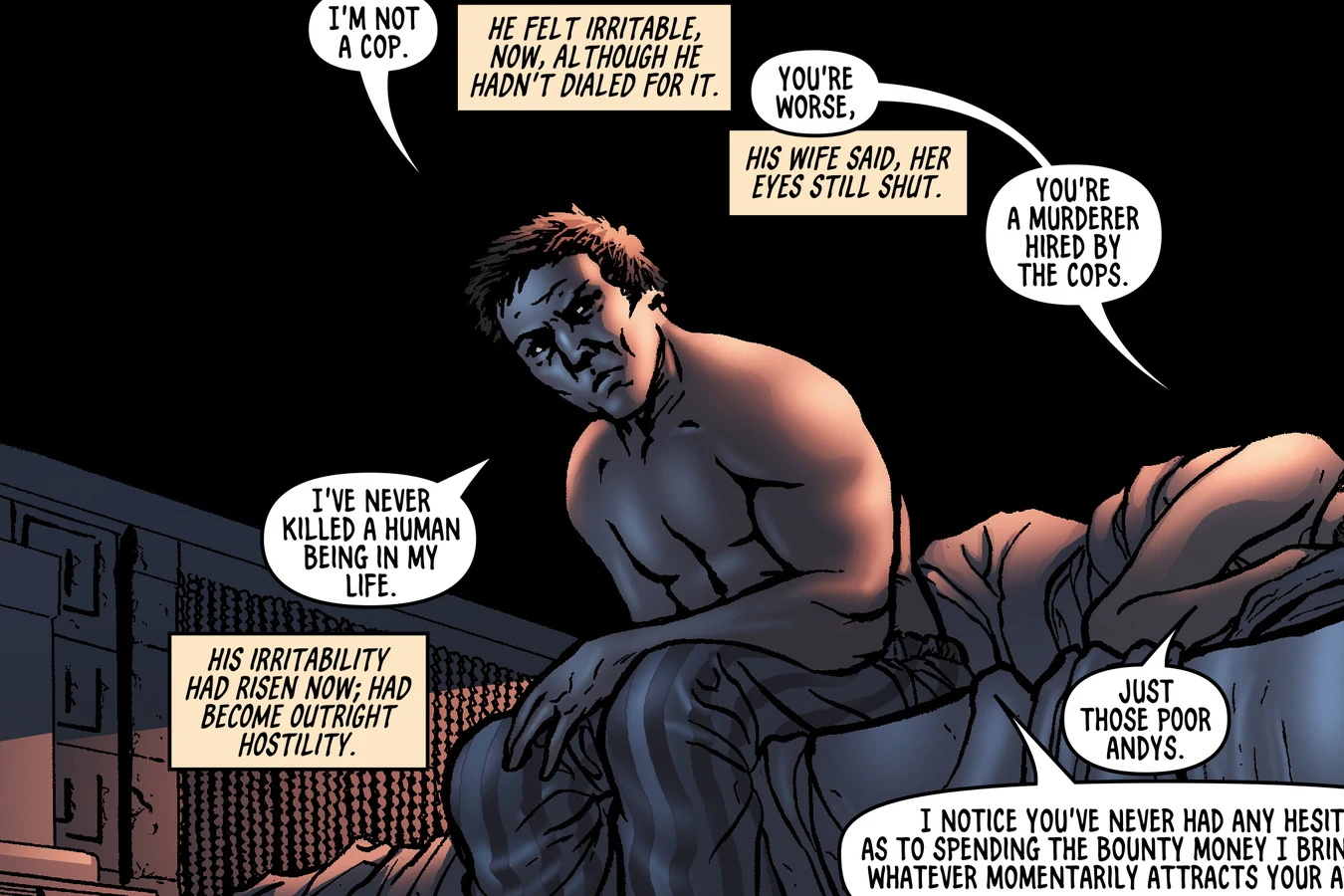
A surge from the automatic alarm on the Penfield mood organ wakes Rick Deckard in his San Francisco apartment. His wife Iran has set her own console so that she wakes up grumpy, and she refuses to dial anything better. When he teases her, she calls him a murderer hired by the cops. Rick answers that he has never killed a human being, only androids, and the quarrel grows until both of them reach for the dial to win it with a stronger setting.
Rick backs down and offers to dial for both of them. Iran tells him she has scheduled a six-hour self-accusatory depression for the day. Earlier, with the television switched off, she had heard how empty the building was and felt the absence of life around them. She had dialed despair because it seemed like the right response to that emptiness. Rick talks her into a happier setting, sets his own console for a businesslike professional attitude and gets ready to go up to the roof before work.
The Electric Sheep
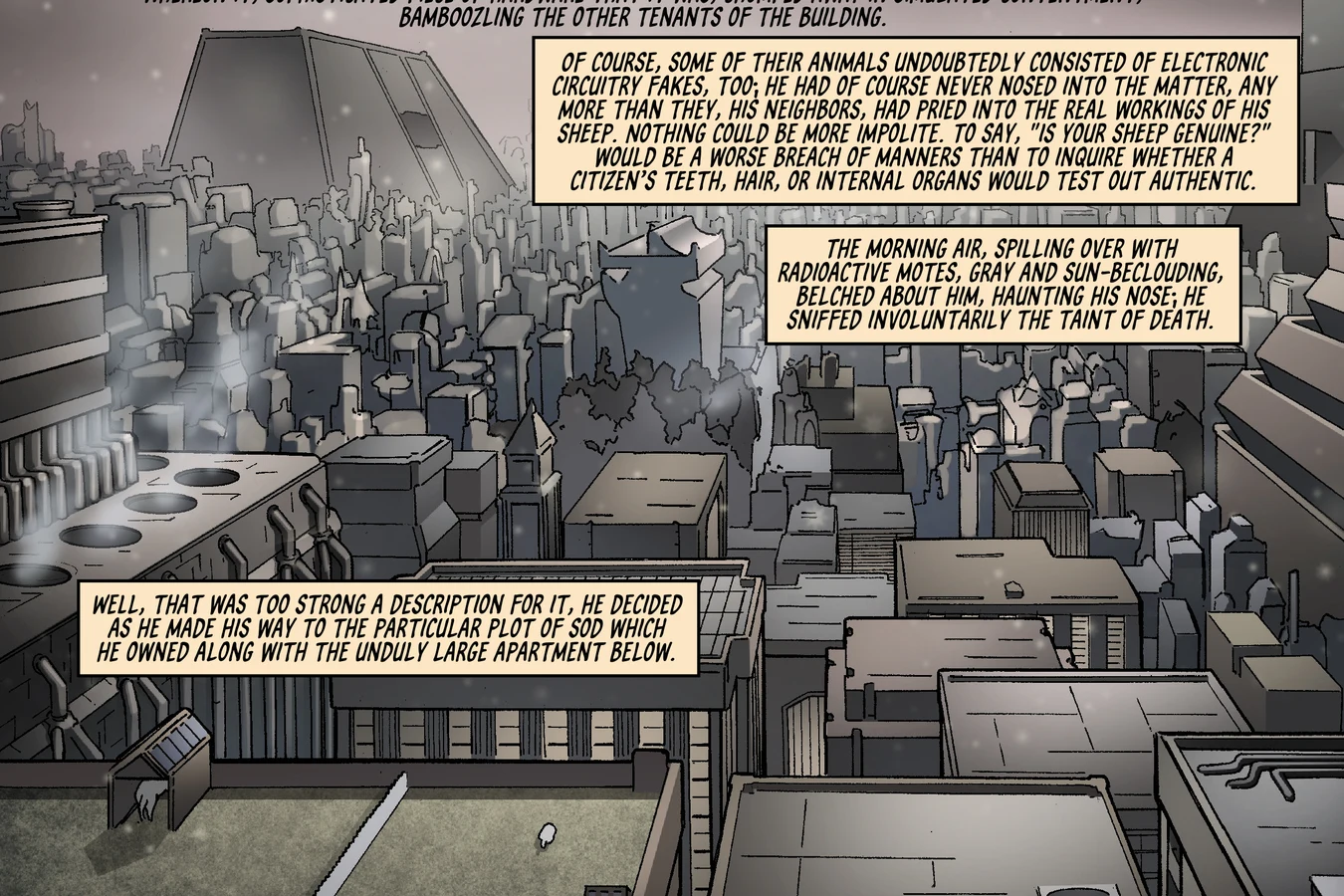
Up on the roof, residents keep their animals in small pastures, and Rick's own animal is a sheep grazing in a fenced pen. Owning a living animal is a duty and a status symbol after World War Terminus, when the radioactive dust killed most species. Every household is expected to care for one, and people study animal price catalogues the way earlier generations studied car prices. The polite rule is never to ask a neighbor whether a pet is real.
Rick's sheep is not real. It is an electric sheep with a hidden control panel under its wool, built so well that it chews, bleats and even fakes illness. Rick checks it the way he would check a living animal and adjusts its wool over the panel. He resents having to keep a machine, because a fake animal earns him the quiet contempt he would feel for anyone else with one. He has spent years wishing he could afford a living animal instead.
Barbour's Pregnant Mare
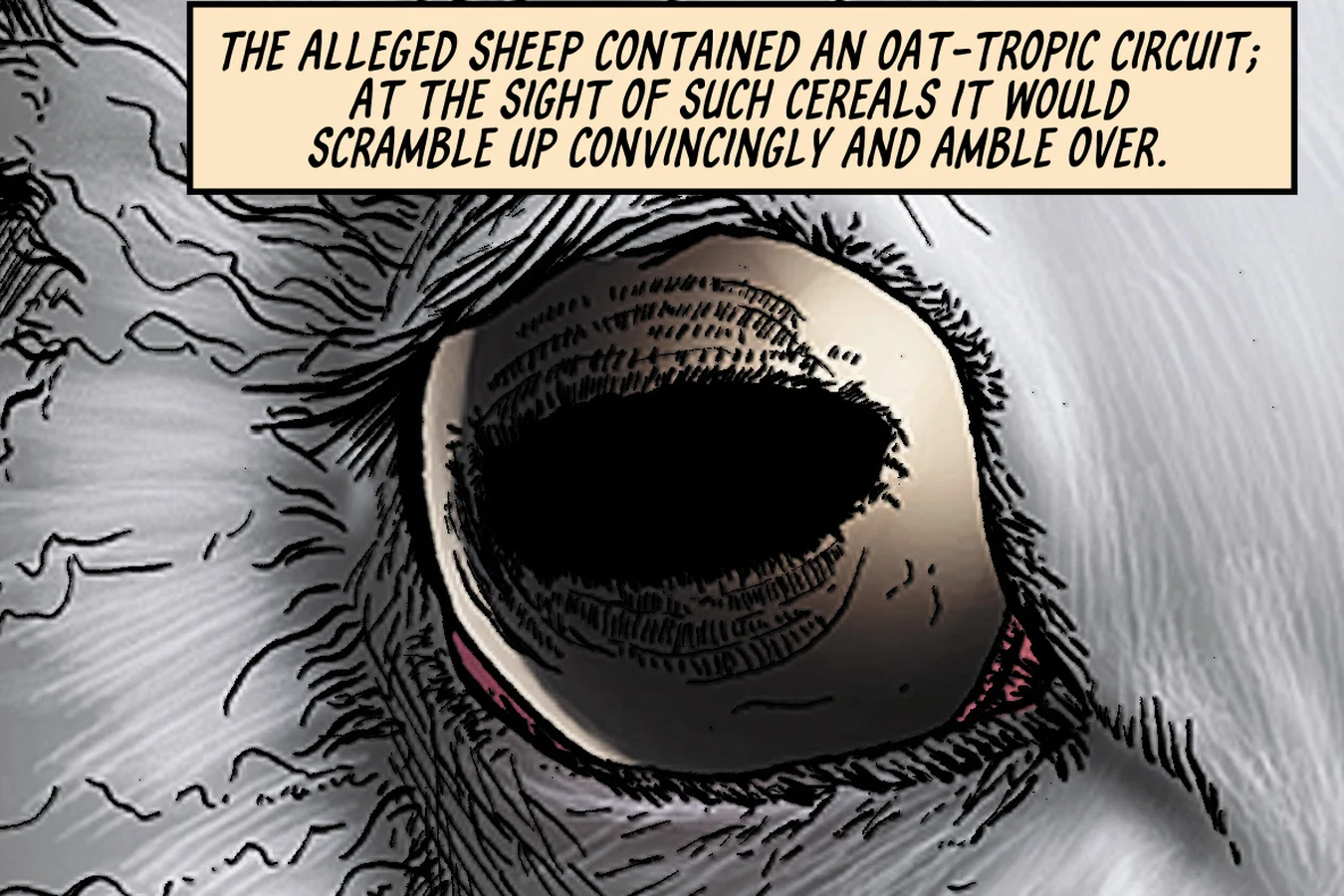
His neighbor Bill Barbour is grooming a pregnant Percheron mare in the next pen. Rick asks to buy the foal and offers payments of five hundred dollars a month for ten months. Barbour refuses, saying that owning two horses while Rick owned none would go against everything Wilbur Mercer teaches. Rick then asks to buy the mare herself and is turned down again, even though Barbour admits that the horse is the most valuable thing he has ever owned. Barbour says the mare is due soon.
Pressed further, Rick admits that his sheep is electric. He had owned a real sheep named Groucho, which died of tetanus after a piece of baling wire cut it. He replaced it with a perfect replica so nobody in the building would know. Barbour promises to keep the secret and suggests that Rick buy a cat, or a mouse for twenty-five dollars. Rick says a mouse would be worse than nothing and leaves for the Hall of Justice thinking about what a real animal would cost.
Isidore's Empathy Box
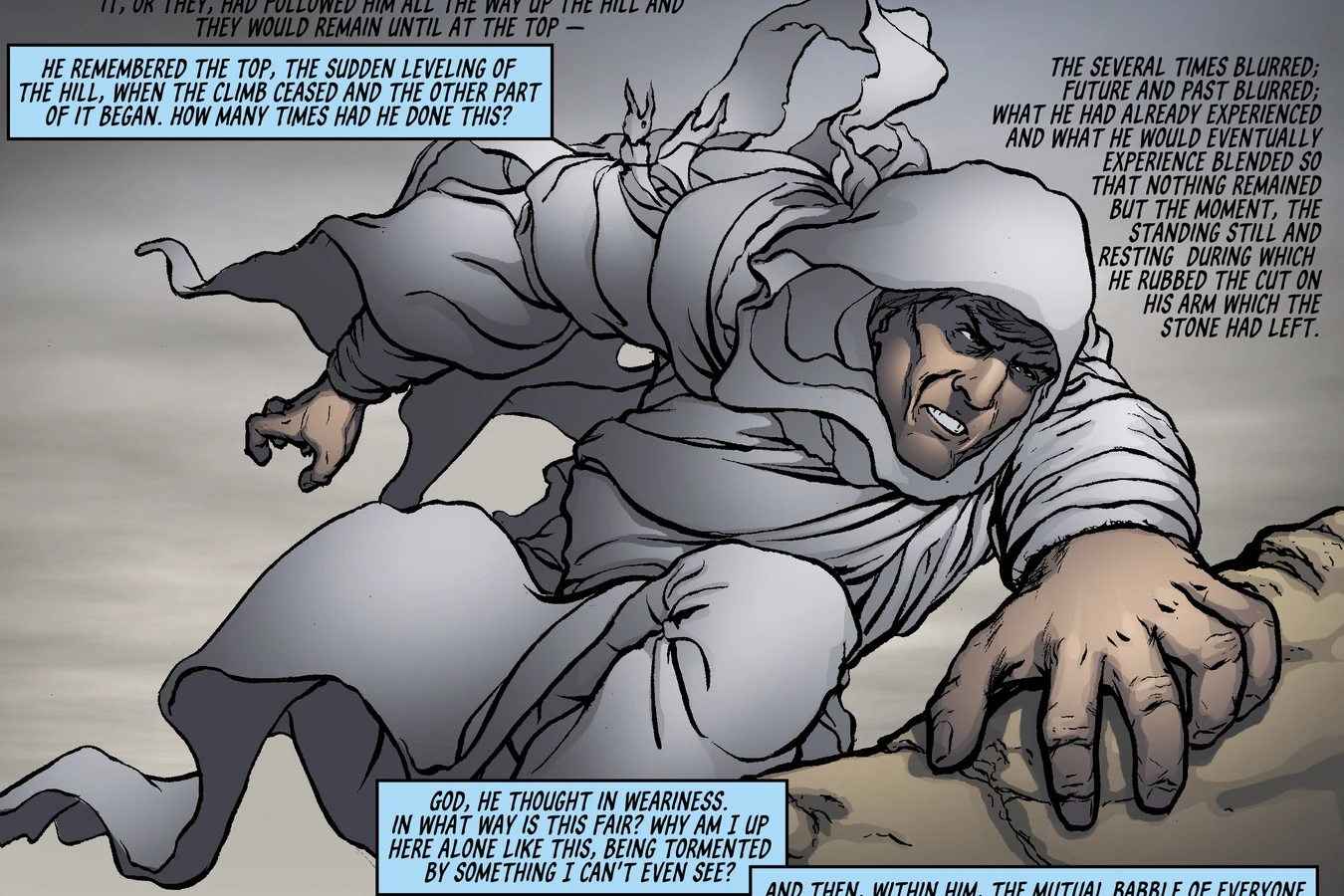
In a decaying apartment building on the Peninsula, J.R. Isidore lives alone among thousands of empty units. The dust has damaged his intelligence enough that he has been classed as a special, called a chickenhead, and barred from emigrating to Mars. In the morning the television praises the life of emigrants and their android servants. When he switches it off, the silence of the building presses on him so heavily that he turns to the empathy box. He has no friends and no one to talk to.
Gripping the two handles, Isidore leaves his apartment and finds himself on a brown, barren slope behind the old man Wilbur Mercer, who is climbing toward a summit he can never reach. Isidore climbs with him and feels the presence of everyone else holding a box at the same moment. Their pain, hope and effort merge into one shared experience. The fusion is the heart of Mercerism, the faith that most people left on Earth now share, and Isidore feels less alone inside it.
A Stone Strikes Isidore
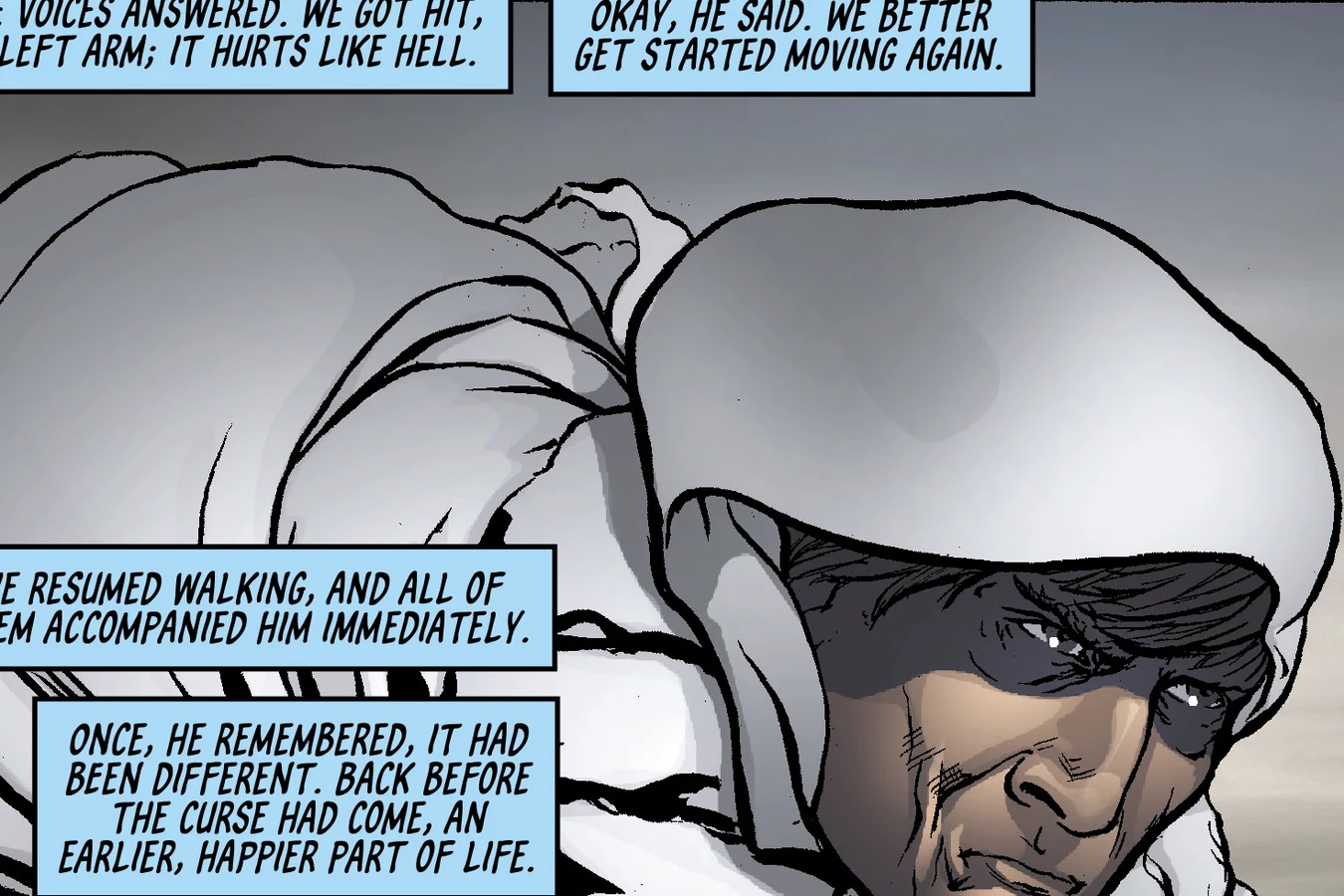
Unseen people on the hill throw rocks at Mercer, and one strikes him on the left arm. Isidore feels the pain as his own. He remembers Mercer's story: as a boy Mercer was found floating on a life raft and raised by foster parents, Frank and Cora Mercer. He could bring dead animals back to life until the killers, enforcing a local law, bombarded his brain with radioactive cobalt. That plunged him into the tomb world, and he climbed out of it only by rising with the bones around him.
When Isidore lets go of the handles, his own arm is cut and bleeding where the rock hit Mercer. He cleans the wound and feels better for having shared it. While he is still at the box, he hears a sound below him: a television playing in another apartment of the building. For the first time in years another tenant has moved in. Isidore, delighted and nervous, decides to go down and welcome the newcomer with a gift of margarine.
Holden's Assignment
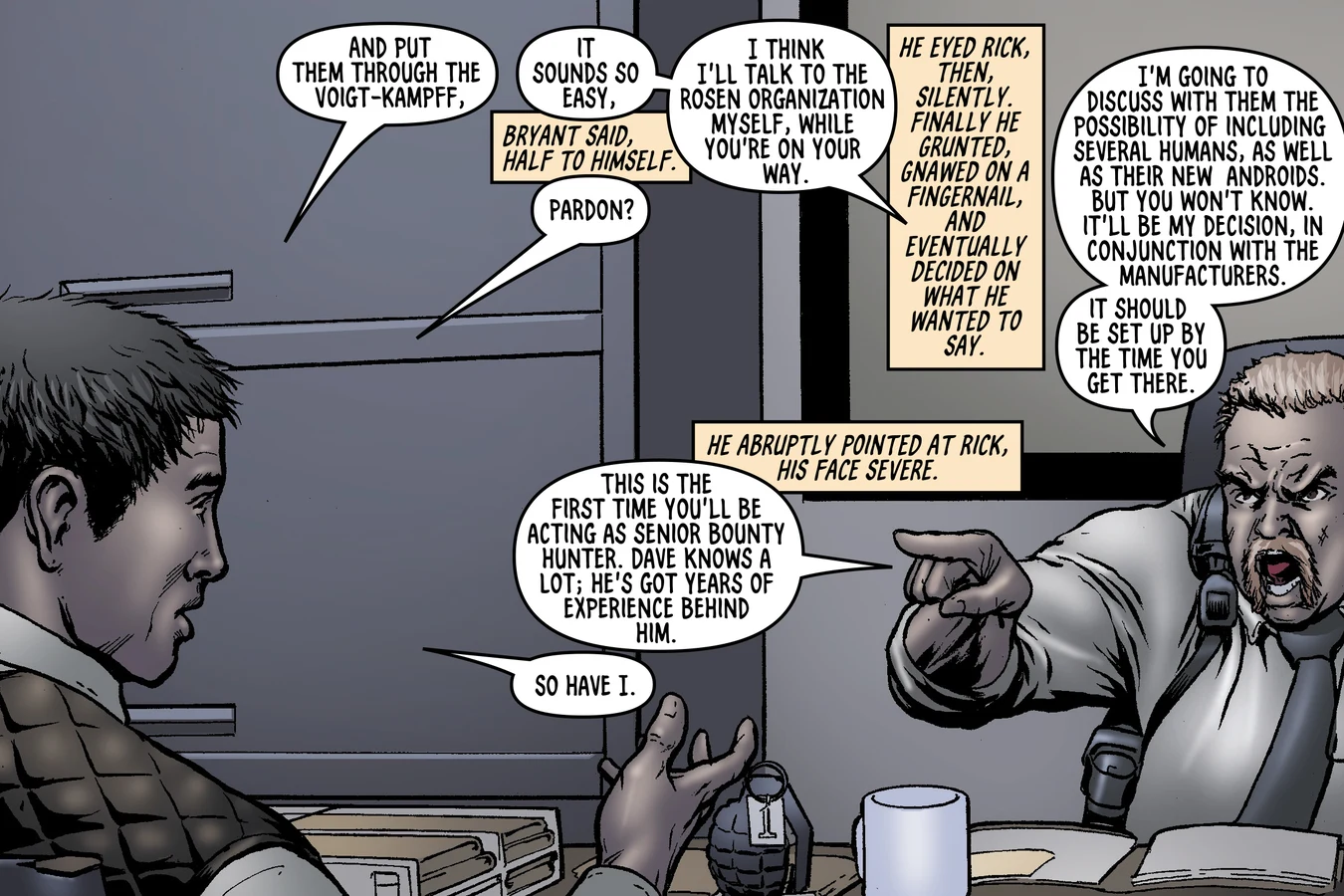
At the Hall of Justice, Rick learns that the department's senior bounty hunter, Dave Holden, has been lasered through the spine by an escaped android and is in Mount Zion Hospital. Before he sees his boss, Rick calls the Happy Dog Pet Shop on Sutter Street under a false name and asks the price of an ostrich. The answer is thirty thousand dollars, far more than he could pay. Holden's bad luck means his assignments, and his bounties, may now pass to Rick.
Inspector Harry Bryant explains that eight androids escaped from Mars with the new Nexus-6 brain unit, built by the Rosen Association. Holden retired two before he was shot. The other six are now Rick's, starting with Max Polokov, the one who lasered Holden. Bryant worries that the Voigt-Kampff test may not detect a Nexus-6, so he sends Rick to the Rosen Association in Seattle to test the test on a group of humans and androids before he goes after anyone.
Arrival In Seattle
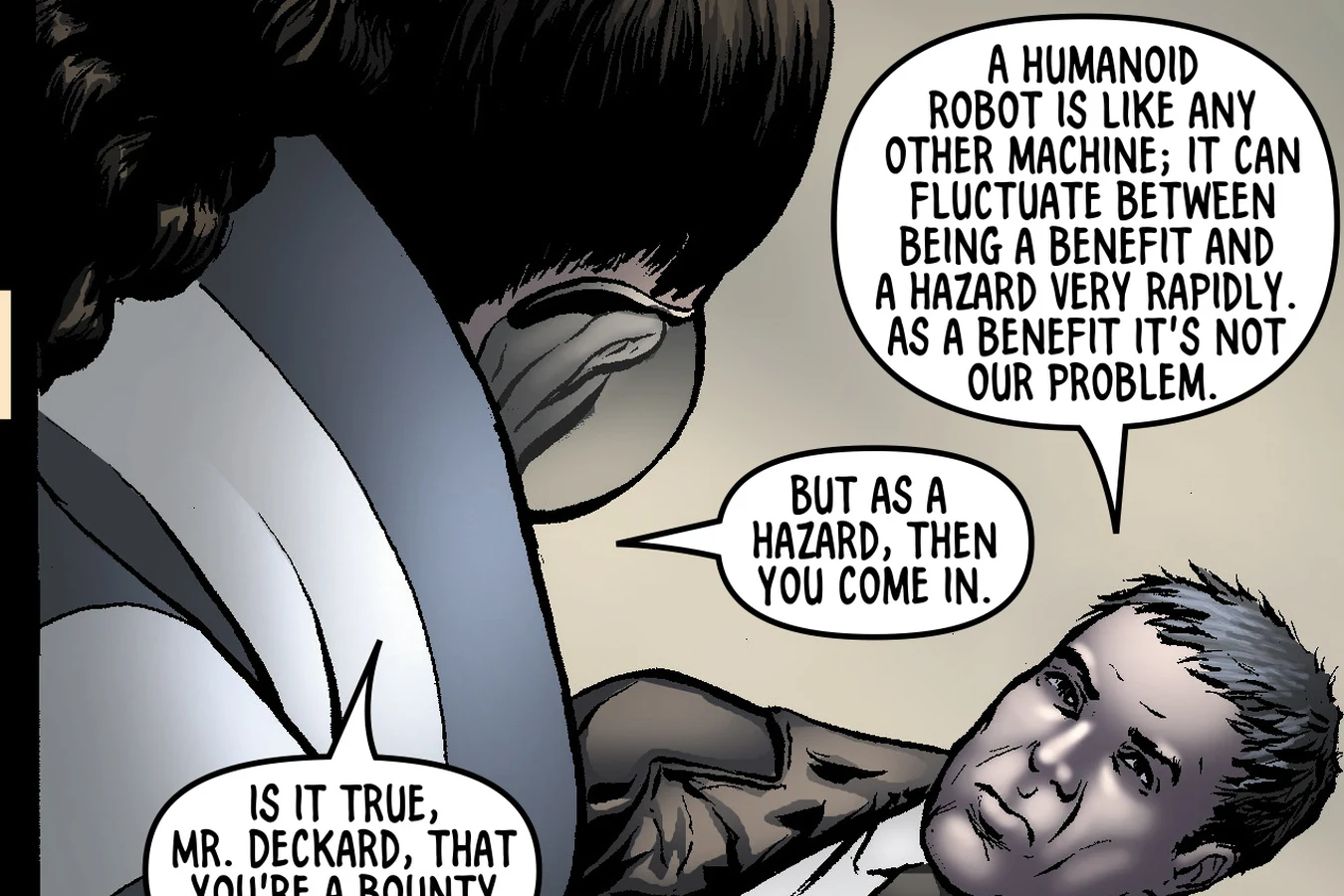
Rick's police car lands on the roof of the Rosen Association building in Seattle. A young dark-haired woman in dust-filtering glasses comes out to meet him and introduces herself as Rachael Rosen. She is cool and openly suspicious of his visit. She points out that the Nexus-6 was built to Mars colonization law and says the company's androids are only doing what the law requires. To her, a bounty hunter testing the test is a threat to the whole company.
While they walk past the company's animal pens, Rick sees a raccoon and asks whether it is real. Rachael says it is, as are all the animals there. Rick has only seen raccoons in pictures and is struck by it. Rachael tells him the corporation keeps a collection of genuine animals. She asks him whether he has ever retired a human by mistake, and whether he lives with a real animal, which he does not answer. She treats the visit as a contest between them.
The Rosens' Owl
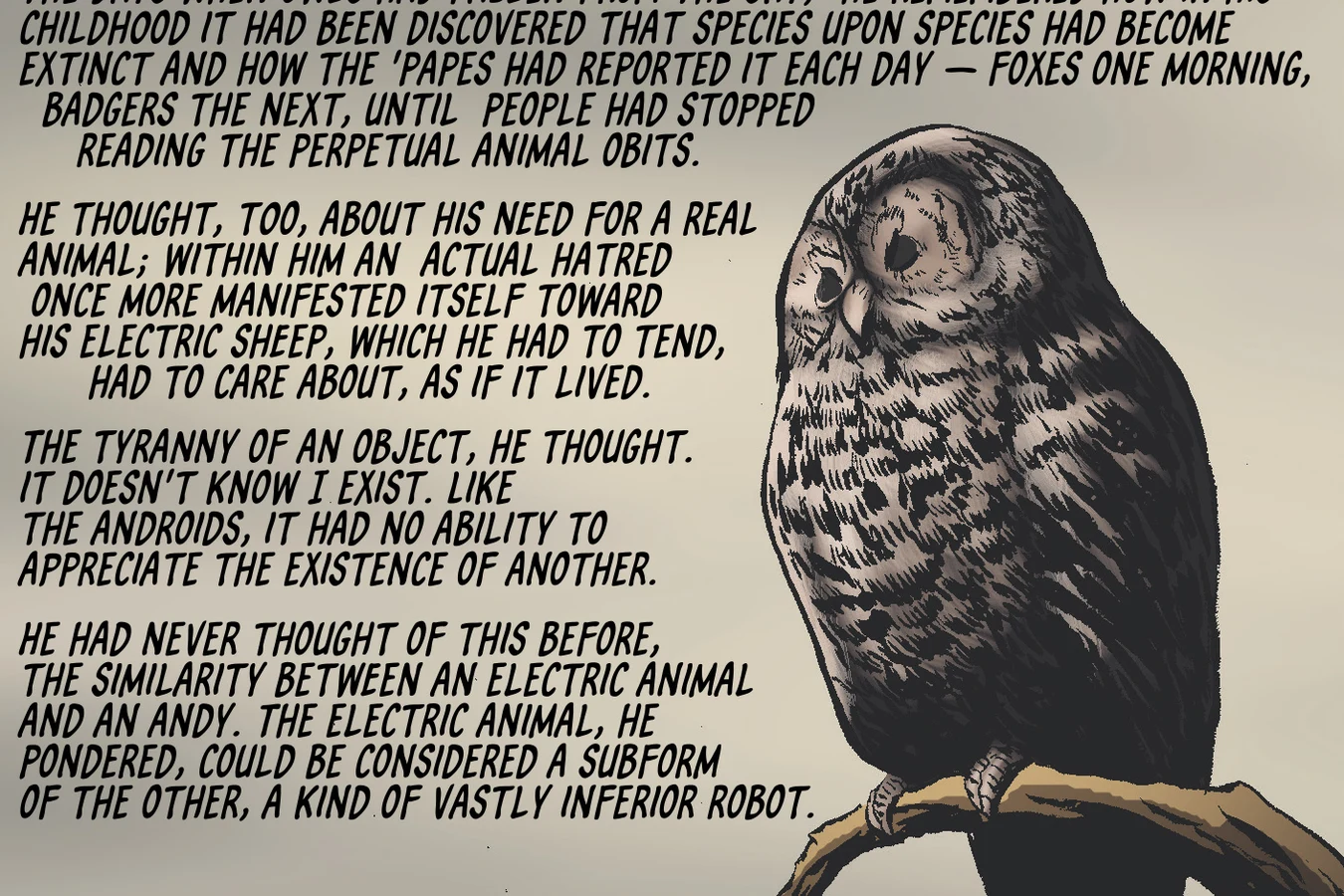
Inside the building Rick sees an owl sitting on a perch, its eyes half closed. He knows owls were the first species to die out when the dust began falling, so he assumes it must be artificial. Rachael tells him it is real. Rick is stunned, because a living owl would be beyond any catalogue price. In his childhood he had seen owls fall dead from the sky, and he was told that none were left anywhere on Earth. Rick stares at the bird for a long time.
Rachael explains that the owl belongs to the corporation and that the Rosens will never sell it. Her uncle, Eldon Rosen, joins them. He has assembled a group of subjects for Rick's tests, some human and some android, and Rick is to say which is which. Before starting, Rick asks to test Rachael first. Eldon agrees. Rick sets up the Voigt-Kampff apparatus on the table between them and explains how the questions will measure her reactions. Rachael watches him closely as he prepares.
Rachael's Voigt-Kampff Test
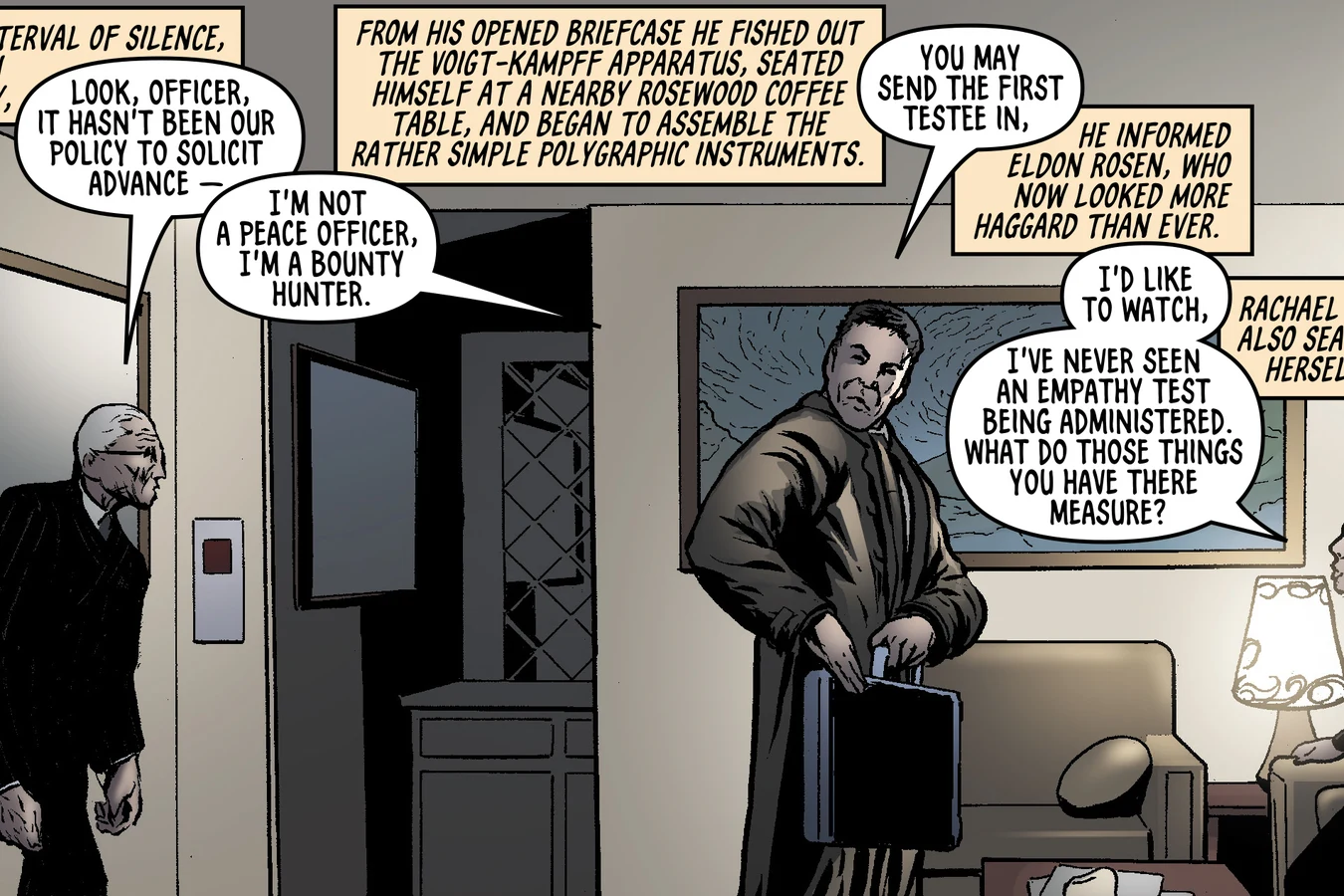
Rick attaches the adhesive disk to Rachael's cheek and directs the beam of light into her eye. The Voigt-Kampff test measures blush response and the tension of the iris muscles in the fraction of a second before conscious control can mask them. He asks her about a birthday gift of a calfskin wallet, a little boy's butterfly collection and killing jar, a deer's head mounted in a mountain cabin, and a lobster dropped into boiling water. Rachael answers each question quickly, while Rick watches the dials and needles of his machine for the small delays that would give an android away.
Her answers are calm and reasonable, but some of the readings arrive a beat too late. He asks about an old prewar film where guests at a banquet eat raw oysters and then a boiled dog stuffed with rice, and her reaction to the dog lags behind the oysters. Rick concludes that Rachael is an android. He tells Eldon Rosen so and starts putting the equipment away, sure that the test has worked. Rick feels satisfied that the department's method still works on the new Nexus-6 type, even though the Rosens insisted it might fail.
The Rosens' Trap
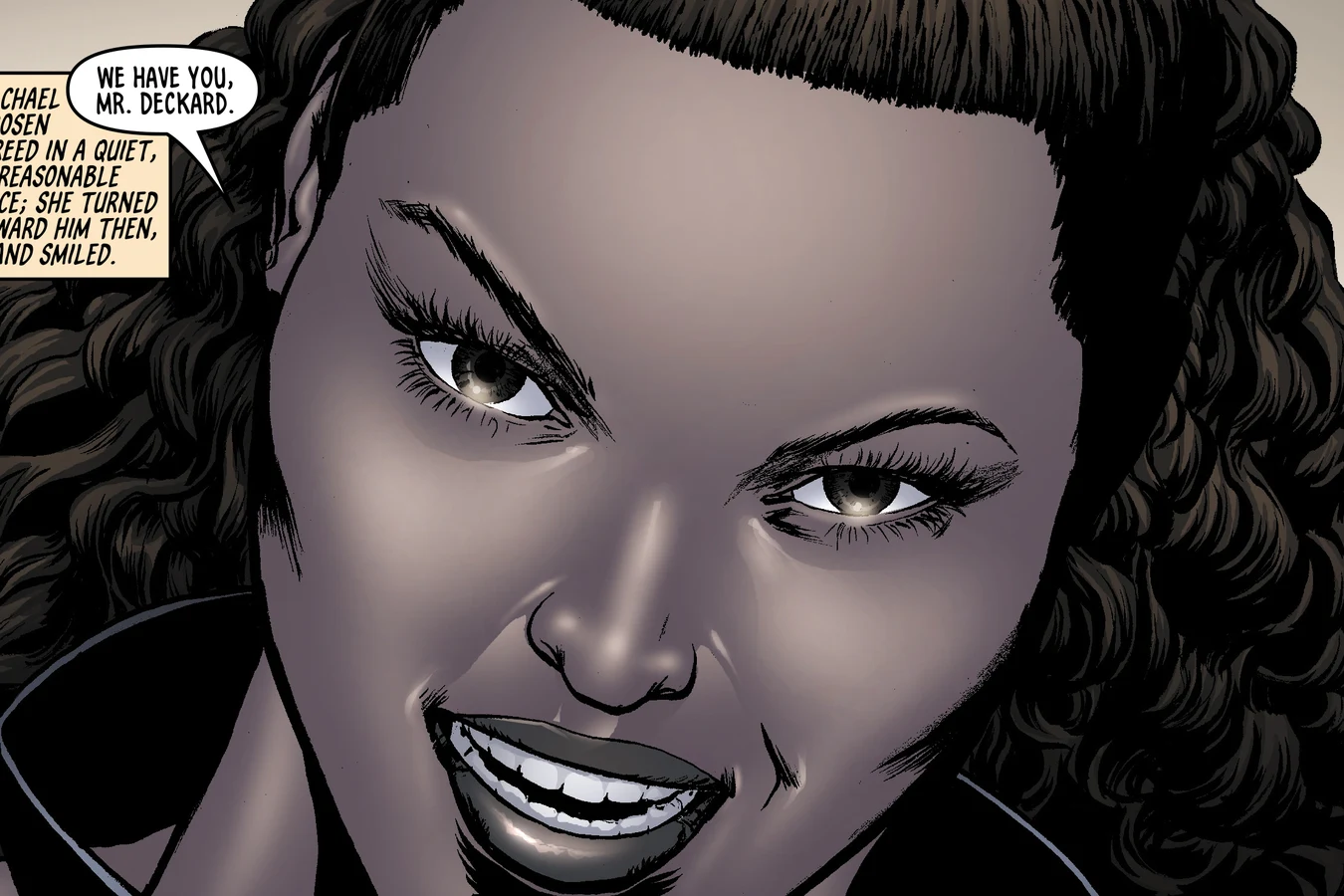
Eldon Rosen tells Rick that he is wrong. According to Eldon, Rachael is human: she was born and raised aboard a spacecraft and spent her early years away from Earth, so her emotional development is different. If the test calls her an android, the test must also be failing to detect real humans. Rachael smiles and tells Rick that they have him. Eldon suggests that the police department should admit the Voigt-Kampff scale cannot tell androids from humans. Rick takes his equipment and leaves the room.
The Rosens then offer him the owl. If Rick will drop the matter, they will give him the most valuable animal he has ever seen. He realizes the offer is a bribe. Before leaving, he asks Rachael one last question about her briefcase, which he says is made of babyhide, and her reaction comes too late again. Rick tells Eldon he knows she is an android. Eldon admits it, and Rick tells Rachael gently that he is not going to retire her. He is not sure he has escaped their trap.
Isidore Meets Pris
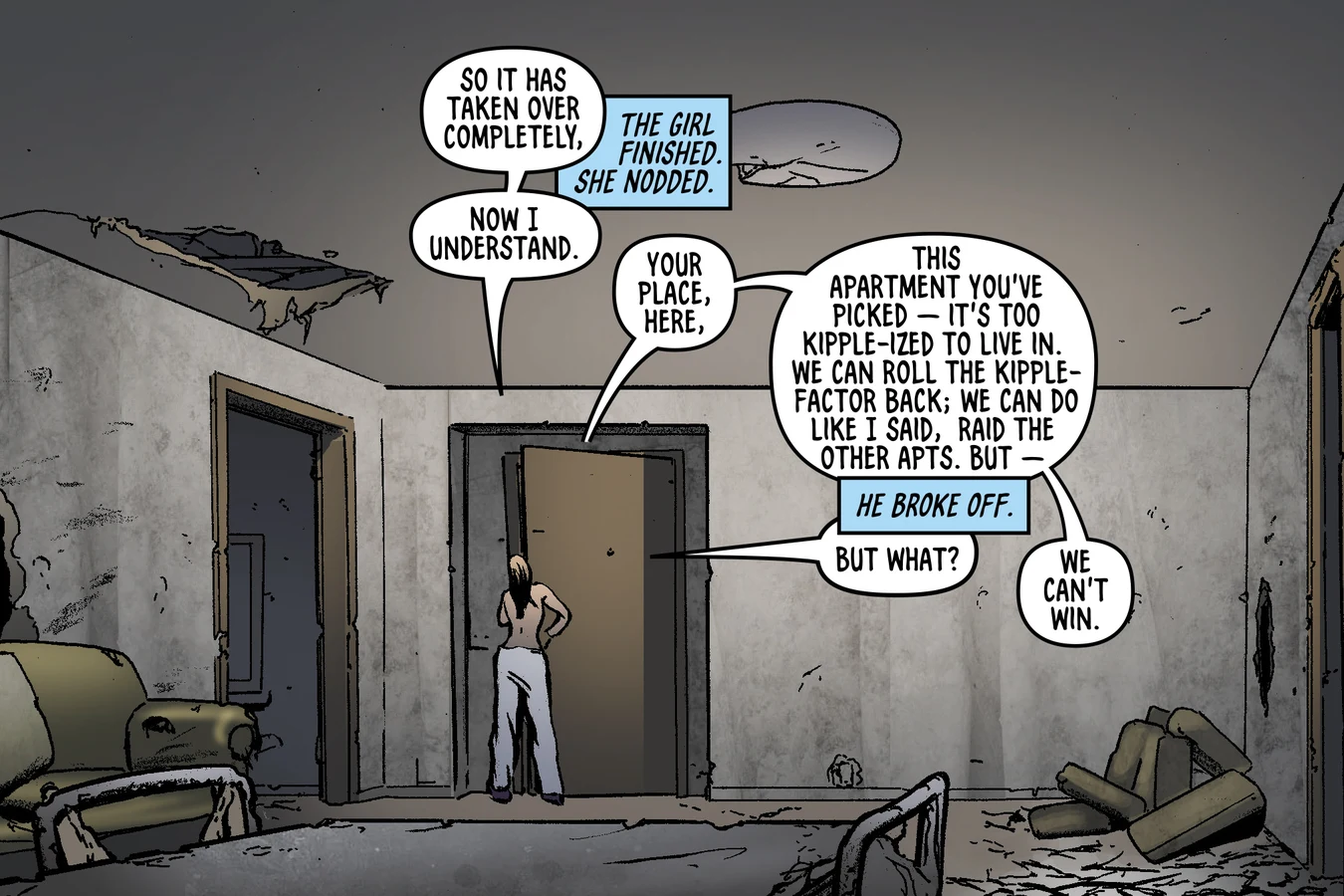
Isidore knocks on the new tenant's door, and the television goes silent at once. He senses someone on the other side hiding from him in fear. A young woman finally opens the door and stands in a room filled with kipple, the junk that builds up when nobody uses a place. Isidore offers to bring her furniture from empty apartments. He explains that kipple drives out nonkipple, and that the whole universe is moving toward a final state of kipple.
She asks whether he is a chickenhead and says it without cruelty, as a plain fact. He admits he is a special, though not a severe case. Isidore offers to bring home food so they can have dinner together. She tells him her name is Rachael Rosen, then quickly corrects herself and says it is Pris Stratton, her married name. She closes the door on him, and Isidore is left alone in the dusty hall, planning dinner for both of them.
The Sick Cat
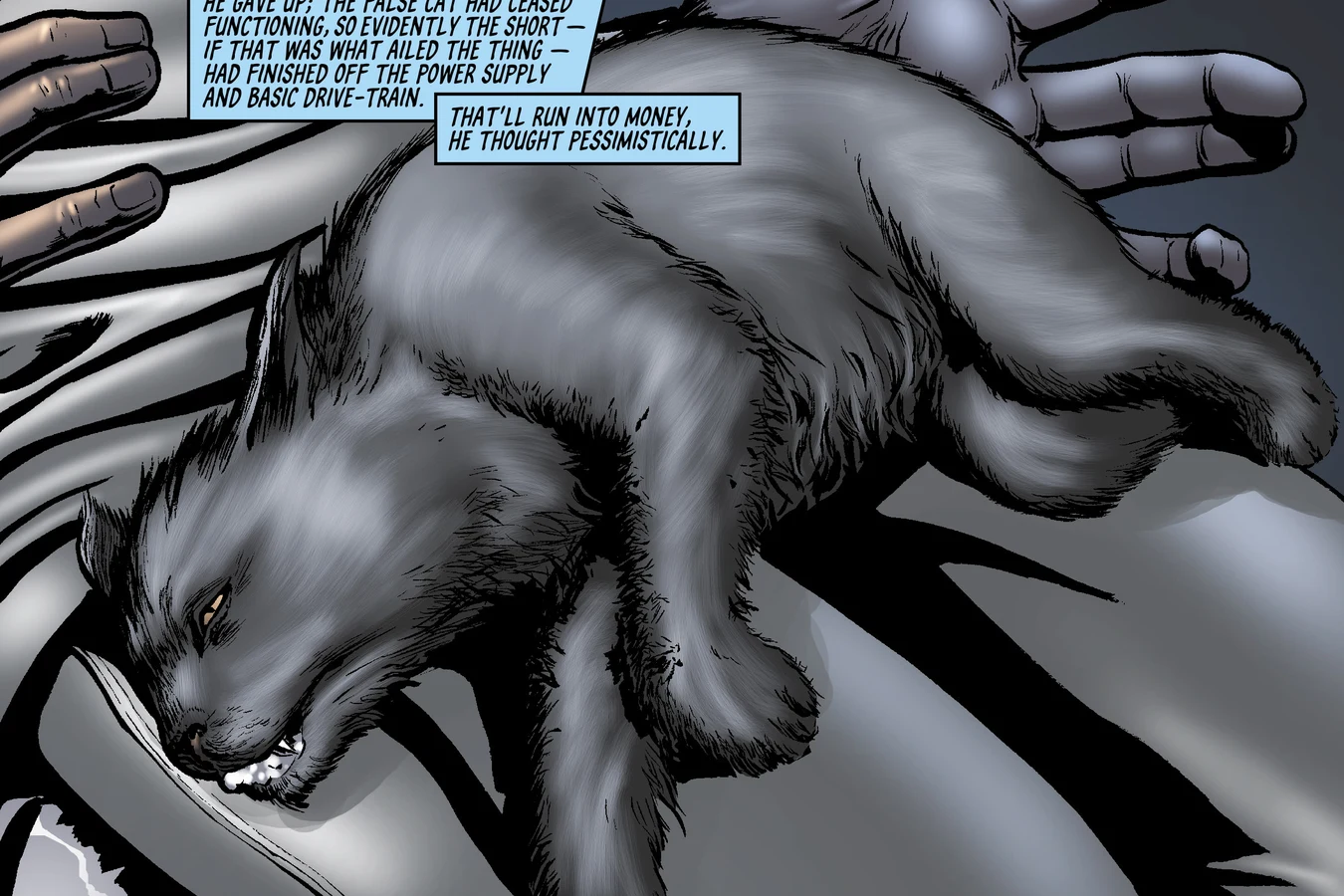
Isidore works as a driver for the Van Ness Pet Hospital, a firm that repairs electric animals while pretending to be an ordinary veterinary hospital. That day he picks up a sick cat from a customer and flies back toward the shop. The cat wheezes on his lap the whole way. He is certain it is a false animal, so he gropes in its fur for the hidden control panel and the quick-charge battery terminals that every model has. The cat is limp and its breathing is ragged, and Isidore talks to it as he flies, telling it to hang on until they reach the shop.
He cannot find the panel. Isidore decides the owner must have neglected its cleaning and lubrication, and that the machine is shorting out. He tells himself that even knowing the noise is faked, the sound of a false animal breaking down still bothers him. Because the mechanism is close to failing, he turns the truck into climb position and hurries back. By the time he lands, the cat has gone silent in his arms, its wheezing stopped. He keeps one hand on the controls and the other on the animal.
Buster Friendly's Show
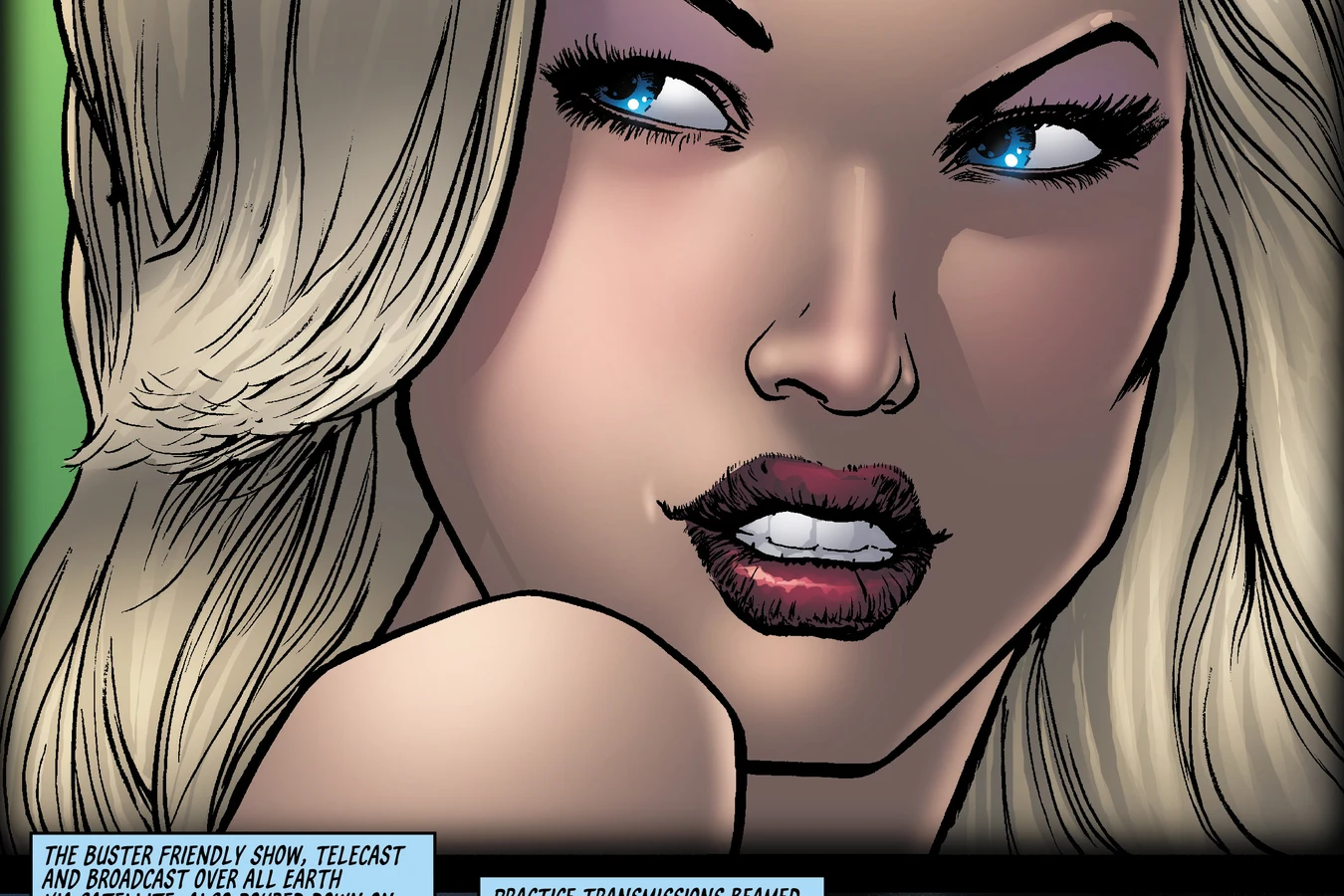
On the way back, the truck's television shows Buster Friendly, the host who is on the air nearly every hour of every day, beamed to Earth and to the colonies. His guest is Amanda Werner, one of the beautiful women who appear on his show again and again. They trade jokes while Buster promises that a big announcement is coming soon. Isidore watches with half his attention, because something about the program always bothers him. Buster's show runs for forty-six hours a week, and Isidore cannot work out how one man could manage so much airtime.
What irritates Isidore is that Buster ridicules the empathy boxes in subtle ways. He does it again on this broadcast, making a joke about the rocks thrown at Mercer. Isidore cannot understand why the most popular man on television would mock the practice that holds people together. He has noticed that Buster Friendly and Mercerism seem to be fighting over the same people, and that Buster never misses a chance to make the faith look silly. Isidore turns the volume down and flies on toward the shop with the cat on his lap.
Back At The Hospital
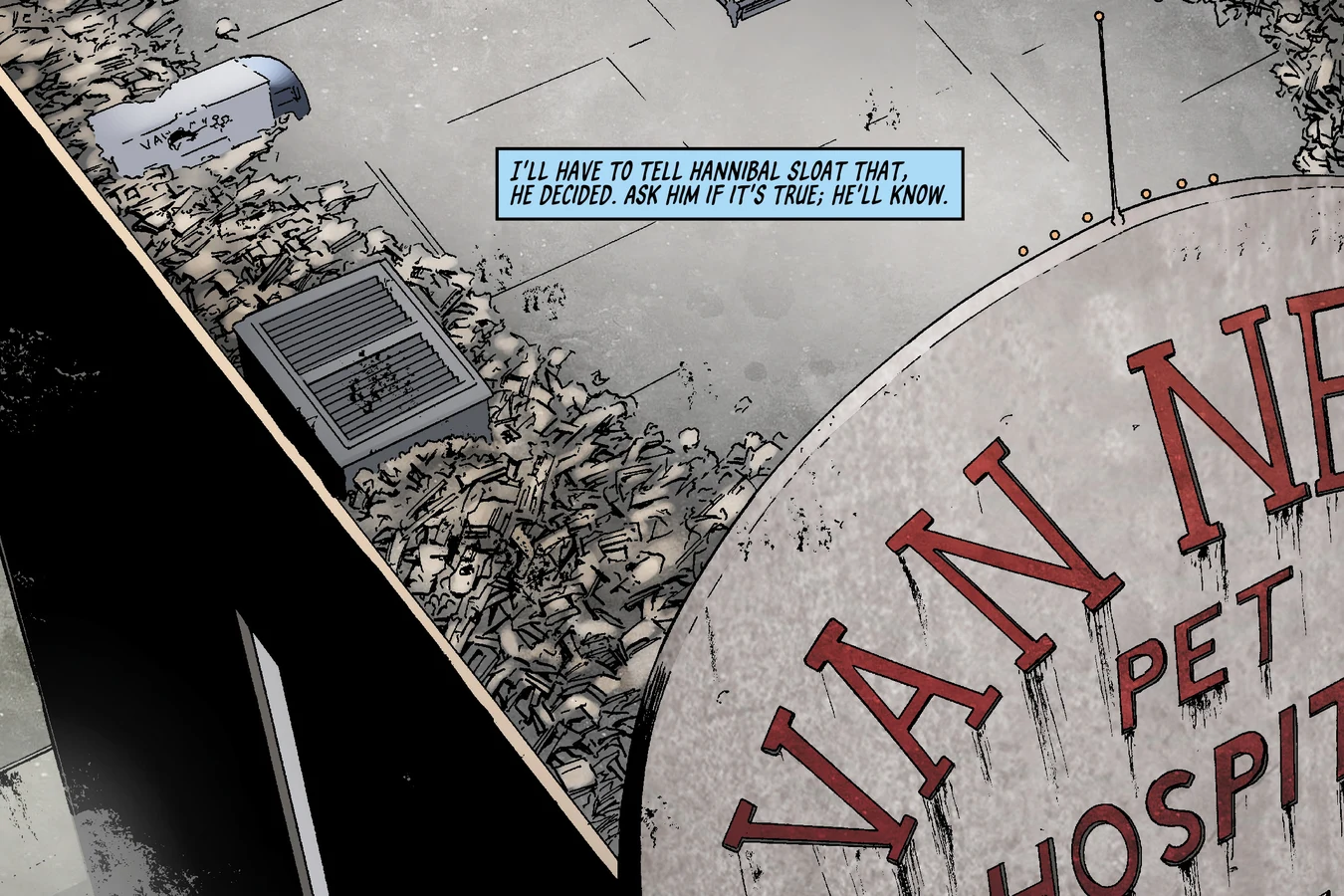
Isidore lands on the roof of the Van Ness Pet Hospital. The name and the building were chosen so that customers would believe their animals were being treated by real vets. The company's truck is painted to match, and nothing on it says that the hospital repairs electric animals. Inside the shop, technicians work at benches covered with half-opened sheep, horses and dogs whose owners hope the neighbors will never learn the truth. The firm survives on that secret, because owning a fake animal is a shame most customers would pay anything to hide.
He carries the cat downstairs to the workroom. Isidore still believes he has brought in a broken machine and expects to hand it over for repair. He knows the shop's rules: customers are never told anything that might make them doubt that a real vet treated their pet. He sets the cat on the bench in front of his boss and waits to hear how long the repair will take and how much the owner will pay. He still hopes the damage is small.
The Cat Was Real
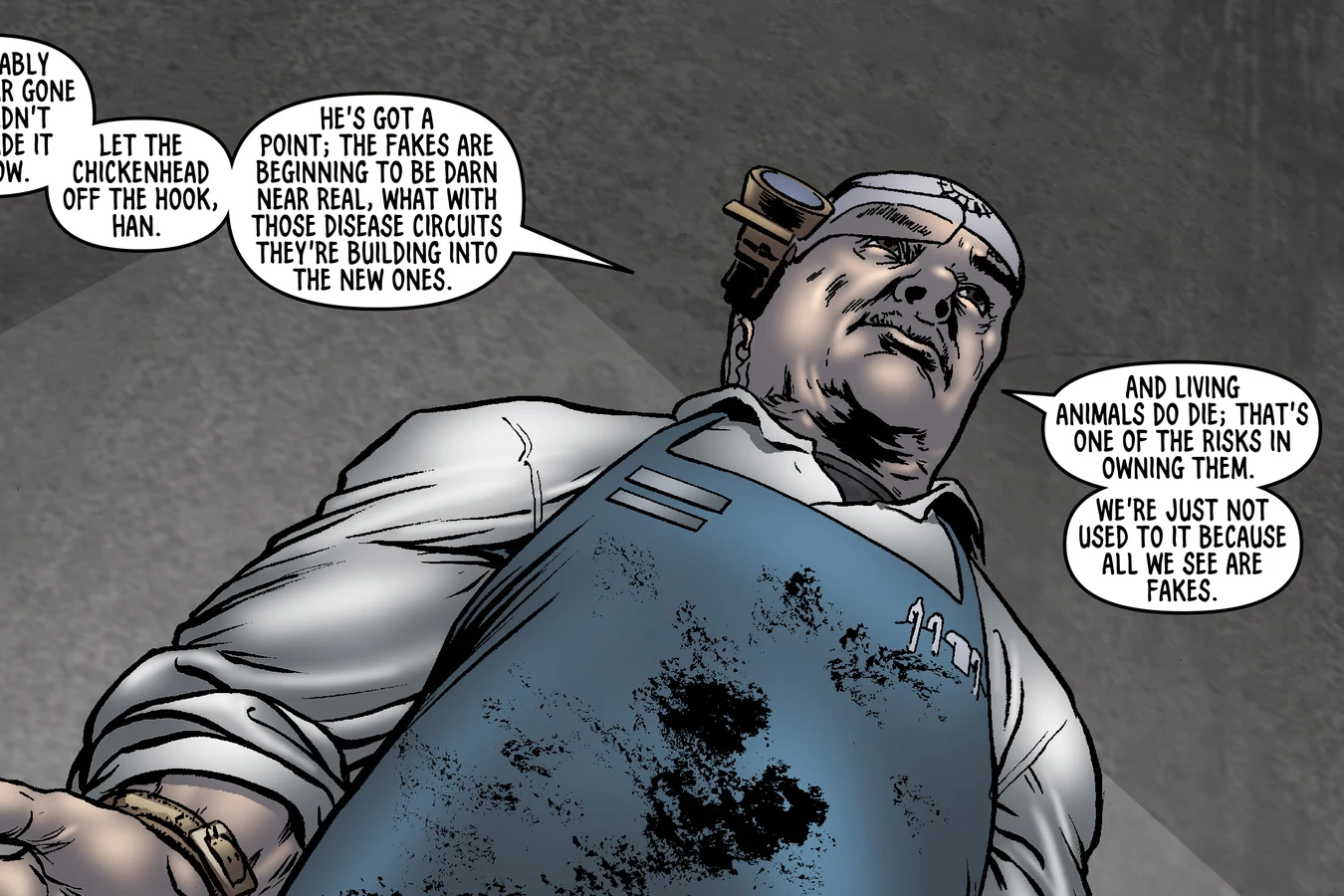
His boss, Hannibal Sloat, is an old man in a work apron whose eyes have been damaged by the dust. Sloat looks at the cat and tells Isidore that it is not a fake. It was a real cat, and it is dead. Isidore is stunned. He had driven the whole way trying to fix it like a machine, and he says he could not tell the difference. Sloat replies that a dead animal is now worth nothing at all.
Sloat tells Isidore that he must call the owner and break the news. Isidore stammers that he cannot; he has a phobia about speaking to strangers on the vidphone. The repairman Milt Borogrove stands up for him and points out that Isidore does not like being called a chickenhead. Isidore insists that the dust has damaged everyone, not only people like him. Then he remembers that Milt is about to leave for another job, which means he will have to make the call.
Calling The Cat's Owner
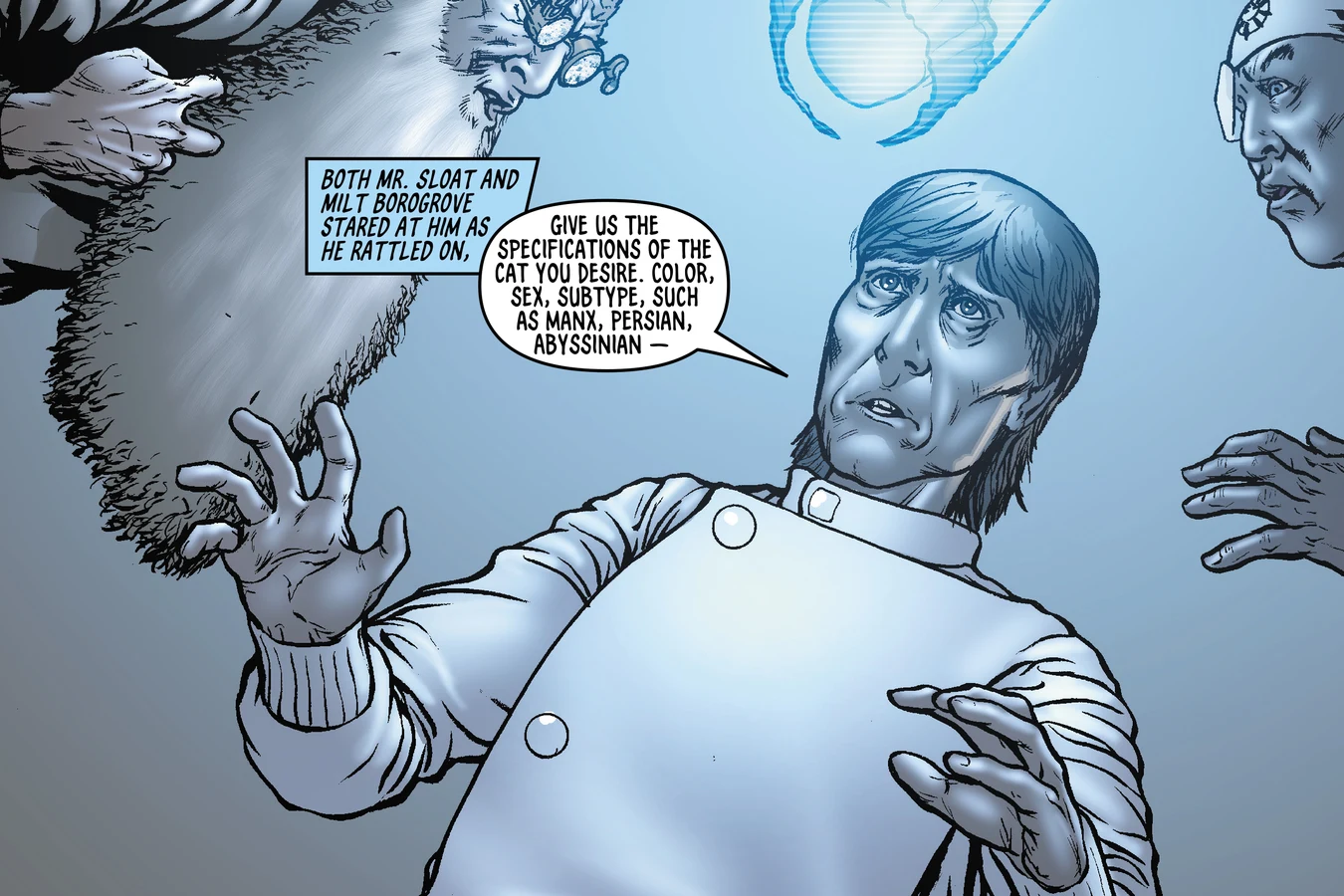
Isidore digs the owner's number out of his pocket and places the call. The owner's wife, Mrs. Pilsen, answers and asks about her cat, Horace. To everyone's surprise Isidore does not stammer. He launches into a smooth speech and cannot stop: Horace died on the way, the senior staff physician Dr. Hannibal Sloat believes nothing could have been done, and the hospital can build an exact electric replica in which every detail of the old animal is faithfully repeated. Sloat and Milt stare at him while he talks.
Mrs. Pilsen tells Isidore not to suggest that to Ed, or he will go mad, so Milt takes the receiver. She then asks whether the company could build an electric replacement so perfect that her husband would never know. Her husband, Ed, loved Horace but panicked and would not face it when the cat fell ill with pneumonitis. Milt warns her that owners are never fooled, only neighbors. She says she wants to try a false animal first. Afterward Isidore feels elated and offers to handle the replica builders himself.
The Polokov Briefing
Back at the Hall of Justice, Bryant tells Rick to try for Max Polokov first, before the android can get out of reach. Polokov has taken a job with the city as a trash collector, a scavenger, and is mimicking a special, an anthead, which is what fooled Dave Holden. Bryant also says that Sandor Kadalyi, an observer from the Soviet police, is arriving on an Aeroflot rocket within the hour and wants to tag along. It is up to Rick to decide whether Kadalyi can be of any use.
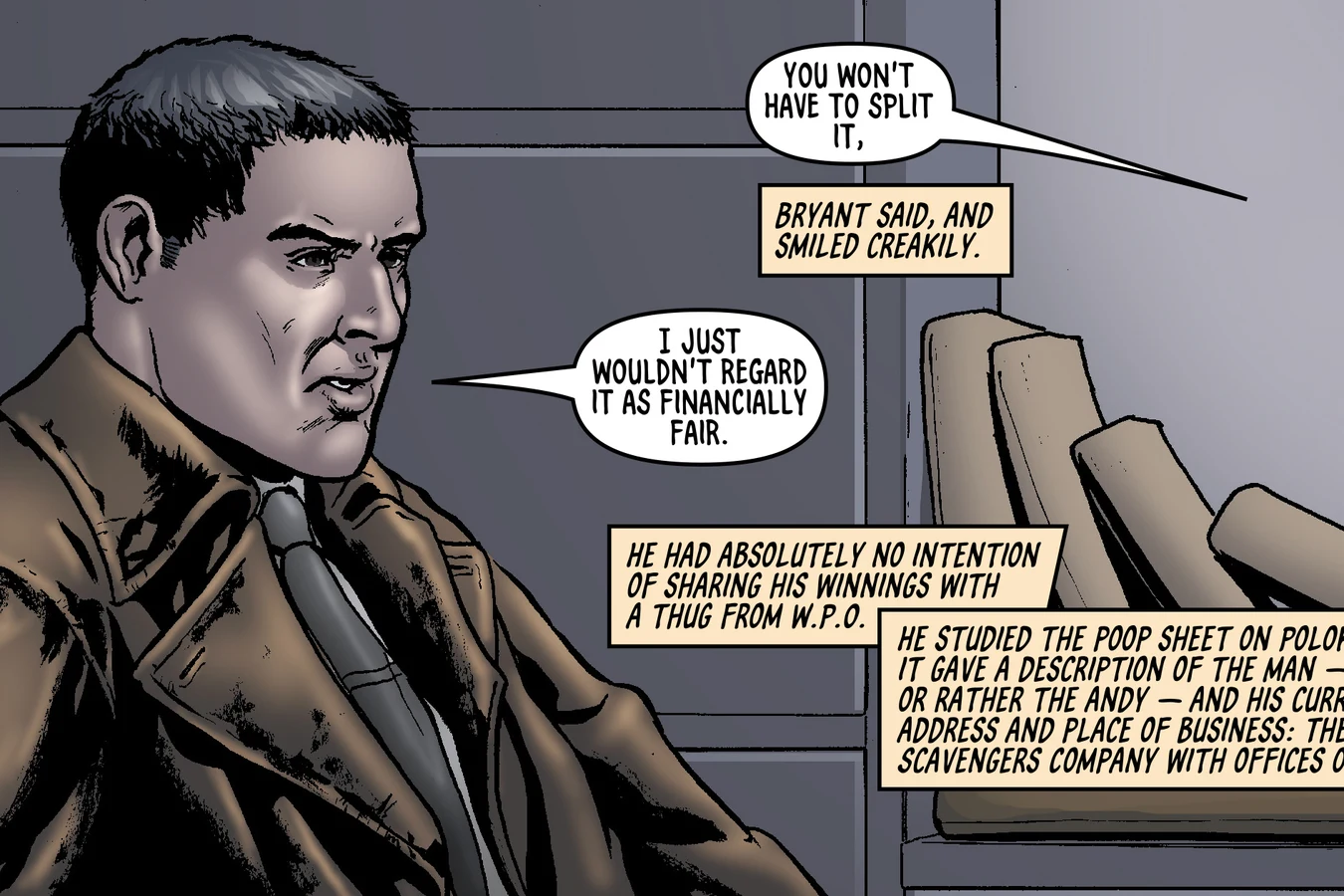
Bryant tells him that he will not have to split the bounty with the Soviet observer. Rick answers that he would not regard that as financially fair, and privately he has no intention of sharing his winnings with a thug from the WPO. He studies the poop sheet on Polokov, which gives a description of the android and its address and place of business: the Bay Area Scavengers Company, with offices on Geary. Rick decides not to wait for the Soviet cop and leaves at once.
Polokov's Empty Apartment
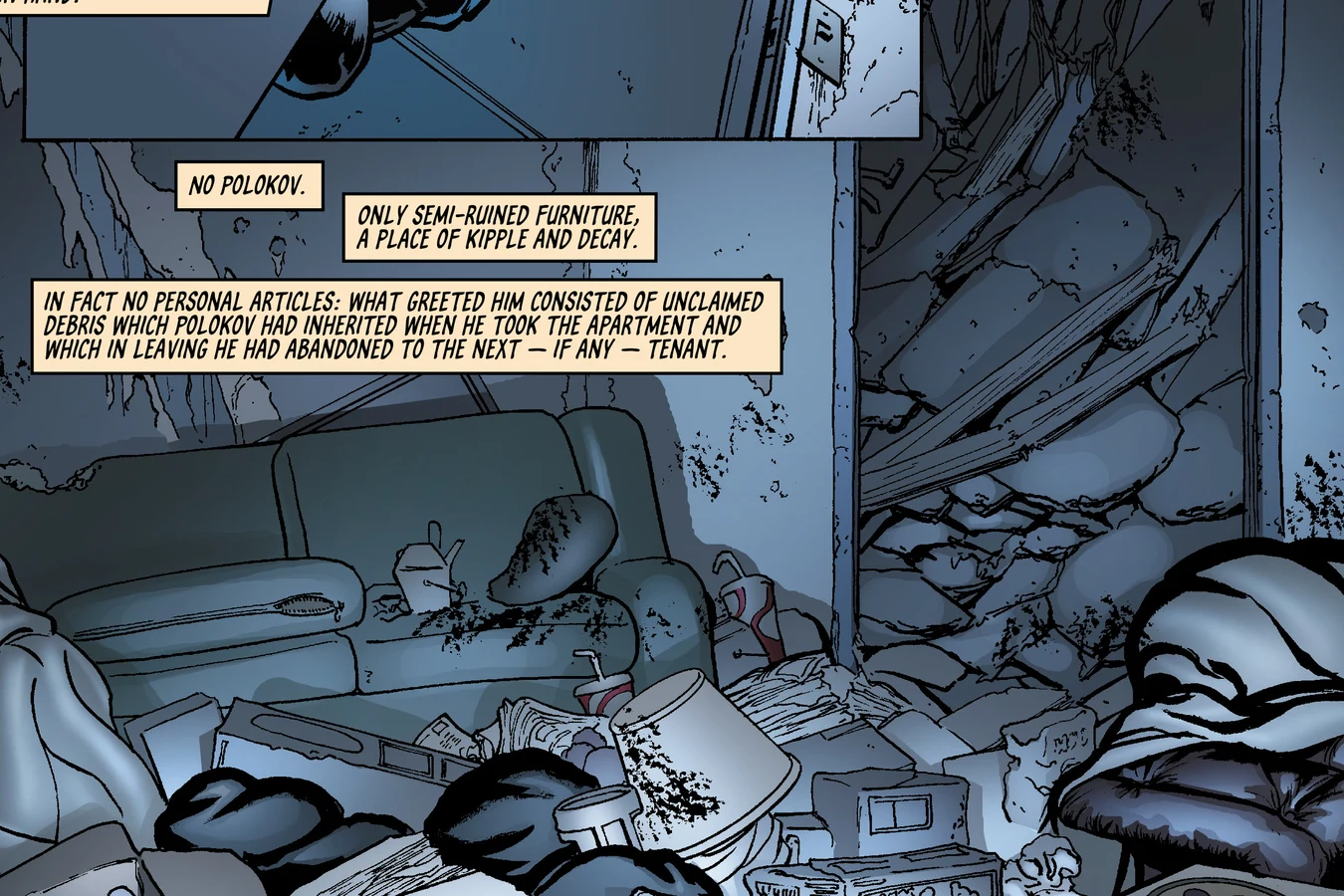
Rick first visits the offices of the Bay Area Scavengers Company, where the personnel manager, Mr. Ackers, reluctantly checks his records and learns that Polokov did not show up for work. Rick flies on to Polokov's apartment building in the Tenderloin. Before he goes in, he switches on a Penfield wave transmitter meant to freeze any android inside. Then he opens the door with an infinity key. The apartment holds no personal articles, only unclaimed kipple and semi-ruined furniture left behind by an earlier tenant.
Rick thinks that the first thousand-dollar bounty has probably skipped all the way to the Antarctic Circle. Back on the roof, he reports to Bryant by phone and starts studying the poop sheet on Luba Luft. A call comes through from Seattle. Rachael Rosen offers to come along on his hunt, saying that a Nexus-6 would be wary of him but not of another Nexus-6. Rick tells her he will take it under advisement. Soon after, a hovercar taxi lands on the roof and a stranger steps out to meet him.
Retiring Polokov
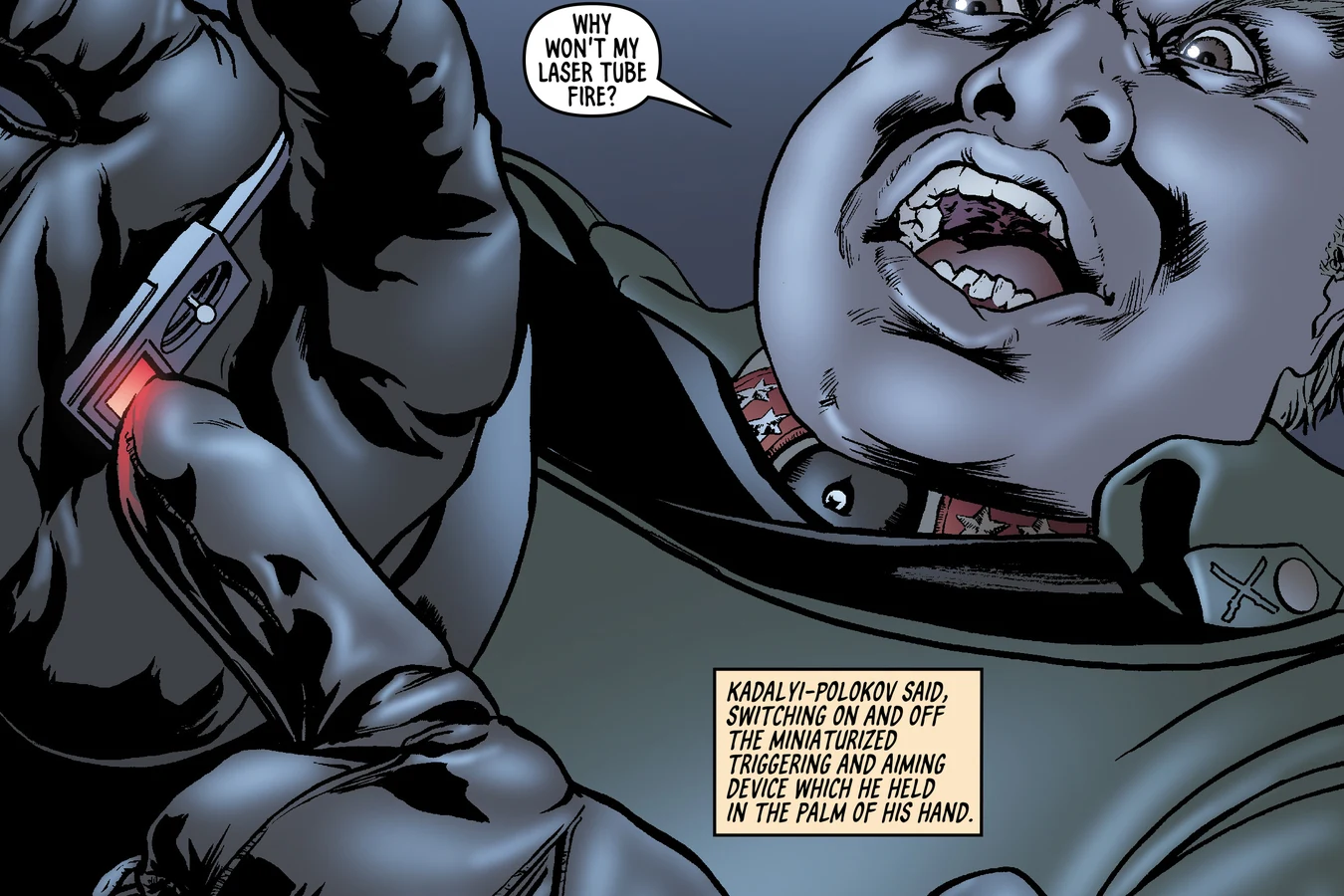
The man is red-faced and cherubic, in his mid-fifties, wearing a heavy Russian-style greatcoat, and he introduces himself as Sandor Kadalyi. He squeezes into the car beside Rick and shows him an unusual laser weapon, which he says the Soviet police made themselves. Rick points it out the window and squeezes the trigger, but nothing happens. Kadalyi explains that the triggering circuit stays with him. Rick realizes that the man beside him is Max Polokov, the android, and not a Soviet policeman at all.
With his toe, Rick presses the emergency button on the floor of his car. Polokov switches the miniature triggering device in his palm on and off and shouts, asking why his laser tube will not fire. He drops the device and lunges with both hands for Rick's throat. As the android's hands sink in, Rick fires his regulation-issue old-style pistol from its shoulder holster, and the bullet blows apart the android's brain unit. Shaking, Rick tells himself that he got Polokov and made a thousand dollars.
Iran's Depression
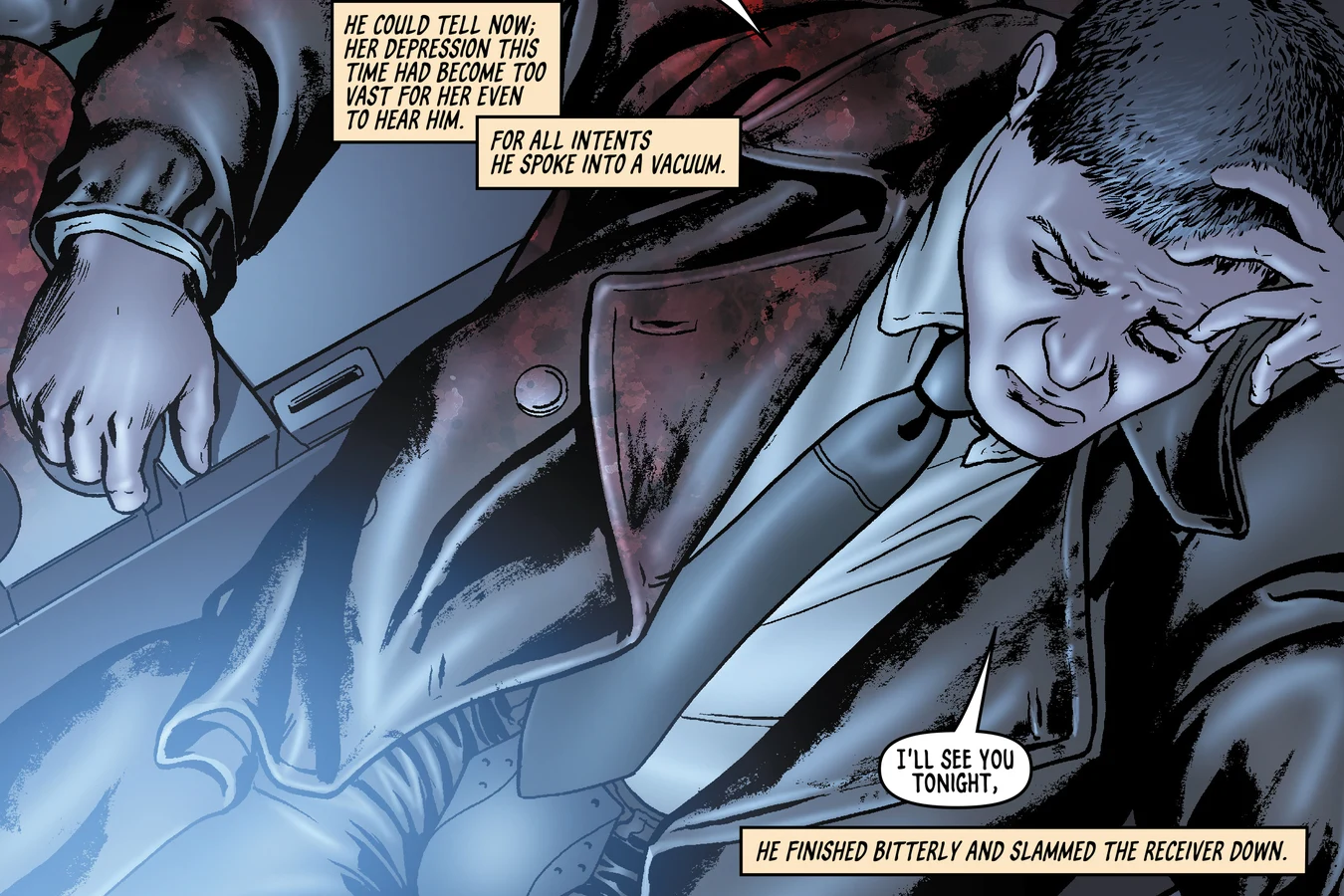
Rick calls home to tell his wife about the bounty. Iran appears on the vidscreen, her face sodden with the six-hour self-accusatory depression she had dialed. Her voice sinks into a dreary drone. She tells him she is tired and has no hope left, and she complains that he could be killed by one of those androids. Behind her, Buster Friendly's show booms so loudly that Rick sees her mouth moving but hears only the television. He tells her that he has already made a grand toward an animal.
He can tell that her depression has become too vast for her even to hear him, and that he is speaking into a vacuum. He thinks that she does not care whether they own an ostrich or not, and he wishes he had left her two years earlier, when they were considering splitting up. He decides that most androids he has known have more vitality and desire to live than his wife. He considers asking Rachael Rosen for help, then heads for the opera house to find Luba Luft.
Arrival At The Opera
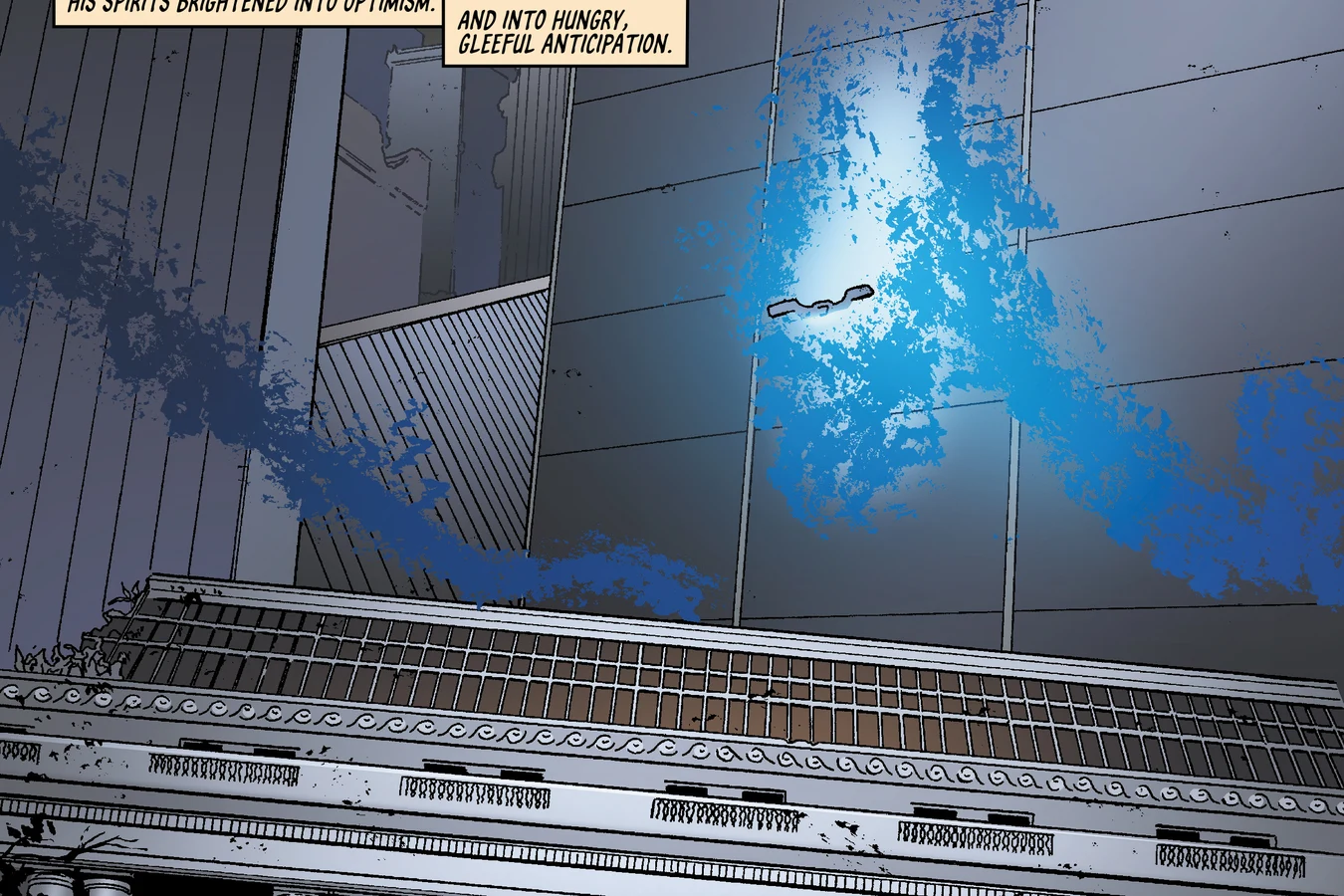
According to Dave Holden's notes, Rick will find Luba Luft at the old War Memorial Opera House at this time of day. As he descends toward the ornate roof, he loudly sings a potpourri of arias with pseudo-Italian words made up on the spot, and even without the Penfield mood organ his spirits brighten to optimism. He decides to try one more android before asking Rachael for help. Inside, a slightly miscontrived rehearsal of Mozart's The Magic Flute is in progress, with the first act in its final scenes.
Rick seats himself in the dress circle, and nobody appears to notice him. On stage, Papageno in his fantastic pelt of bird feathers and Pamina sing the words about the magic bells that always bring tears to Rick's eyes. The song says that a brave man with such bells could make his enemies vanish effortlessly. Rick thinks that no such magic bells exist in real life. He watches the rehearsal move along and waits to see the soprano singing Pamina.
Luba Luft At The Opera
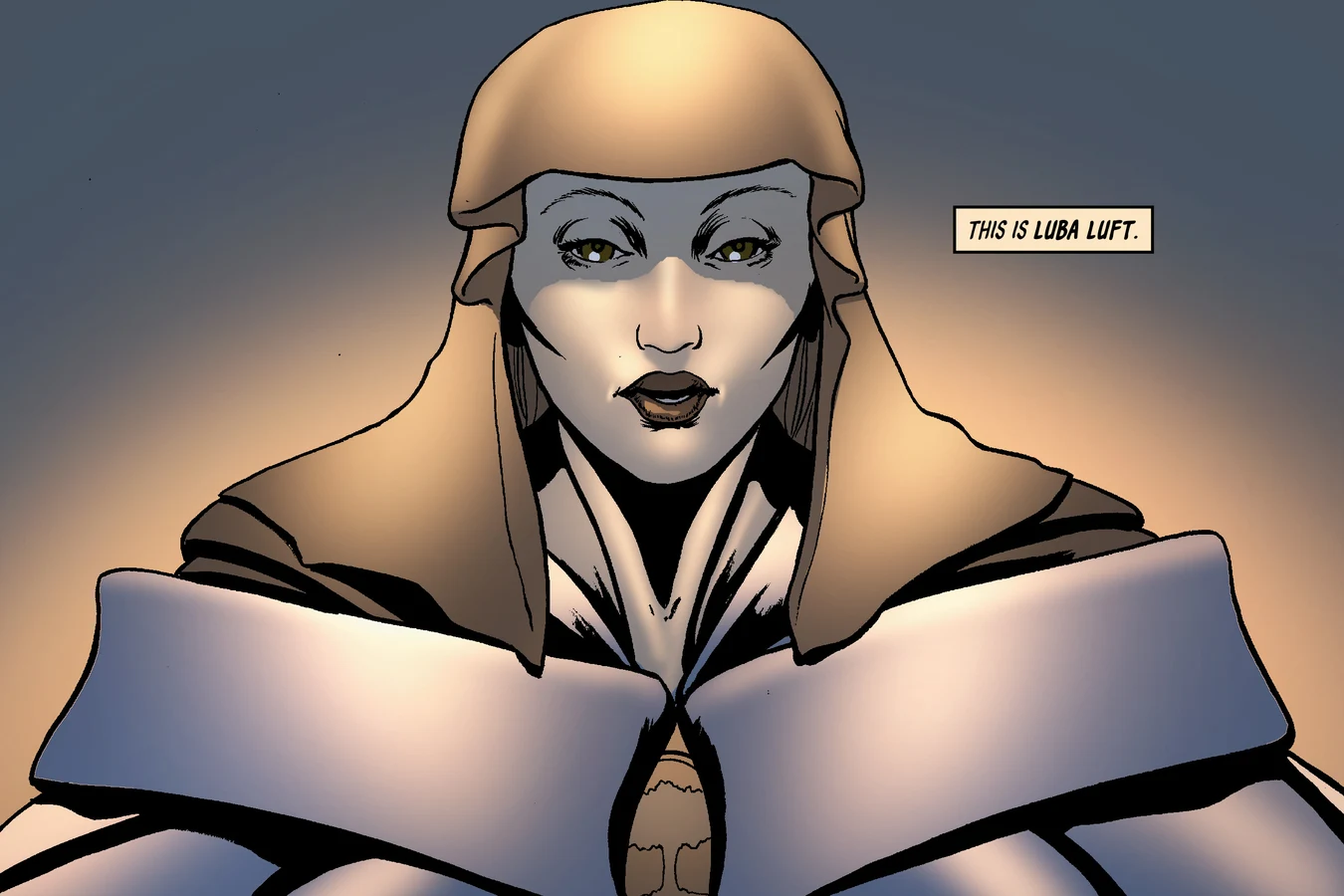
Leaning forward, Rick studies Pamina in her heavy, convoluted robes, with her wimple trailing its veil about her shoulders and face. This is Luba Luft, and he is surprised by the quality of her voice, which compares well with the singers in his collection of historic tapes. He reflects that the better she functions and the better a singer she is, the more he is needed. When the director calls a break of an hour, the musicians leave their instruments and the cast heads for the dressing rooms.
Rick makes his way backstage, following the tail of the cast and taking his time. He decides it is better to get it over with immediately and to spend as little time talking to her as possible. He arrives at a door with a note tacked to it reading Miss Luft, private, and knocks. The girl sits at her dressing table with a much-handled clothbound score open on her knees, marking it with a ballpoint pen. Her enormous hazel eyes fix on him and do not waver.
Luba Luft's Test
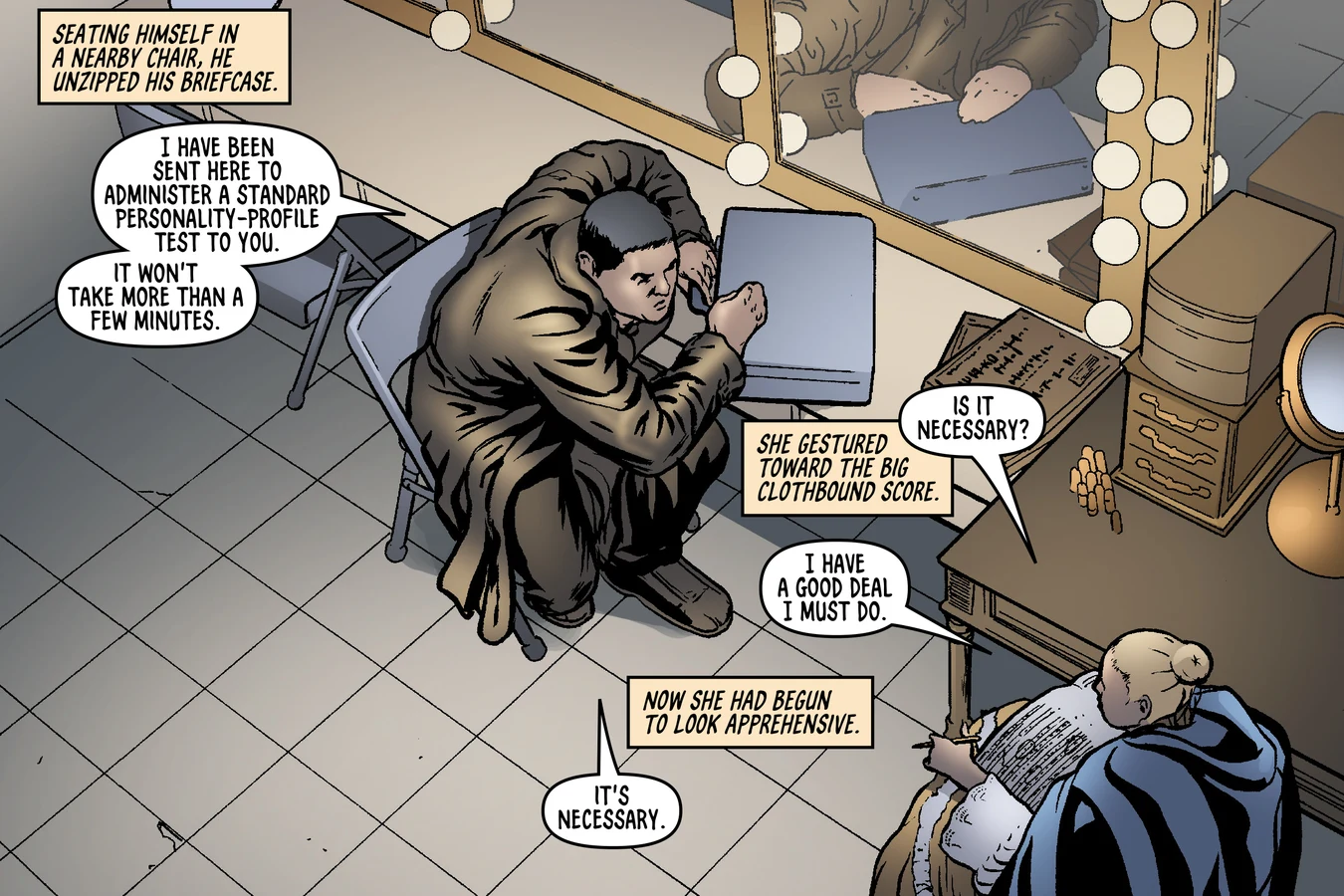
Rick says he is from the San Francisco police and has been sent to administer a standard personality-profile test. Luba asks whether he thinks she is an android and insists she has never even been on Mars. She suggests he may be an android himself with false memories, and asks whether he has taken the test. He says he took it a long time ago, when he started with the department. When he asks about a wasp crawling on her wrist, she asks what a wasp is, and he has to give her the German word, eine Wespe.
She claims not to understand question after question, and Rick begins to think her semantic fog has a purpose. When the adhesive disk drops under her dressing table and he kneels to find it, he stands up looking into a laser tube. Luba takes his sheet of questions, reads the ones about a nude girl in a magazine and about an abortion, and accuses him of being a sexual deviant. Still holding the laser on him, she calls the police. Rick wonders why she does not simply kill him.
Arrested By Officer Crams
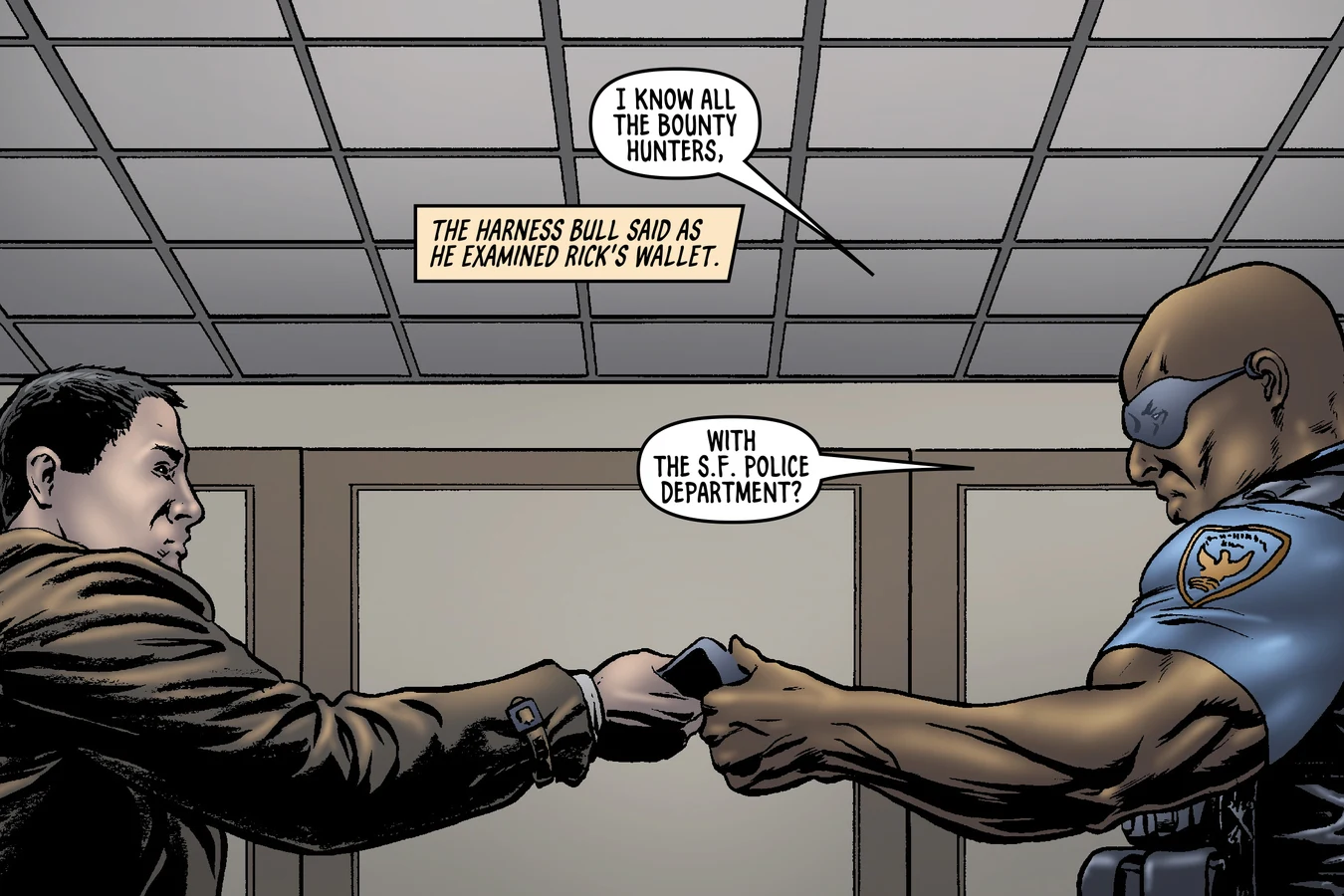
A large harness bull in an archaic blue uniform arrives. Luba hands over the laser tube and says she has never seen Rick before. The officer, Officer Crams, examines Rick's wallet and says he knows all the bounty hunters in the department. Rick explains that he has taken over Dave Holden's list and that his supervisor is Inspector Harry Bryant. Crams says there is no such inspector. When Rick dials the familiar number, the phone rings but no one answers, and the vidscreen stays blank.
Crams takes Rick's pistol and laser tube and leads him up to the opera house roof, where he inspects the body of Polokov in Rick's car and radios for someone to pick it up. Luba follows them to the door, saying she is afraid Rick will come back. The patrol car lifts off with Rick aboard and heads south. Rick realizes what the androids, working together, have achieved. He tells himself that whatever they have planned, at least he got Polokov.
The Mission Street Station
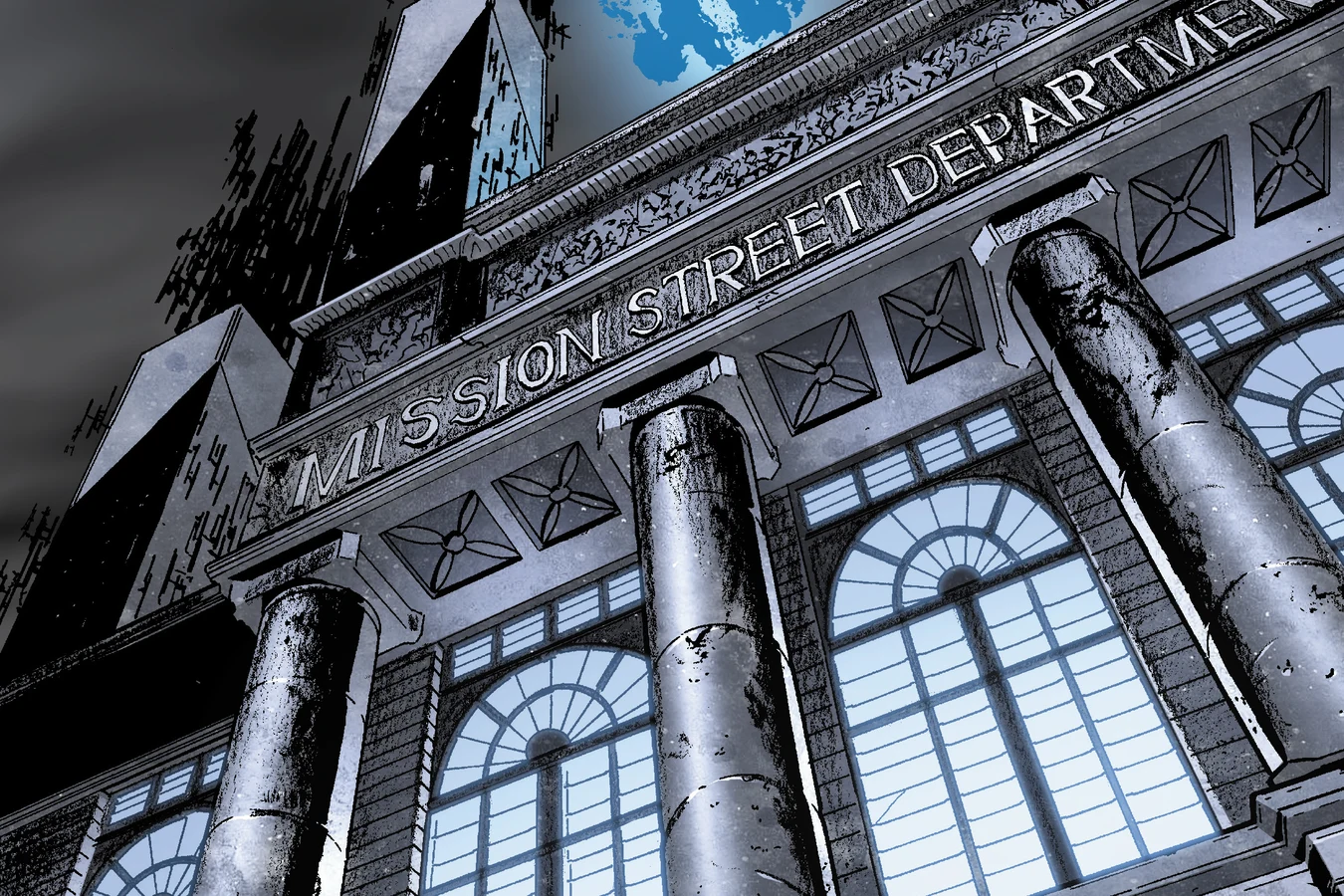
Rick protests that the Hall of Justice is north, on Lombard. Crams tells him that the new one is on Mission and that the old building on Lombard is disintegrating, a ruin nobody has used for years. The patrol car lands on the roof of the Mission Street Hall of Justice, which juts up in a series of baroque, ornamented spires. Rick finds the handsome structure attractive, except for one aspect: he has never seen it before. Inside, he is booked for impersonating a peace officer.
A technician takes his cephalic pattern at a familiar-looking table, and Rick is led off to an equally familiar room. He thinks it is hard to believe that two parallel police agencies could exist without discovering each other long before. A plainclothes officer goes through his briefcase and asks whether he is an android. Rick offers to take the Voigt-Kampff test and asks to phone his wife. A woman he has never seen before answers his home number. The officer introduces himself as Inspector Garland.
Inspector Garland
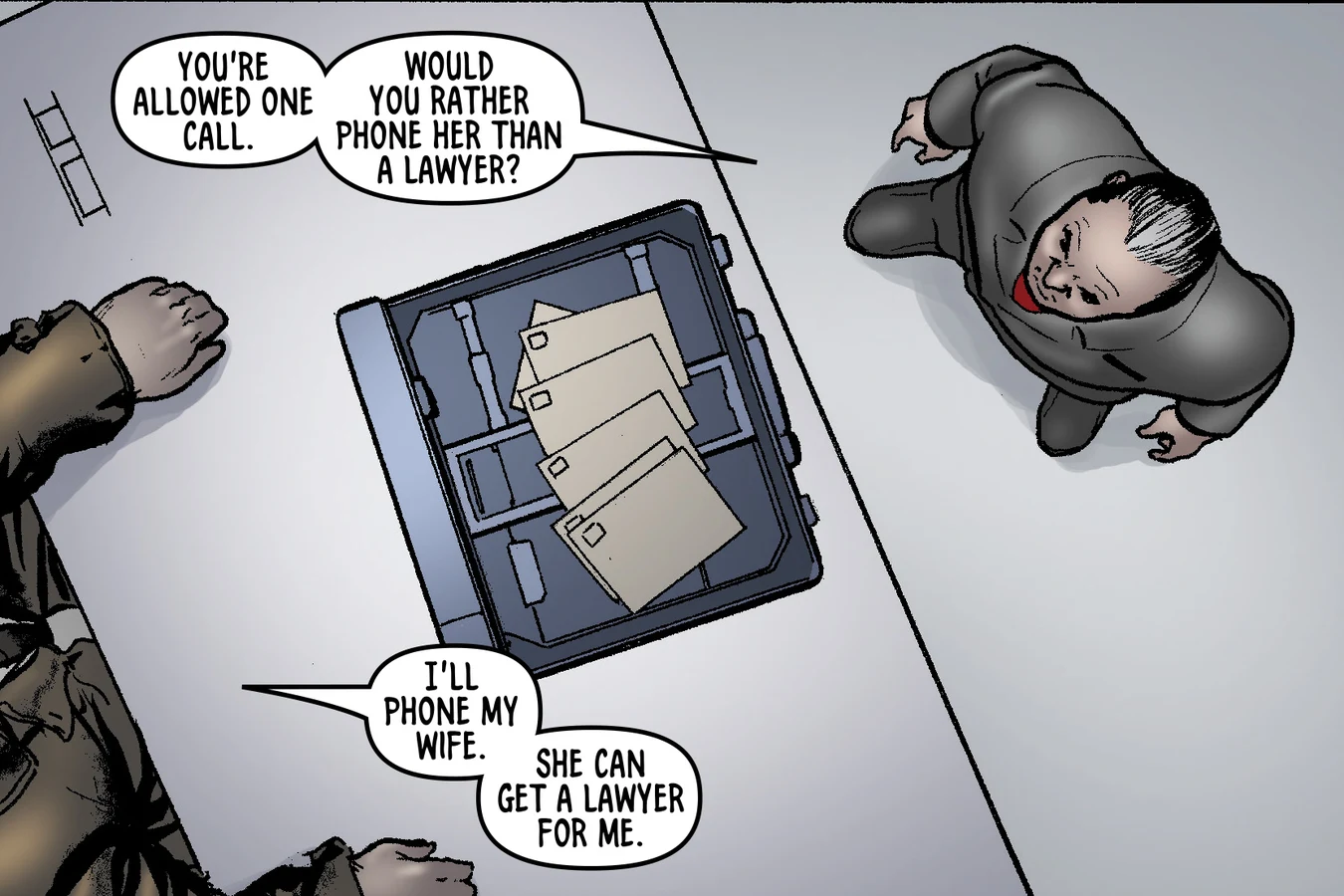
In his office, Inspector Garland asks about the Voigt-Kampff test and the papers in Rick's briefcase. Rick spreads out the carbons of his assignments. The next one after Luba Luft is Garland himself, listed with his description and a cover as an insurance underwriter. Garland admits that the sheet describes him and calls in the department's bounty hunter, Phil Resch, a tall man with horn-rim glasses and a fuzzy Vandyke beard. He tells Resch that he should take a look at the list.
Garland says the bone marrow test on Polokov's corpse is meant to remove any legal basis for Rick's claim. Resch says Polokov always struck him as cold and that he had wanted to test him. When the lab reports that Polokov was a humanoid robot, Garland seethes. Resch explains that he uses the Boneli Reflex-Arc Test and suggests that it should be applied to police personnel, the higher up the chain of command the better. He goes to fetch his equipment and test them all.
Garland's Death
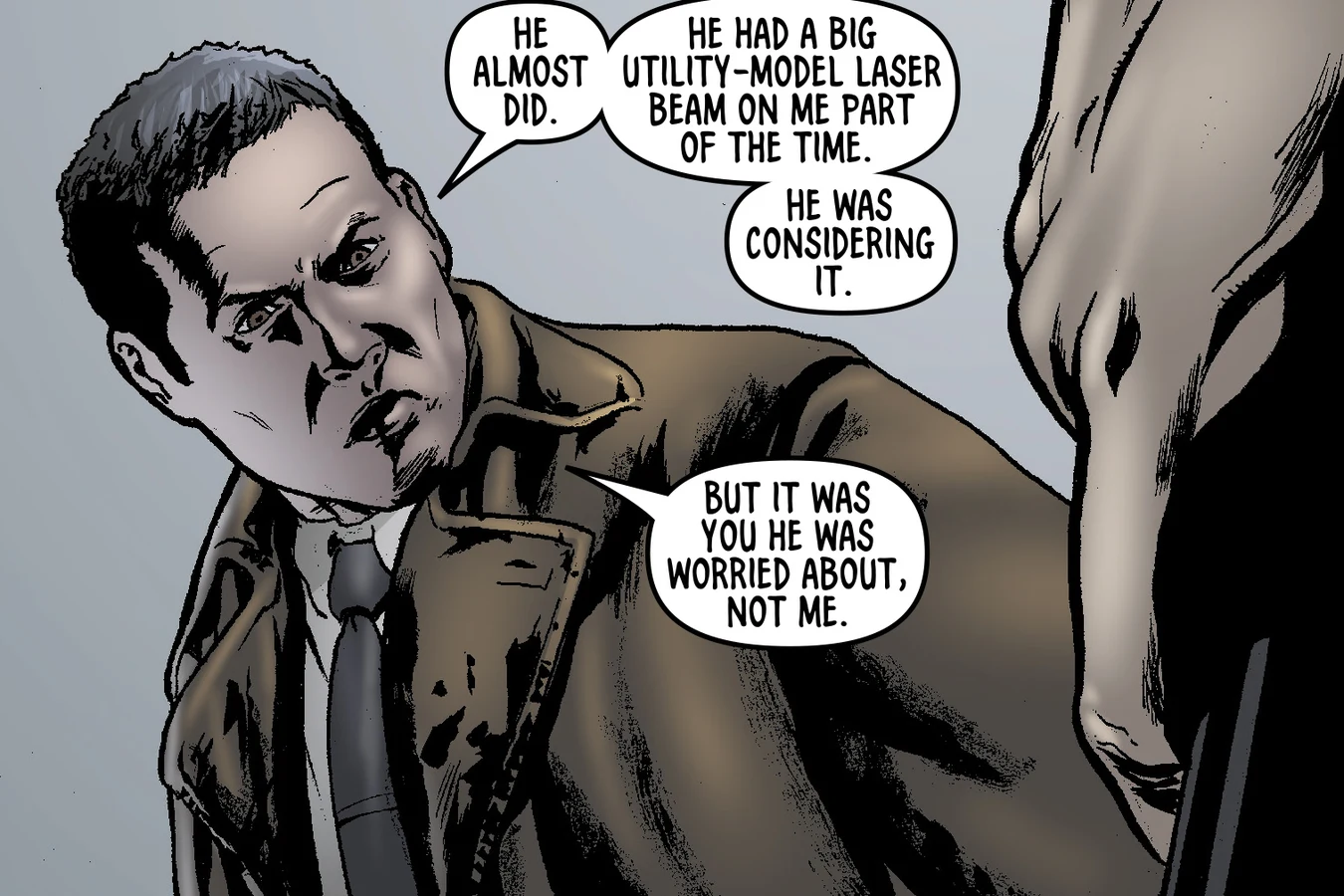
While Resch is gone, Garland takes a laser tube from his desk drawer, then puts it back and locks the drawer. He admits that he is an android, and that the androids have run the Mission Street station for years. The vidphone lines are trapped, which is why Rick's call reached a stranger. Garland says that Phil Resch does not know he is an android himself, since he has a synthetic memory system, and that the Boneli test will end with Resch killing them both.
Resch returns carrying his test device. As Garland pulls out a miniature laser, Resch yanks out his own and fires first. Garland slumps forward, and the body slides from its chair to the floor. Resch says that it was Rick Garland was worried about, not himself, and that he intervened when he saw Crams bring Rick in. Resch handcuffs Rick to his own wrist so they can walk out past the officers. On the roof they take off for the opera house to reach Luba Luft before anyone can warn her.
Phil Resch's Squirrel
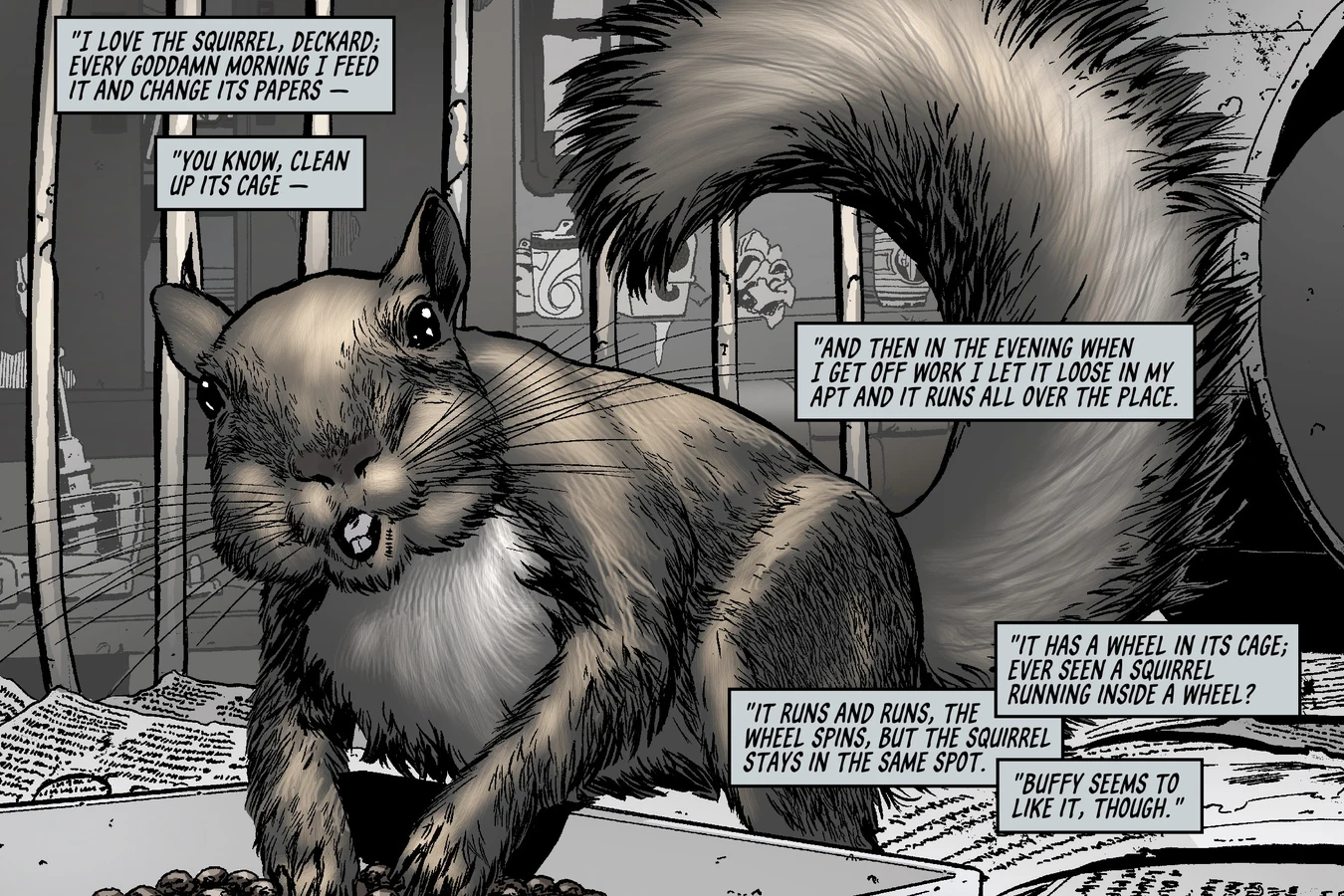
In the air, Resch asks Rick to give him the Boneli test or the Voigt-Kampff after they retire Luba Luft. He senses that Garland must have told Rick something about him. Rick tells him to keep his attention on the job. Resch insists that he owns a real animal, a squirrel. He says he loves it, feeds it every morning and changes its papers, and lets it loose in his apartment in the evening, where it runs all over the place. The squirrel is named Buffy.
Resch describes how the squirrel runs on a wheel in its cage and stays in the same spot, and says Buffy seems to like it. Rick tells him that androids can have false memories too, but Resch holds on to the squirrel as proof. They learn that Luba Luft has gone to the museum to see an exhibit of Edvard Munch. As they walk to the museum, Resch bets that she has flown and that they will not find her there. Rick keeps wondering whether Resch is an android.
The Munch Exhibit
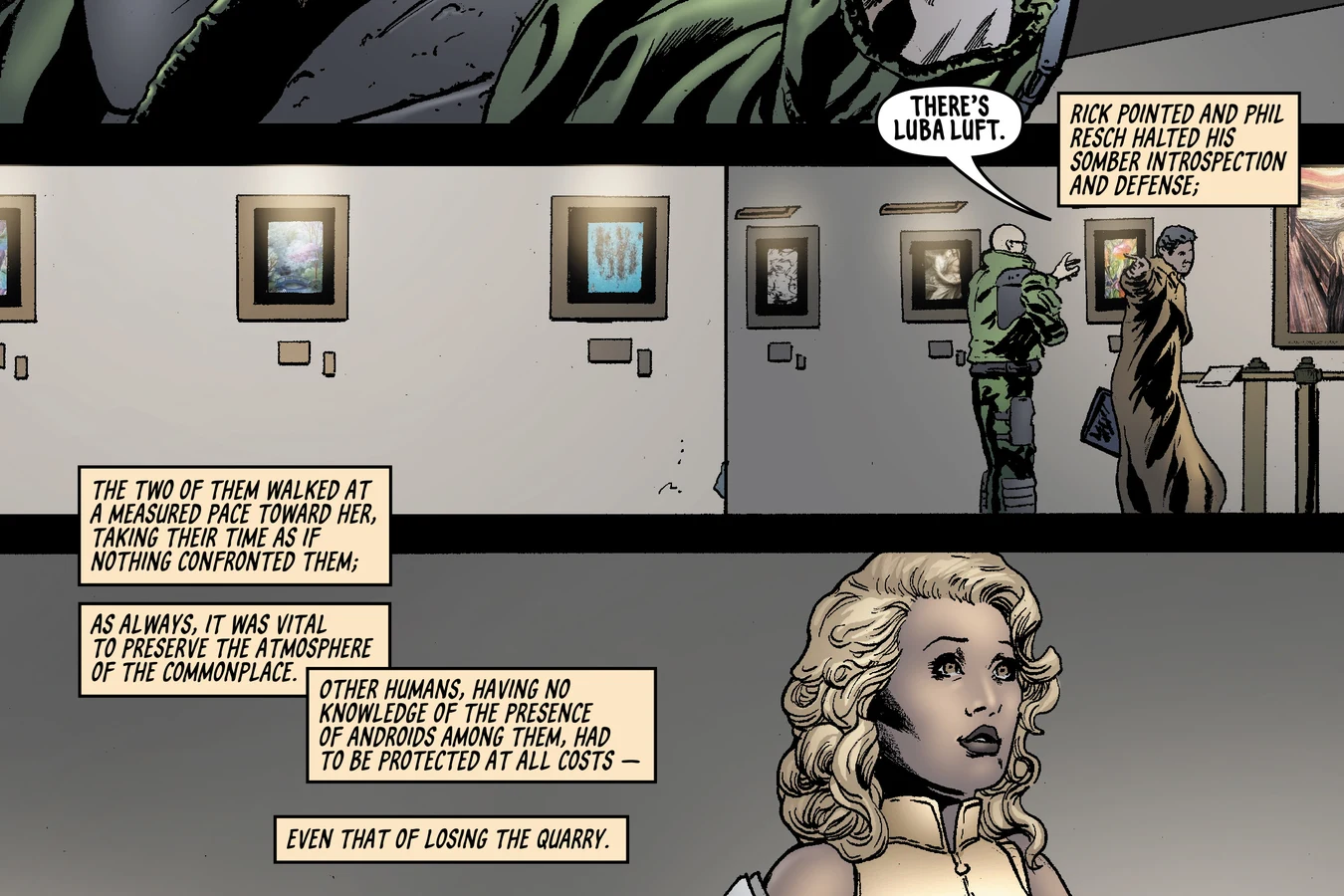
Inside, a grammar school class is touring the Munch exhibit. Resch stops in front of The Scream, the figure with its hands clapped to its ears, howling in isolation. He tells Rick that this must be how an android feels, then says he does not feel like that, so maybe he is not one. Then Rick spots Luba Luft, wearing shiny tapered pants and a gold vestlike top. She is absorbed in a picture of a young girl sitting on the edge of a bed with an expression of bewildered wonder.
When she sees Rick, life seems to retreat to a point far inside her. She says she thought he had been arrested. Rick introduces Phil Resch and tells her that the policeman who arrested him was an android, as was his superior. Luba asks Rick to buy her a reproduction of the picture she was looking at. The print costs far more than his department would ever pay, but Rick buys her a book of Munch prints anyway. Luba tells him that there is something strange and touching about humans.
Luba Luft's Death
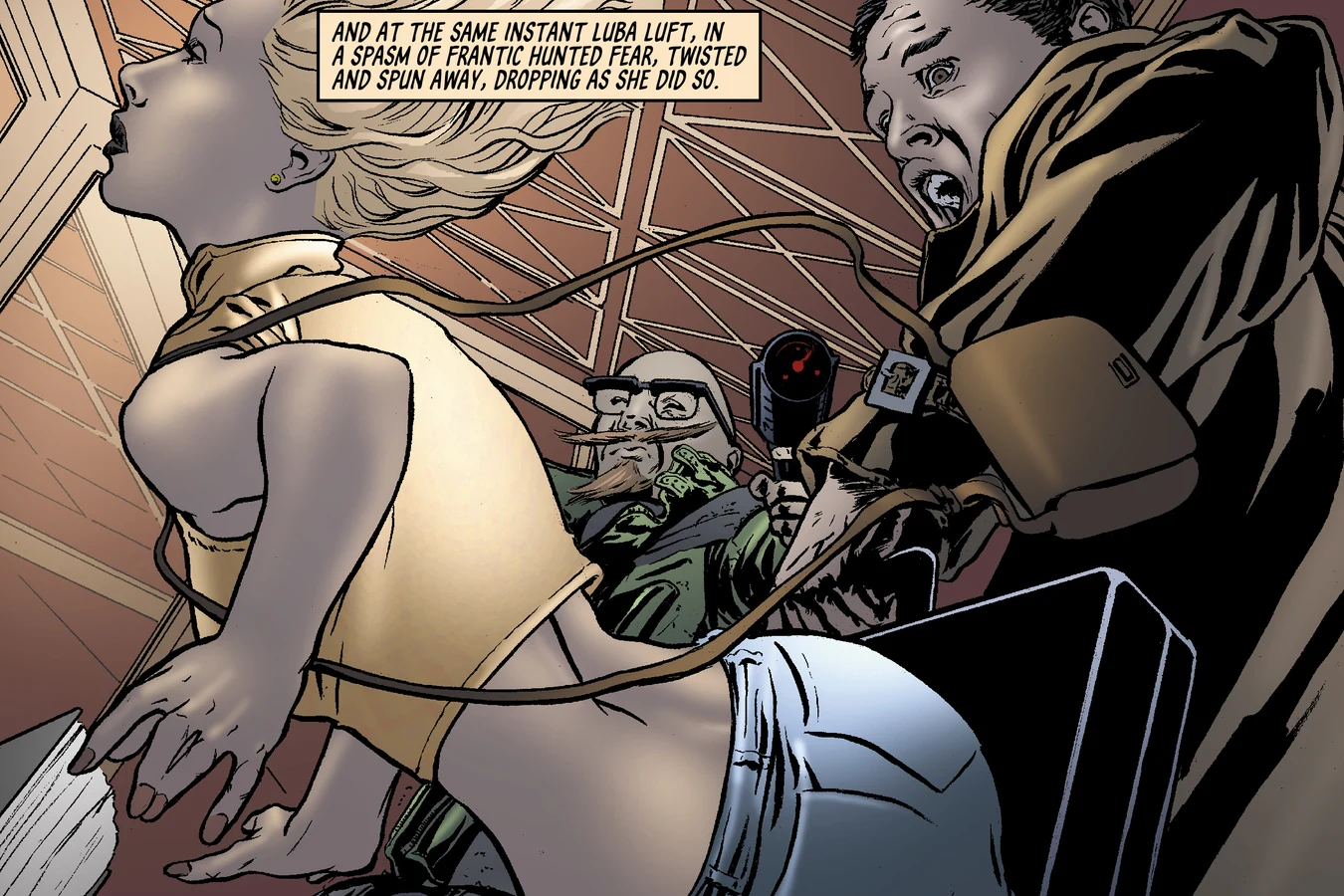
Luba glances icily at Resch and tells them she really does not like androids. Ever since she came from Mars, she says, her life has consisted of imitating the human, doing what a real woman would do. She needles Resch, and Rick struggles to pry the laser tube out of Resch's hand. Resch circles away, his attention on Luba only, and fires. The beam passes into her stomach, and she falls forward, face down, in a heap. Rick then burns the book of pictures he bought her with his own laser.
Resch watches without understanding and says Rick could have kept the book himself. Rick says that androids have pain and that he is getting out of the business. Resch reminds him that they would have had to retire Luba Luft anyway. Rick phones for a patrol car to take her body to the Hall of Justice for a bone marrow test. He tells Resch that he sees a pattern in the way Resch killed Garland and Luba, and that when they reach the car he will give Resch the Voigt-Kampff test.
Testing Phil Resch
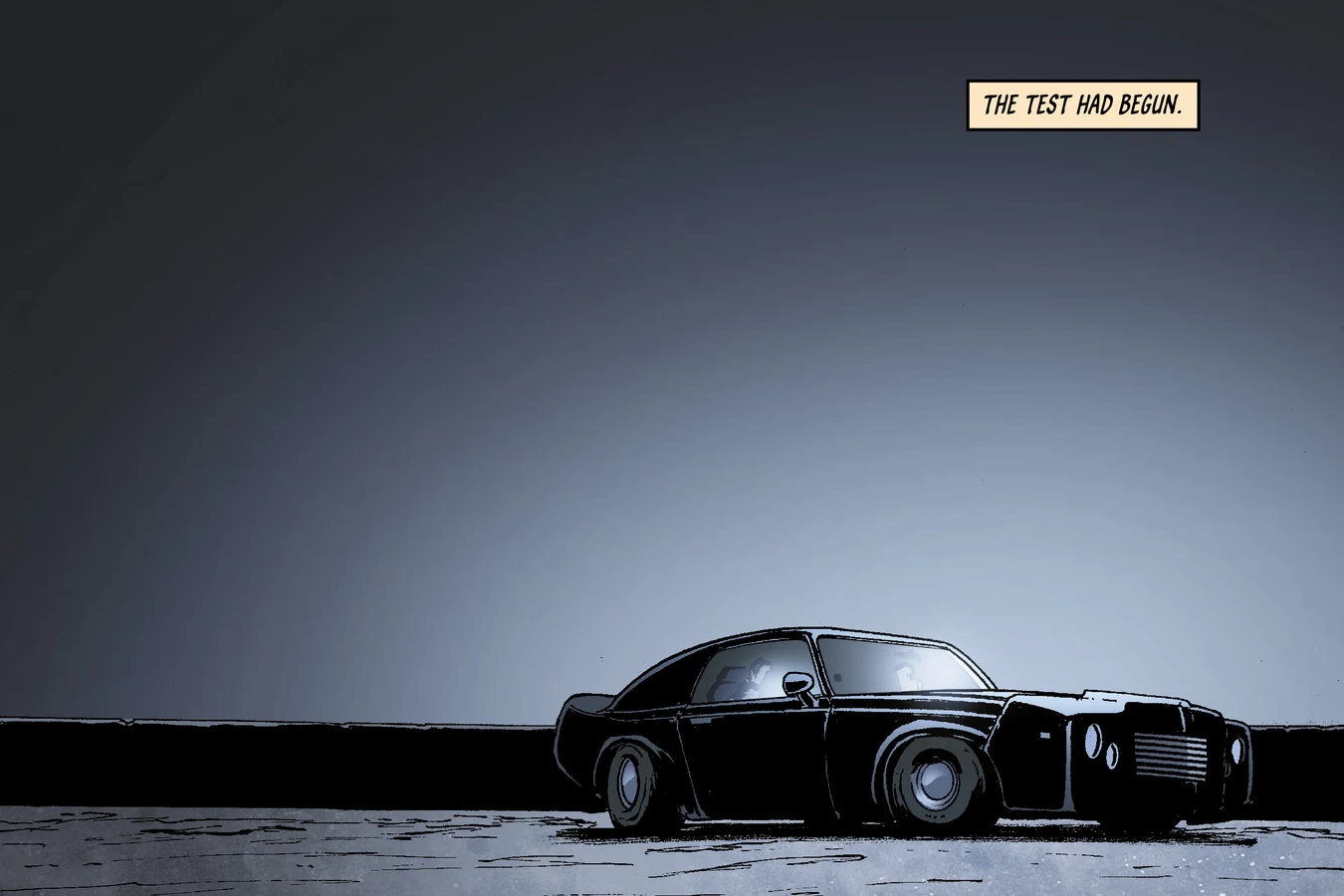
In the parked car, Rick tests Phil Resch. The result shows that Resch is human. Resch exhales in weightless, almost convulsive relief. He feels free to be the kind of man he is. Rick asks him what ideology he has to explain himself as part of the human race. The answer seems to be that Resch lacks empathy for androids, which is not a flaw the test measures. Resch's long relief convinces Rick that the man is not an android, only a killer who enjoys his work.
Then Rick tests himself. The readings show a strong response when he imagines killing a female android, the same reaction an empathic human gives to questions about human pelts used as decoration. He realizes that he is capable of feeling empathy for at least specific, certain androids. He thinks it may have to do with his feelings for The Magic Flute and for Luba's voice. Resch tells him that it is only sex, and that Rick simply wanted to go to bed with a female android.
Dinner With Pris
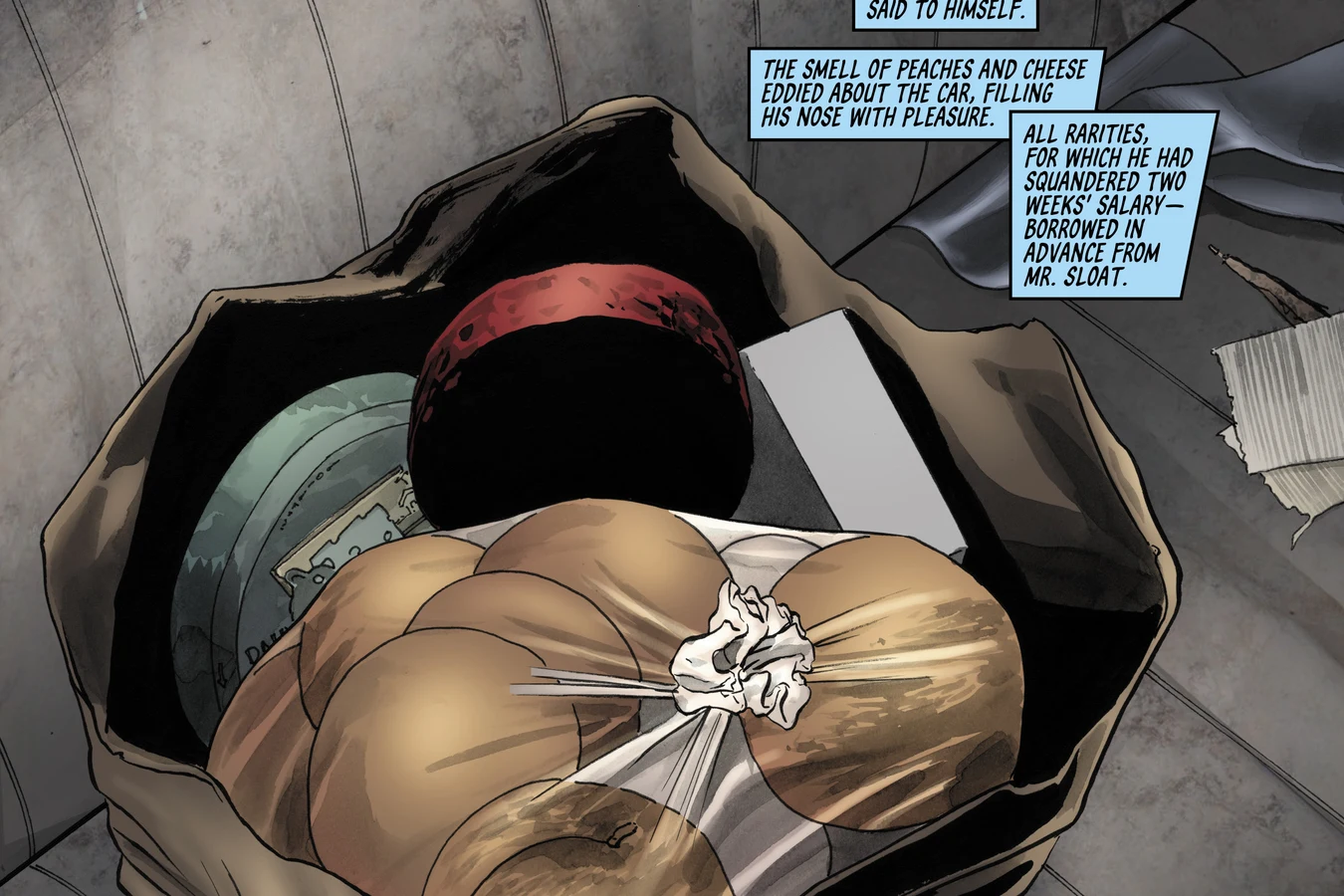
On his way home, Isidore carries a bag of rare delicacies on the seat beside him: bean curd, peaches and soft, evil-smelling cheese, bought with two weeks' salary borrowed in advance from Mr. Sloat. Under the seat rides the greatest rarity of all, a bottle of Chablis he had kept in a bank safe deposit box in case a girl ever appeared. He goes down to the floor where Pris Stratton now lives and raps on her door with the bottle, his heart going to pieces in his chest.
Pris opens the door a crack and says he sounds different, then lights up with glee when she sees what he has brought. Her mood quickly turns bitter. She tells him she once had friends, seven of them, but bounty hunters may have got them all: Max Polokov, Garland, Luba, Hasking and Roy Baty. She explains what a bounty hunter is: a professional murderer given a list of people to kill. Isidore offers to get a license to carry a laser beam and protect her, then washes dishes for their dinner.
The Batys Arrive
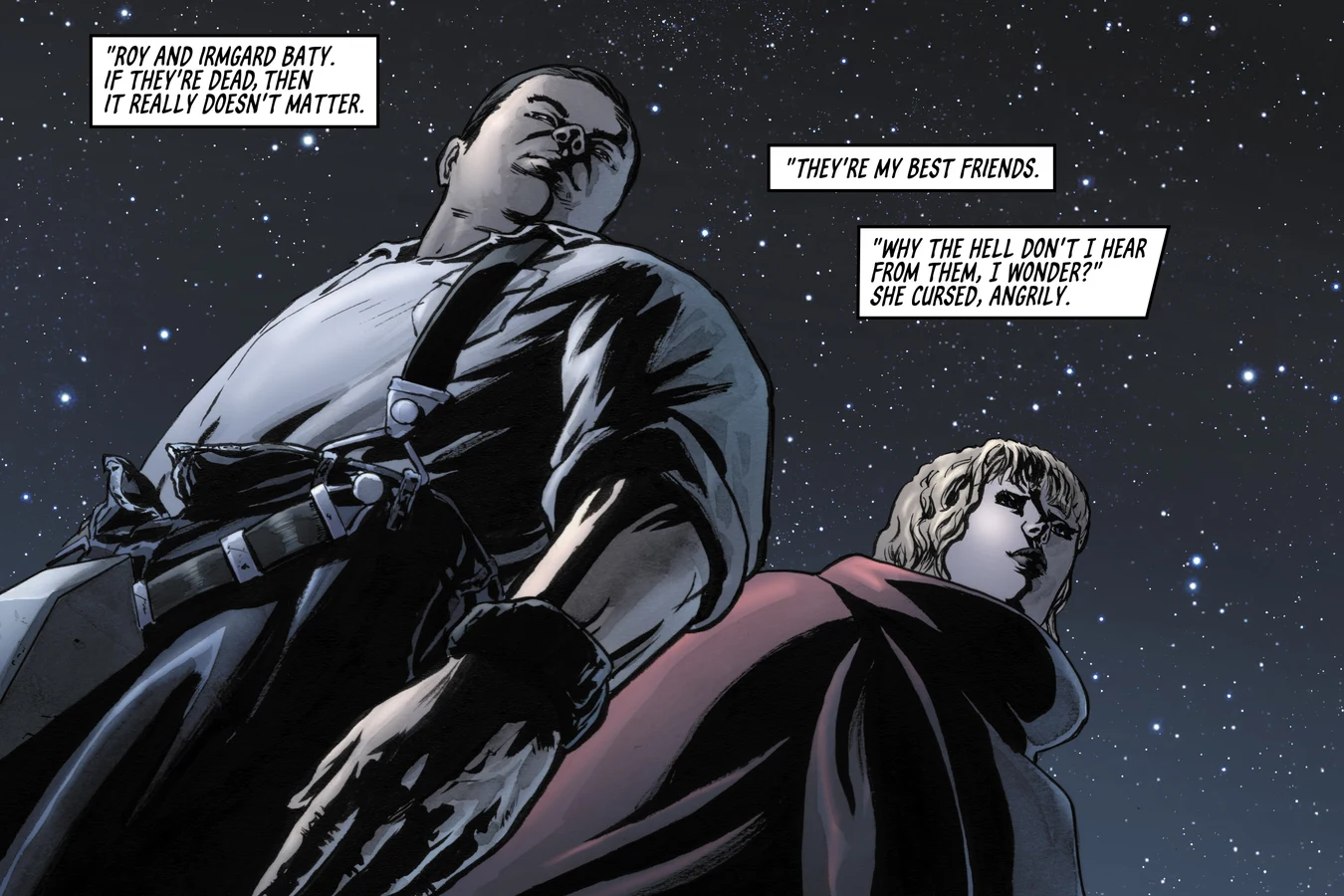
A voice calls from the hall, and Pris has Isidore write a note asking who is there. Then Roy Baty and his wife Irmgard Baty come in. Irmgard is small and lovely in the manner of Greta Garbo, with blue eyes and yellow-blond hair. Roy is larger, with intelligent eyes and flat, Mongolian features, and wears a rumpled shirt and stained trousers. Pris greets them with bliss and tells Isidore they are her best friends. Irmgard trots into the kitchen to try the food and smiles warmly at Isidore.
Roy delivers the news, almost with pleasure, that Polokov, Garland and Luba Luft are dead. Irmgard explains that Luba called Garland's agent to arrest the bounty hunter and take him to the Mission Street building, but something went wrong there. The hunter has their names but not their location, they think. Roy proposes that Pris move in with Isidore while he and Irmgard stay in her apartment, and that he rig an alarm system from junk he took off their ship so all four of them can warn each other.
Flight From Mars
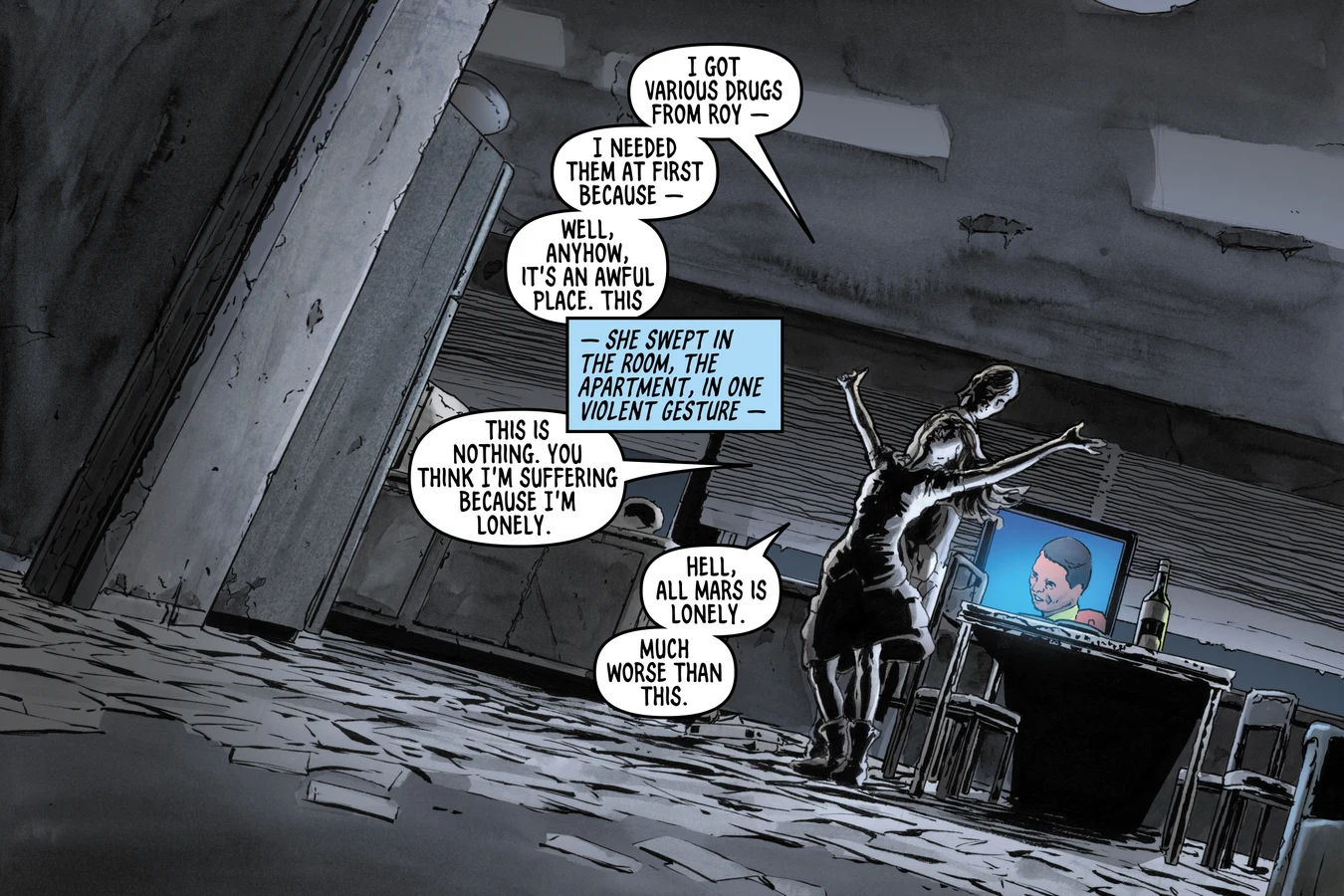
Upstairs in Isidore's apartment, Pris tells him that bounty hunters killed her friends. When Isidore says that the government never kills anyone, for any crime, she answers that it is different if you are not human. She says that every living thing that wriggles or burrows is protected by law, but they are not. Roy interrupts and installs the alarm, with wires under the carpet as antennae. He explains that it produces such panic in any intruder that no human can remain in the vicinity for more than seconds.
Pris says in a brittle voice that what they did on Mars could not be helped. Isidore says he does not care, and Pris points out that he could get a lot of money turning them in. Roy says that if Isidore were an android, he would turn them in at ten the next morning. Isidore tells them they are superior and that he wishes he had an IQ like theirs. Earlier, Pris had told him that Mars was lonely, much worse than Earth, and that nobody should have to live there. She votes to make their stand in the building.
Buying A Goat
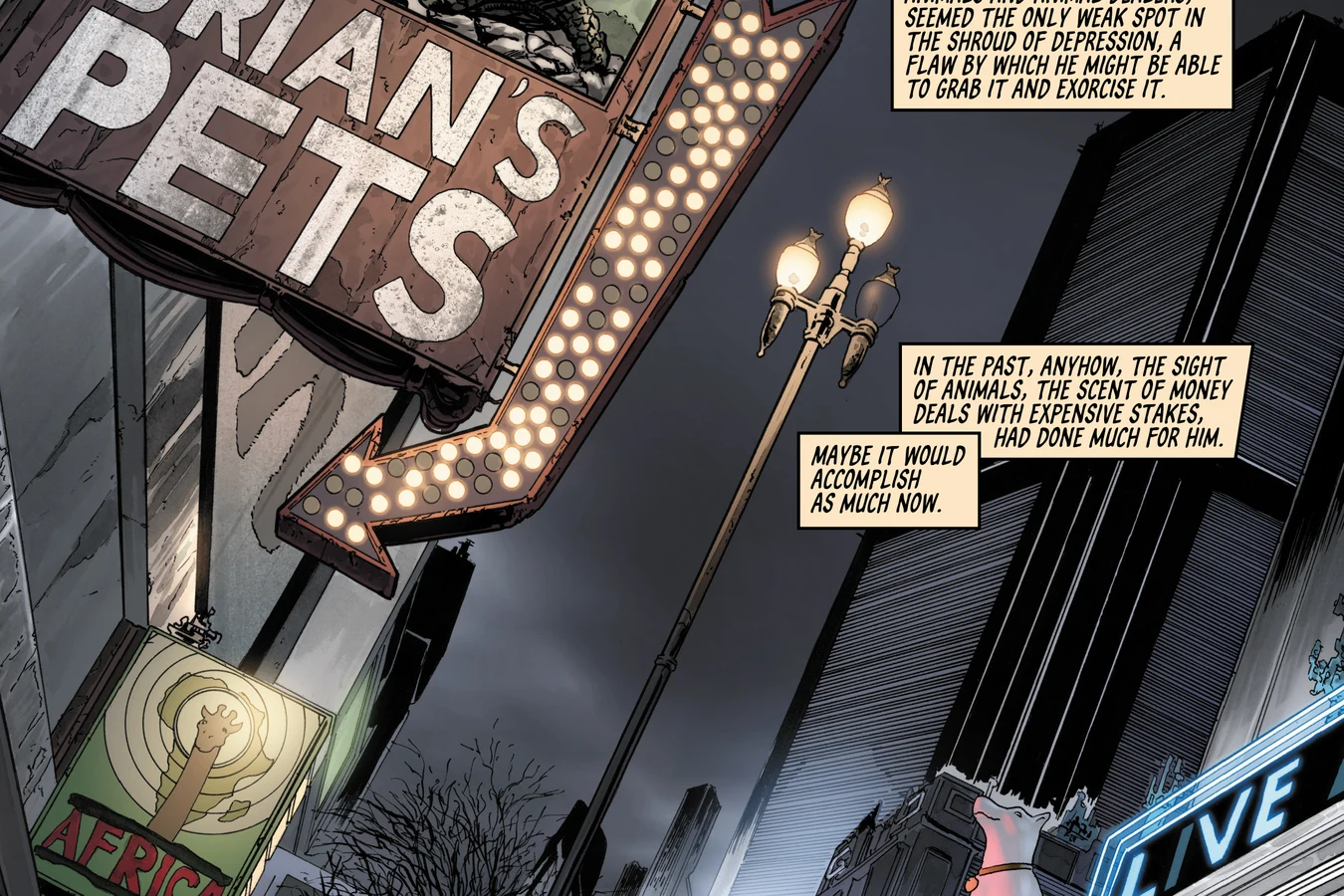
As soon as he quits work that evening, Rick flies to the blocks of big-time animal dealers, hoping to break through his new depression. A salesman asks what he likes, and Rick says it is the cost that bothers him. The department has paid him his bounty, and he has three thousand dollars in cash. He asks about a family of rabbits, but the salesman says a down payment of three thousand could buy something much better. When Rick asks about a goat, the salesman says it represents a new price bracket for him.
The salesman argues that a goat can be taught to butt anyone who tries to steal it, eats almost anything, and as a female offers unbeatable advantages. Rick sees a big black Nubian goat, less than a year old, and finds it beautiful. They haggle over figures on a slip of paper until Rick says it is a deal. He signs a time-payment contract, pays his entire bounty money as the down payment and flies home shaking. Iran is upset that he bought it without her, but when she sees the goat she is overjoyed.
Deckard's Fusion With Mercer
Iran celebrates by fusing with Mercer, and when she comes back she shows Rick the bruise where a rock hit her. Rick tells her that something went wrong that day: he has begun to empathize with androids, and he does not know what that means for his job. Iran asks how much the monthly payments on the goat are, and Rick extends the contract on the spot. Then Bryant calls. The three remaining androids, Roy Baty, Irmgard Baty and Pris Stratton, are alerted, and Bryant wants Rick to get them tonight.
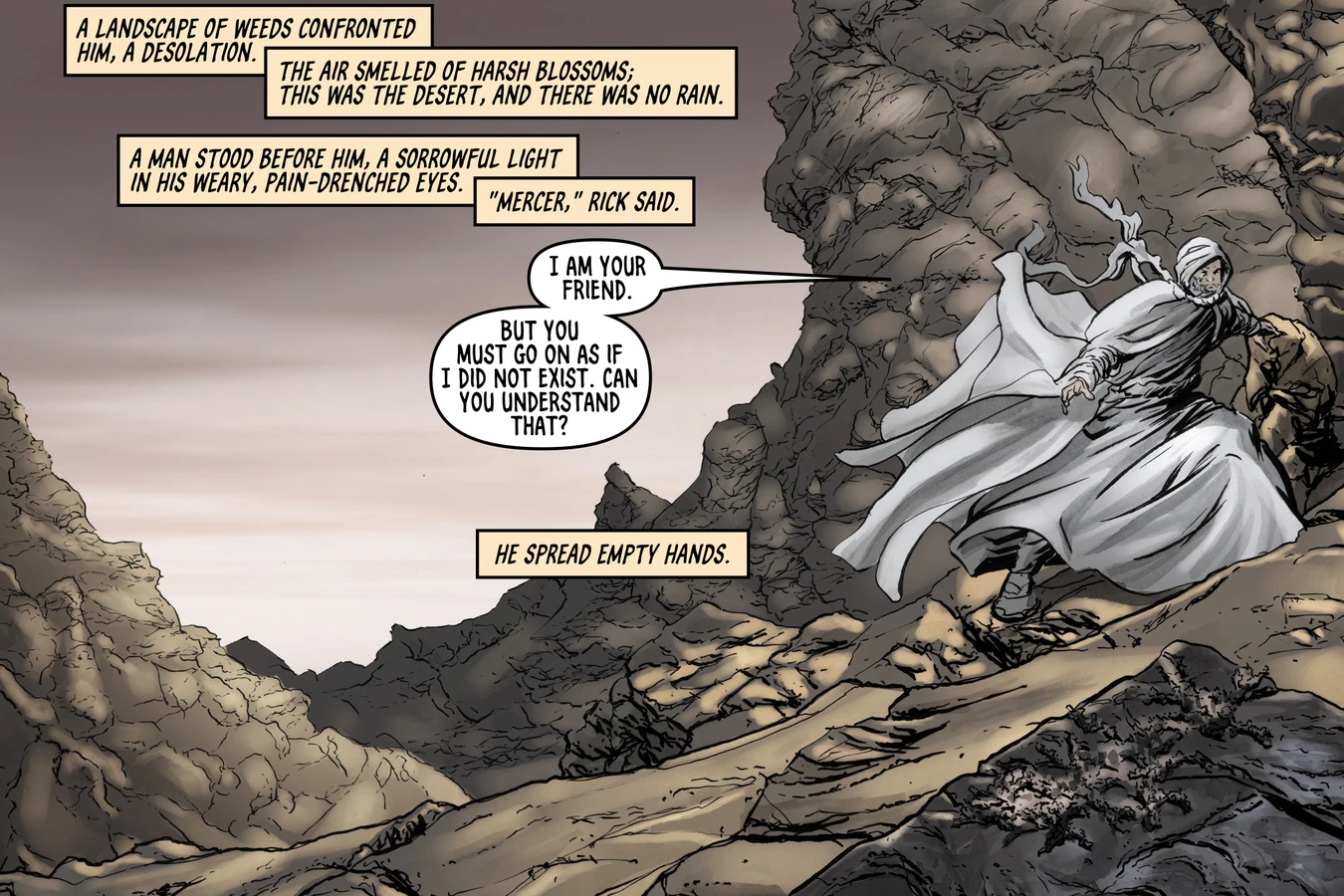
Rick says that if he gets them, he will buy a real sheep. Iran goes back to the empathy box, and Rick gently removes her fingers from the handles and takes her place. In a desert of weeds, Wilbur Mercer tells Rick that he is his friend, but that Rick must go on as if Mercer did not exist. There is no salvation, Mercer says. Rick will be required to do wrong no matter where he goes, and he should do his task even though he knows it is wrong. Then a rock strikes Rick on the ear.
Calling Rachael
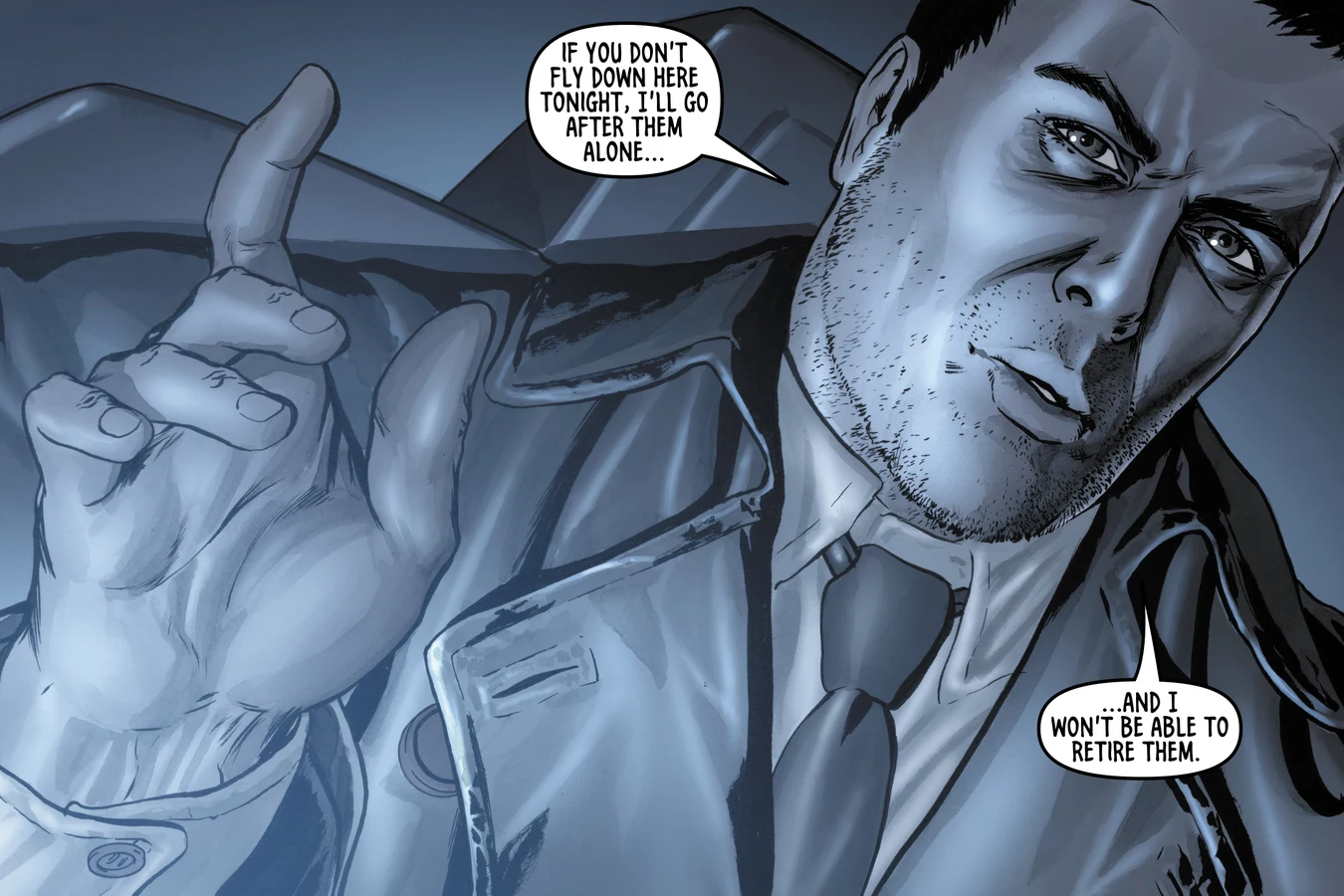
Rick lets go of the handles, his ear bleeding, and Iran thanks him for taking the rock in her place. He leaves for the city and calls Rachael Rosen in Seattle. She says it is too late to fly down tonight and that it will have to be tomorrow. Rick tells her that three androids are left and that if she does not fly down tonight, he will go after them alone and will not be able to retire them. She asks if he is sure he knows what he is doing, trying for six in one day.
Rachael suggests that he does not really want to do the job tonight. Rick tells her that if she comes to San Francisco tonight, he will give up on the remaining androids and they will do something else. She eyes him, then agrees to fly down and asks where to meet. He chooses the St. Francis, the only halfway decent hotel still operating in the Bay Area. Sitting in his car, he thinks that he likes her and could watch her for the rest of his life.
The St. Francis Hotel
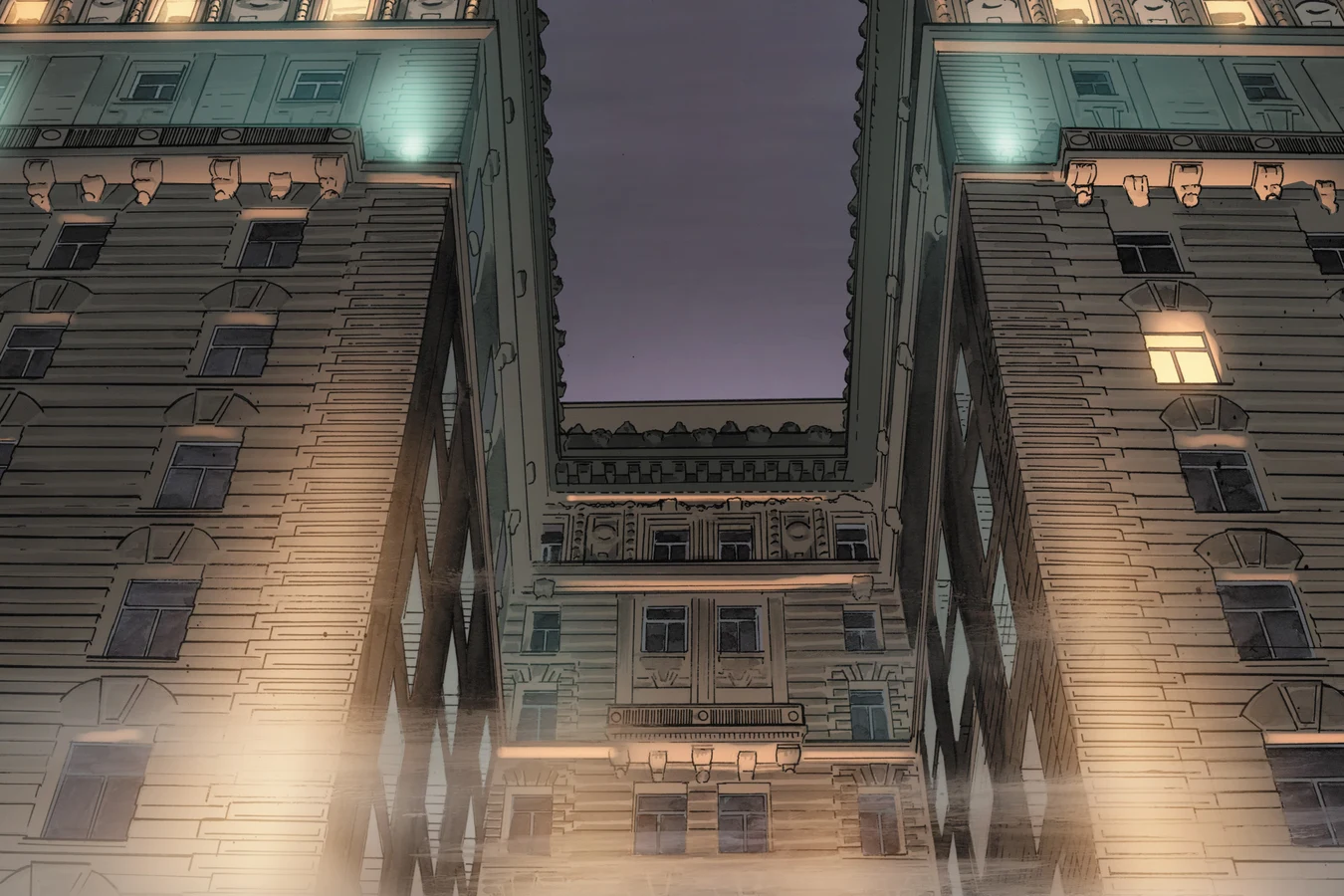
In the hotel room Rick reads the poop sheets on Roy and Irmgard Baty. Roy organized the escape and claimed that android life was sacred. Rachael arrives in a long fish-scale coat, carrying a bottle of bourbon from before the war. She reminds him that he promised to give up on the remaining androids, and when she reads the sheets she says the last one, Pris Stratton, is the same type as she is. Rick will see Rachael's own body when he retires Pris, and she fears that he will retire her by mistake.
Rachael gets drunk and tells him she has a device in her purse that can stop an android's breathing for a few minutes, long enough for him to kill Roy Baty. They go to bed together. Afterward she tells him that she has existed for two years, and he guesses that she has about two more. Later, as they fly toward the Batys, she admits that the Rosen Association sent her to sleep with bounty hunters so they could no longer retire androids. She has done it nine times before. Rick lands to kill her, but cannot, and turns back toward the St. Francis to let her off.
Mercer Exposed
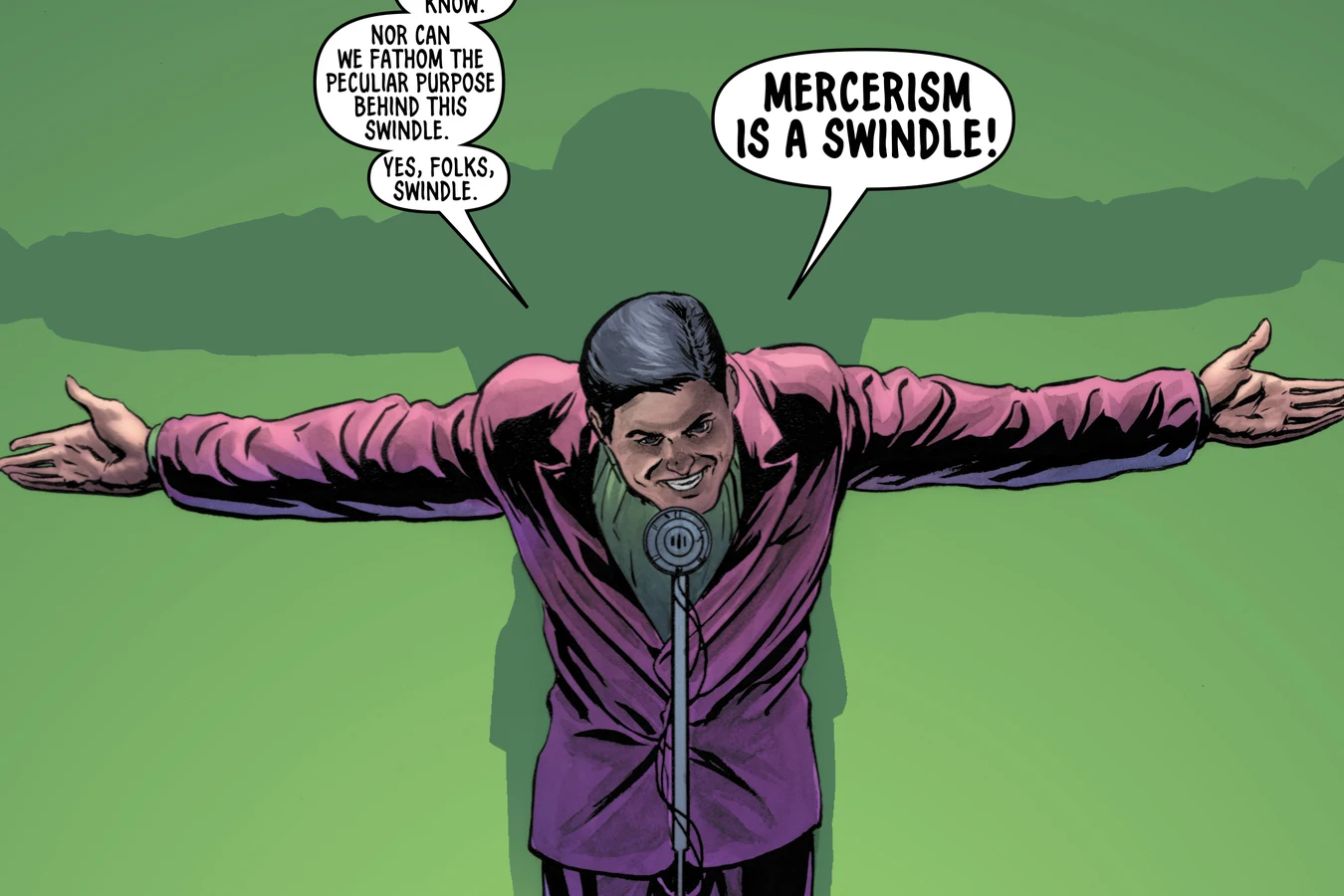
Isidore has carried Pris's television up to his apartment so the androids can watch Buster Friendly's long-promised exposé. Buster's technicians show blowups of the Mercer films proving that the sky and the moon are painted, with brush strokes visible, and that the stones thrown at Mercer may be soft plastic. A team traced the man playing Mercer to an old bit-part actor named Al Jarry in East Harmony, Indiana, who made a series of short films for an employer he never met.
According to Buster, the only suffering Al Jarry ever endured was having to go a whole day without a shot of whisky. Buster declares that Mercerism is a swindle and asks why it exists. Irmgard says the purpose was to prove that humans can do something androids cannot. The androids are delighted, and Roy says it is all over for Mercerism. Shaken, Isidore insists that Mercerism is not finished, and stands silently by the sink while the others talk. He keeps thinking of the spider.
The Spider
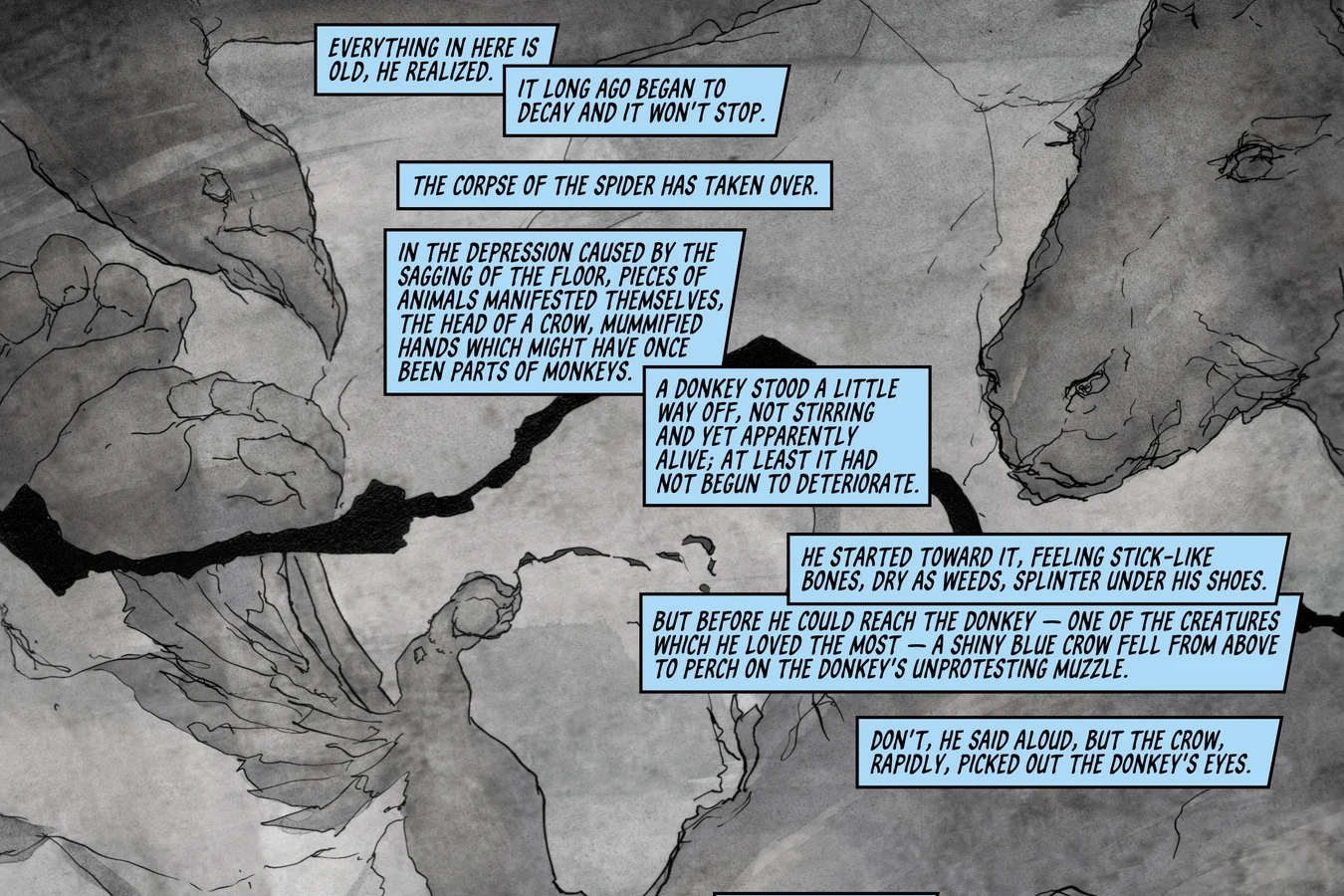
On his way up with Pris's things, Isidore had found a spider in the hall and caught it in a medicine bottle. While Buster talks, Pris borrows Irmgard's cuticle scissors and snips off the spider's legs one at a time to see whether it can walk on four. Roy holds a lit match near it to make it move. Isidore pushes Pris aside, lifts up the mutilated spider and carries it to the sink. Later he lifts its corpse from the sink, and the tomb world begins to rise around him.
Isidore hears the kipple coming, the final disorder of all forms. The cupboards crack and the floor gives way. Everything in the apartment is old and has long been decaying. In the depression caused by the sagging floor, the corpse of a donkey lies in the dust, and a crow drops down and pecks out the donkey's eyes. Isidore calls out to Mercer, saying he is in the tomb world again and wishes he could remember how to climb up from it.
Mercer's Gift
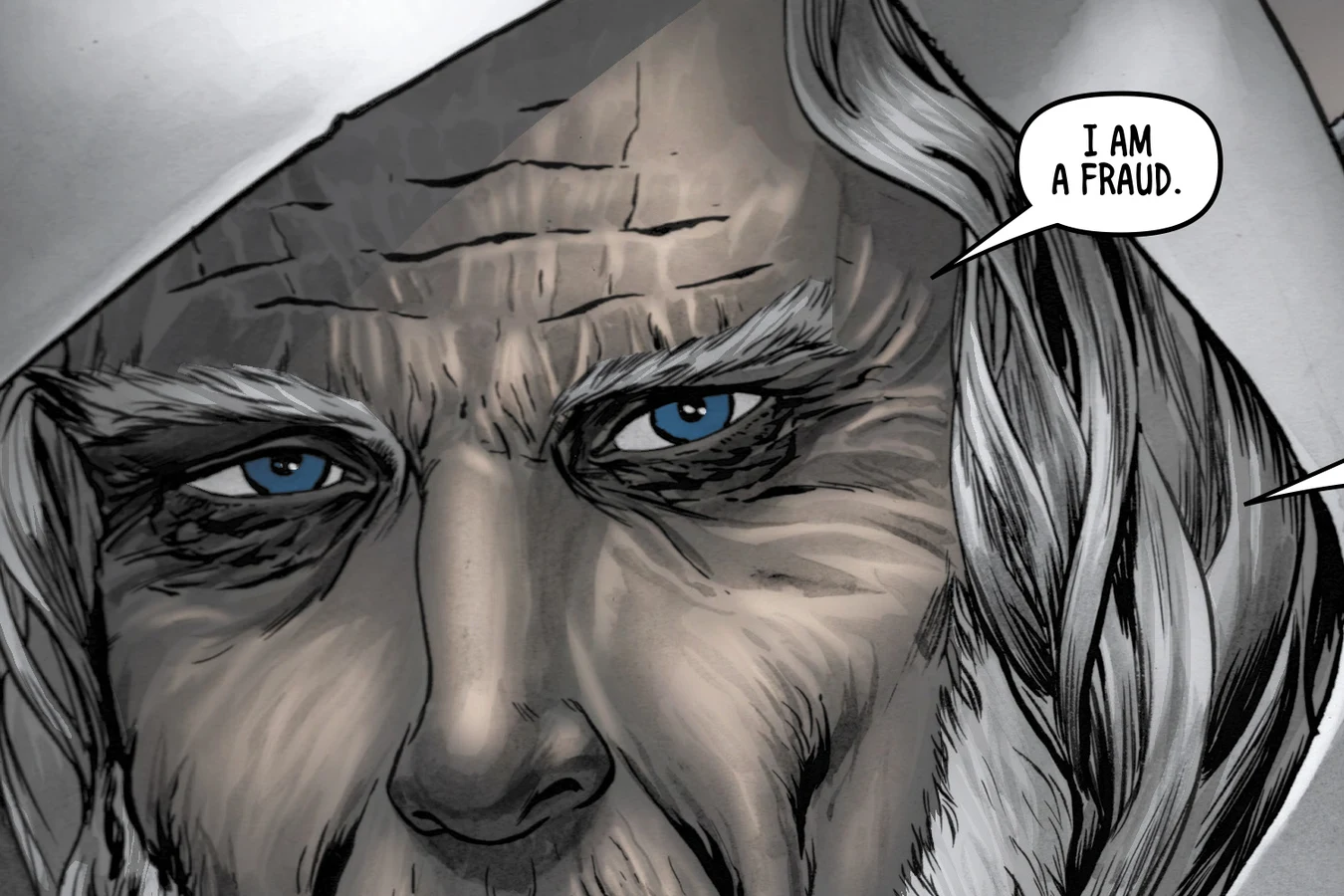
Wilbur Mercer appears, with a placid expression on his face. Isidore asks whether the sky is painted and whether there are really brush strokes. Mercer says yes, and that he is a fraud: the androids are sincere and their research is genuine, and from their standpoint he is an old retired bit player named Al Jarry. He says that everything they disclosed is true, even the whisky, but that nothing has changed. He has just lifted Isidore from the tomb world, and he will keep lifting him.
Mercer hands Isidore the spider, now alive and whole. Isidore finds himself back in his living room, gripping the handles of the empathy box, while Pris tells him a bounty hunter is in the building and the androids beg him to stop the man. Isidore goes outside and sets the spider down in the dead garden. A man with a flashlight tells him he could have sold it for a lot of money, then introduces himself as Rick Deckard of the San Francisco police.
Retiring Pris And The Batys
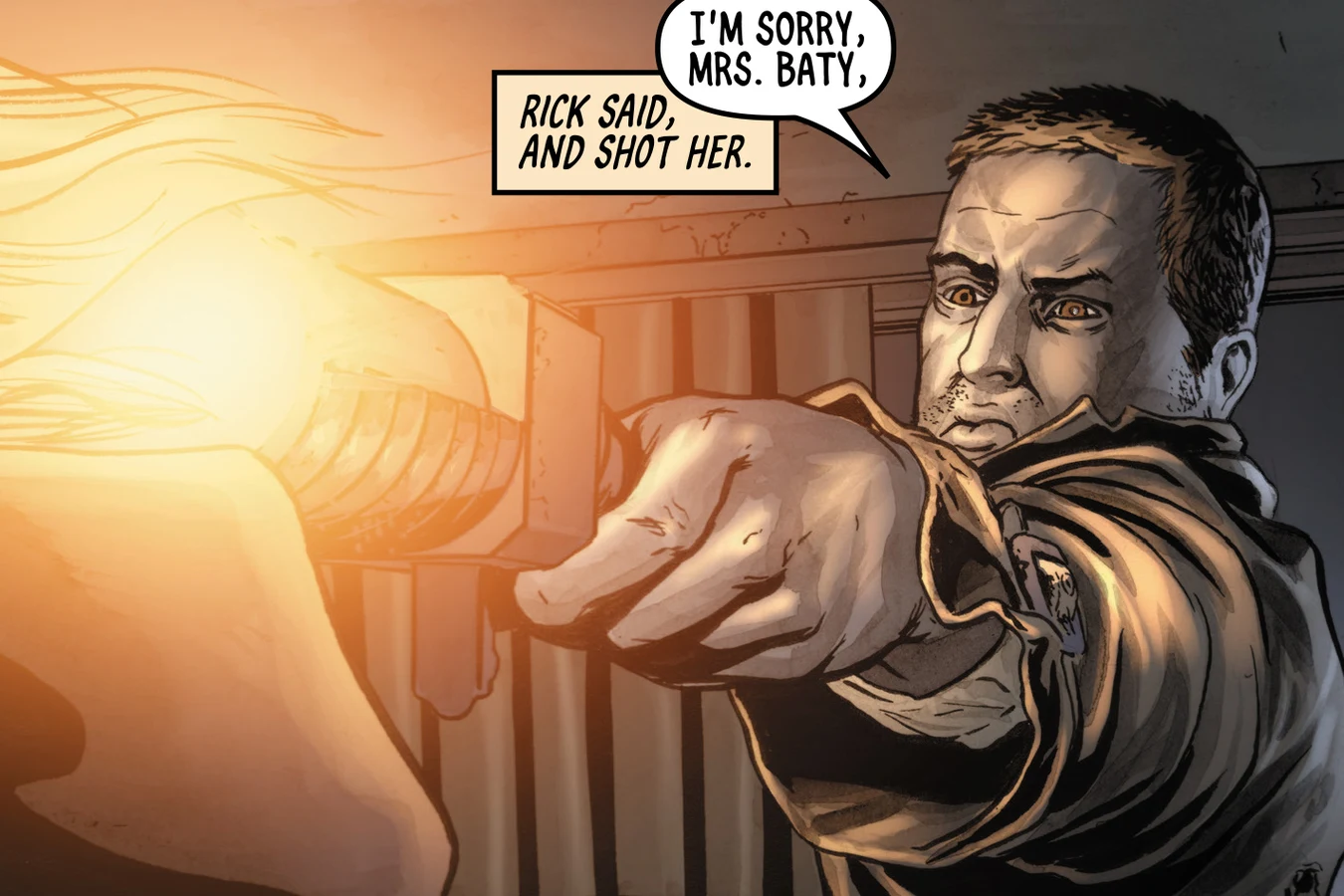
Isidore will not say which apartment the androids are in. Inside, Rick climbs the stairs with his detection gear. Mercer appears and warns him that one of them is behind him, below him on the steps. Rick turns and sees Rachael, then realizes it is not Rachael but Pris Stratton, the same type. He fires, and the android runs at him, then falls. He thinks the manufacturer can follow him with Rachael Rosens until he dies. Then he goes on to the door where the Batys are hiding.
Isidore reaches the door first, and Rick gets inside in the confusion. He lets Roy Baty fire once and twists out of the way. Roy drops his tube and runs deeper into the apartment. Rick fires at Irmgard Baty, saying he is sorry, Mrs. Baty. When Roy cries out, Rick tells him that he loved her, and that Rick loved Rachael, and shoots him. Roy Baty's body smashes into the kitchen table and carries the dishes down with it. Rick tells himself that now it is over and he can go home to Iran.
The Desert Hill
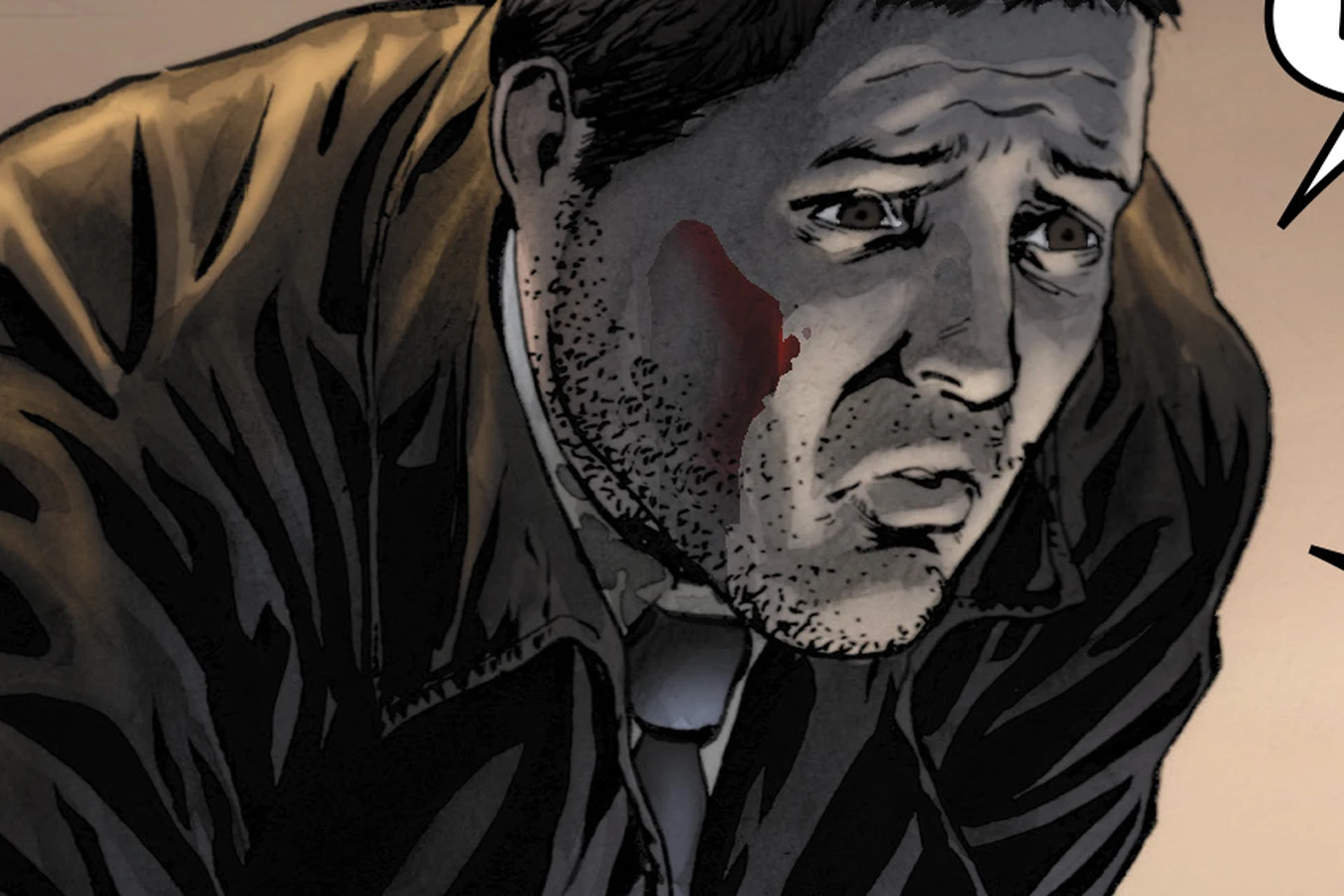
Bryant sends men to pick up the three bodies, and Isidore leaves to find another apartment. When Rick gets home, Iran tells him that a small, very thin girl with dark hair and large black eyes came to the roof and killed the goat by pushing it off. Rick knows it was Rachael. He flies north through the night into the desert near the Oregon border, thinking that he is now the greatest bounty hunter who ever lived. He lands on a barren hillside and tries to phone Dave Holden at Mount Zion Hospital.
The doctors will not let Holden take any calls. Rick climbs the slope, hungry, alone and feeling defeated in some obscure way. Then the first rock strikes him, not rubber or soft foam plastic, and he feels absolute isolation and suffering in its actual form. He resumes his climb as stones roll upward. When he calls out to Mercer, the shadowy figure in front of him is his own shadow. He scrambles back down to his car, asking himself who threw the stone.
Finding The Toad
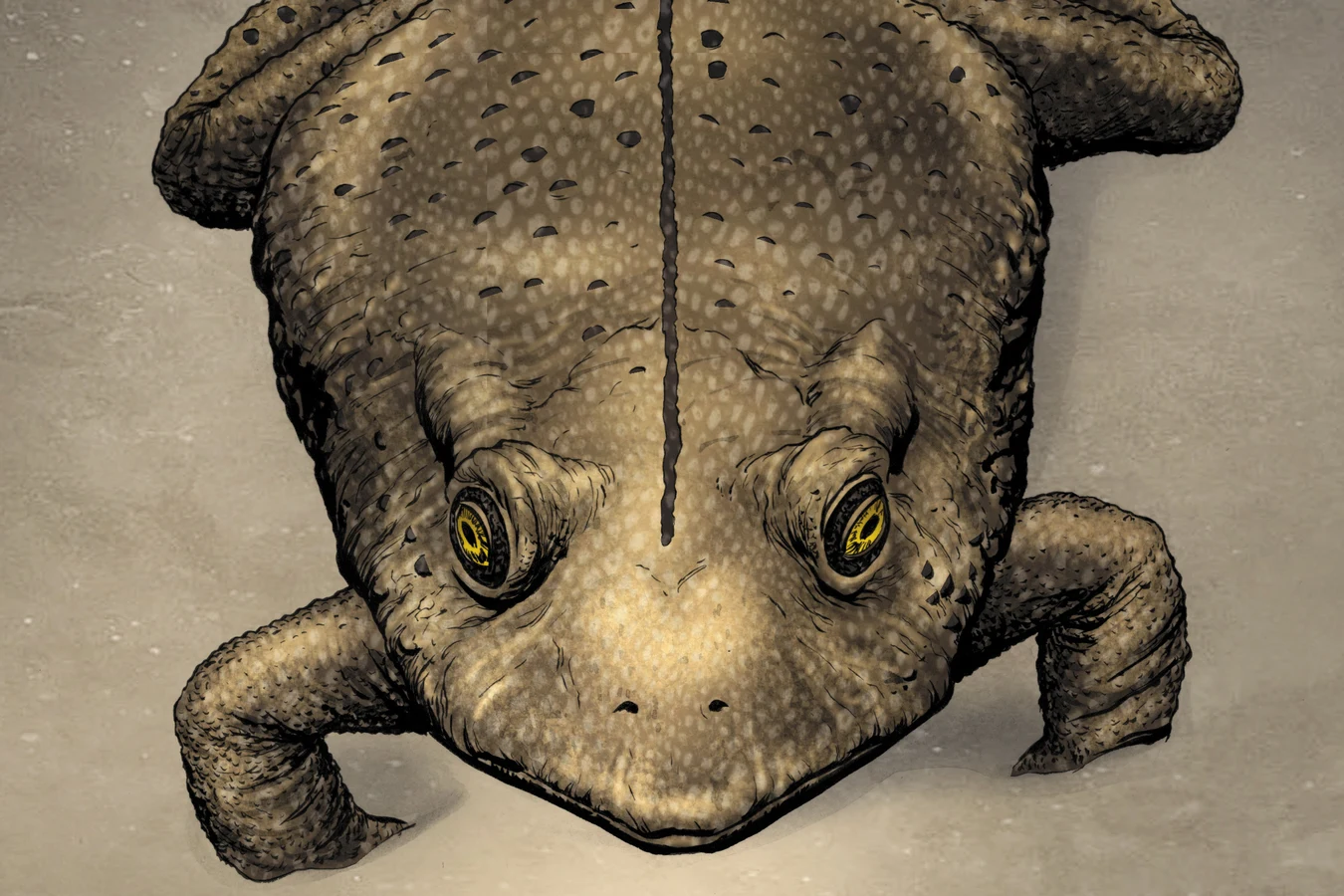
Rick calls Bryant's office. Miss Marsten tells him that Bryant is putting his name forward to Chief Cutter for a citation for retiring the six androids, and that his wife is worried and wants him to call her. She says he looks awful. Rick says that he has become Wilbur Mercer permanently and cannot get out. Then he notices something move outside the car. He recognizes it from old nature films: a toad, the creature most sacred to Mercer, listed in his Sidney's catalogue as extinct.
Rick empties a cardboard box from the trunk and finds some twine. He brushes away the dust around the toad, which seems to be in a trance, and lifts it out. It feels cool and dry, and then it squirms. He ties the box shut and places it on the seat beside him, feeling like a kid again. He decides to keep it as a surprise for Iran and flies the seven hundred miles back to San Francisco. When Iran opens the door, he stands there covered with dust, holding the box, with round-eyed wonder on his face.
The Electric Toad
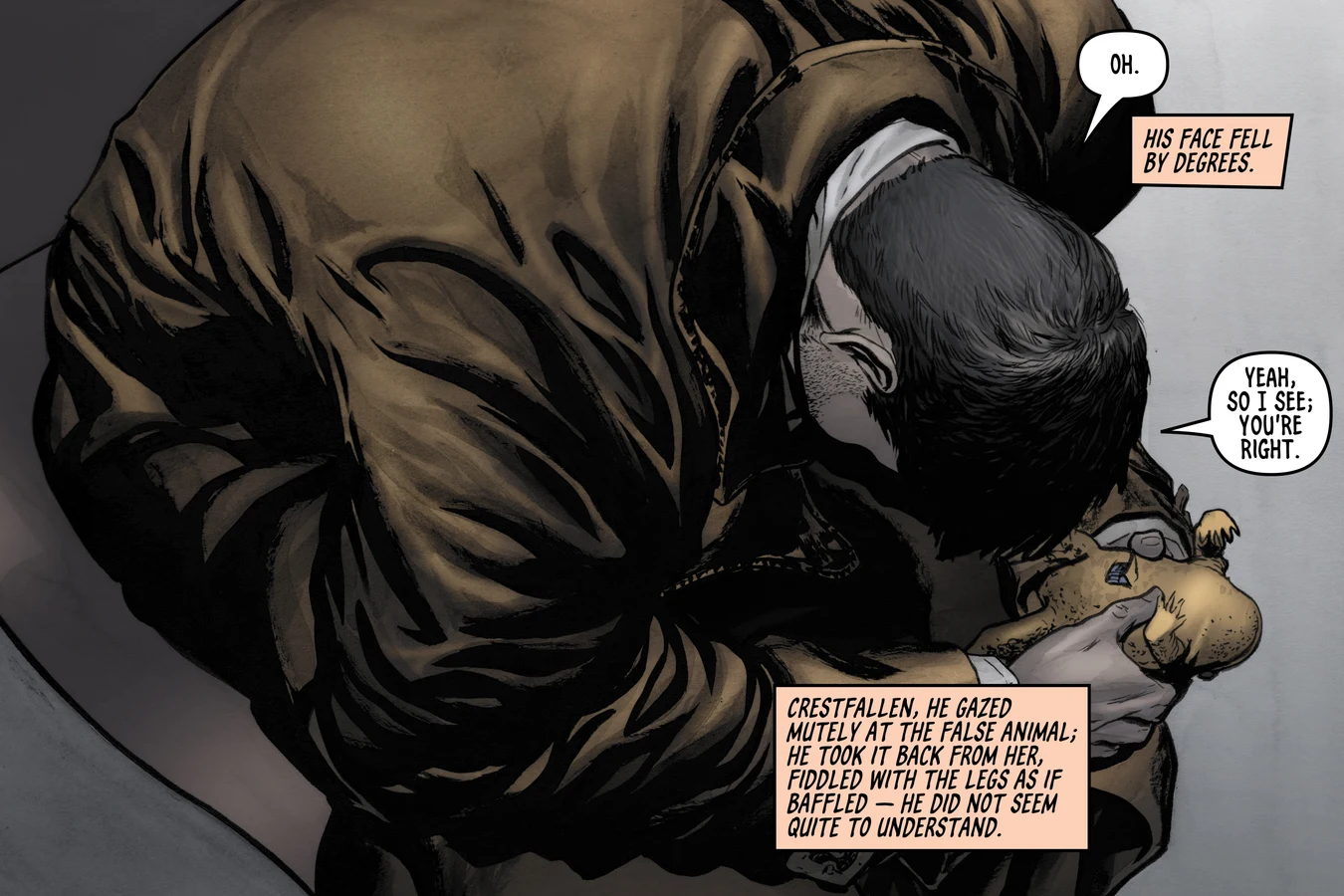
Iran presses the coffee button for him, and he tells her he found the toad near the Oregon border. While holding it upside down, she pokes at its abdomen, finds a tiny control panel with her nail and flips it open. Crestfallen, Rick gazes at it. Iran feels guilty and offers him the mood organ, but he says he would rather know. He tells her the spider Mercer gave Isidore was probably artificial too, and that it does not matter, because the electric things have their lives too, paltry as those lives are.
Rick goes to the bedroom and falls asleep with dust sifting onto the sheets, and Iran sees there is no need for the mood organ. In the kitchen, the electric toad flops and rustles in its box. She looks in the yellow pages under animal accessories, electric, and orders one pound of artificial flies that really buzz. The saleswoman suggests a terrarium kit and a periodic tongue adjustment. Iran says she wants it to work perfectly, because her husband is devoted to it.
Key Characters
- Rick Deckard is a bounty hunter for the San Francisco police who takes over Dave Holden's list of six Nexus-6 androids and retires all of them in one day, while longing to replace his electric sheep with a living animal.
- Iran Deckard is Rick's wife, who dials depression on the Penfield mood organ, welcomes the goat and ends the story ordering artificial flies for the electric toad.
- J.R. Isidore is a special classed as a chickenhead, who drives for the Van Ness Pet Hospital and shelters the last three androids in his empty building.
- Rachael Rosen is a Nexus-6 android presented as Eldon Rosen's niece, who tries to trap Rick in Seattle, sleeps with him before the final hunt and later throws his goat off the roof.
- Pris Stratton is a Nexus-6 android of the same type as Rachael who moves into Isidore's building and cuts the legs off a spider.
- Roy and Irmgard Baty are the married androids who lead the escapees from Mars and hide in Isidore's apartment until Rick retires them.
- Wilbur Mercer is the climbing old man of the empathy box, exposed by Buster Friendly as the bit actor Al Jarry, who still appears to Isidore and Rick.
- Buster Friendly is the television host who mocks the empathy boxes and finally declares that Mercerism is a swindle.
- Harry Bryant is the police inspector who hands Rick the assignment after Dave Holden is lasered by Max Polokov.
- Eldon Rosen is head of the Rosen Association, which builds the Nexus-6 brain unit and offers Rick the owl as a bribe.
- Max Polokov is the android who lasers Holden and then poses as the Soviet policeman Sandor Kadalyi.
- Luba Luft is an android opera singer rehearsing The Magic Flute, killed by Phil Resch in a museum elevator.
- Inspector Garland is the android who runs a hidden police station on Mission Street.
- Phil Resch is the Mission Street bounty hunter who kills Garland and Luba Luft and passes the Voigt-Kampff test as human.
- Hannibal Sloat and Milt Borogrove are Isidore's boss and coworker at the pet hospital, who discover that the cat he brought in was real.
- Bill Barbour is Rick's neighbor, who refuses to sell the foal of his pregnant Percheron mare.
Behind The Scenes
The series ran for 24 monthly issues, with the first on sale in July 2009 under editor Ian Brill and the last in June 2011 under Bryce Carlson, who took over the editing during the run. BOOM! published it together with Electric Shepherd Productions, the company of the Philip K. Dick estate. The six collected volumes each gathered four issues, and the later omnibus divides the story into six parts that follow those volumes. The omnibus credits Philip K. Dick as writer, Tony Parker as illustrator, Blond as colorist and Richard Starkings of Comicraft as letterer, with a cover design by Jay Shaw.
The approach was unusual for a comic adaptation. Instead of a script that condensed the novel, BOOM! kept every word of Dick's text and placed it around Parker's art as narration and dialogue, so the comic reads as the whole book. In the interview printed with the final issue, Isa Dick Hackett, one of Dick's daughters, told Bryce Carlson that the result had exceeded her expectations. She described it as a gamble, because nothing had used the entire text in this way before, and she gave much of the credit to Richard Starkings, whose lettering made the long passages readable on the page.
Hackett also praised Parker's art, the essays and the early covers by Bill Sienkiewicz. She said she liked seeing Isidore's emotions and Mercerism drawn, since both were left out of Blade Runner. She recalled that her father wrote the novel in suburban Marin County while her mother was pregnant with her, and spoke about his love of animals. She noted that Blade Runner had failed at the box office before the director's cut sold out at the Castro Theater, and said that she and her sister Laura had discussed a comic for years before they connected with BOOM!.
Each issue carried an essay by a writer influenced by Dick, and the omnibus reprints them in a section called On Philip K. Dick. Warren Ellis wrote an introduction to the first issue that opens with the death of Dick's twin sister Jane in 1929 and calls him the great pulp visionary. Matt Fraction wrote an open letter to Dick about Blade Runner and growing up with science fiction films. Ed Brubaker recalled seeing Blade Runner at twelve or thirteen and buying the Marvel adaptation of the film before he turned to Dick's books.
Other contributors included Rockne S. O'Bannon, Graeme McMillan and Gregg Rickman, whose essay is the address he gave at a 2007 memorial in Berkeley on the 25th anniversary of Dick's death, first published in the series. Rickman calls Dick our Dostoyevsky. Dick's friends James Blaylock and Tim Powers wrote about visiting him in Fullerton in the 1970s. Blaylock remembered their first meeting in 1975 and long talks about conspiracies, and Powers described an evening in March 1977 when Dick said he had figured out the universe and read him two versions of a limerick.
Tony Parker and Blond wrote a joint commentary about Polokov's empty apartment in Part Two. Parker explained that he broke the panel border to create a pause before showing the empty room, and he drew Polokov as a packrat surrounded by kipple. He described the book as dark, gritty and noir, and pure fun to draw. Blond said he chose a cool palette for the apartment to contrast with the warm, opulent location before it, and used darkness to stress danger and loneliness. Their essay is one of the few pieces in the series that talks about how the art was made.
Richard Starkings wrote that he was relieved when Ridley Scott told OMNI that the novel was too difficult to read, because he had felt the same as a teenager. He described seeing Blade Runner in the rain in Leeds and pointed out that Mercerism, with its stress on empathy, is missing from the film. Gabriel McKee noted that Dick wrote the novel in 1966, the same year as Ubik, and that J.R. Isidore reworks Jack Isidore from Dick's Confessions of a Crap Artist. Chris Roberson, Daryl Gregory, Jack Skillingstead, Ted Kosmatka and Keith R.A. DeCandido also contributed essays.
BOOM! marketing director Chip Mosher wrote that he saw Blade Runner at nine in 1982 and joined the publisher in 2007. He sat in on the meetings with Electric Shepherd Productions and told publisher Ross Richie that he had to be part of them, and he remembered Laura and Isa coming to the office, which he called very Philip K. Dickian. David Mack wrote about his own Dick adaptation, The Electric Ant at Marvel, drawn by Pascal Alixe. Jonathan Lethem contributed Crazy Friend, a memoir of reading Dick in Brooklyn, and the series closes with Hackett's interview. The series was nominated for an Eisner Award for Best New Series.
Conclusion
Do Androids Dream of Electric Sheep? from BOOM! Studios is the complete novel set in comic form, with Tony Parker's San Francisco built around every line Philip K. Dick wrote. It follows Rick Deckard through one long day of hunting six Nexus-6 androids and J.R. Isidore through his friendship with three of them, and it ends with Rick home from the desert, asleep, while Iran orders artificial flies for an electric toad. It includes Mercerism, the goat, Buster Friendly and the Mission Street police station, none of which appear in Blade Runner, together with essays from writers Dick influenced and an interview with his daughter.
External Sources
- Do Androids Dream of Electric Sheep? on the Grand Comics Database
- Do Androids Dream of Electric Sheep? on ComicVine
Tag Categories: Blade Runner Lore | Blade Runner Comics