
The Spinner is the flying police car of Blade Runner, a land and air vehicle that could lift off the street and cruise above Los Angeles. In Ridley Scott's Blade Runner, Gaff arrived in one to collect Rick Deckard from a noodle bar and later flew him to a case. The same kind of car carried Deckard once he was put back on the job. Denis Villeneuve's Blade Runner 2049 kept the Spinner in service with the Los Angeles Police Department, now as a heavier Peugeot-badged machine assigned to K.
Design And Capabilities
The Spinner was built to work as a car on the street and as an aircraft once it left the ground. Syd Mead rejected helicopter blades and folding wings, and treated the machine as an aerodyne, a heavier-than-air craft with an enclosed lifting system, like the Harrier jump-jet. Hydraulic sections let the front wheels fold up for flight, and the underside carried jets that could lift the hull straight off the pavement. In the air it still read as a car, which was the point of the "Chevrolet scale" body Mead drew for Ridley Scott. Hampton Fancher coined the word Spinner for that land and air police vehicle.
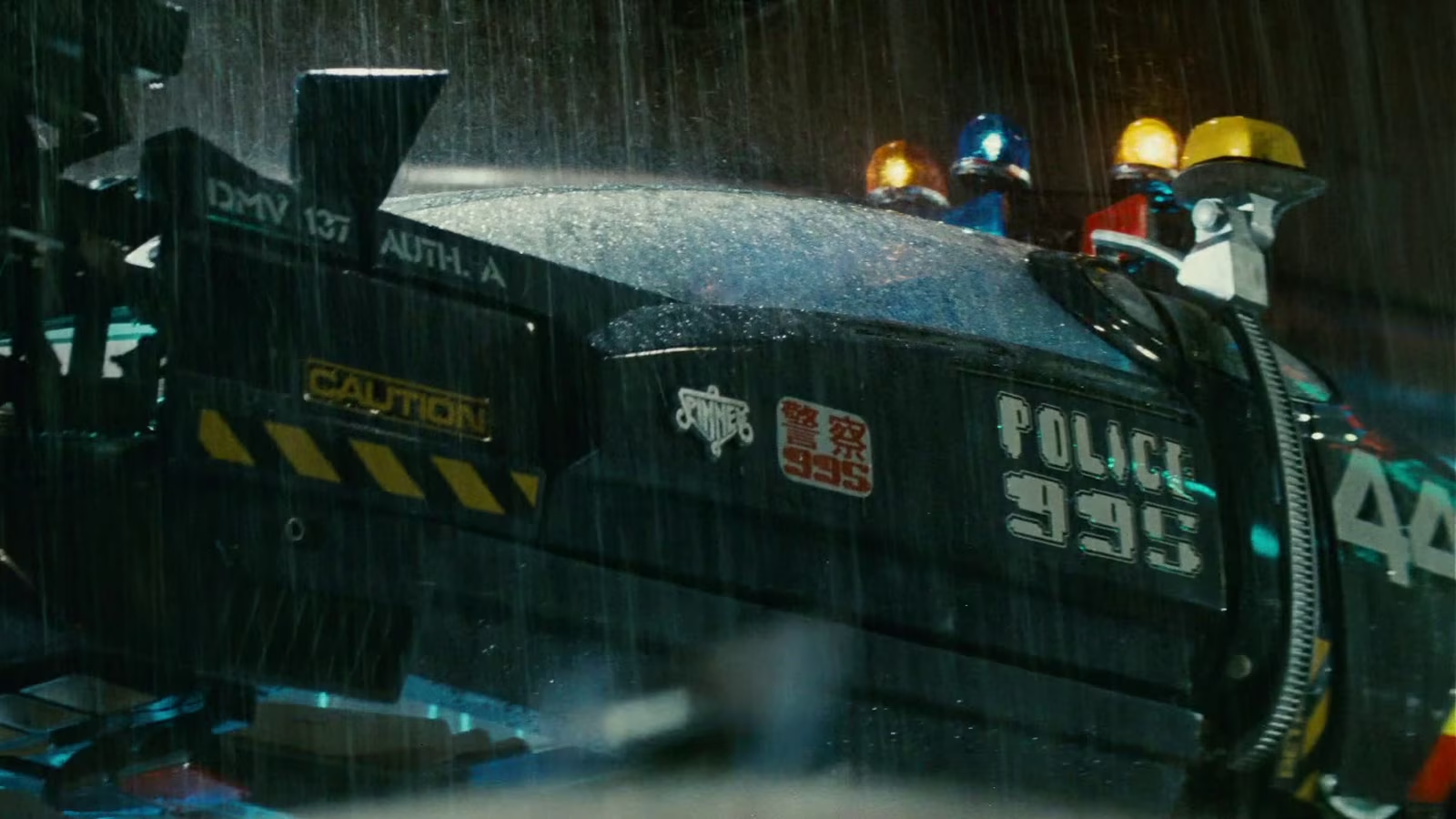
The 1982 police hull carried a roof light bar with amber, blue, and red beacons, and close views of the marked car show the side codes DMV 137 AUTH. A and POLICE 995, a CAUTION panel, and the number 44 toward the rear. Philip K. Dick's Do Androids Dream of Electric Sheep? does not use the word Spinner at all. Its bounty hunters fly a hovercar that fills the same role, and the 1982 film replaced that novel craft with the land and air police car designed for the screen.
Inside The Spinner
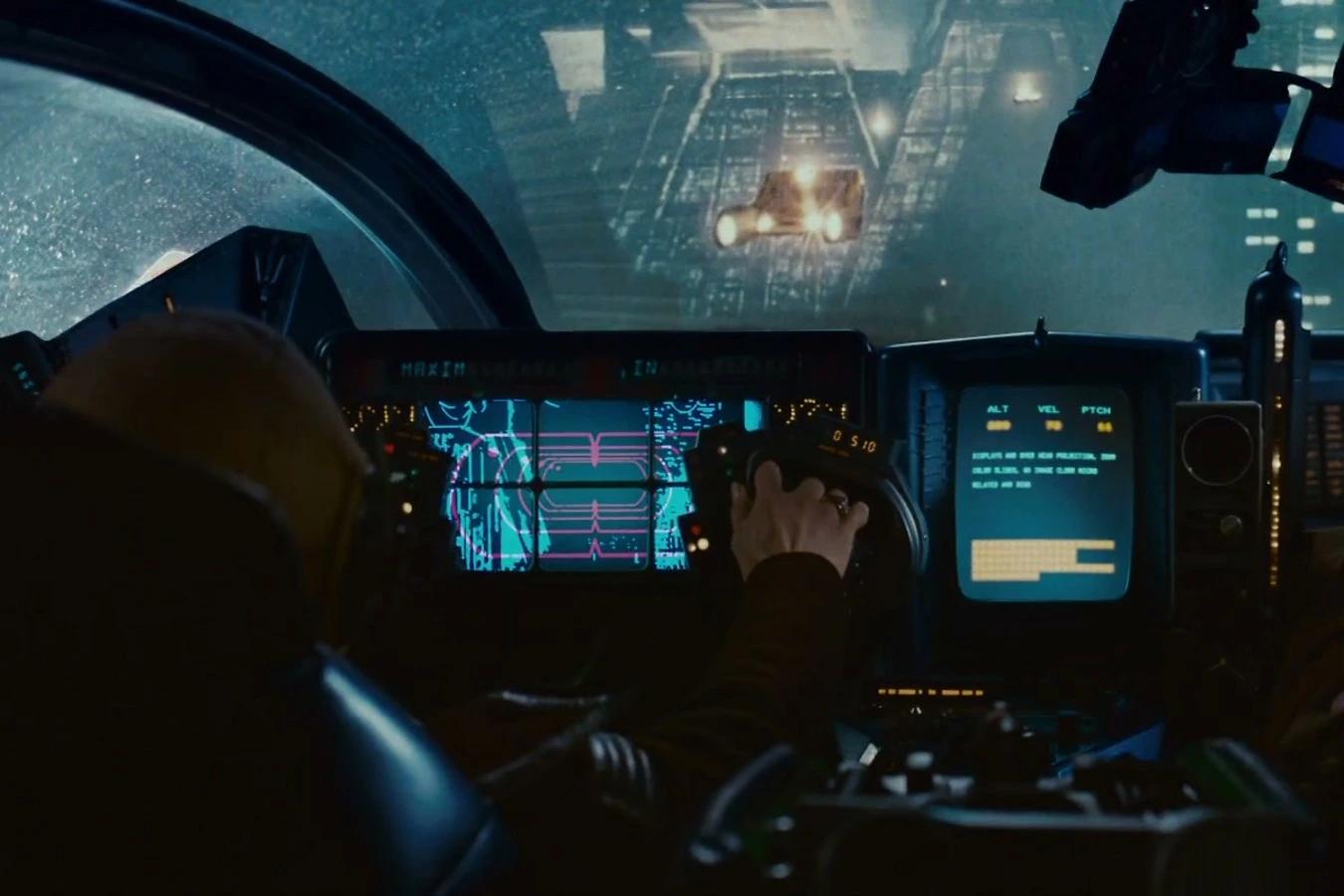
Gaff flew the Spinner from the street outside the noodle bar with Deckard in the passenger seat, and the film holds on the cabin during the climb to police headquarters. The instrument panel carried a bank of screens and readouts, among them an altitude and velocity monitor, and just before takeoff a display that read PURGE. Rain streaked the canopy, and other Spinners moved through the night city ahead of them. Syd Mead gave that cockpit unique interior instrumentation, including collapsible headrests with self-contained speakers, which can be seen behind Deckard's head on the later flight toward the Tyrell pyramid.
In Blade Runner 2049, K's heavier Peugeot-badged Spinner kept a screen-forward cockpit. Those displays held scan charts, a vehicle register, and target files, and they also received imagery from the roof unit when one was deployed. Paul M. Sammon's Future Noir records that the PURGE graphic in the 1982 car had first been made for a screen in Alien, and that Ridley Scott liked the look enough to reuse the original negative in Gaff's Spinner. The monitor images in the full-scale cockpit were later matted in, because the cabin was too cramped to pipe video during the shoot.
The LAPD Fleet
Street Pickups
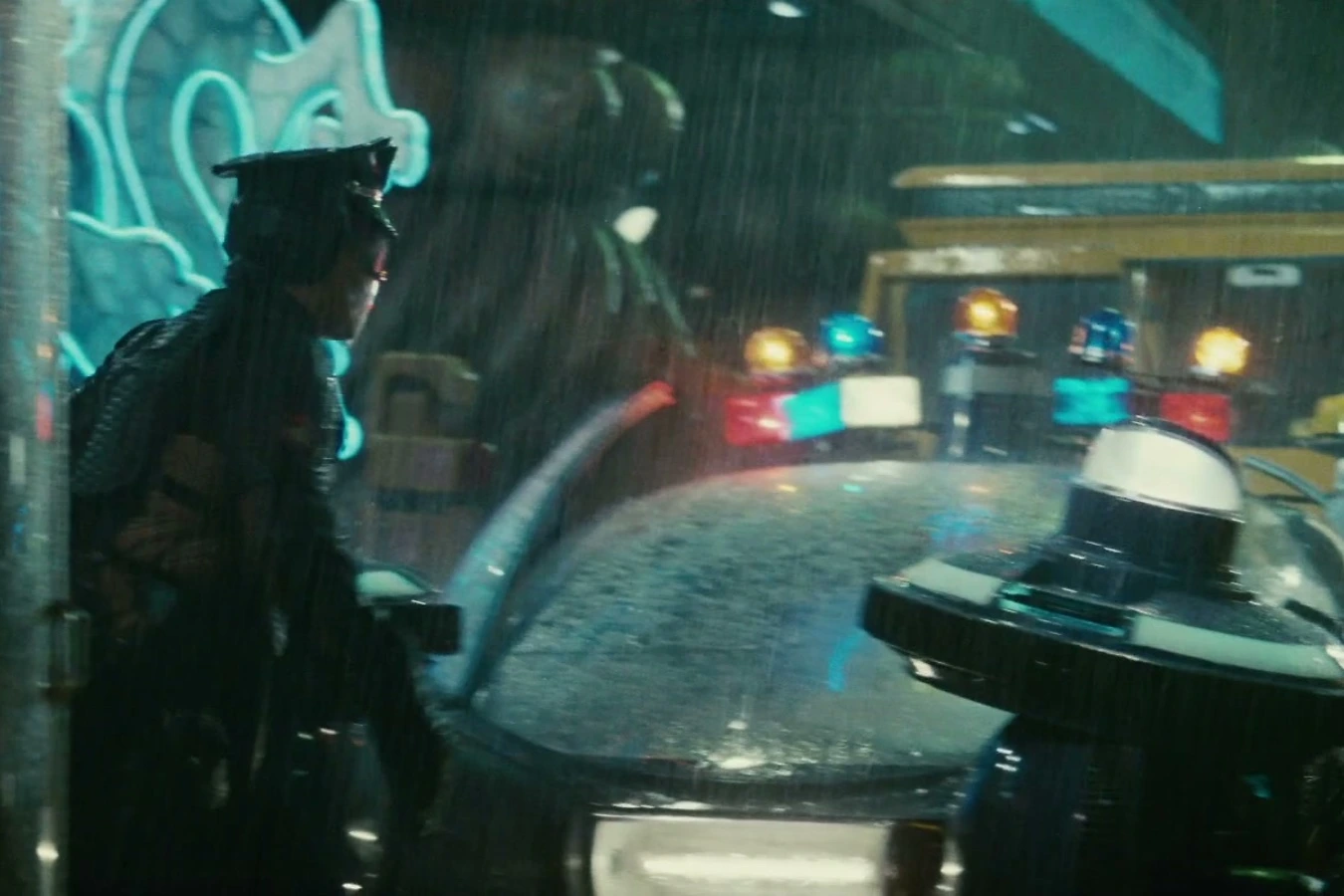
The Los Angeles police used Spinners as ordinary street cars when they had to reach someone on the pavement. Gaff brought one down near a noodle bar to collect Deckard after an arrest, and the full-size police car stood in the rain among the neon signs, with a uniformed officer at its nose, before it left the street. In 2019 the same land and air shape served on the street or in the sky. The department could put a marked Spinner beside a curb, take a passenger on board, and go, without needing a separate aircraft for the next part of the trip.
Lift-Off From The Street
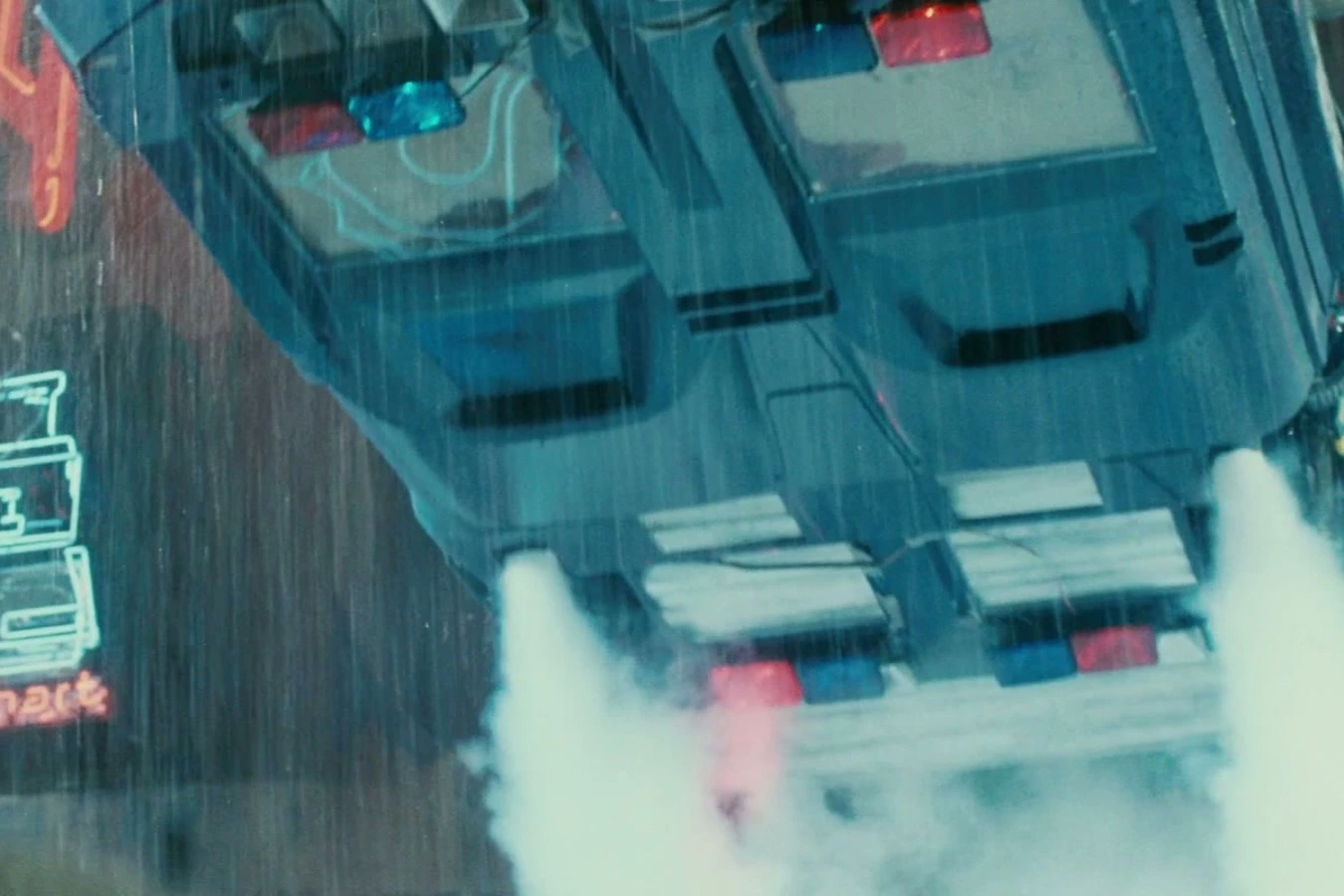
Once the car was clear of the curb, it could rise on its jets and leave the pavement for the air. The 1982 film holds on the underside of a police Spinner as it climbs from a rainy street, with white exhaust pouring from the vents and the wall of the block still close beside it. Those vents and the folding underbody belonged to the same machine that had stood on the street a moment before. Vertical lift let the LAPD leave a crowded, rain-soaked street without a runway. Deckard was already in the passenger seat for one such climb, with Gaff at the controls of the marked Spinner.
Landing At Police Headquarters
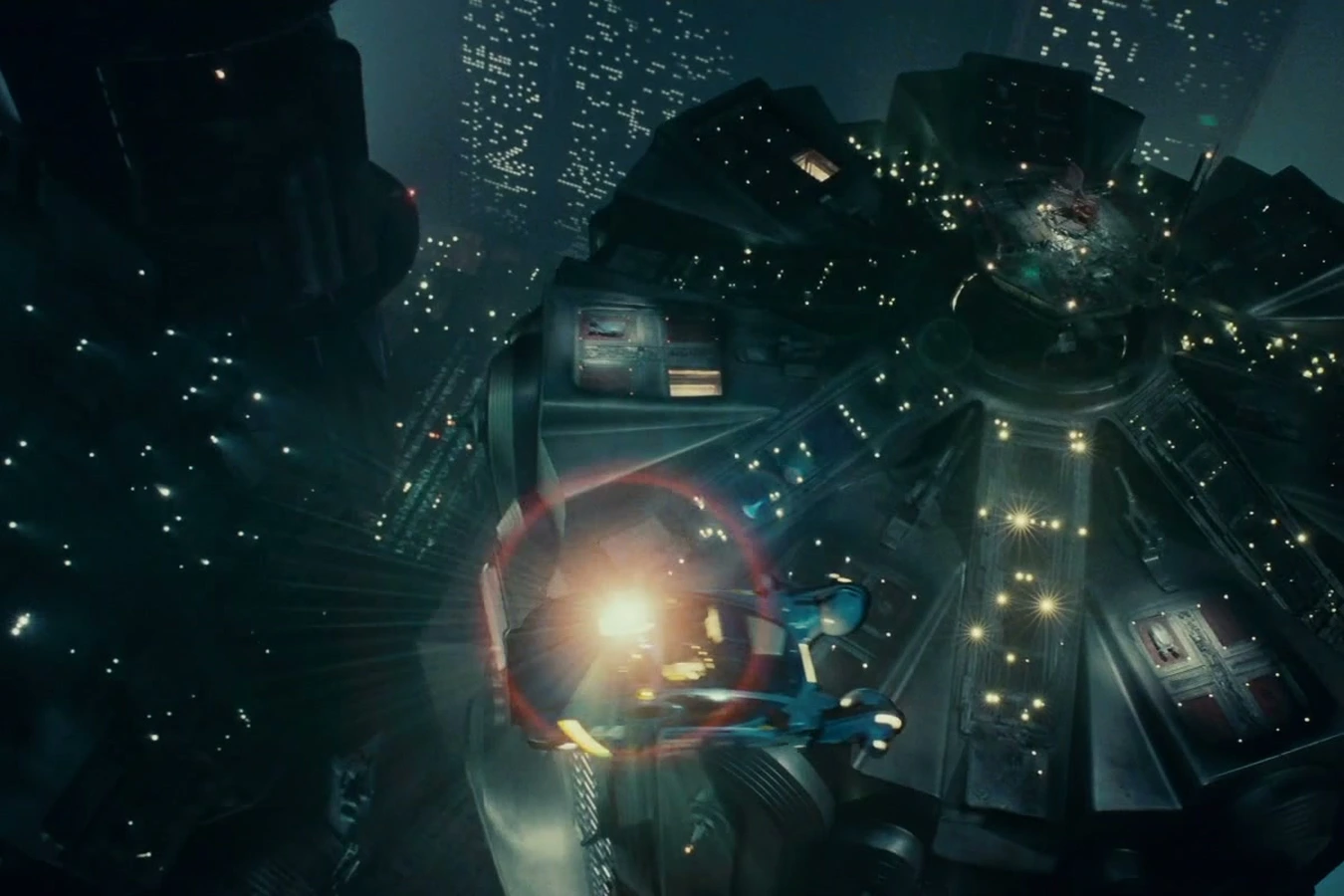
Police headquarters was reached from the air as often as from the street. A Spinner could climb over the night city and approach the circular precinct from above, then land on the roof. The 1982 film follows that descent past the stacked rings of the building and onto the pad where officers go in. Rain streaked the glass on the way, and the same kind of car could take officers out again after a briefing. The roof pad made the Spinner a door-to-door police vehicle, from a street corner to the station in 2019 without mixing into the traffic below.
Over The Night City
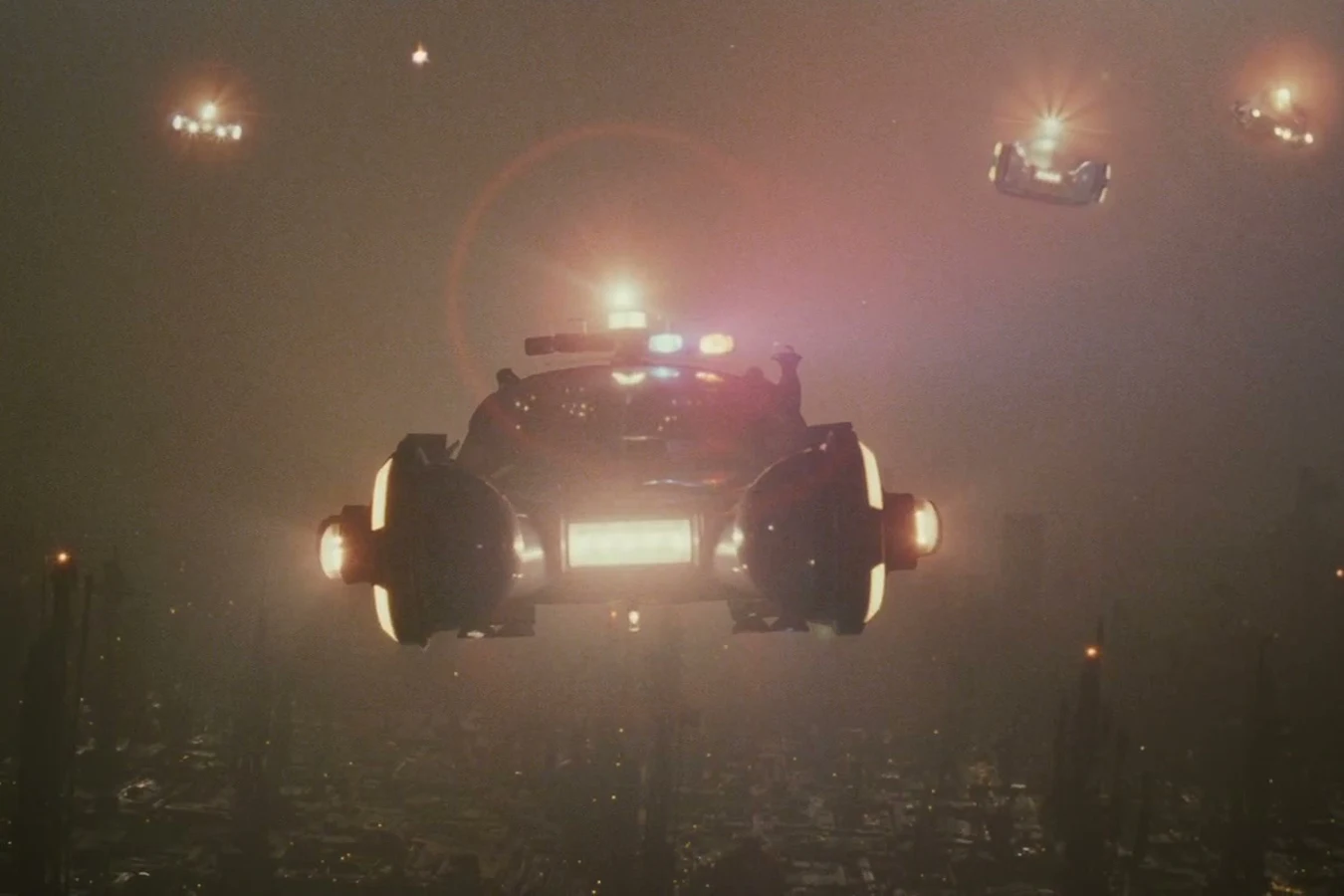
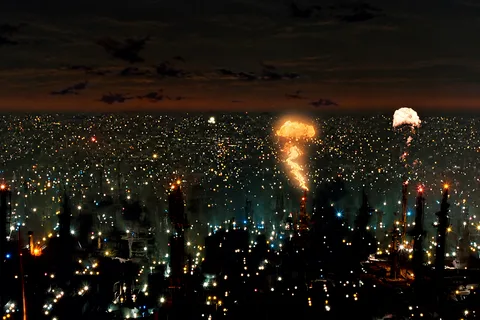
Once airborne, police Spinners shared the sky over Los Angeles with other machines of the same kind. After a briefing, Gaff flew Deckard toward the Tyrell Corporation pyramid at dusk, with other Spinners moving through the haze, their lights small against the city. The police car came on with its light bar and engine pods lit, a blue shape in the murk. Deckard later took a Spinner of his own after Harry Bryant put him back on the job. On screen the car remains simply a Spinner, used to reach a scene and to leave it, whether the destination was a precinct roof or a case across the city.
The Spinner In 2049
The Heavier Peugeot Model
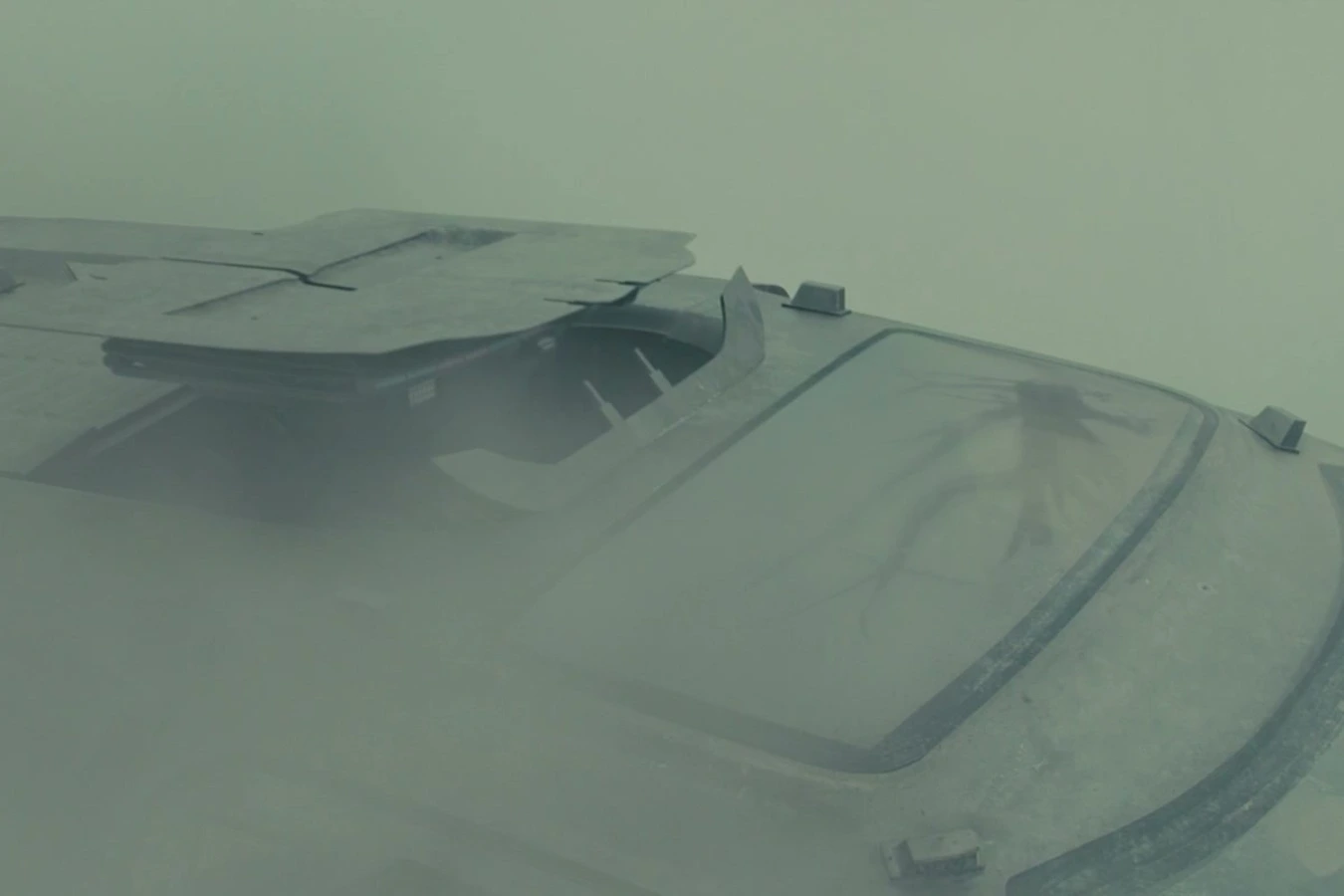
The 2049 police Spinner was still an LAPD machine, but the bodywork was heavier, more angular, and more brutal than the 1982 car, and it carried a Peugeot badge. K flew one of those cars, and when a case demanded it the same vehicle carried a small detachable drone on the roof. The production team at Territory Studio called that unit the Pilotfish, a reconnaissance craft that undocks from the car, scans a site, and sends imagery back to the screens in front of the pilot. K launched that unit on his approach to Sapper Morton's protein farm through the fog.
At The Protein Farm
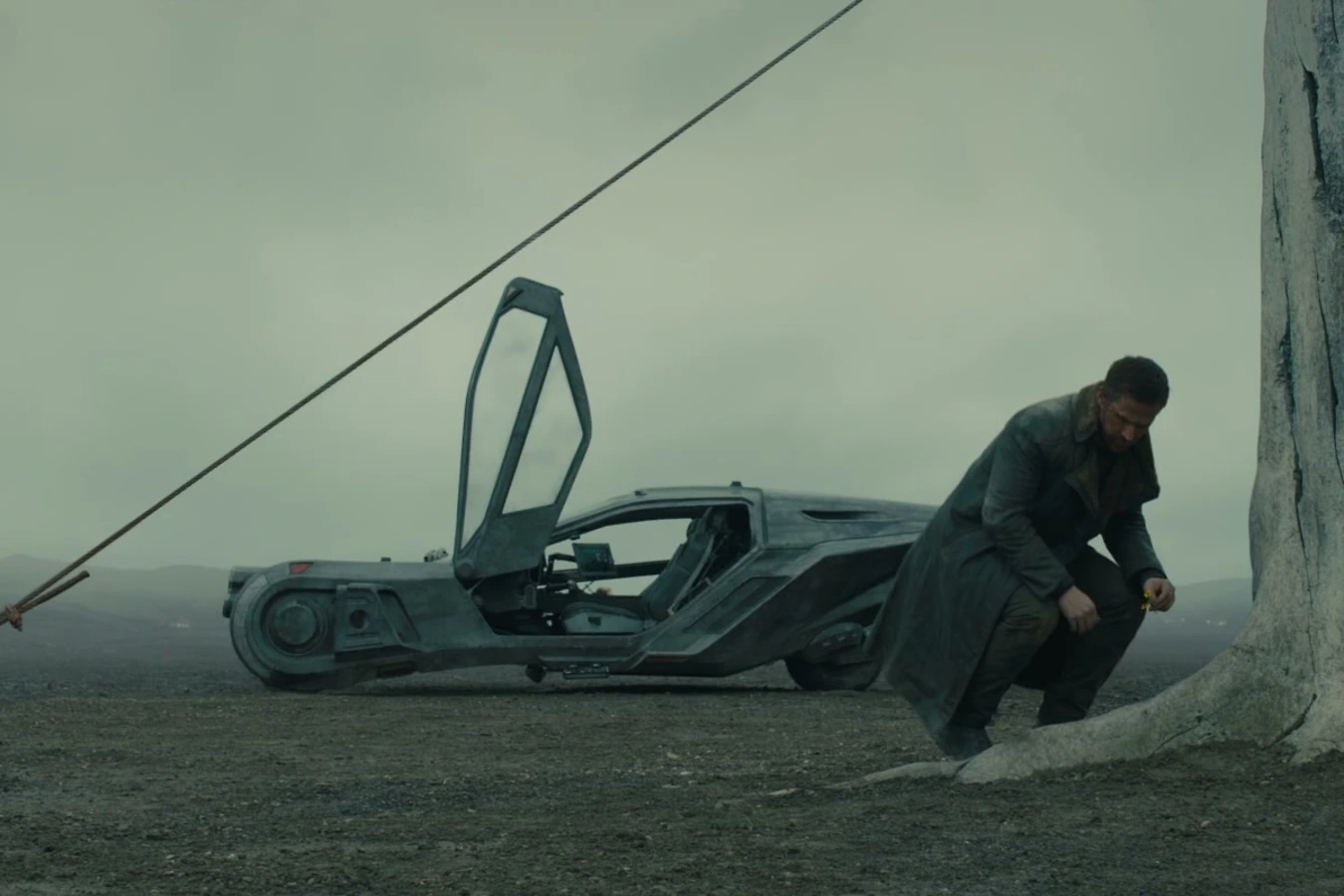
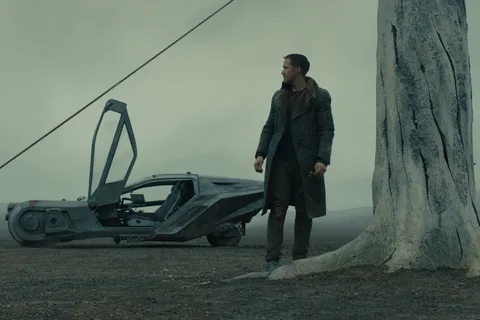
On the ground the 2049 Spinner still worked as a parked police car, with a raised door and a heavier body than the 1982 machine. K left his beside a dead tree at Sapper Morton's protein farm, where a small flower grew at the base of the tree, and the door stayed raised while he was away. The 2049 car remained a police Spinner in function, even as its bodywork grew heavier and more angular than the 1982 machine. That parked view shows how far the design had moved toward a thicker, more enclosed hull.
Brought Down On The Trash Mesa
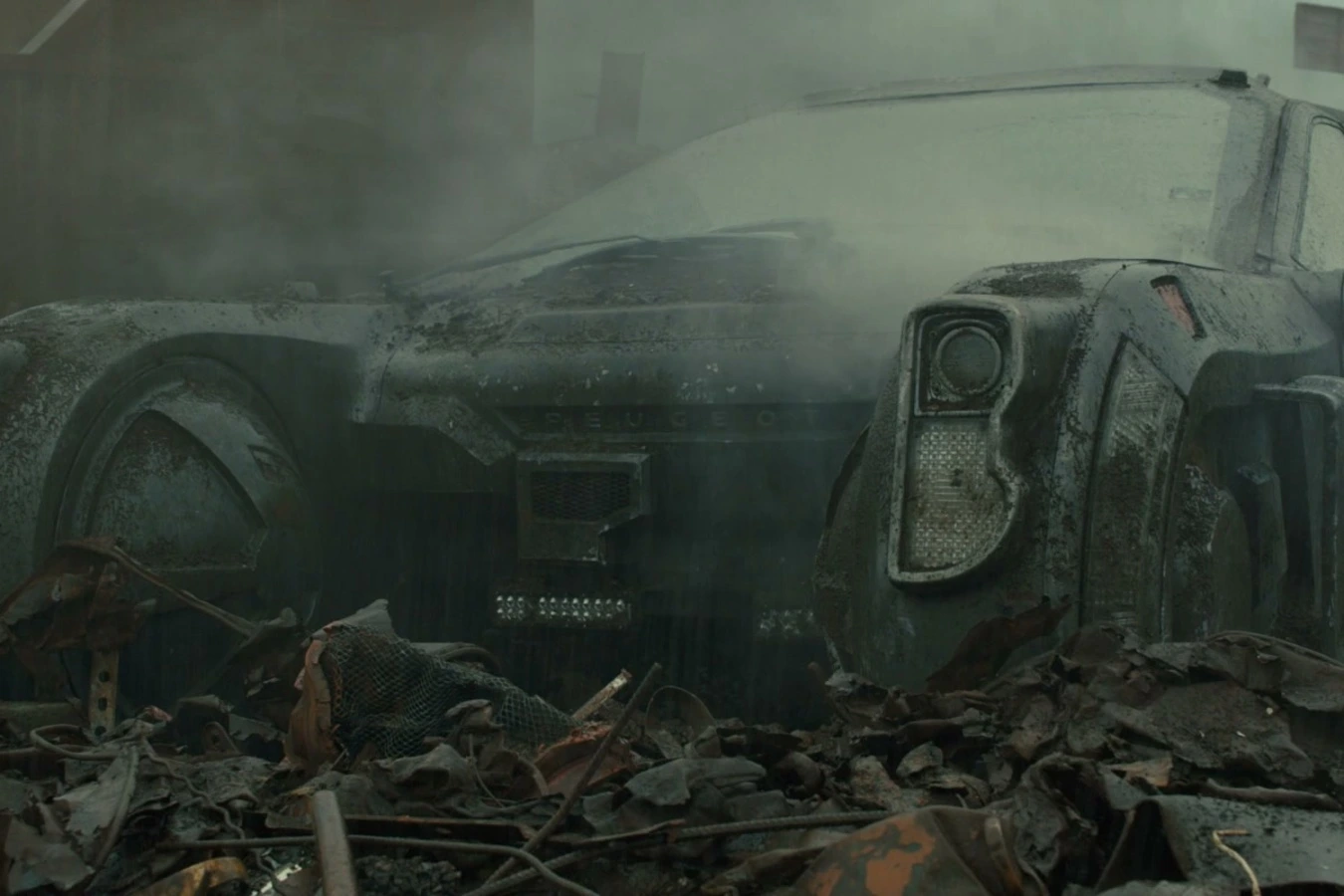
The 2049 Spinner could also be forced down and left among scrap. When K's car was brought down over the San Diego trash mesa, scavengers had already hit the machine, and he stepped out to continue on foot. The dirty Peugeot-badged police car remained among the wreckage where it had come down, its body caked with dust and debris. He left it there to go on with the search at the orphanage of Mister Cotton. Even wrecked, the hull still reads as the heavier 2049 police model rather than the slimmer 1982 car.
Arriving In Las Vegas
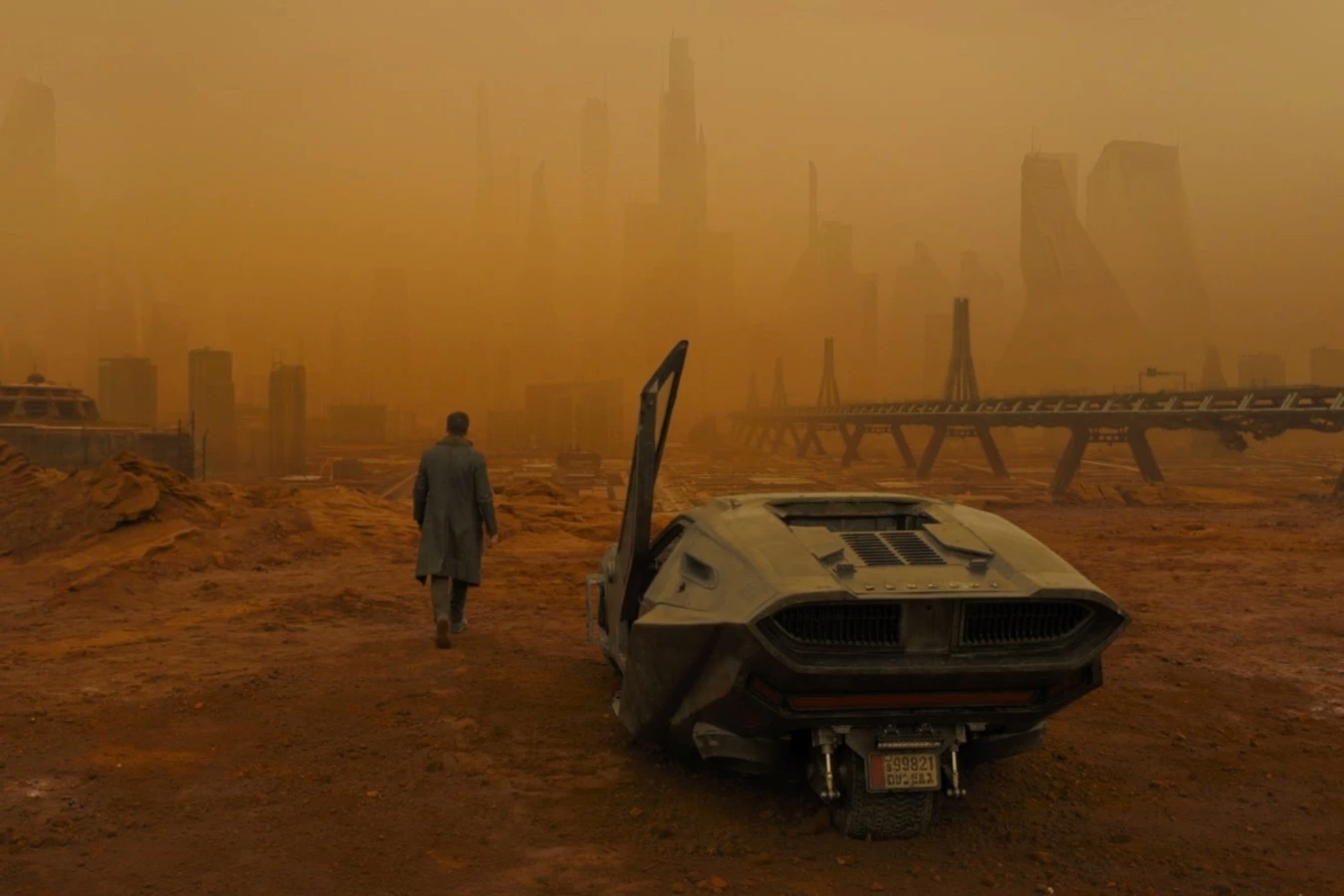
K later flew the same Spinner into the ruins of Las Vegas. He parked on the open ground at the edge of the city, with the door raised, and walked toward the empty towers in the orange haze to find Deckard. Joi went with him on that flight. The car that had carried him from the protein farm and the trash mesa stayed behind him on the waste while he went on foot. Luv followed the same trail in a spinner of her own, a larger cabin machine with a rear seat, smashed Joi's portable emanator, and took Deckard away in that car.
In 2049, those Spinners also served as weapons platforms. After scavengers had already brought K's car down on the trash mesa, incoming projectiles tore through the gangs around the wreck, while Luv directed that fire from a salon through a visor and a targeting display. Later, K intercepted her convoy at the sea wall, escort machines were destroyed in mid-air, and a small airborne device closed on her cabin in the rain.
Spinner Types
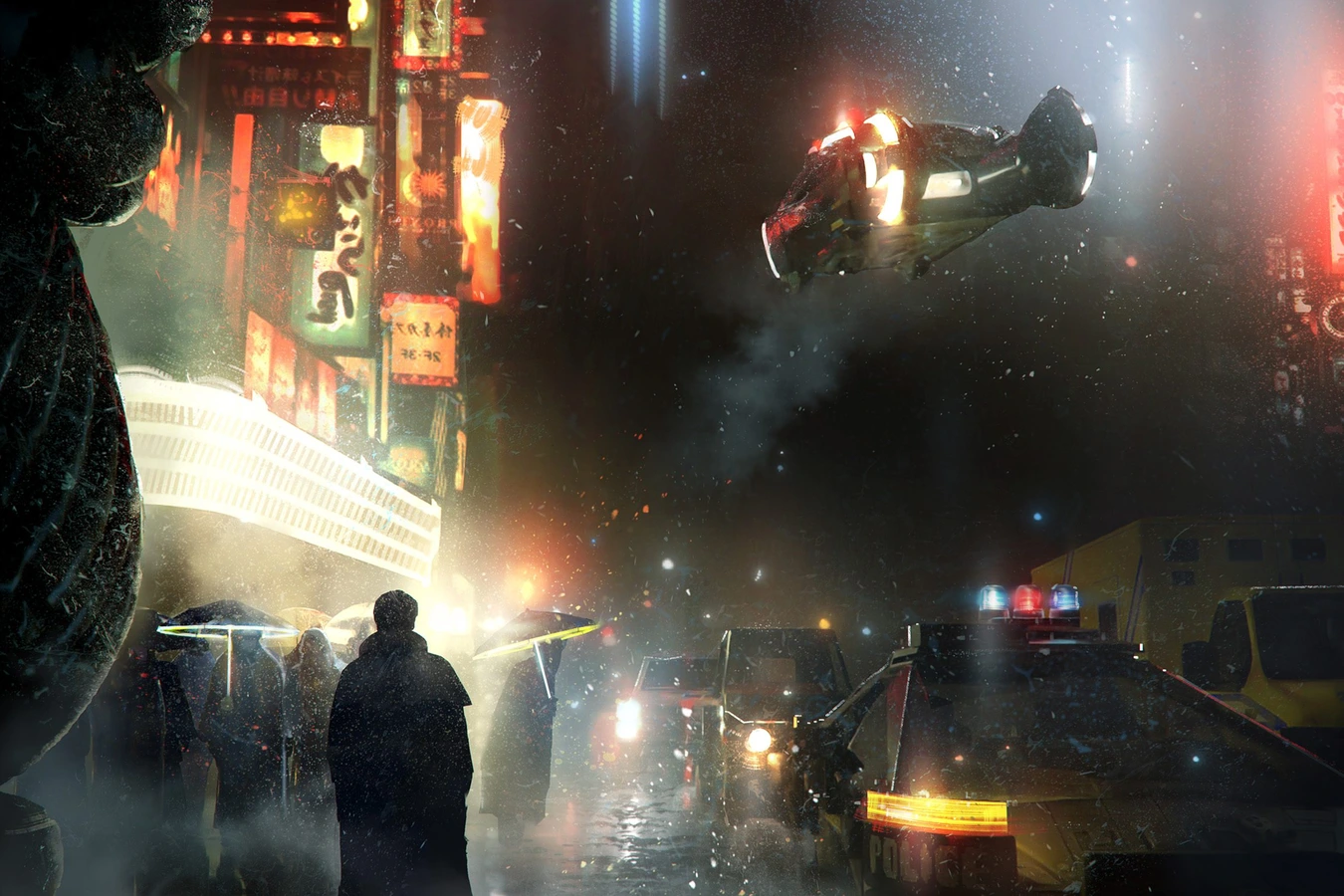
On screen the car is simply a Spinner, first in 2019 and then in 2049. The marked hull in the 1982 film bears painted codes, including DMV 137 AUTH. A and POLICE 995. Blade Runner: The Roleplaying Game later catalogued the film car with police livery and variant bodies. In the Core Rules the Spinner is called the most vital tool to any investigation, and the RDU garage holds only so many of them.
Standard LAPD Spinner (DMV 137)
Most officers in the game use the standard LAPD Spinner, marked in bold blues and whites, with spot beams and sirens. The Core Rules designate that marked cruiser as DMV 137, the same code painted on the 1982 hull as DMV 137 AUTH. A. The game gives that model two passengers and treats it as the car most cops can actually take out, because the unmarked specials are reserved for Blade Runners. Those named details belong to the tabletop game, even where they echo a marking already visible on the film car.
Detective Special 294-02
Only Blade Runners receive the unmarked Detective Special, Model 294-02, a matte black cruiser with no precinct badges, sirens, or detailing, designed for covert investigations. The Core Rules list that Detective Special as 4.62 meters long, with room for two passengers, a cruise speed of 120 km/h, and a top speed of 250 km/h. The game also gives it a biolock limited to authorized operators, an encrypted uplink to the LAPD Mainframe, and an Esper 360-degree camera array.
Squad Transport
The Core Rules also name a six-passenger Spinner Squad Transport, a larger car used when a task force has to stay together. It shares the game's aerodyne lift and wheel retraction with the smaller cruisers, and it can be fitted with the optional twin .50 caliber guns listed for models other than the carrier. The book places that transport beside the unmarked Detective Special, for cases that are no longer a job for two officers alone. Like the other named body types, the Squad Transport appears only in the tabletop game, not in the 1982 or 2049 films.
Spinner Carrier
The Core Rules also list a twenty-passenger Spinner Carrier, also called a Troop Carrier in the same book, as the largest police model. It is used for Spec Ops raids or joint operations when many officers have to embark and drop from one machine at once. Twin .50 caliber guns are standard on the Carrier, and a tactical missile launcher is listed as an option for that model only.
2032 Spinner Cycle / Detective Special 08-3
The Spinner Cycle arrived in 2032 as a one-seat stealth craft, 2.45 meters long, with a top speed of 295 km/h. The Detective Special 08-3 is the matte black Cycle, offered beside a blue and white edition for seasoned pilots. Like the larger Spinners, it uses an aerodyne turbine for vertical lift, then a turbofan for vectored thrust, and it is not meant for extended ground travel. The Core Rules give it no offensive weaponry and describe it as a machine for surveillance, reconnaissance, and a fast entrance or exit, cleared only for pilots with rigorous training. Those cycle variants belong to the game, not to either film.
McCoy's Spinner
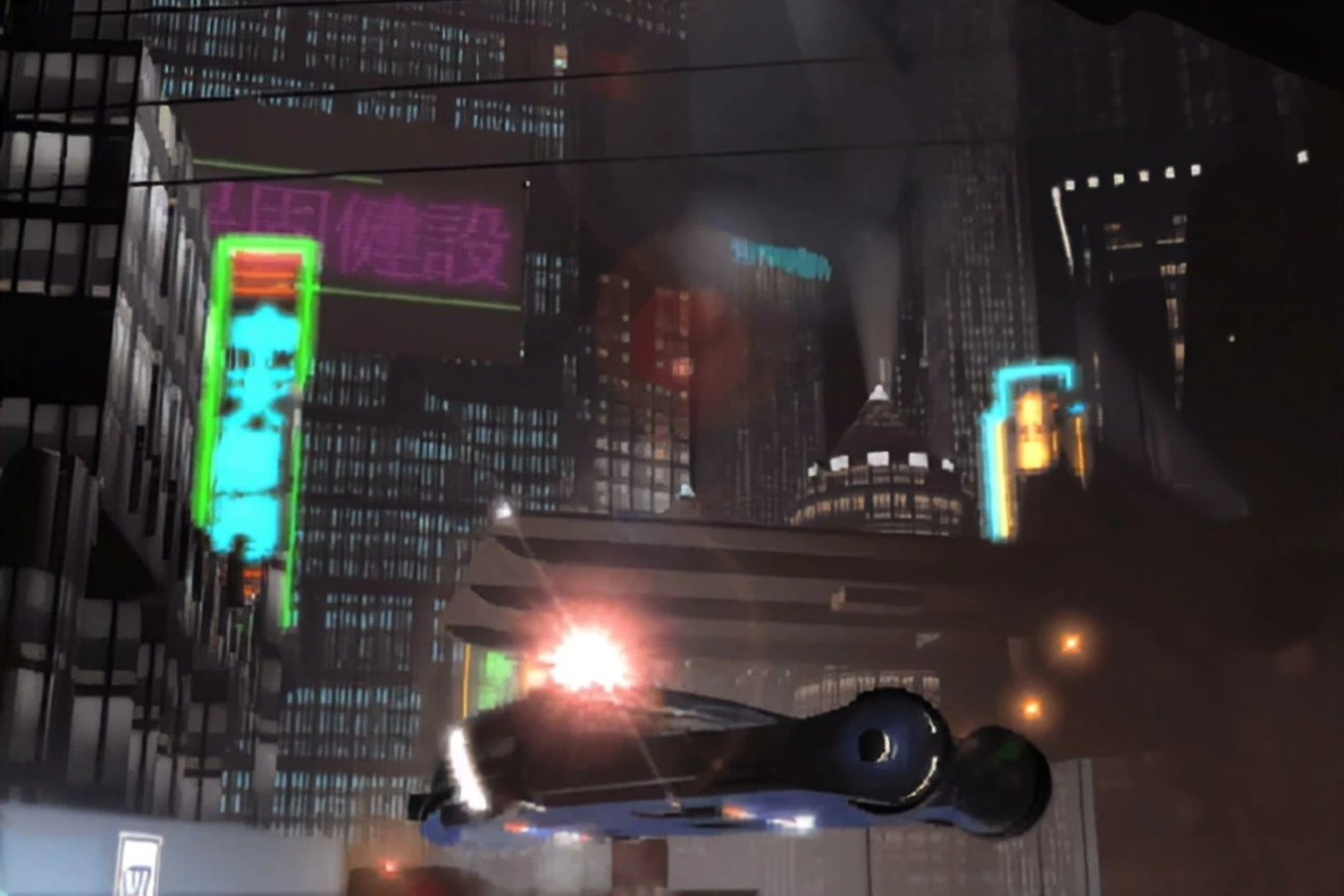
Westwood's Blade Runner (1997) gives rookie Blade Runner Ray McCoy a department-issue Spinner as his car. Spinner keys appear as a clue, and the game lets him fly to a fixed list of destinations, including the police station, his apartment, Runciter's Animals, Chinatown, Animoid Row, the Tyrell Building, DNA Row, the Bradbury Building, Nightclub Row, and Hysteria Hall. McCoy even uses the car as a figure of speech, saying he would "bet my spinner it was valuable to somebody."
The Fiery Angels case file, written for the Blade Runner RPG, later gives McCoy a Detective Special. A Replicant copy named Ezekiel uses that car, and in addition to its normal features it is armed with an autocannon and a tactical missile launcher. Those extra weapons are tabletop details from that case file. Dave Holden is already in hospital in the Westwood story, and Gaff is occupied with the Tyrell break-in, so the rookie uses his own car and his department-issue KIA to move from scene to scene.
Behind The Scenes
Syd Mead's Design
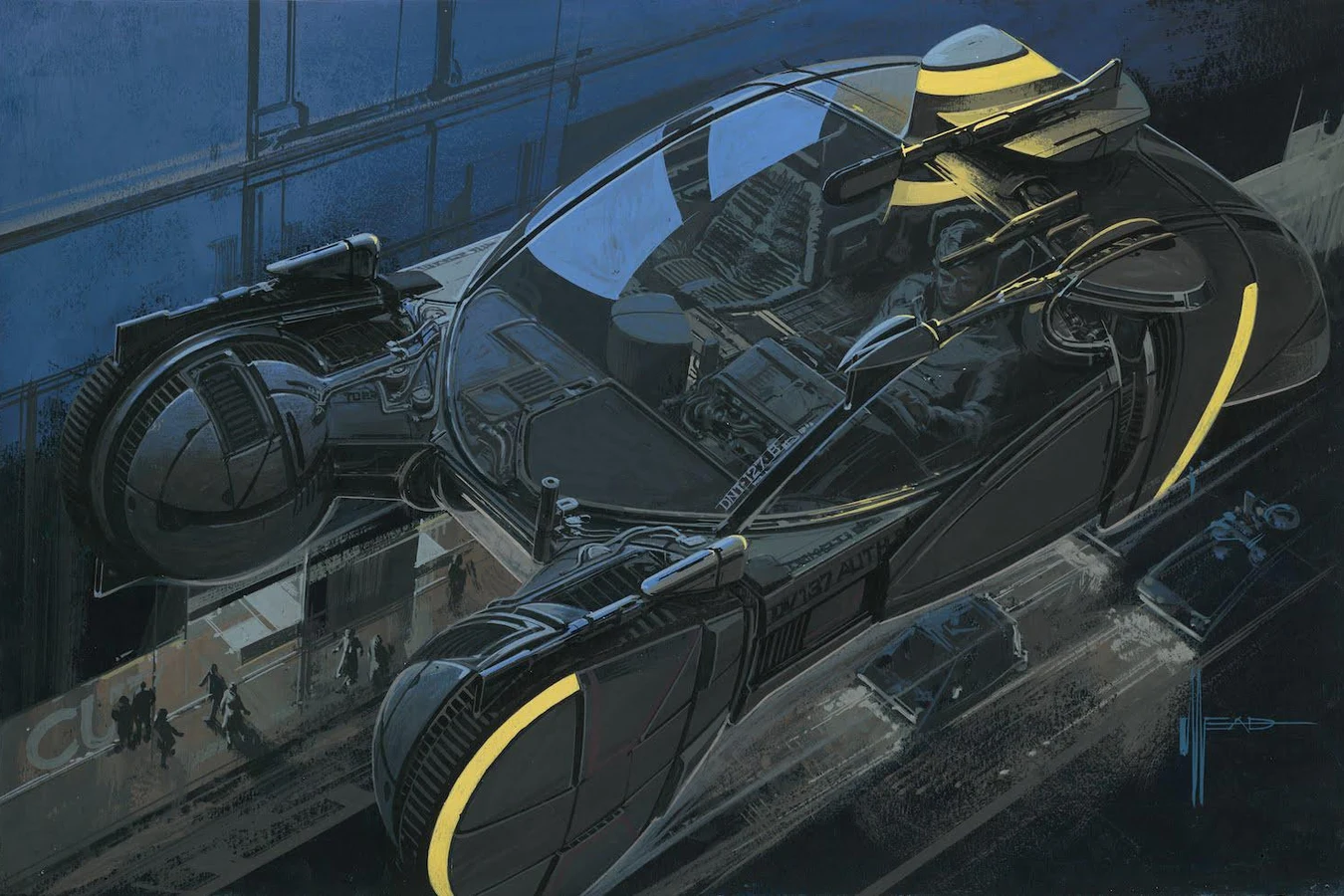
Syd Mead designed the Spinner, and it was the first design concept he discussed with Ridley Scott. Mead was originally hired just to design the automobiles that would appear in the film, and the flying police car was his first official assignment. Scott had first thought of a compact coupe, but Mead drew a larger, "Chevrolet scale" model that would support visually impressive full-scale takeoffs. He rejected helicopter-like blades and folding wings, and treated the Spinner as an aerodyne, a heavier-than-air craft with an enclosed lifting system, like the Harrier jump-jet. Hampton Fancher coined the word Spinner for that land and air police vehicle.
Mead also designed hydraulic sections so the police Spinner's front wheels could fold up for flight, and a "twist-wrist" steering system that replaced a steering wheel with two in-dash handles. He gave the cockpit unique interior instrumentation, including collapsible headrests with self-contained speakers, which can be seen behind Deckard's head on the flight toward the Tyrell pyramid. Paul M. Sammon later noted a metal plate reading "Spinner" riveted onto the framework of a full-scale car. Mead's own paintings already used a side code close to DM 137 AUTH, a marking the finished 1982 hull carried as DMV 137 AUTH. A.
Building The Full-Size Spinners
Gene Winfield built the full-scale vehicles, with a crew of 35, in Canoga Park. The cars used fiberglass bodies over a Volkswagen chassis, which Winfield preferred because it was air-cooled and rear-engined. He built four full-scale Spinners, including two that could be driven like ordinary cars and a lighter flying Spinner on an aluminum frame, designed to be lifted by a crane. Extra hydraulics folded the front wheels into the body, and movable sections channeled steam and carbon dioxide. The art department dirtied the freshly painted cars, and after an arson fire at his shop on 14 May 1981 destroyed two vehicles that were not rebuilt, Winfield delivered twenty-three cars.
Effects And Miniatures
A full-scale Spinner was filmed lifting off from the noodle bar on the Warner Brothers Old New York street set. Douglas Trumbull's Entertainment Effects Group photographed motion-controlled Spinner models, including smaller traffic on a seventy-five-foot track. For the descent to police headquarters, the crew filmed the hero Spinner as a stand-alone shot on the Icebox system, then composited that footage over a model of the precinct and the buildings around it. Paul M. Sammon records those methods in Future Noir. The street lift-off, the night traffic, and the roof landing were therefore a mix of Winfield's full-size cars and Trumbull's miniatures, not a single technique.
The 2049 Redesign
When Denis Villeneuve began Blade Runner 2049, production designer Dennis Gassner asked him for a single word to describe the new world, and Villeneuve answered "brutality." Gassner started with the Spinner and used it as the pattern language for the rest of the film. He said the 1982 car had a softer quality, while the new one was more robust, angular, and brutal, a logical evolution from 2019 to 2049. Officer K spent a long stretch of the story in that heavier machine, and Gassner treated the vehicle as an extension of the character. K's car carried a Peugeot badge, and a holographic Peugeot logo also appeared in the city.
The 2049 cars were also built as full-size practical vehicles. A British crew began the work at Pinewood Studios, then finished the fleet at Origo Studios in Budapest. Robert Stannage, who designed the worn silver and graphite paint, wrote that the crew completed seven Spinners in under six weeks, including three police Spinners, some built to be filmed under water. The bodies came from fiberglass molds over welded frames, with LED strip lights and hydraulic doors that swung up for the driver and passenger. K's police Spinner was among the cars that rolled out for filming, and the first of them was placed on a reddish sand set.
Conclusion
The Spinner remains the most recognizable machine in Blade Runner, the car that takes a blade runner from the street to a crime scene and back into the sky. In 1982 it was Gaff's ride and then Deckard's, a blue land and air police vehicle whose name was coined for the film and whose shape was drawn to stay a car even in flight. In 2049 it was still an LAPD machine, heavier and Peugeot-badged, and still the car that carried K across the farms, the desert, and the sea wall. The marked 1982 hull already carried codes such as DMV 137 AUTH. A.
Later sources added named body types around the same police car. The Blade Runner RPG gave Blade Runners the Detective Special, and it added a carrier, a squad transport, and the 2032 Spinner Cycle. The 1997 game kept the simpler word and let McCoy bet his spinner on a hunch. Across those versions the job still depends on the same idea: a police car that can leave the ground when the streets below are too slow, too crowded, or too dangerous to cross.
Tag Categories: Blade Runner Lore | Blade Runner Technology