
The Esper was the voice-controlled photo analysis computer of the LAPD in the world of Blade Runner, able to enlarge a photograph and move through the space it recorded. A central police system at headquarters fed screens such as the Esper Wall, where Harry Bryant briefed his blade runners, while smaller terminals stood in their homes. In 2019, Rick Deckard used his home unit to search a snapshot from the hotel room of Leon Kowalski and found the replicant Zhora hidden in a mirror. Espers returned in Westwood's 1997 Blade Runner game, in the K. W. Jeter sequels and in later stories.
What Is The Esper?
The Esper was a police computer built to analyse and enlarge photographs, and in Los Angeles it was one of the two machines a blade runner relied on beside the Voight-Kampff test. Investigators fed it photographs from crime scenes and searched them by voice for faces, objects and hiding places. The 1982 production notes called it "a high-density computer with a very powerful three-dimensional resolution capacity and cryogenic cooling system" that could "analyze and enlarge photos, enabling investigators to search a room without even being there." That capacity let an Esper find angles no ordinary camera seemed to record.
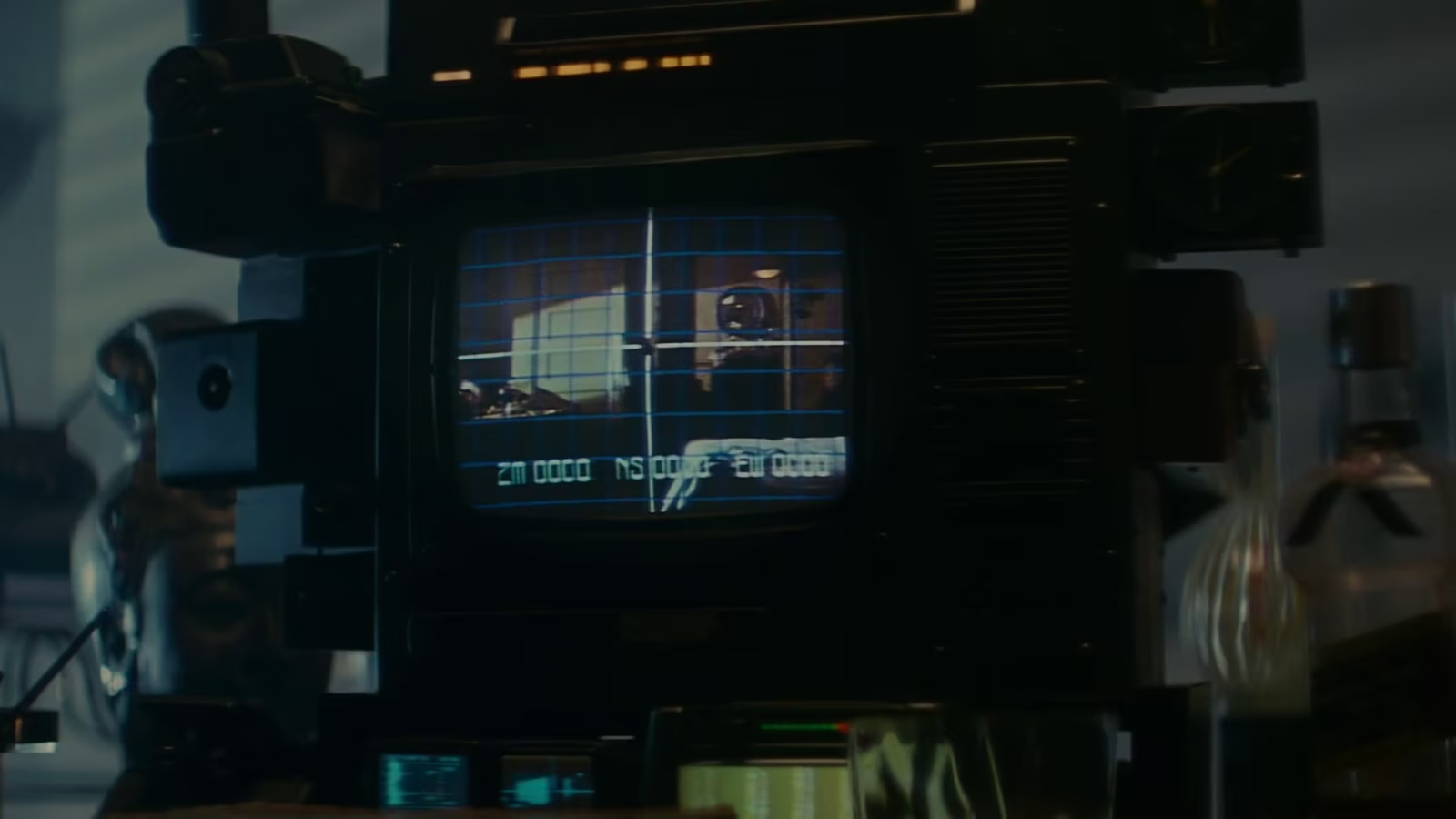
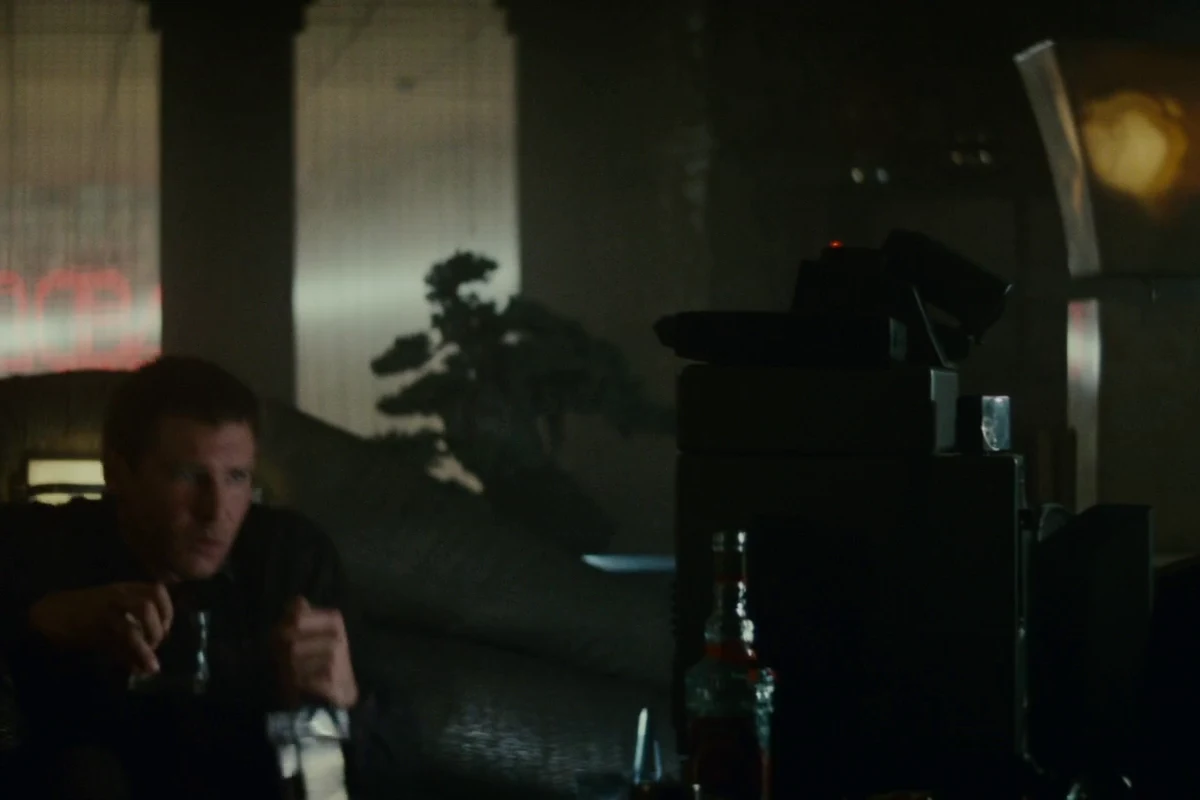
A home unit was a stack of black housings around a small cathode-ray screen, with a slot for the photograph, a printer for hard copies and rows of small displays and lights. Because it answered to spoken commands, an officer could work it from an armchair rather than at a keyboard. Paul M. Sammon's book Future Noir describes the apartment model as a personal extension of the police department's own Esper. Philip K. Dick's source novel already gave its police files "fuzzy 3-D color prints," and a brief flicker of movement in Rachael's childhood photograph hints at the same technology.
How The Machine Works
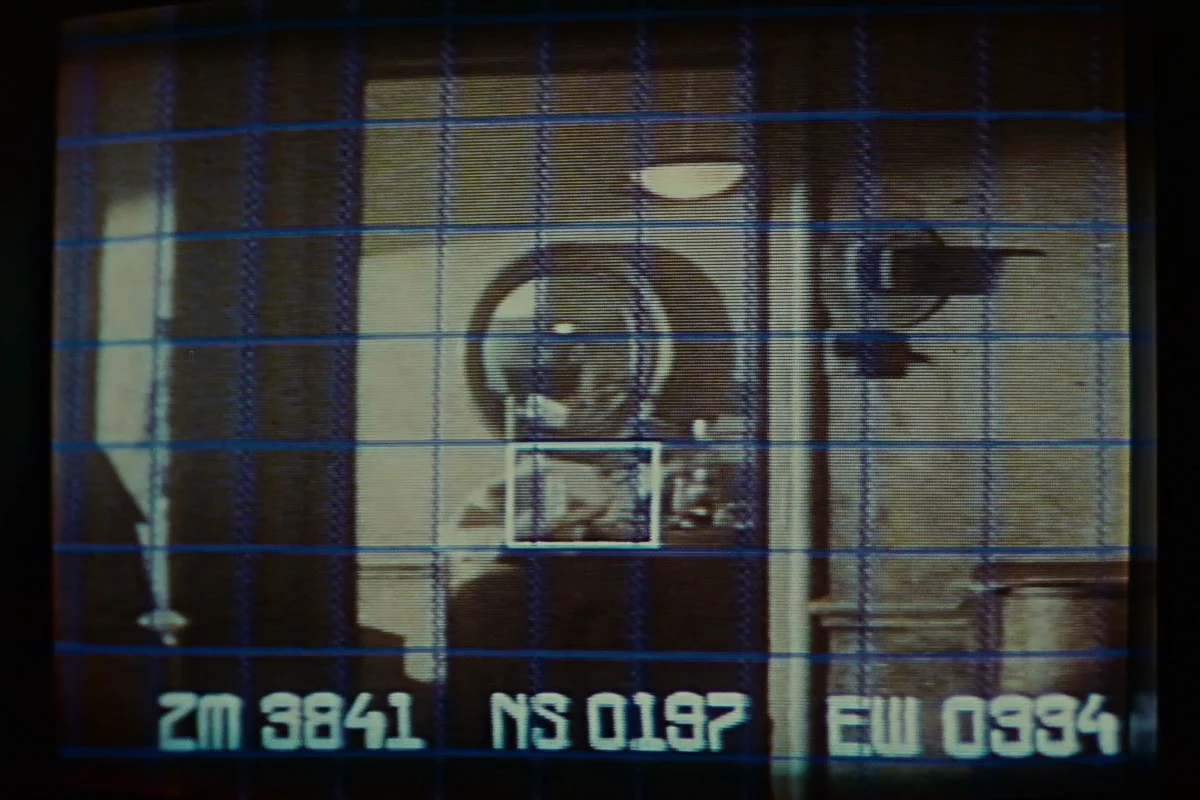
A photograph went into a slot on the side of the unit, and the screen brought it up under a fine blue grid with a crosshair and a line of coordinates. The readout gave a zoom value and two positions, labelled ZM, NS and EW, which the operator used to name the part of the image he wanted. Commands such as "Enhance," "Track," "Pan," "Center," "Pull back" and "Stop" were spoken with numbers, and a white rectangle marked each chosen area before the machine jumped forward to fill the screen with it. A rising whir and a blue flash greeted every step.
The Esper did more than magnify a flat print. The picture sharpened as it grew, as if the machine were rebuilding detail rather than enlarging grain, and tracking commands swung the view around corners and through doorways as though a camera were moving inside the room. Convex mirrors and other reflections could be followed into spaces the original lens never faced directly. When the operator found what he needed, a spoken request for a hard copy pushed a square print out of a slot at the top of the unit, a physical clue a detective could carry and show around.
The Police Network
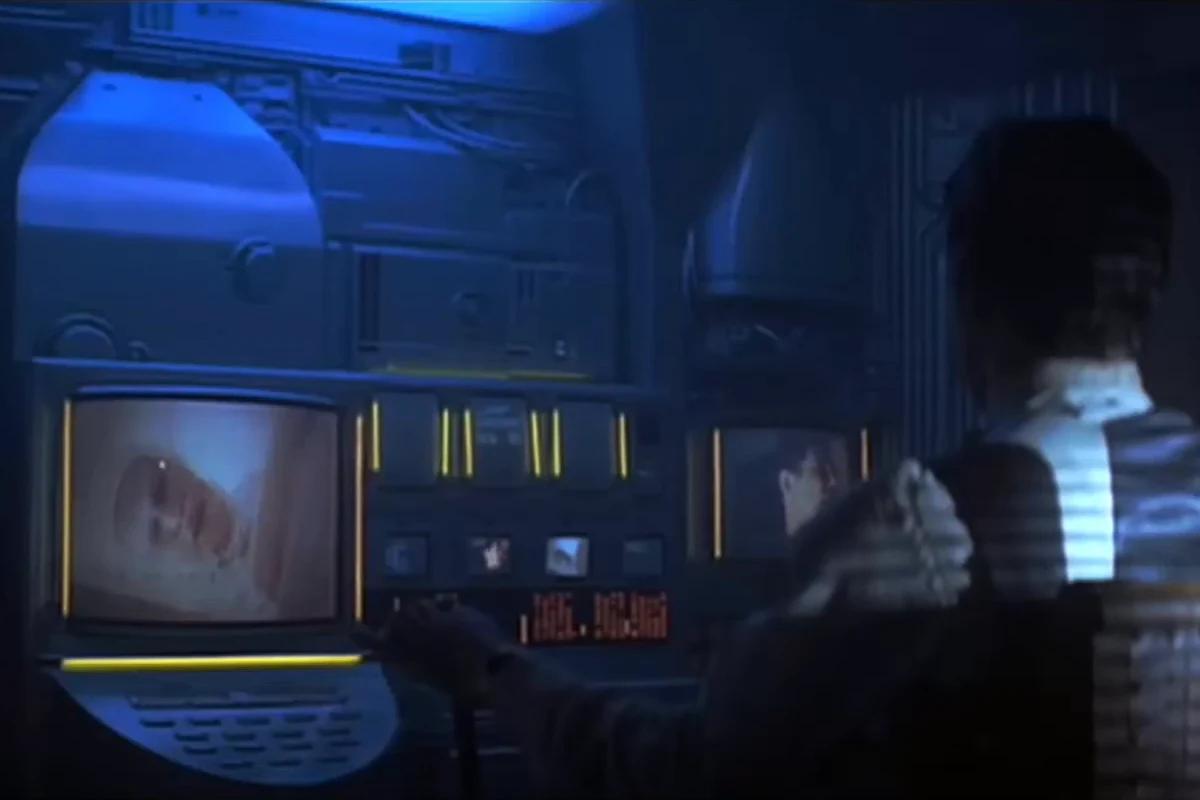
The home terminals were the small end of a much larger police system. At headquarters, Bryant briefed his blade runners in a small anteroom known as the Blue Room, whose wall of monitors the production called the Esper Wall. The wall played the escaped replicants' incept tapes, showing each fugitive turning slowly in profile beside a file card. Leon's card listed his Nexus 6 designation, an incept date of 10 April 2017 and his function as combat and loader, framed by glowing blue tubes.
A full desk terminal at headquarters could also show live pictures from elsewhere in the city. In a deleted scene, Bryant and Gaff used it to spy on Deckard's hospital visit to Dave Holden, who had survived Leon's shots inside an enclosed life support capsule. The console carried a large main monitor flanked by orange neon tubes, a row of smaller screens and a keyboard shelf, a far bigger machine than any home unit. The later Blade Runner RPG builds on the same idea, placing a giant Esper Wall at LAPD headquarters as the heart of a citywide camera network.
Later Police Models
The K. W. Jeter sequels kept the Esper as standard LAPD equipment. In Replicant Night, Deckard recalled the trick units built in the department's research labs, "the voice-controlled espers, the softly breathing Voigt-Kampff machines." By the time of Eye and Talon, cheap flat-rez espers were standard issue, and a blade runner who could afford it bought a surround-esper, or surresper, that projected a recorded scene in three dimensions around its user. Unlike the home unit of 2019, the surresper let its owner walk through a recording rather than steer a picture on a screen.
Deckard's Esper Scene
After Deckard and Gaff searched Leon's room at the Yukon Hotel, Deckard pocketed a set of family snapshots and a scale from the bathtub. Alone in his apartment after Rachael left, he leafed through the pictures at the piano, chose one and carried it to the machine with a bottle of whisky. He worked the Esper from his armchair with a glass in his hand, talking it through the image one command at a time. The search lasted only a few minutes, yet it turned an ordinary hotel room into a lead on the next replicant, the snake dancer Zhora.
Leon's Photograph
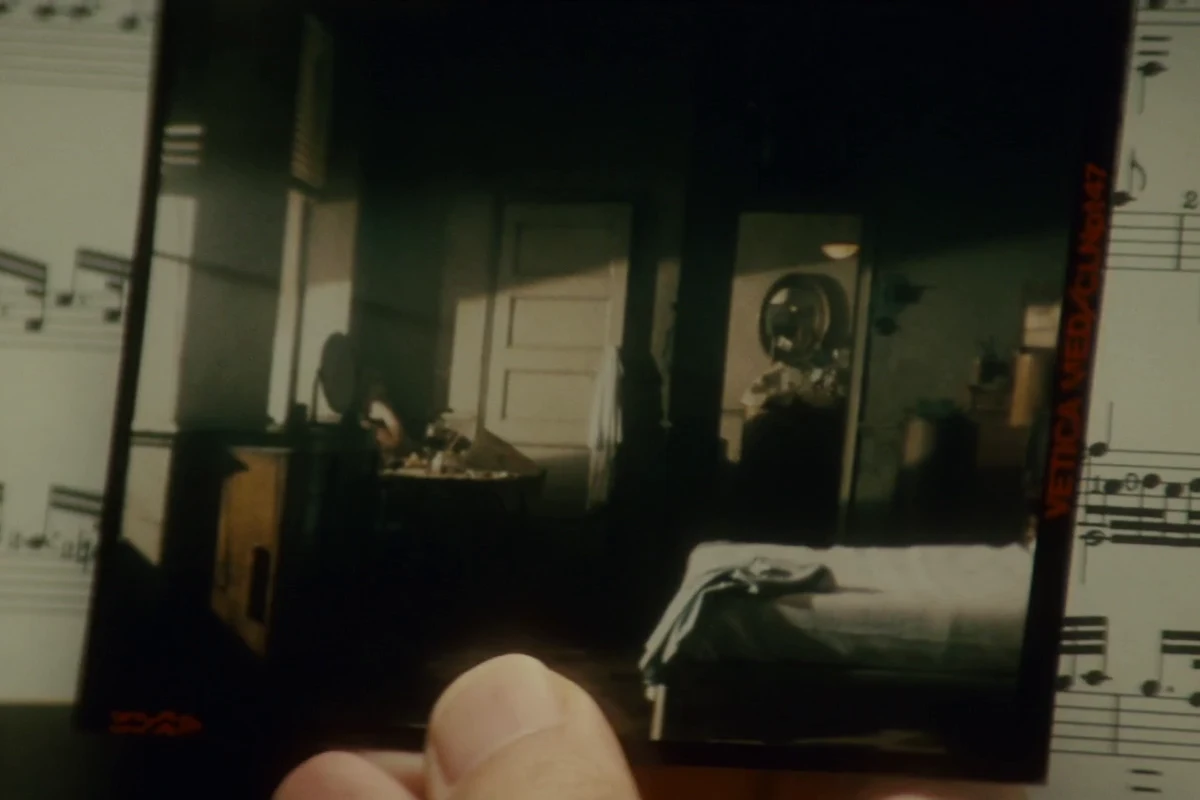
The snapshot showed a dim hotel room with a doorway, a bed and a round convex mirror on the far wall, with the shoulder and arm of a man at a table in the foreground. Sammon identified that man as Roy Batty, seated with his back to the camera. Leon had been unable to recover the pictures after shooting Holden, telling Roy that someone was already there when Roy asked whether he got his precious photos. His loss became Deckard's best lead, left behind in his room at 1187 Hunterwasser, the hotel address Holden had read out at the start of Leon's Voight-Kampff test.
Leon collected his photographs like keepsakes, and Rachael brought one of herself as a child to prove she was human. For a replicant, a snapshot stood in for a history that had never really happened. Deckard treated it purely as evidence, searching the room for anything that might give away where the fugitives were hiding. The search placed the replicants' longing for a past right beside the LAPD's ability to mine that past for clues.
Moving Through The Room
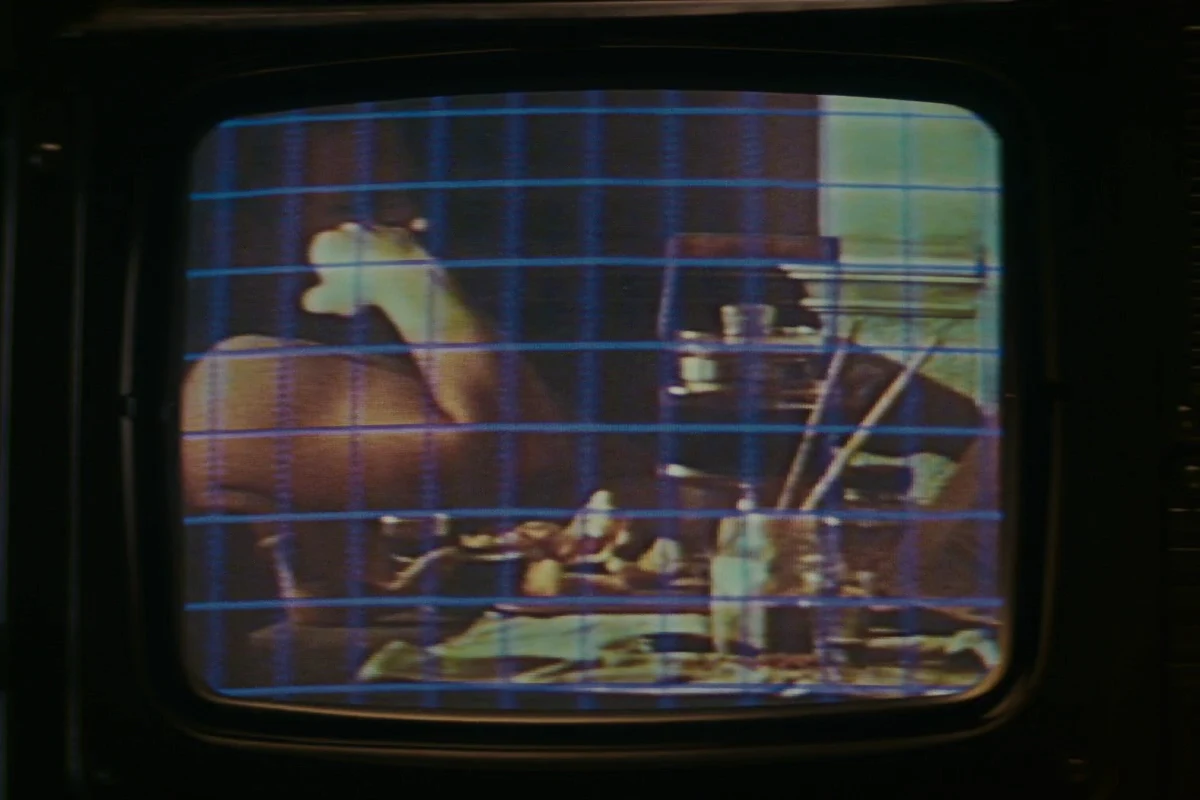
Deckard began with "Enhance 224 to 176," and the machine pulled the table and the man's arm close enough to see bottles, glasses and clutter on the tabletop. He ordered it to move in, pull out, track right and center, walking the view across the room in short stops. "Track 45 right" turned the view through the open doorway into a second room, the moment the Esper stopped behaving like a magnifying glass and became a camera that could travel inside the photograph. Each enhancement was a hunt for something that did not belong, and Deckard kept scanning past furniture, fixtures and a fan until he reached the far wall.
Through The Mirror
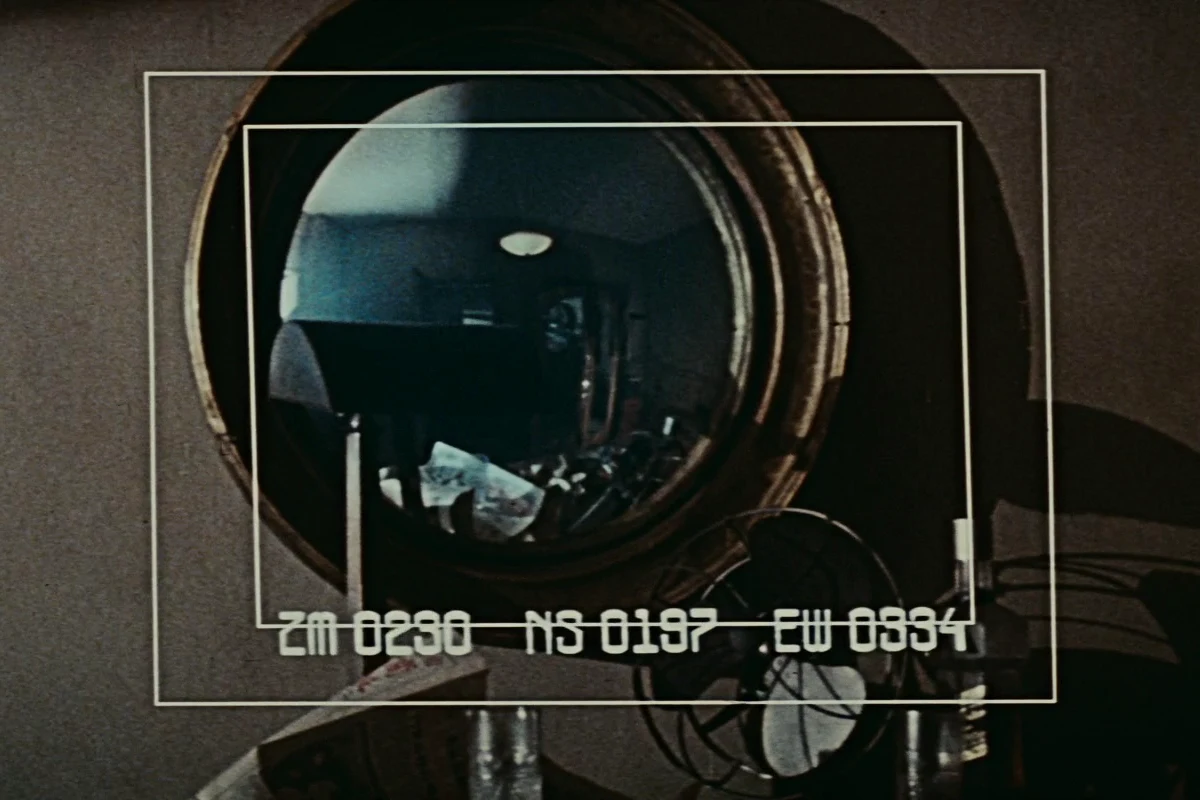
There a round mirror in a heavy frame reflected part of a space the camera could not see directly, and Deckard had the machine center on it and stop. Deckard called "Enhance 34 to 46," and the rectangles closed around the convex mirror until its curved reflection filled the screen. Inside it a doorway opened onto yet another space, and a wardrobe hung with a sequined dress came into view on the far side of the room. "Wait a minute. Go right," he said, and the Esper moved past an edge in the reflection that no flat print could look around.
Finding Zhora
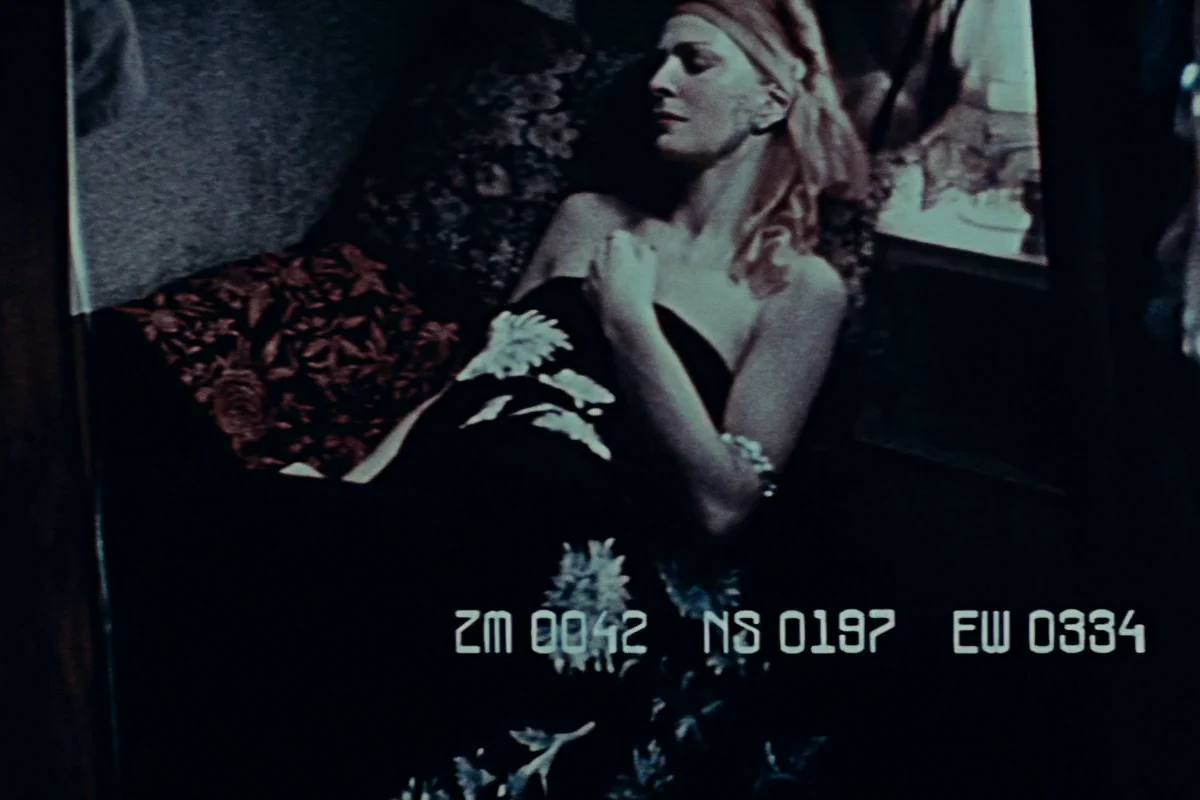
After "Enhance 57-19," "Track 45 left" and "Enhance 15 to 23," a woman appeared asleep on a daybed in a small alcove, her head wrapped in a towel and a snake tattoo on her neck. The final enlargements brought her face close enough to recognise, and the sequined dress from the wardrobe hung beside her. Deckard did not know her name yet, but the tattoo connected her to the scale he had pulled from Leon's bathtub, which a market vendor soon identified as coming from an artificial snake. The woman was Zhora, who was working as an exotic dancer at Taffey Lewis' club, and the snake led straight to her.
The Hard Copy
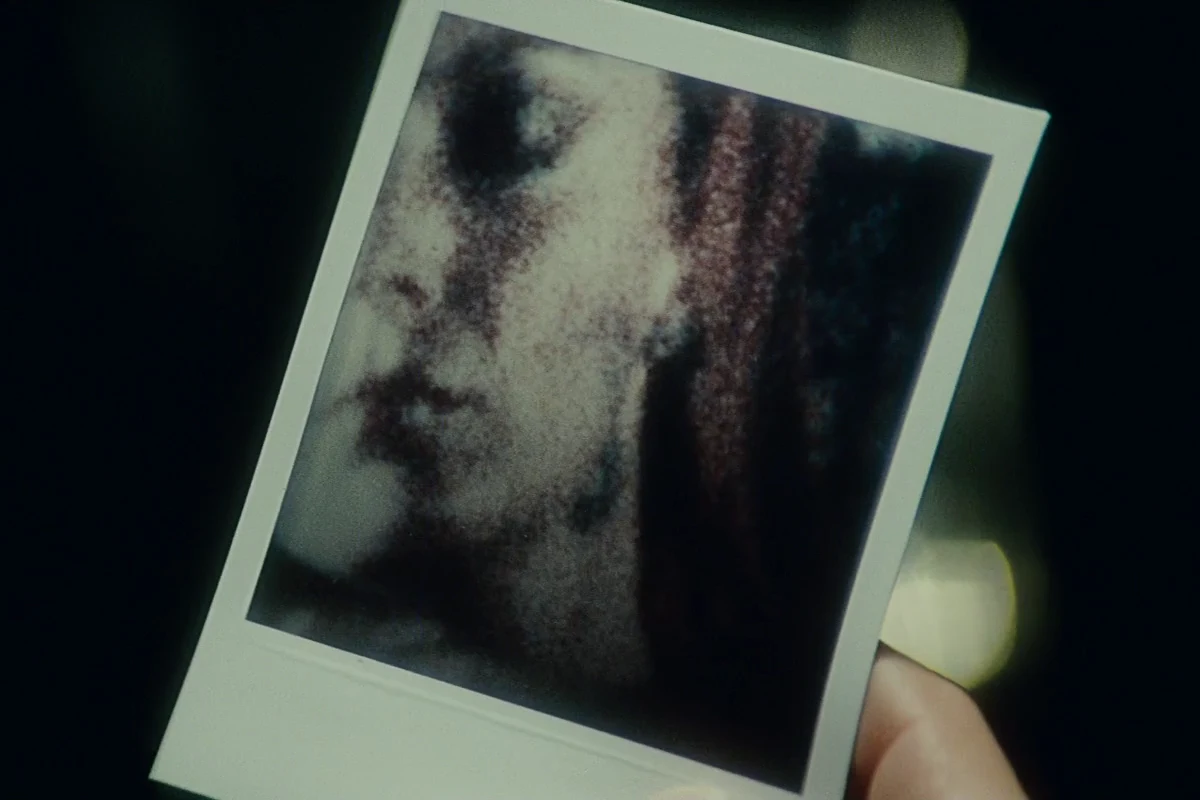
"Give me a hard copy right there," Deckard said, and the machine pushed a print out of a slot at the top of the unit. The square photograph showed the sleeping woman's face and the tattoo in coarse, grainy colour. Deckard's bottle of Johnnie Walker Red travelled with him when he collected the print. He pocketed it beside the snake scale and took both to Animoid Row, where the scale led to the maker Abdul Ben-Hassan and then to the club. The print was the only object the Esper produced in the film, and it turned a voice-driven search into a physical clue.
The Esper In The Novels
The word Esper does not appear in Do Androids Dream of Electric Sheep? or in The Edge of Human, the first of the K. W. Jeter sequels. It surfaces in the later Jeter novels, which treat espers as ordinary LAPD equipment. Eye and Talon went furthest, building a whole case around one blade runner's private machine. Dick's novel has no such machine, but its police photographs and a television exposé both rely on enlargement in ways that echo the film.
Do Androids Dream Of Electric Sheep?
In the novel Deckard read the case files on Roy and Irmgard Baty in a hotel room, and the files include telescopic snapshots that are only "fuzzy 3-D color prints which he could barely make out." Nothing let him explore those images, and he had to judge the androids from typed carbon sheets instead. Photo enlargement matters elsewhere in the book, when Buster Friendly broadcast blowups of the video backdrop behind Wilbur Mercer. His research chief showed that the moon behind Mercer was painted and that brushstrokes appeared in the enlargements, an exposé that shook Mercerism to its core.
Replicant Night
In Replicant Night, Deckard approached his hovel on alert and missed the gadgets the department had once given him. Without the voice-controlled espers of his blade runner days, he admitted that he now had to work the old-fashioned way. The passage confirms that Jeter's espers worked by voice like the film's, and that they were standard issue rather than Deckard's private hardware. Elsewhere in the same book a giant viewscreen on the Outer Hollywood studio replayed a staged version of Deckard's past, a darker echo of the Esper's promise to show what really happened.
The Surround-Esper
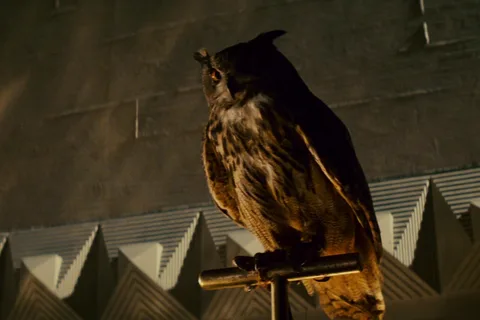
In Eye and Talon, blade runner Iris Knaught worked her cases on a surresper that filled her apartment with recorded scenes. She was still paying it off to the police credit union, but thought it worth the debt next to the flat-rez espers of her colleagues. Given a recording of an escaped owl by her boss Meyer, she walked through it giving orders such as "Freeze image," "Magnify, two ex" and "Enhance ambient light levels." Enlarging the band on the bird's leg, she read that it was property of the Tyrell Corporation, which explained why the case had come to her division.
The machine talked back, and when Iris ordered a brute-force identity trawl it warned her that the method was illegal under a United Nations court decree. She overrode it, knowing the surresper was wired to the LAPD switchboard and would report her to her supervisor. Its recordings also replayed sound, showing Eldon Tyrell feeding a white rat to the owl in his candlelit office. Later Iris had it lay a narrowing grid of green lines over the living bird she had found, and the machine confirmed that it was the same creature as Tyrell's owl from the recording.
The Westwood Game
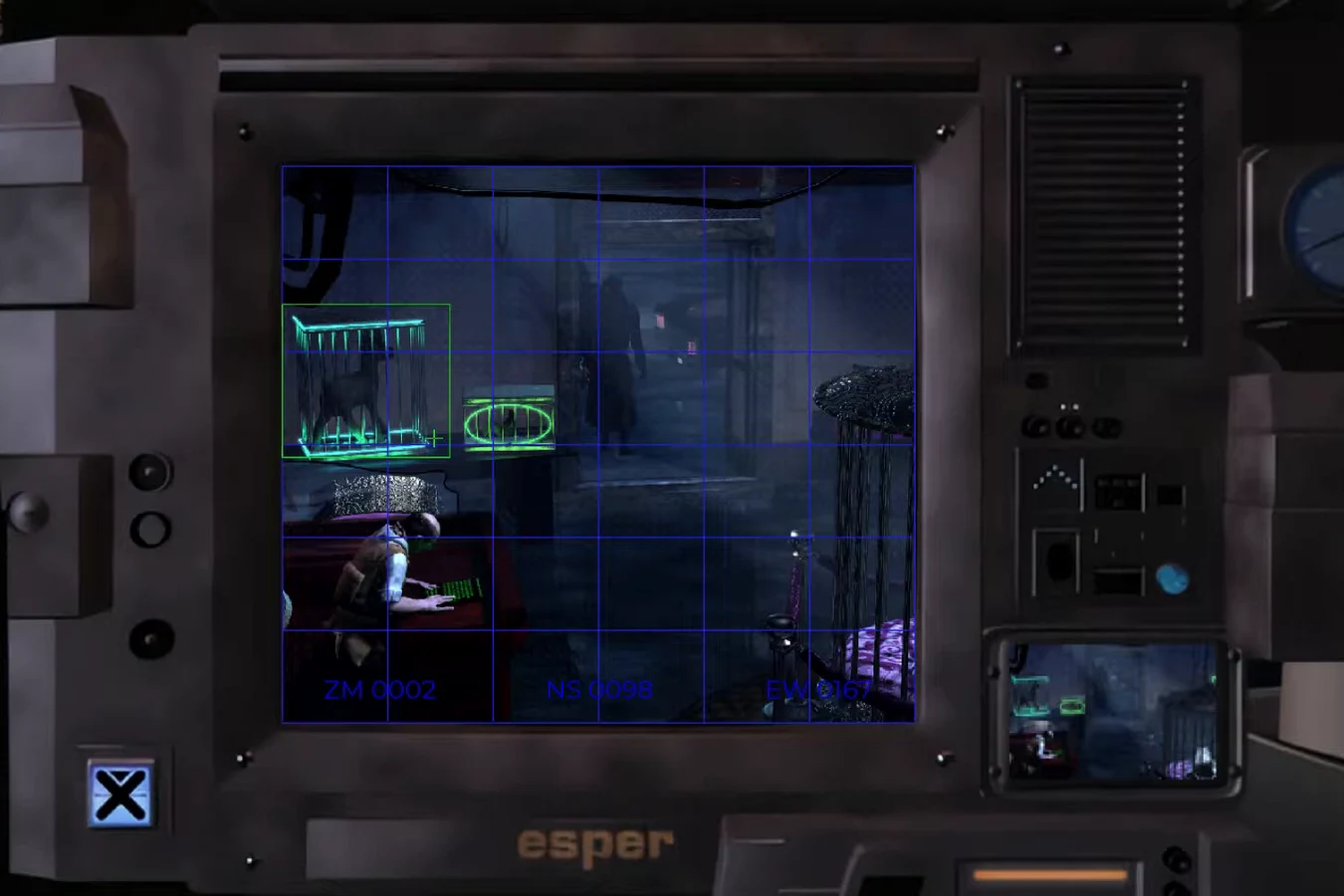
In Westwood's game the Esper was one of the main detective tools of rookie blade runner Ray McCoy, used beside the Voight-Kampff test. Photographs and security discs gathered at crime scenes were uploaded at the mainframe and Esper room of police headquarters, and a smaller unit in McCoy's apartment did the same work at home. The player pans across a full-screen image and drags a box around anything suspicious, and if the box is in the right place the analyzer swings in on the hidden detail. Each find becomes a new photograph in the clue database, so the Esper feeds the case in the same way it fed Deckard's.
The first photographs came from the camera in Runciter's animal shop, where the Esper found the girl Lucy hiding behind the tiger cage, a dragonfly anklet and a sushi menu from Howie Lee's on her desk. A second shot showed Clovis at the door, mud on his boots and the license plate of a black ground car. Later images exposed Sadik holding a bomb on a Tyrell security disc and put Sadik, Clovis and McCoy himself around a Moonbus, while the home unit found Izo and Guzza on another disc. Some photographs change between playthroughs, so the Esper can show different suspects.
Later Appearances
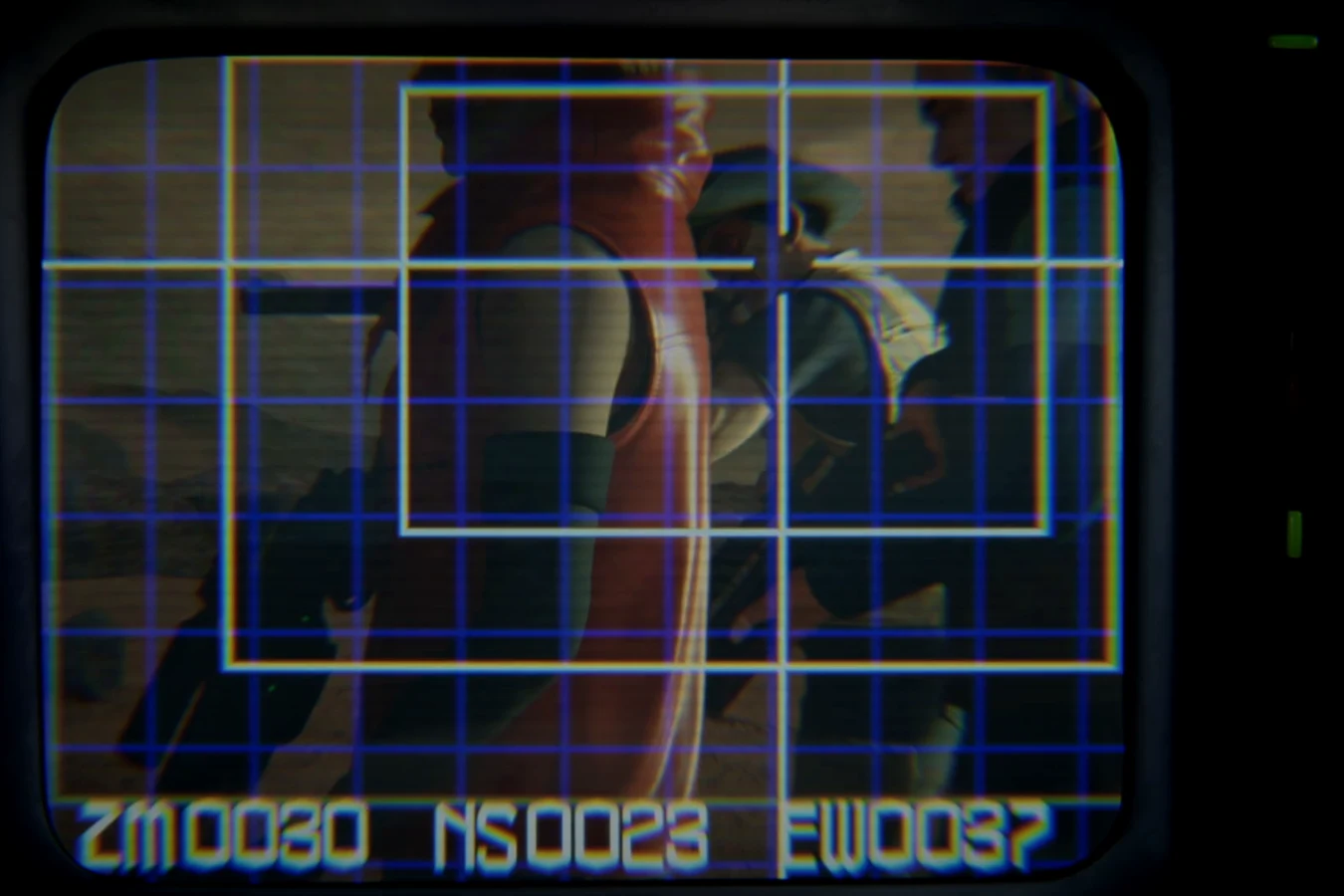
In Blade Runner: Black Lotus, the former blade runner Joseph used an Esper machine to enhance frames from a recording of the hunt that nearly killed Elle. He worked through the footage until he had the faces of a police officer and a blonde woman, giving Elle the leads she needed for her revenge. Doc Badger brought an Esper printer to the apartment and worked through the images while Elle waited. In the 2023 game Blade Runner: Revelations, Gaff had blade runner Harper test a new Esper playback function on his multitool that rebuilt the moments before an attack.
That version needed three points of reference before it could reconstruct a scene as glowing figures that the player could scrub back and forth. Blade Runner 2049 had no machine named Esper, but prop master Doug Harlocker's team built a photo reader for K that echoed Deckard's. The tabletop game gives every blade runner a personal Esper terminal at home and describes Esper photographs that can be explored in three dimensions or printed from one chosen angle. Even the children's photo novel Blade Runner: A Story of the Future had Deckard work an Esper over clothes and a speck from Leon's room.
Behind The Scenes
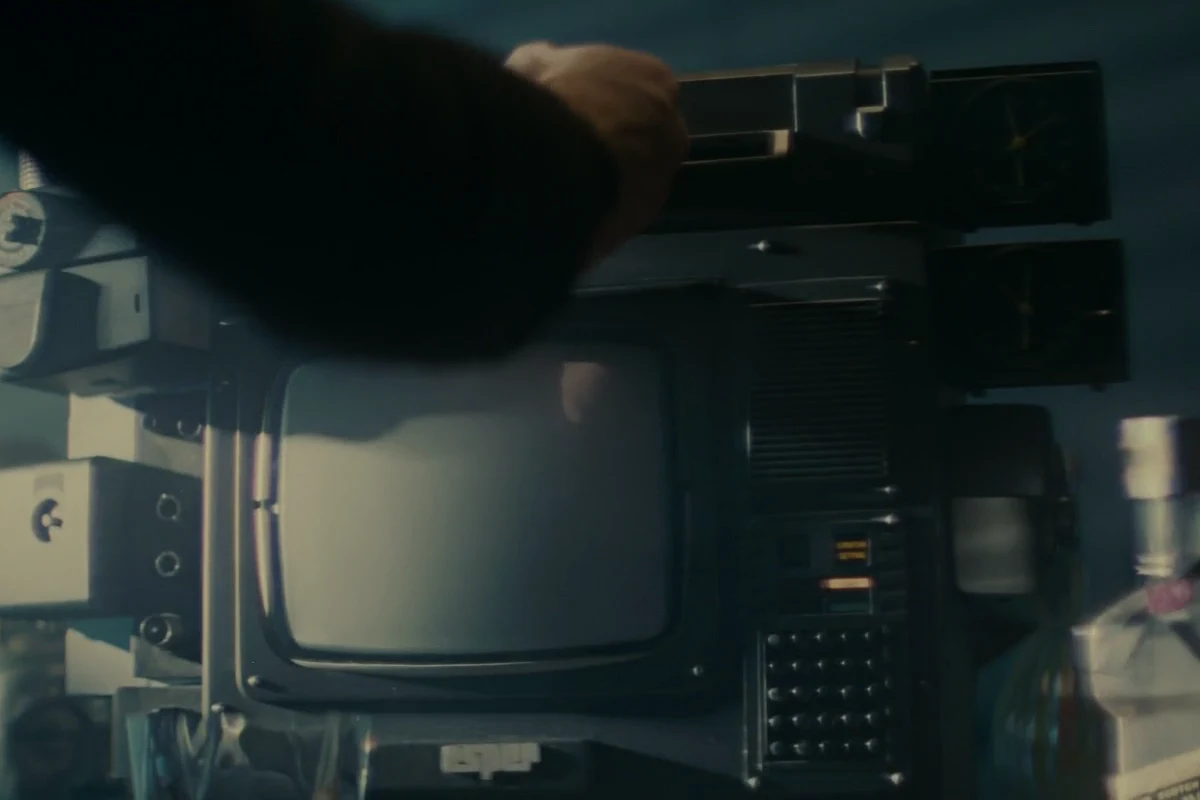
The Esper was one of the most complicated effects in the film, even though it had to look like an ordinary appliance in a cluttered apartment. The prop, the photographs and the animated screen footage were all made separately, by Entertainment Effects Group in Los Angeles and by effects houses in London. Harrison Ford then acted to a screen that played prepared footage, so the scene only works because the timing of his voice and the image line up. Several of the oddities fans have spotted since 1982 come from the way those pieces were reshot and put together.
Building The Prop
Sammon calls the Esper the largest prop built by Mark Stetson's model crew at Entertainment Effects Group, and elsewhere credits its construction to the supervision of Mike Fink. It was a dressed stack of housings and lights around a real monitor, with a slot that took the photograph and another that pushed out the print. Two shafts of light that sweep through the apartment window at the start of the scene came from xenon spotlights of the kind used for night advertising and sporting events. The machine is crowded by bottles, figurines and paperwork in every shot, so it reads as a well-used piece of furniture rather than a showpiece.
Publicity text quoted by Chris M. Rogers promised that the Esper could isolate individuals in crowds, read license numbers and search a room without being there. Rogers suggests the name may have been chosen like a brand, the way Spinner names the police cars. The word esper had long been used in science fiction for telepaths, notably in Alfred Bester's novel The Demolished Man, though the film never explains its choice. Producer Michael Deeley later admitted that the production never really had the money to make the sequence high-tech.
Scripts And Drafts
Editor Terry Rawlings described the Esper of the scripts by Hampton Fancher and David Peoples as a talking supercomputer run by the police, which was originally going to be everywhere, inside cars and out on the sidewalk. Sammon notes that Fancher's draft of 24 July made it a constant presence in Deckard's work rather than a single scene in his apartment. Rewrites whittled it down until the release showed only the home terminal and the screens of the Esper Wall. An earlier idea had the image analysis done with a simple magnifying lens over a normal print, before later scripts moved to holographic images Deckard could travel inside.
Before Ridley Scott hit on the Esper search, Peoples wrote an unfilmed alternative in which Deckard returned to the noodle bar and noticed that the scales on a customer's fish head resembled the one from Leon's bathtub. Scott explained that he gave the replicants photographs because photographs are essentially history, which is exactly what replicants do not have. He also said that Deckard was meant to be drunk in the scene, a Marlowe-like detective puzzling over old photographs late at night. The whisky bottle that travelled with him to the printer was meant to show how much he had been drinking.
The Film Within The Film
Effects supervisor Douglas Trumbull's team built a small set beside the Tyrell office set to stand for the rooms in Leon's photograph. David Dryer of the effects team explained that it was built as two and a half small, interconnecting hotel rooms. The far room had a mirror reflecting its unseen side, which held another mirror reflecting a small alcove that could not be seen from the first room either. That alcove, where the hidden woman lay, was lit to look like the paintings of Vermeer and Edward Hopper.
Rutger Hauer was placed at a table with his back to the camera, and a five-second exposure was meant to blur his head as if he had turned when the snapshot was taken. A motorized Nikon still camera on a dolly was pushed through the set, panning and tilting as it shot the mirror reflections that would reveal the hidden woman. Close details such as a whiskey bottle, two glasses and a fan were shot separately as large 8x10 transparencies. All the stills were rephotographed in sequence on motion picture film and tied together by Don Baker on an animation stand.
John Wash added the coordinate points, crosshairs, zooming rectangles and blue flashes, and the finished footage was transferred to videotape and played on the prop monitor while Ford performed. Ford spoke his commands at a pace timed to suggest that the machine was reacting to his instructions. Trumbull called it a weird, voyeuristic scene, as though one holographic image had everything in the whole building recorded on a single frame. Writer Chris M. Rogers connected the effect to the Dutch perspective boxes of the 17th century, painted peepshows that seem to hold whole furnished rooms.
The Police Terminal Set
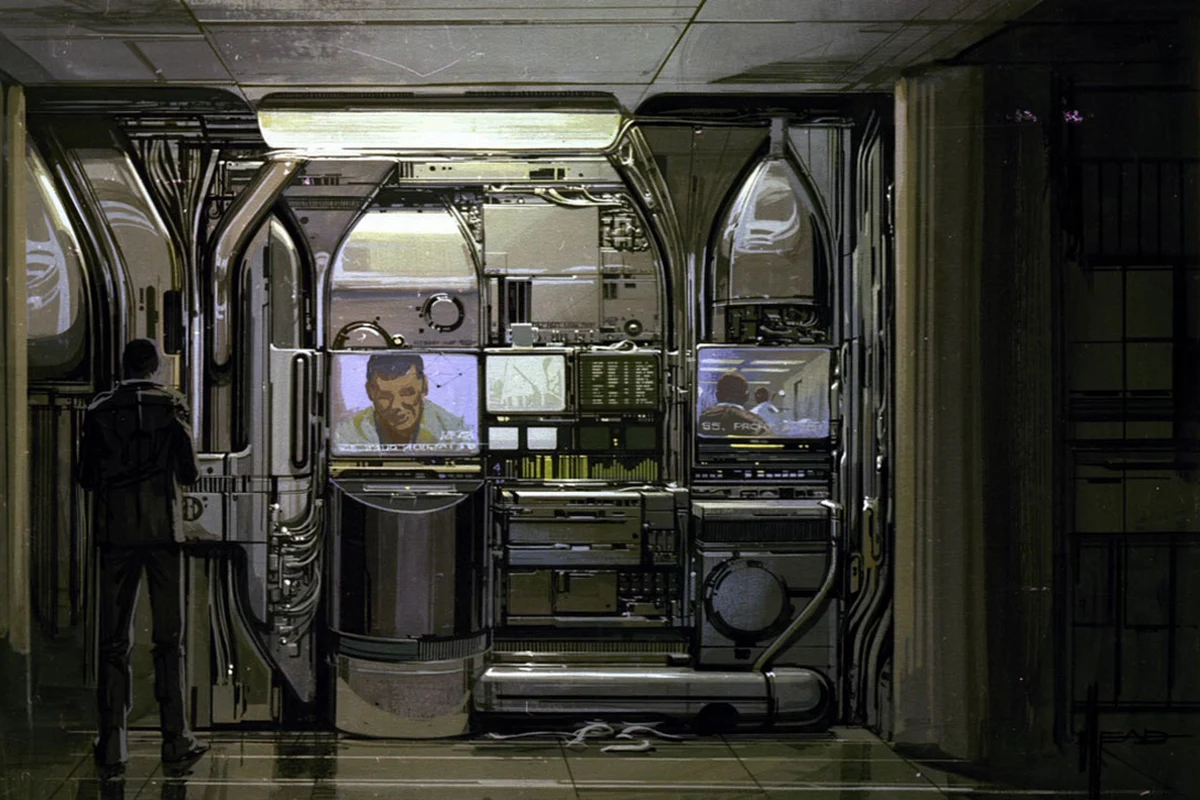
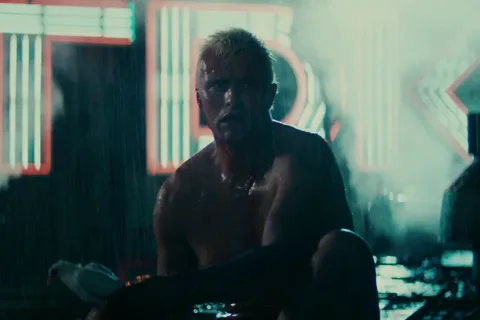
The Blue Room was built on a Burbank soundstage and named by the crew for its cold blue light. Rutger Hauer remembered that the incept tapes for its monitors were made by putting nylon stocking caps on the actors' heads and filming them on a turntable at Warner Brothers. Joanna Cassidy, Daryl Hannah and Hauer each kept a blank expression and turned in a circle while the camera ran, which gave the Esper Wall its eerie mugshot quality. In the finished film the wall is shown only in close-ups of its screens, so the console behind them never appears in full.
The shooting script of 23 February 1981 included two hospital scenes in which Deckard visited Holden. The second visit ended with a pullback revealing that Bryant and Gaff had been spying on the whole conversation on a monitor. Scott cut both hospital scenes as redundant, but the footage surfaced among the deleted and alternate scenes released with the 2007 Final Cut collector's edition. That material shows the full police terminal, so the complete machine existed as a set even though the release showed only its monitors.
The console is a faithful build of a Syd Mead production sketch of the Esper terminal, down to the orange neon tubes on either side of the monitor. In the cut shot Gaff holds a coffee cup beside Bryant, and the orange neon differs from the blue used in the released Blue Room scene. The fan edit White Dragon Cut 5 later composited this footage into the Blue Room briefing. It put Leon's Voight-Kampff test on the monitor, turned Gaff into a silhouette of Deckard, erased the cup, added cigarette smoke and kept the orange neon from Mead's sketch.
The London Reshoot
After principal photography ended, Scott moved to England for postproduction and decided he was not satisfied with parts of the Esper sequence. He ordered a selective reshoot by the London companies Filmfex and Lodge/Cheesman, who redid several close-ups and replaced the blurred head with a still figure seated at the table. The new insert shots used another performer handling a different photograph and a different machine, while the master shots of Ford stayed from the original shoot. The original version of the sequence can now only be seen in the documentary Dangerous Days.
The face on the Esper screen does not belong to Joanna Cassidy, who played Zhora. Sammon confirmed with the actress that the woman on the daybed is an anonymous stand-in in every shot, added after Cassidy had finished her work, and Cassidy said she could have killed Scott when she saw it. Some views of the man at the table are also a double, and producer Michael Deeley admitted that nobody could remember which shots were Rutger Hauer. Cassidy is not in the hard copy either, since the print was made from the same stand-in footage.
Continuity And Versions
The reshoot left a famous continuity error. Deckard picks up the new photograph from the piano, but the print he holds in his mouth as he walks to the Esper is the original one, which prop builders identified by the word Polaroid along its edge. When he inserts it, the screen shows the replacement image, so two different photographs appear within a few seconds. Sharp-eyed fans also noticed that the face on the hard copy is turned at a different angle from the face on the Esper screen. Rawlings admitted that the team never noticed the mismatch at the time and only learned about it when fans pointed it out.
The Workprint differs in small ways. Deckard mutters "Hello, Roy" when the figure at the table appears, and his voice asks "Zhora or Pris?" after the print comes out, showing that he did not yet know which replicant he had found. Sammon notes an extra low whirring sound from the machine and a somewhat different Vangelis cue in the same version. Rutger Hauer later called the sequence one of his favourites because it says "Watch me create a lie," with a false Roy, a false Zhora and a photograph that hides a second person in the room.
Screen Graphics And Lettering
Dave Addey's design study Typeset in the Future noticed that the coordinates rarely follow the orders. Whatever Deckard asks for, the readout settles on NS 0197 and EW 0334 while only the zoom figure changes, a detail that is easy to confirm in the frames of the Final Cut. Addey calculated that the last close-up of Zhora amounts to roughly a 668-times zoom into the original snapshot, and he called the sequence perhaps the earliest example of the "enhance" button in popular fiction. He also drew a floor plan of the hotel rooms, concluding that the final view is probably a reflection of a reflection.
The edges of Leon's snapshots carry red technical-looking codes, applied with Letraset rub-down lettering. Typeset in the Future noticed that the codes read "HELCLN/IUM pt47" and "VETICA MED/CLN pt47," fragments of the header text from a used Letraset sheet of Helvetica Medium Condensed. The art department seems to have cut up the leftover edges of the sheet rather than letting them go to waste, and the code is visible on the photograph Deckard holds at the piano. The same study traced the film's opening crawl to Goudy Old Style, part of a wider look at how ordinary graphic tools of 1982 built a convincing future.
Conclusion
The Esper turned a single snapshot into a crime scene, letting Deckard search Leon's hotel room from his armchair and find Zhora in a mirror. Behind those few minutes stood a much bigger police system, from the Esper Wall at headquarters to the full terminal Bryant and Gaff used to watch their own officers. Jeter turned it into everyday LAPD gear and a surround projector for Iris Knaught, while Westwood made it the heart of McCoy's detective work. Later stories kept rebuilding it for each new era of Blade Runner.
The scene also carries the film's central doubt, because the machine revealed a woman hidden in a photograph that was never quite what it seemed. It shows how much a single image can hide and how easily it can be shaped, in a world where replicants treasure photographs as proof of a past. Many later "enhance" scenes in crime television follow the pattern Deckard set in his apartment in 2019, spoken numbers, a moving rectangle and a print at the end. The scene remains one of the most quoted in the film, from the voice commands to the grainy photograph in Deckard's hand.
Appearances
- Blade Runner (1982 film)
- Blade Runner: A Story of the Future by Les Martin (1982)
- Blade Runner 3: Replicant Night by K. W. Jeter (1996)
- Blade Runner (Westwood, 1997 game)
- Blade Runner 4: Eye and Talon by K. W. Jeter (2000)
- Blade Runner: Black Lotus (2021-2022)
- Blade Runner RPG (Free League, 2022)
- Blade Runner: Revelations (2023 game)
Tag Categories: Blade Runner Lore