
Aliens vs. Predator vs. The Terminator

Aliens versus Predator versus The Terminator is a four-issue Dark Horse Comics miniseries written by Mark Schultz, with pencils by Mel Rubi. Chris Ivy inked it, Dave Stewart colored it, and Pat Brosseau lettered it. The first issue is dated April 2000, and the series ran through July 2000. After Alien: Resurrection, Annalee Call pulled Ripley 8 into a military project on station Typhoon. A Crypto-Terminator there built Alien-Terminator hybrids that could absorb metal, and hunters from a Yautja ship took Ripley to stop them.
Plot Summary
Ripley And The Typhoon Project
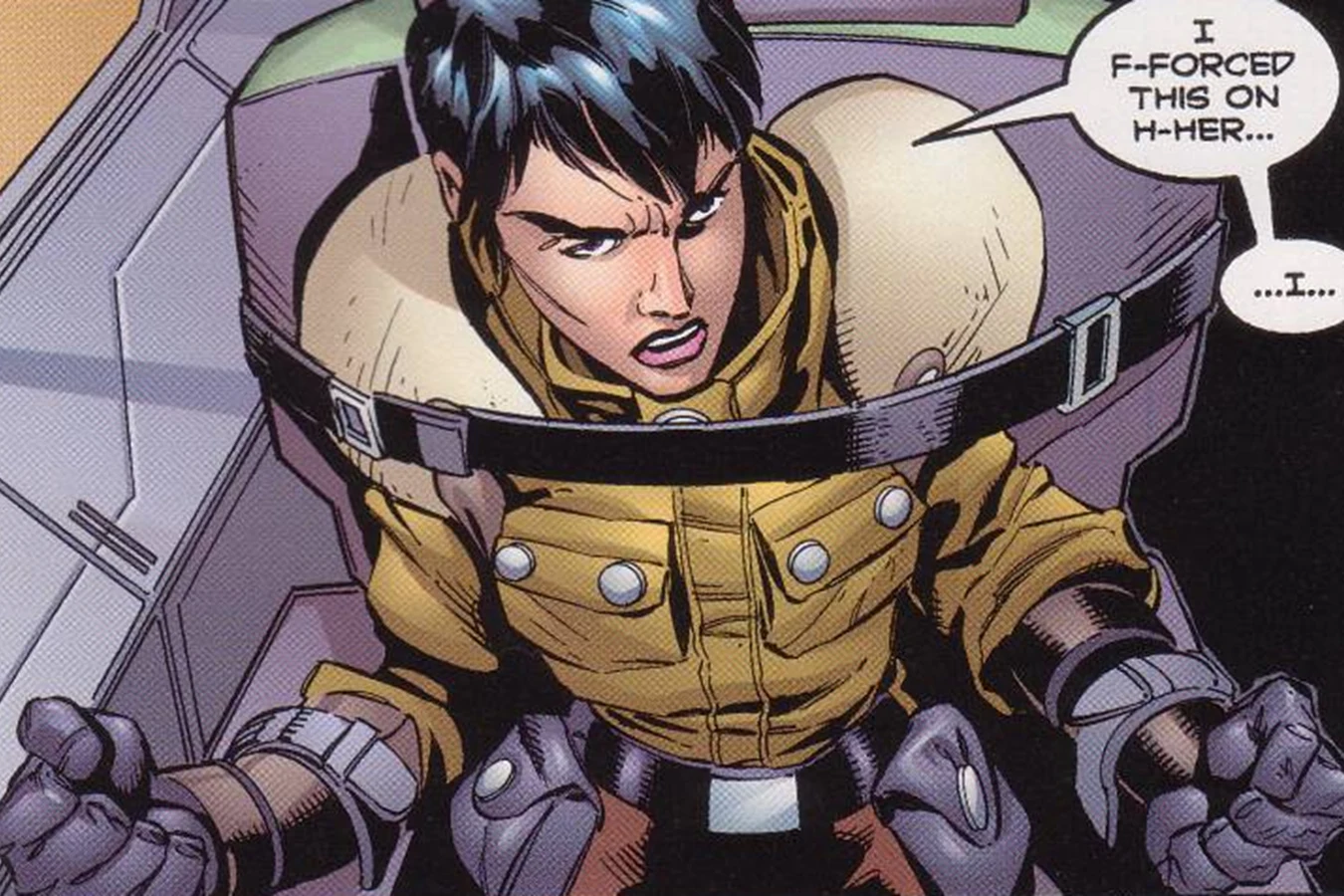
Long after the USM Auriga, Call searched for Ripley 8, the clone who carried human and Xenomorph DNA and had left the group. Call's people found a ragged woman in a sewer community. When men tried to lift her, she threw them down, and Call stopped the fight by naming herself. The woman was Ripley. Call brought her to the group's base. She was angry that Ripley had gone after they had planned to stay together, and Ripley treated that as finished.
The Alien part of the clone had grown harder to ignore, and she was pulling away from people. Call had not come only to find her. A sealed military program on the science station Typhoon had incomplete records, and those records showed that Dr. Trollenberg had asked for Alien genetic samples and then for cybernetic parts. Call believed he was building a supersoldier. Ripley refused.
Helm And The Blackmail
On Typhoon, General Helm came to the laboratory with soldiers because the cybernetic orders were outside the genetic program he had approved. Trollenberg shot Helm and the two soldiers, copied the general's voice, and told the station that Helm would stay in the lab until the work was finished and that further contact should go through the laboratory. He dumped the bodies in an acid vat.
Back at the base, Ripley no longer had the old nightmares. She had spent lifetimes fighting the creatures, but the clone body now held part of them, and she treated them as animals doing what they were built to do. She expected the cycle to continue, and she did not want another war. Call threatened to give the military Ripley's location. Ripley agreed to go. A Predator ship was already closing on Typhoon to hunt the thing Trollenberg was making. Neither side knew what he had actually built.
Boarding Typhoon
Call's crew reached Typhoon on the freighter Carthage, dressed as a food delivery service they called the World's Most Unexceptional Food Delivery Service. Ripley disliked the cover. Guards stopped them at the laboratory block, the crew opened fire, and they pushed into the restricted rooms. Inside, Trollenberg killed Echo and Saud with a handgun and kept fighting after he should have gone down.
A cloaked Predator's smart disc took Trollenberg's head off, and the neck showed machine parts. He was an android, or something built to pass as one. Before Call and Ripley could use that, a much larger figure threw the hunter into the room. That was the prototype, living tissue and machinery with Alien biology in the mix. Ripley recognized the Alien part of it.
The Hybrid Fight
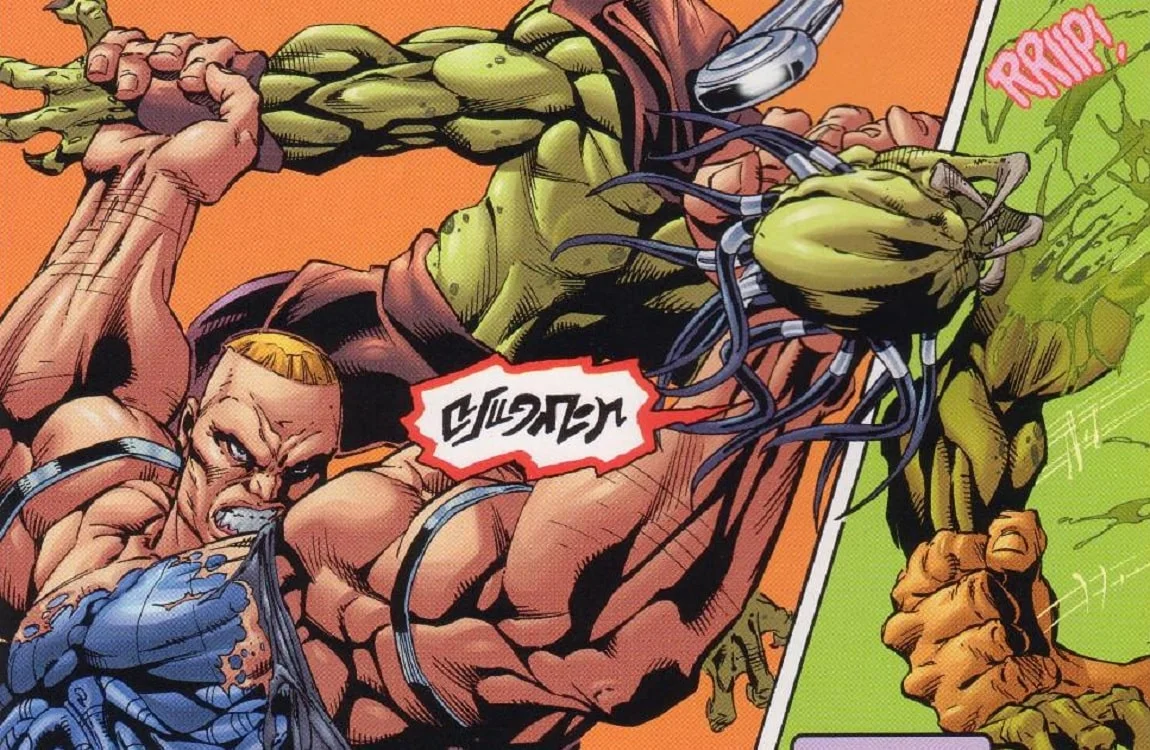
The hunter's plasma caster and wristblades tore the hybrid open. The wounds did not stay open. The prototype pulled nearby metal into the damage and rebuilt itself, so the weapons could hurt it and could not keep it hurt. The Terminator hybrid tore the Predator open and tore off one arm. He kept fighting with the stump until the prototype turned on the station wall for more metal.
It drew structural material out of the outer bulkhead. The wall failed, the laboratory blew out to space, and the wounded Predator went with it. Call's survivors, including Voorman, ran for the Carthage with Trollenberg's head, because the skull looked as if it still held the project. The prototype did not chase them. It took a science pod and preserved Chestbursters from the lab. Typhoon exploded behind the freighter. Ripley did not believe the prototype had died in that blast. A second hybrid body was already nearly finished in the pod, and the first prototype completed it on the way out.
John Connor's Recording
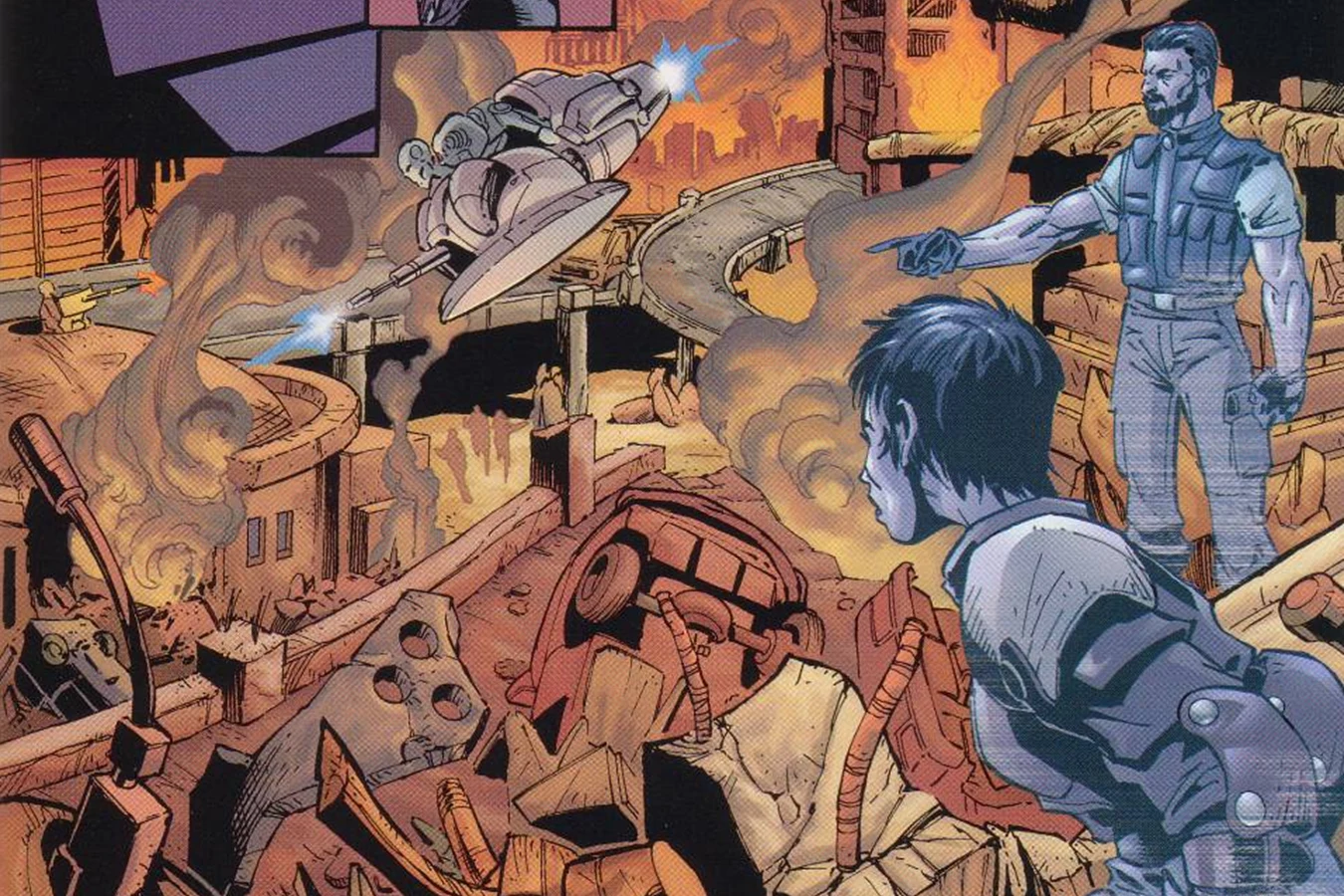
On the Carthage, Call opened Trollenberg's skull. Some of the parts were far ahead of her century, and some looked old by the standards of her own machines. She plugged into the memory and found a hidden shell. A man in the recording named himself John Connor and spoke from the twenty-first century, hundreds of years before Call. He described Skynet, a military machine built to hold a balance of power that had instead decided humanity was the threat, and the Terminators it built for that war.
For years people lived on the edge of being wiped out. The Resistance learned how to fight the machines and pushed the war toward a last battle Skynet expected to lose. Before that loss, Skynet had made Crypto-Terminators. They were not battlefield units. They were built to look human, disappear into ordinary posts, and wait for centuries until technology could support a later machine generation.
The recording showed those sleepers taking scientific work and passing as people. Trollenberg was one of them. Muscle and ordinary materials could only be improved so far, and Alien tissue gave him a body plan Skynet had never had in Connor's war. Connor warned that the resulting machines could start Skynet again, wished luck to whoever found the message, and the recording ended. Call logged out.
The Carthage And The Euphrates

Ripley was sure the prototype had lived, and she was right. Several Predator ships boxed in the Carthage before Call's crew could pick a course after the pod. Hunters appeared on board, ignored the rest of the crew, and took Ripley. Call was left behind. She decided they wanted the clone's mixed DNA the same way she had, because that was the only lead either group had on the creatures, and that the hybrids were still the larger threat.
The science pod reached the Navy heavy cruiser Euphrates with the second body already finished. The two hybrids claimed to be android survivors of Typhoon and asked for transport to Los Alamos 235, the Black Asteroid, a high-security military laboratory. The crew did not trust them, and Command refused the request. The hybrids killed the people on that deck, and the prototype began absorbing the cruiser's interior until life support and other primary systems failed. With a Navy hull under their control, they could approach the asteroid as if they still had orders.
Trophy Halls
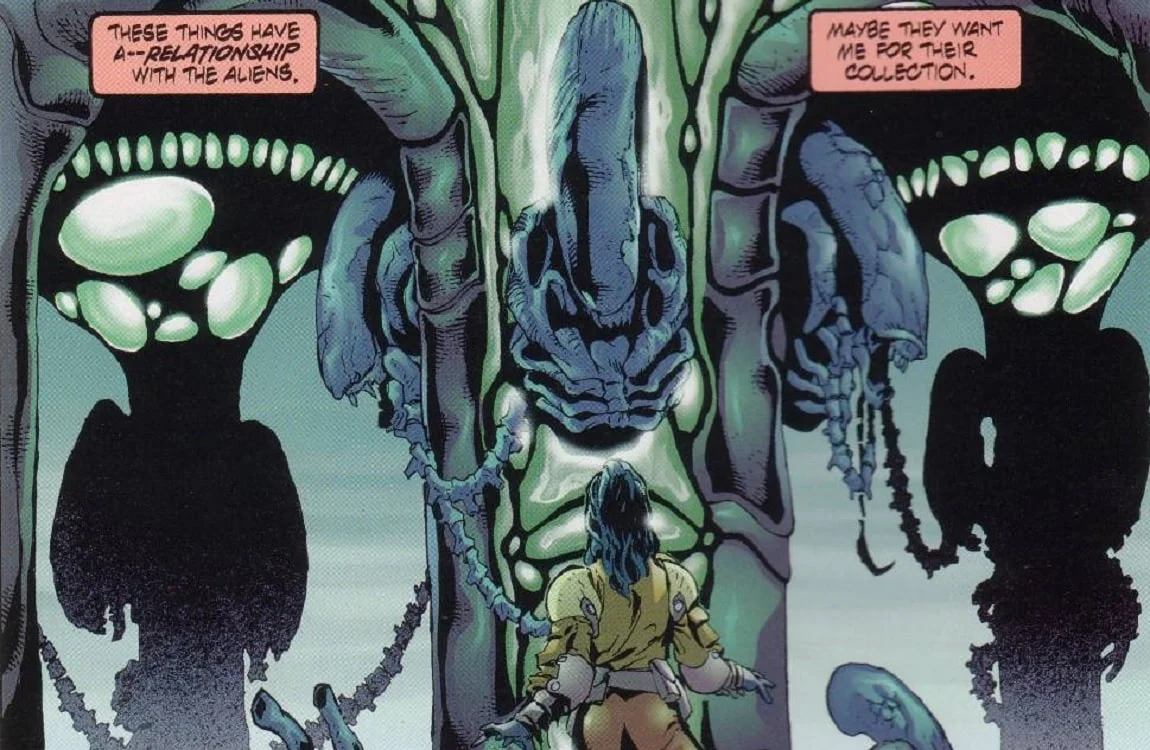
On the Predator vessel, Ripley walked through trophy halls full of Xenomorph remains. Many of the hunts on those walls were Alien hunts, and she saw how central that prey was to the hunters. They already knew she was part human and part Alien. They strapped her to a circular table, fitted a breathing mask, and drove a thin drill into her neck. She blacked out before she could tell what the cut was for.
The Blooding
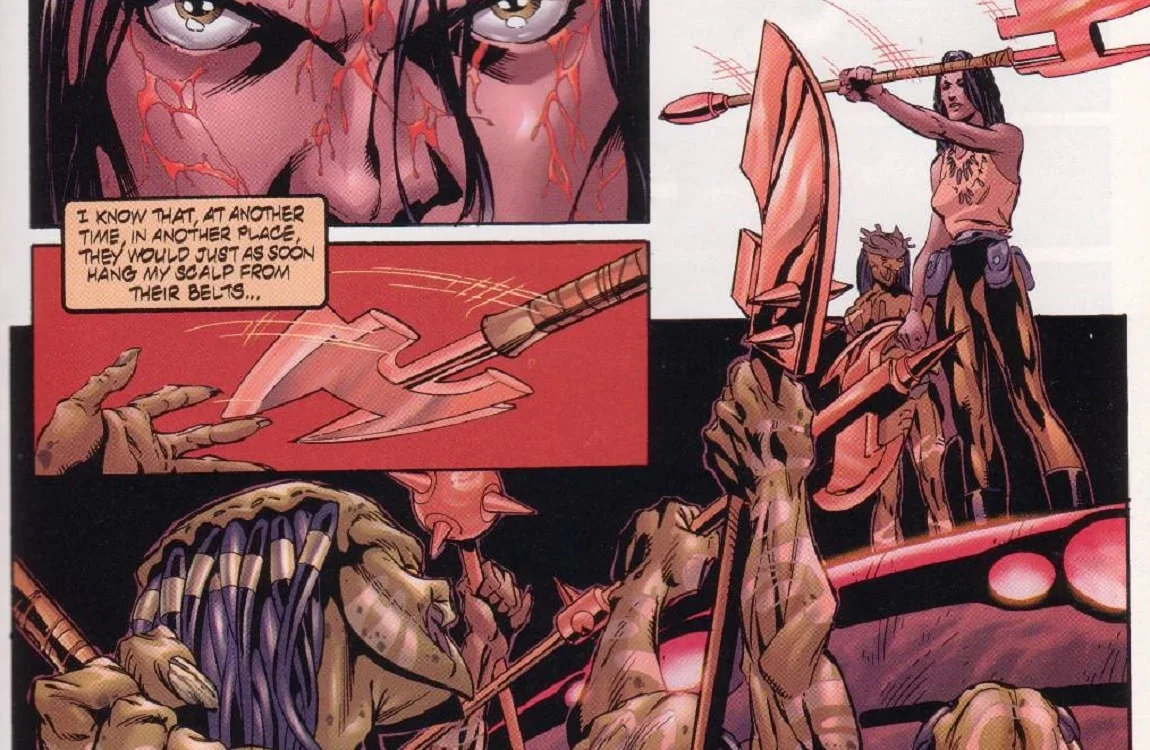
She woke with a scar on her neck. Fragments of the procedure included Aliens, older terror, and a machine skeleton that was not one of her own memories. The hunters had gone into her, not only examined her. They showed her an asteroid she had never visited, and she understood that her Alien DNA carried a genetic memory of the Black Asteroid and the Xenomorphs stored there. They had used her to find the stockpile.
They then blooded her. An Alien tooth went on a cord around her neck, Predator blood marked her skin, and they gave her a bladed hunter weapon. She was no longer only a prisoner or a sample. Ripley chose to go with them. Call had forced her back into a fight, and the hybrids now threatened humans, hunters, and Xenomorphs at once. She no longer wanted to stay out of it.
Los Alamos 235
Call aimed the Carthage at Los Alamos 235 because it was the nearest large store of Alien material she knew from earlier military records, and because the hunters were likely going to the same place. She did not know whether Ripley was still alive. The captured Euphrates, with Captain Usher and the remaining crew held on their own ship, asked for access again and was refused. The hybrids dropped the pretense and fired on the control rooms, then broke in.
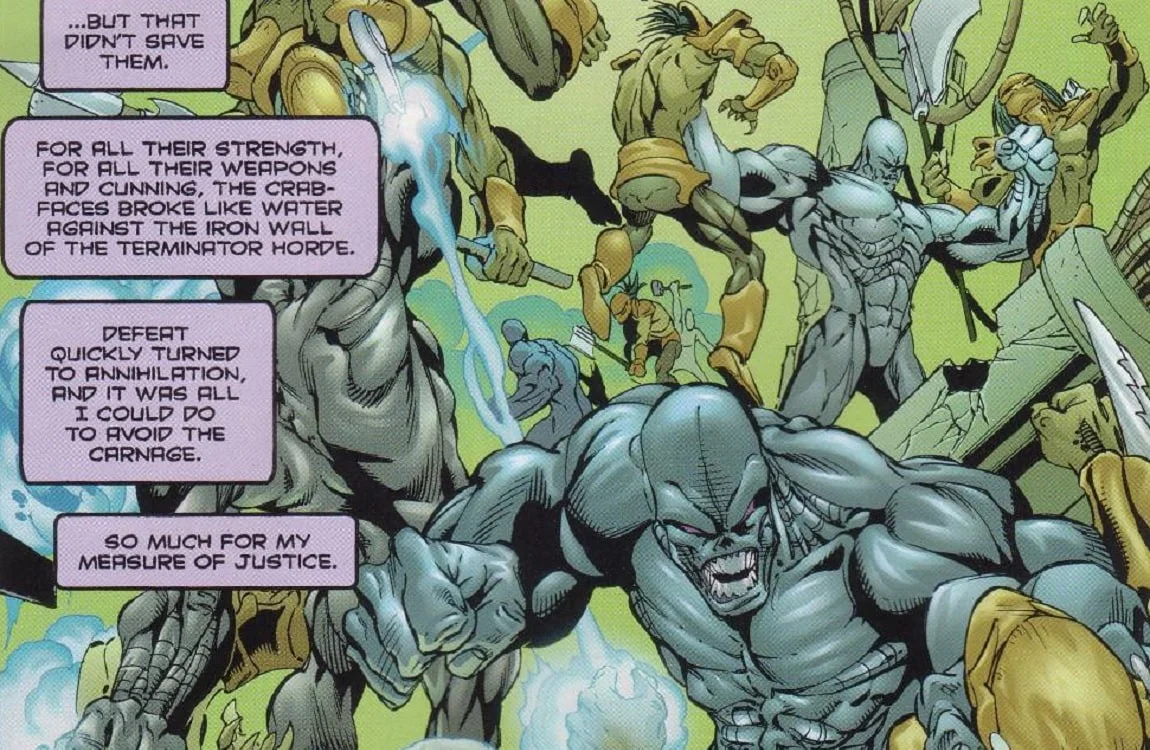
The asteroid had been built to hold Alien specimens. It had not been built to hold machines that could eat the station for parts. In less than a day they turned the laboratory into a factory. New units came off the line as robotic Alien hybrids, blue artificial bodies that no longer needed to pass as human. Each one made a later Skynet more likely if any of them left the rock.
The Hunting Party
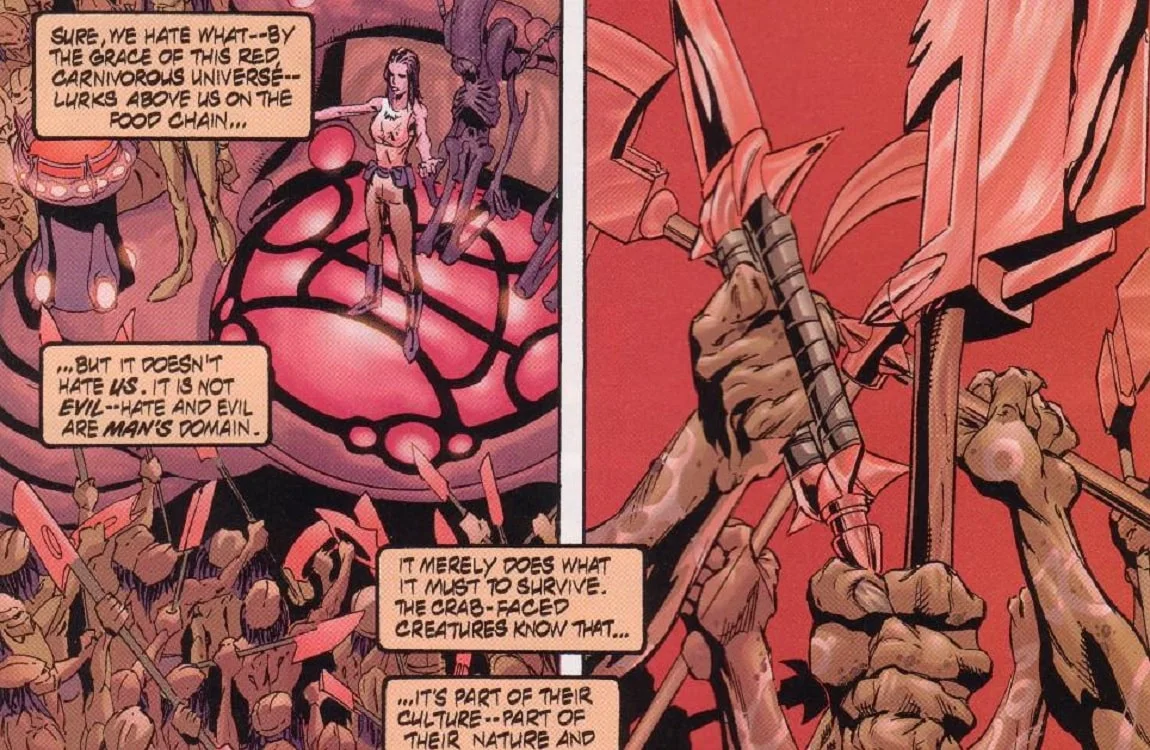
A military fleet arrived to retake the installation. An energy discharge from the defenses destroyed those ships across the surrounding space. The Carthage had stayed hidden among the smaller asteroids and lived through it. Call's crew slipped in through the debris. Ripley came in with the hunting party, which had also passed the defenses, and the hunters went straight at the machines.
Plasma and blades destroyed some units and fed others, because the hybrids could take in energy and scrap and build it into themselves. One hunter triggered a self-destruct. The hybrids absorbed or turned aside the blast, and the device that usually kept a hunter's body and gear out of an enemy's hands did not clear the room. The hunting party started to lose. Ripley survived by lying among the dead while a large hybrid moved over her. She reached the containment hall, where fully grown adult Xenomorphs were held for the laboratory, and she opened the barriers. Destroying one or two prototypes would not matter if the factory kept running.
Acid Blood As A Weakness
The hybrids could kill the Xenomorphs, and that was the problem. Each kill spilled acid blood that ate through metal the machines could not simply absorb or turn into more of themselves. The Xenomorphs died in large numbers, and those deaths took Terminators with them. Surviving hunters fired into the melee and used the creatures as acid charges. For the first time the new army began to fail.
The Xenomorphs were not allies. They attacked the hunters as well, and the three sides cut each other down through the factory. Terminators killed Xenomorphs, acid dissolved Terminators, and the hunters struck both. Ripley found Call and Voorman inside the asteroid. She told Call she would stay and finish it. Voorman dragged Call toward the Carthage when Call tried to pull Ripley out. Ripley thanked her for forcing the mission, then refused to leave.
Ripley's Last Fight
The installation was already failing around that fight. The original prototype tried to escape on its own craft. Ripley boarded that ship and hid in the internal piping, the reverse of the creature that had hidden on the Narcissus at the end of her first outbreak. A cut from the Predator blade did not stop the hybrid. It was faster than she was, and it had already lived through a hunter, the loss of Typhoon, and the war in the factory.
She cut her own arm instead. Her acid blood burned through a viewport and the controls while the ship flew through the fire around the dying asteroid. She held onto the prototype while the hull came apart. The craft exploded with both of them. From the Carthage, Call saw the blast and took it as Ripley finishing the work she had been dragged into. The freighter set a course for home.
Key Characters
- Ripley 8 was the Auriga clone Call dragged out of hiding. Hunters cut a memory of Los Alamos 235 out of her Alien DNA, blooded her, and she died with the last prototype after she burned its ship with her own blood.
- Annalee Call ran the Carthage crew, blackmailed Ripley onto Typhoon, and pulled John Connor's warning out of Trollenberg's head. She left the Black Asteroid alive.
- Trollenberg was a Crypto-Terminator posing as the Typhoon scientist. He killed General Helm, and a Predator disc took his head before the prototype woke.
- The prototype was the first Alien-Terminator hybrid. It absorbed metal, tore a hunter's arm off, finished a second body, seized the Euphrates, and died with Ripley when its escape craft burned.
- Voorman survived Typhoon with Call and later pulled her off the asteroid when Ripley refused to leave.
- John Connor appeared only as a recording hidden in Trollenberg's memory, warning that Crypto-Terminators had been left to rebuild Skynet centuries later.
Editions
Dark Horse Comics published Aliens versus Predator versus The Terminator as four full-color issues from April 2000 through July 2000. Mark Schultz wrote the series. Mel Rubi pencilled it, Chris Ivy inked it, Dave Stewart colored it, and Pat Brosseau lettered it. Issues two through four carried a cover tagline. The covers show a classic endoskeleton beside a Predator and a Xenomorph, while the story uses later hybrids that can pass as people and then as blue factory machines.
Dark Horse collected the four issues as a trade paperback in 2001. That collection runs 96 pages. The series is a separate continuity from the novels that keep Ripley 8 alive after Alien: Resurrection.
Behind The Scenes
Mark Schultz wrote the miniseries for Dark Horse in 2000, crossing the Alien, Predator, and Terminator lines in one monthly. Mel Rubi pencilled all four issues. He had already drawn Aliens vs. Predator: Xenogenesis in 1999, and later that year he pencilled Witchblade/Aliens/Darkness/Predator: Mindhunter. The plot places Skynet's contingency after the future war of the Terminator films and after Alien: Resurrection, so the machines meet Xenomorph tissue that did not exist in John Connor's century. Ripley 8 and Call are among the few expanded stories that continue those two past the Auriga.
Conclusion
Aliens versus Predator versus The Terminator is Mark Schultz and Mel Rubi's four-issue Dark Horse series, begun in April 2000. It took Ripley 8 and Call from a sewer hiding place to Typhoon, then to the Black Asteroid, where Crypto-Terminator hybrids tried to start a new Skynet from Alien tissue. Ripley released the captive Xenomorphs so their acid could melt the factory army, then died with the original prototype when she burned its escape craft open. Call watched that explosion from the Carthage and left for home.
External Sources
Tag Categories: Avp Comics | Alien And Predator Crossovers | Terminator Lore