Dune Messiah is the second novel in Frank Herbert's Dune Chronicles, first published in 1969. Twelve years after Paul Atreides seized the throne, the Fremen had conquered worlds in his name and his priesthood had turned his reign into a religion. The Spacing Guild, the Bene Gesserit and the Tleilaxu conspired to unseat him by exploiting his attachment to Chani and his old friend Duncan Idaho. The novel follows the aftermath of the events covered in the graphic novel adaptation of the original Dune.
Plot Summary
Bronso of Ix and the Jihad
The book opened with a record of the interrogation of Bronso of Ix, who had been condemned for challenging the official account of Muad'Dib. His interrogators wanted to know why he had written about Paul the man when orthodoxy demanded that he write about Paul the god. Bronso treated the reign as a historical puzzle. The same man who had gained extraordinary knowledge of the future had helped unleash a movement that overwhelmed his ability to direct it.
Twelve years after Paul defeated Shaddam IV, Fremen armies had carried his religion across the Imperium. When Korba brought a record of the jihad before him, Paul estimated that his armies had killed sixty-one billion people, sterilized ninety planets and wiped out the followers of forty religions. Korba defended the campaigns in the language of conversion, and Paul insisted on counting the people his armies had killed as believers in their own right. Arrakeen now housed an imperial court, pilgrims and a priesthood whose influence depended on keeping Muad'Dib's divinity beyond dispute. Paul could remember when the Fremen had fought to survive on their own planet, and he could see what they were doing in his name now that they held it. By opening with the interrogation, Herbert also introduced a struggle over the historical record. The Qizarate could punish Bronso for what he wrote, but its need to question him showed how much damage a competing account of Paul could do.
The Conspiracy on Wallach IX
Edric, a Guild Navigator, met Reverend Mother Gaius Helen Mohiam, Princess Irulan and the Tleilaxu Face Dancer Scytale. Each brought a different stake in the Atreides succession. The Guild depended on spice, the Sisterhood wanted to recover its breeding line, and Irulan occupied a throne beside a husband who had never given her a child. The Tleilaxu supplied a means to attack Paul through his private attachments.
The Guildsman's value went beyond his political position. Another prescient could interfere with the range of futures Paul could see, giving the conspirators a place to meet and act in relative secrecy. Their plan exploited two limitations at once. They could work inside the concealment Edric provided, and they could offer Paul something he might knowingly accept even if he recognized it as a trap. Irulan described her interference with Chani's fertility at the meeting, making the imperial household part of the plot before the Tleilaxu gift reached Arrakeen.
Irulan and Chani's Unborn Heir
Irulan wanted a child by Paul, which could give the Corrino princess an enduring place in the dynasty and serve the Bene Gesserit breeding program. Paul reserved that place for Chani. The distinction between his formal wife and the woman with whom he shared his life left the succession dependent on a pregnancy that had repeatedly failed to happen.
Irulan had secretly administered contraceptives to Chani. The delay served the Sisterhood, but Paul's own knowledge of the possible futures complicated the situation. He understood what an heir might cost Chani, and the postponement gave them more time together. Chani experienced the delay as something she had to resolve herself, with little reason to suspect how many people had already made decisions about her body. By withholding the full truth, Paul left Chani to visit physicians and turn to the prayer wall at Sietch Tabr without understanding why those efforts had failed.
Scytale Visits Farok
Farok, a former Fedaykin, gave Scytale a view of the jihad from outside the palace. He remembered the sea he had encountered on another world and the shock of being able to enter water that no one needed to guard. His son had lost his sight to a stone burner on Naraj, an earlier instance of the weapon that would be used against Paul. Through Farok, Scytale could hear how the campaigns had changed Fremen who had once shared Paul's cause.
Scytale also identified an opening into the emperor's old circle. Otheym was dying, and his daughter Lichna could deliver a message that Paul would take seriously. Lichna had come to see Farok's son, who had been giving her semuta. Scytale killed Farok and his son with poisoned darts, got Lichna to leave with him and later took her place. The impersonation relied on the trust Paul placed in surviving comrades and their families, which gave a Face Dancer a way to approach him through an obligation that an official visitor could never invoke. Farok had considered getting his son Tleilaxu eyes, but the young man feared becoming dependent on their makers. That choice foreshadowed Paul's own refusal after the attack in Arrakeen.
Edric Presents Hayt
Edric arrived at Paul's court with Hayt, a ghola made from the remains of Duncan Idaho. Duncan had died defending Paul and Jessica during the fall of House Atreides. The Tleilaxu had restored his physical likeness and given him metal eyes, Mentat training and a Zensunni education. He had neither consciously lived Duncan's life nor been told everything about the purpose for which he was made.
Paul kept Hayt close despite the obvious danger. The gift offered contact with a friend whose death had helped Paul survive, and Hayt could already give him sharp advice. Hayt also understood that his makers might have trained him to harm the people whose welfare now mattered to him. His inquiry into who he was therefore became as important to the conspiracy as anything Edric did at court. Hayt's metal eyes made the difference visible every time Paul looked at him. Even his new name belonged to the people who had sent him, leaving the ghola to work out what he owed those makers and what he owed the Atreides.
The Reverend Mother's Imprisonment
Mohiam came to Arrakis despite restrictions on her presence. Paul had her taken into custody, but imprisonment still gave the Reverend Mother a chance to press Irulan about the succession. Irulan had delayed Chani's pregnancy without securing the outcome the Sisterhood wanted. Mohiam was prepared to make Chani's position more dangerous if delay ceased to work.
Paul eventually offered the Sisterhood access to his genetic line through artificial insemination. It would give the order something it wanted while leaving Chani's place in his household intact. The proposal crossed a line in Bene Gesserit doctrine, and Mohiam had little freedom to accept it. It also exposed a weakness in the conspiracy, since any agreement with one faction might give it a reason to abandon the others. Her discussion with Irulan also showed how little leverage the princess had gained through the marriage. Mohiam expected her to direct the succession from inside a household where Paul had already made his choice.
Alia and the Dead Woman
Alia had possessed ancestral awareness since before birth. In adulthood she was both an Atreides political actor and an object of religious devotion. Her bout against a training machine showed how little room she had for ordinary vulnerability. It also drew Hayt's attention to the risks she took, and their conversations gave each a chance to speak with someone who understood the difficulties of living with memories inherited from someone else.
The discovery of a dead young Fremen woman touched the problem of the Face Dancer disguise. Alia used spice to search for a clearer view, but she could not simply read the future at will. Her visions and her exchanges with Paul showed that two people with extraordinary awareness could experience the danger differently. What the conspirators had concealed could still enter the palace as an apparently ordinary request for help. The possibility of a disguise mattered because the plot depended on ordinary people trusting familiar voices and faces. A warning from a vision could be harder to use than a witness who could say where Lichna had last been seen.
The Falling Moon
Paul saw a moon fall in a vision. He had glimpsed enough of related futures to understand the image as a warning, but it supplied neither an exact date nor a way to escape the loss it represented. Talking with Hayt forced him to consider how much of his conduct had become obedience to an outcome he had already seen. A man who could see several possible futures still had to decide which losses he was prepared to risk.
The image returned as Paul approached the place where he would learn the full circumstances of Chani's death. Duncan later recognized the connection. Herbert let the vision recur before explaining it through events, so Paul and the reader could recognize the same image well before either knew the full shape of the scene at the sietch. The moon also gave Paul a way to speak about his fear without telling everyone around him exactly what he expected to happen. Hayt answered as an adviser who could question the assumptions behind a vision.
Chani Returns to a Fremen Diet
Chani returned to a Fremen fertility diet rich in spice. The change in meals cut off Irulan's opportunity to administer the contraceptive, and Chani conceived. The pregnancy then progressed at an unusual pace. Chani's needs changed rapidly, and the continuing demands on her body gave the household much less time to prepare than an ordinary pregnancy would have allowed.
Once Chani knew she had been drugged, she wanted to hold Irulan responsible. Paul restrained her and had to reckon with the time the interference had given him. His visions had tied the birth to a loss he could scarcely bear to acknowledge to Chani. Her happiness at becoming pregnant and his knowledge of the likely cost made the event a physical emergency and a private crisis long before either of them reached the birth chamber. The change restored some control to Chani. With the pregnancy underway, however, neither the Sisterhood's earlier intervention nor Paul's foreknowledge could give her back the ordinary months of a Fremen pregnancy.
Lichna Brings Otheym's Message
The woman who called herself Lichna told Paul that Otheym wanted him to come in person. Paul recognized that a Face Dancer had taken her place, but the disguise did not make the summons worthless. Otheym really had uncovered a threat, and Paul had a reason to hear a man who had fought for him before he had an empire.
Following the summons meant moving through a future whose dangers Paul already recognized. He could see that attempting to sidestep a particular event could lead to consequences he found worse. Scytale had chosen a message that still mattered even after its bearer had been exposed. Paul went to Otheym's home, leaving his enemies in position to spring the larger trap. Paul let his aide Bannerjee arrange a guide and have the supposed Lichna watched. He considered telling Bannerjee who she was, but withheld the warning because he had seen the meeting unfold without giving it.
Otheym Hands Over Bijaz
Ill and close to death, Otheym had collected evidence of Fremen treason. He entrusted Paul with Bijaz, a Tleilaxu dwarf capable of remembering people's voices and repeating what they had said. Bijaz gave Paul a way to carry away the names and conversations that Otheym could no longer reveal in person.
The witness was useful for the same reason he was dangerous. Perfect recall let Bijaz repeat incriminating speech, yet it also let his makers send a voice into Paul's household that could do more than furnish evidence. Accepting him brought the investigation closer to the people conspiring against Paul and placed another Tleilaxu instrument within reach of Hayt. Otheym's companion Dhuri was present when Paul took Bijaz away. Otheym was still worried about his daughter, and Paul had to leave the household with the evidence while keeping what he knew of Lichna to himself.
The Stone Burner Blinds Paul
A stone burner detonated after the meeting. Its radiation destroyed the eyes of Paul and other people nearby, leaving survivors for whom the attack meant permanent blindness. For Paul the blast also carried a political consequence. Fremen custom expected the blind to go into the desert, and an emperor raised to leadership among the Fremen could hardly dismiss that obligation without weakening his claim to speak for them.
Paul arranged to pay for replacement eyes for the other victims and declined them for himself. He continued to move as if he could see. He drew on prescience to locate people and objects in surroundings that matched the future he had already seen. The performance preserved his authority for the moment. It also made that authority depend on following a sequence of events closely enough for the remembered future to remain a reliable guide. News of his apparent sight spread through the Keep. The people waiting for Korba's hearing were already interpreting it as another miracle of Muad'Dib, reinforcing the very religion Paul was trying to rein in.
Korba Faces the Naibs
Korba, once a Fedaykin and now the Panegyrist of the Qizarate, faced accusations concerning the stone burner and the conspiracy. The hearing uncovered a wider breach of trust among Fremen leaders, linking the attack to stolen weapons and a stolen worm. The aftermath mattered to Paul's religious establishment because men who preached loyalty to Muad'Dib had been implicated in a plot against him.
Korba asserted his right to face his accuser under Fremen law, while Paul and Alia relied on testimony Otheym had left behind. Stilgar insisted that Fremen law apply. Paul understood afterward that the Naibs were watching to see what the procedure meant for their own rights. The old customs remained a source of authority even in a court built around the emperor's personal power. When Korba pressed his demand, Paul remanded him to a secured cell. He and Alia then considered which Naibs had sympathized with Korba, since their reaction told them something about how far the court could count on Fremen support.
Bijaz Conditions Hayt
When Bijaz was alone with Hayt, his voice served its other purpose. He could name traitors among the Fremen, but he also used a specially prepared delivery to activate behavior implanted by the Tleilaxu. The moment chosen for the command was tied to Paul's grief over Chani. The plan put the ghola under maximum pressure just as the emperor was least able to defend himself emotionally.
The Tleilaxu were pursuing a result larger than a successful assassination. If the ghola obeyed, they could strike Paul through the man he trusted. If Duncan's loyalties prevailed against the command, the struggle might bring back memories of his former life. That outcome would let the Tleilaxu offer something more persuasive than the creation of another living replica. Bijaz made ordinary conversation part of the mechanism. His questions and rhythms let him work on Hayt while the two appeared to be discussing names from the investigation.
Chani Goes into Labor
Paul traveled with Chani to Sietch Tabr, away from the imperial capital. The move returned her to familiar Fremen surroundings as the fast-moving pregnancy came to term. Paul brought Hayt and Bijaz with him. The tension between the intimate reason for the journey and the uncertain loyalties of its company followed them into the last hours before the birth.
Chani delivered twins, Ghanima and Leto II, and died after the birth. Paul had expected a daughter, but his son had escaped his direct prescient view. Leto's arrival interrupted the future that had allowed Paul to compensate for blindness. He now faced a situation in which his knowledge of the children and his immediate surroundings could no longer be taken for granted. Harah helped at the sietch and led Paul's hand to each child afterward. By then Tandis had told him there were two babies, and the medics had linked Chani's death to how quickly the pregnancy had drained her.
Duncan Idaho Returns
Chani's death brought about the crisis the Tleilaxu had prepared for. Hayt felt the implanted compulsion to turn against Paul. At the same time, the bond he experienced as Duncan made the act intolerable. The collision brought Duncan's memories back, and he was able to recognize himself as the friend who had once given his life for the Atreides.
The recovery confirmed something the conspirators had sought to demonstrate. A ghola could be more than a body trained for a second life. It could remember the first one. For Paul, the proof arrived when he had the greatest reason to want it to be true. For Scytale, it made the offer he was about to make valuable enough to put an empire in play. The recovery was also personal for Duncan. He had felt that his duty to Paul resembled a father's devotion, and killing him would have destroyed the relationship that helped him recognize the man he had been.
Scytale Threatens the Twins
Scytale abandoned the pretense that he was Lichna and offered a ghola of Chani. Duncan's recovery gave the offer force, and the Face Dancer heightened the pressure by threatening the newborns. Paul was blind, inexperienced with the future that had just opened and confronted with the possibility of losing the children as well as their mother.
Paul briefly saw through the eyes of Leto II, whose awareness exceeded that of an ordinary newborn. Using that perspective, he threw a knife and killed Scytale. Bijaz subsequently made the offer of a restored Chani again. Paul told Duncan to kill him, closing the immediate route by which the Tleilaxu could turn his grief into leverage over the Atreides. Once the attack was over, Paul asked Harah to help name the children. She objected to the associations of Ghanima's name, then went to stand beside Chani for the last time under Fremen custom.
Paul Walks into the Desert
With the crisis at the sietch over, Paul could no longer rely on the vision that had served as his sight. He went into the desert under the custom that applied to blind Fremen. That act also settled a question left open after the stone burner. When the emperor was finally subject to the same obligation as his followers, he accepted it in a way they could recognize.
Alia took responsibility for the regime in the aftermath, and ordered the execution of Edric, Mohiam, Korba and other conspirators. Stilgar carried out the order even though Paul had left word against executing Mohiam. Irulan broke with the Bene Gesserit and devoted herself to the children. Duncan remained with the Atreides. Paul's departure ended his personal reign, but the survival of the twins left the empire, the priesthood and the consequences of the jihad for the next generation to inherit. Tandis escorted Paul as far as the sietch's outer boundary. Duncan later went to the same place and found no sign of him among the dunes. The empire had lost its ruler, while the Fremen understood his departure as the act of a blind man accepting their law.
Characters
- Paul Atreides (Muad'Dib) The emperor tried to protect Chani and their children from conspirators who exploited the limits of his foresight. His Fremen legions had conquered in his name. After the stone burner blinded him, he moved through Arrakeen by following a future he had already seen.
- Chani Paul's partner had traveled and fought with him among the Fremen. She chose a traditional fertility diet after repeated attempts to conceive, gave birth to Leto and Ghanima at Sietch Tabr, and died after the accelerated pregnancy.
- Princess Irulan Corrino Shaddam IV's daughter occupied the position of imperial wife and answered to the Bene Gesserit. She secretly delayed Chani's pregnancy, then broke with the Sisterhood after Chani's death and took a role in raising the twins.
- Alia Atreides Paul's younger sister advised him and helped govern while dealing with the religious claims made about her own abilities. She grew close to Hayt and took control of the government after Paul walked into the desert.
- Duncan Idaho (Hayt) The Tleilaxu gave the ghola of Paul's old swordsman an education as a Mentat and Zensunni philosopher. His advice was valuable to Paul even while his makers expected him to act against the emperor. Resisting their command brought back his first life's memories.
- Gaius Helen Mohiam The Reverend Mother hosted the conspiracy's gathering on Wallach IX and used Irulan as the Sisterhood's point of access to the imperial household. After her arrest, she weighed Paul's proposal to preserve the Atreides bloodline through artificial insemination.
- Edric The Guild Navigator's foresight hid the conspirators from Paul's. He also used his position as Guild ambassador to present Hayt at court, where the ghola could get close to the emperor under diplomatic cover.
- Scytale The Tleilaxu Face Dancer used the appearance of Otheym's daughter Lichna to draw Paul to a meeting. He hoped Duncan's restored memories would make the offer of a Chani ghola irresistible, and threatened the twins when Paul refused.
- Bijaz The Tleilaxu dwarf could reproduce the voices and words of the people he had heard. He was Otheym's witness against Fremen conspirators and the means by which the Tleilaxu triggered the conditioning inside Hayt.
- Stilgar Paul's longtime Fremen ally insisted that the Naibs respect Korba's rights under their own law. After Paul left, Stilgar recognized Alia's authority and carried out her order to execute the conspirators.
- Korba The former Fedaykin served as Panegyrist of the Qizarate, which taught and defended the faith of Muad'Dib. Accused in connection with the stone burner plot, he tried to turn the hearing toward his legal right to confront his accuser.
- Otheym An old Fedaykin in failing health, Otheym sent for Paul after discovering a conspiracy among Fremen. At his home he entrusted Paul with Bijaz, who could repeat the evidence even after Otheym was dead.
- Lichna Otheym's daughter had been visiting Farok's son. Scytale took advantage of that connection to get her away from the house and assume her identity. Her real family ties made the false messenger's request difficult for Paul to refuse.
- Farok The veteran remembered seeing an ocean during the jihad and returned with a son blinded by a stone burner. He spoke to Scytale about the campaigns, and both he and his son were killed before Scytale left with Lichna.
- Bronso of Ix The historian challenged the authorized version of Paul's reign. His death-cell interview opened the book and showed that studying Muad'Dib as a political leader could bring a charge of heresy.
- Tandis The Fedaykin lieutenant brought word of Chani's death and reported that she had delivered a boy and a girl. Later he escorted Paul to the edge of the desert and returned to tell the others what Paul had said there.
- Leto II Paul and Chani's son was the child Paul had failed to see coming. Moments after his birth, his sight and awareness gave Paul a way to strike at Scytale.
- Ghanima Paul and Chani's daughter was the child Paul had expected. She survived alongside her brother, and Harah agreed to stand as a friend of Chani at the naming despite her misgivings about the name Paul chose.
- Harah Stilgar's wife helped when Chani went into labor. She guided the blind Paul to the twins' cradle and remained involved in the Fremen observances for Chani.
- Bannerjee The officer Paul trusted questioned the woman posing as Lichna and arranged a guide to Otheym's home. He understood Paul's instruction to put the messenger in suitable quarters as an order to keep her under watch.
- Dhuri Otheym's companion helped transfer Bijaz to Paul during the visit. She urged Paul to leave with the dwarf before anyone discovered him there.
- Lady Jessica Paul and Alia's mother remained on Caladan during the events of the novel. Her letter to Alia gave her a voice in family affairs from outside the Arrakeen court.
Behind the Scenes
Frank Herbert's sequel appeared in Galaxy in 1969 and in hardcover from G. P. Putnam's Sons the same year. The magazine installments ran from July to November. The manuscript went through several working titles, including Fool Saint, which Brian Herbert recalled in his introduction to the Ace edition. The introduction relates the book to Frank Herbert's experience in political speechwriting and his interest in what happens when a leader's personal appeal leads followers to overlook the institutions growing up around him.
The first Dune had shown why the Fremen followed Paul, giving readers his perspective as the Atreides fought back against the Harkonnens and the Emperor. Messiah opened after the war of conquest and gave its consequences to other people to describe. Bronso's interrogation made it dangerous to ask historical questions in public. Farok's memories exposed changes in Fremen life that an imperial chronicle could overlook. Paul's willingness to believe the toll of the jihad put him at odds with the priesthood that spoke in his name.
The novel also changes the way the series uses prescience. Paul's ability had helped him survive ambushes and move through the political crisis of the first book. In the sequel, he knew enough about several terrible outcomes to be afraid of changing course. After the stone burner, Herbert made this dependence physical. The power that allowed Paul to cross a room unaided also meant that every deviation from the future he had seen could leave him genuinely unable to see.
Duncan Idaho's return established the principle of recovered ghola memory, which Herbert developed further in the succeeding novels. Here the discovery arose from a particular relationship and from the Tleilaxu's bet that they could reproduce the circumstances needed to recover a dead man. The book leaves Paul's children as heirs to the empire while giving the Tleilaxu a discovery that outlasts the conspirators who arranged it.
Television Adaptation
The 2003 Sci Fi Channel miniseries Frank Herbert's Children of Dune covers both this novel and its sequel, Children of Dune. Its opening installment, The Messiah, follows Paul's imperial reign, the plot against him, Duncan's return and the birth of the twins. The remaining installments move on to Leto and Ghanima as young adults. Alec Newman plays Paul, Barbora Kodetová plays Chani, Julie Cox plays Irulan and Edward Atterton plays Duncan Idaho. The title on the miniseries refers to the third novel, so readers looking for the television version of the second novel should start with the first installment.
Movie Adaptation
Denis Villeneuve's Dune: Part Three draws on Dune Messiah and continues his film series after Dune: Part Two. Legendary lists December 18, 2026 as the theatrical release date. Timothée Chalamet and Zendaya return as Paul and Chani, and Robert Pattinson plays Scytale. The film begins from a different position for the couple: in the second film, Chani walked away after Paul announced that he would marry Irulan. In the novel, Paul and Chani still shared a household as the conspiracy took shape, and Chani's struggle to conceive depended on Irulan already having access to her.
Comic Adaptation
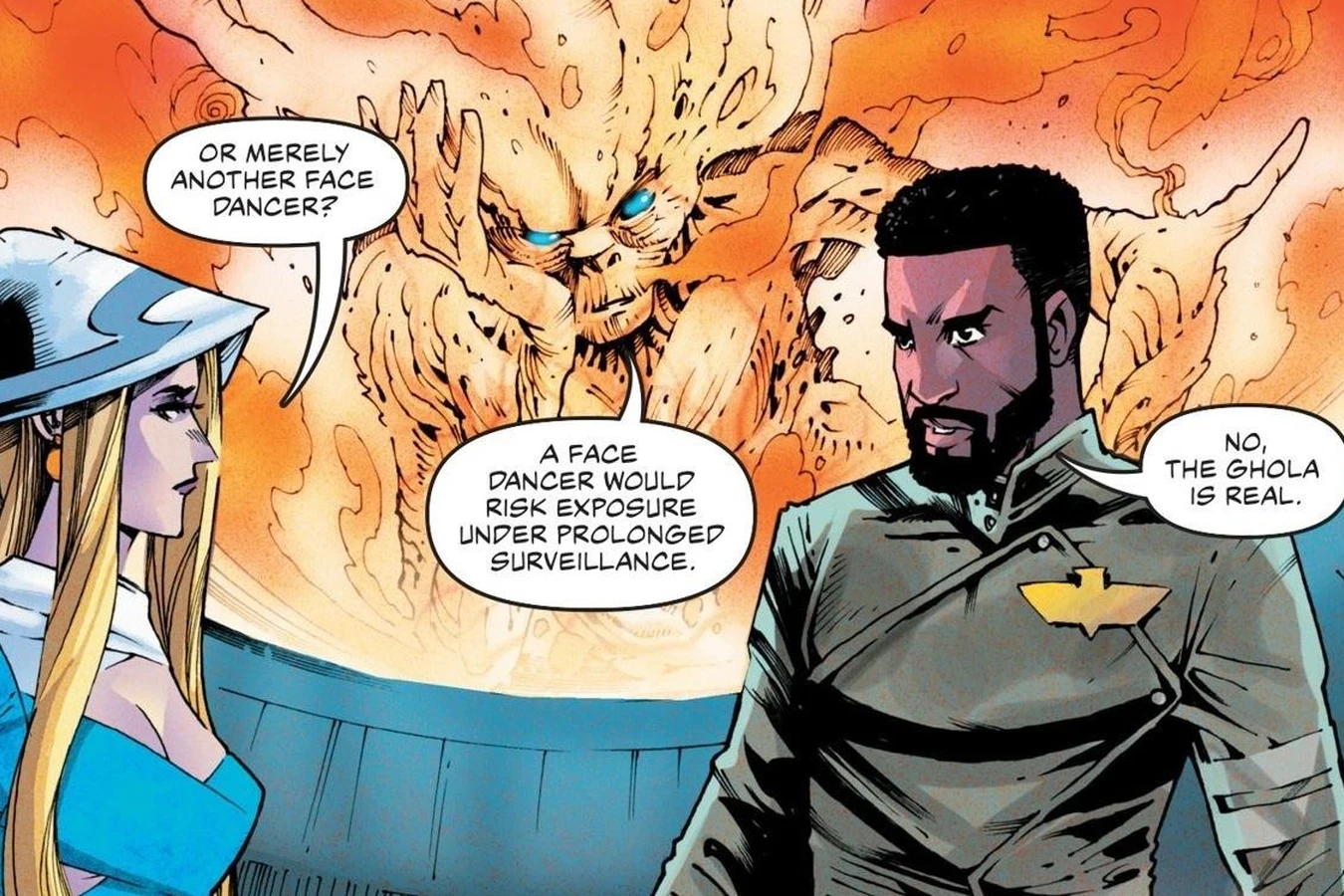
Abrams ComicArts' Dune Messiah: The Graphic Novel adapts the novel in two books, following the publisher's three-volume adaptation of Dune. Brian Herbert and Kevin J. Anderson wrote the adaptation, Michael Shelfer drew the interiors, and Bill Sienkiewicz painted the cover of Book 1. The first volume appeared in November 2026 as a 128-page hardcover. It follows Bronso's interrogation, the meeting on Wallach IX and Hayt's arrival at court, then closes with Scytale urging Edric to question the ghola.
Shelfer made Edric's tank a visible barrier between the Navigator and the other conspirators. Scenes in the Atreides Keep give the reader a sense of the distance between Paul's public life at court and his private conversations with Chani and Hayt. The book also includes production material that pairs portions of the script with artwork in progress. The Dune Messiah graphic novel article covers Book 1's story, characters and art in more detail.
Sources
- Dune Messiah at Penguin Random House
- Dune Messiah at the Bibliothèque nationale de France
- Dune: Part Three at Legendary
- Children of Dune on Apple TV
- Dune Messiah Book 1 at Abrams
Tag Categories: Dune Lore