
David's Drawings: Artbook Lore Overview

David's Drawings is a 2018 Titan Books set by concept artists Dane Hallett and Matt Hatton. The larger volume reprints more than two hundred sketches they made as set dressing for David's workshop in Alien: Covenant. Those plates follow his years alone on Planet 4, from local plants and animals through Engineer dissections to the body of Elizabeth Shaw. A slimmer companion, Developing the Art of an Android, prints an interview with the two artists.
Sketchbook And Companion
Titan Books released the set in the United Kingdom and the United States on 4 September 2018. The two volumes ship together in a box patterned after Engineer design. The in-universe sketchbook has a faux-leather cover, and the plates are printed to look like scans of drawings from the set. Some pages overlap one drawing on another so more of the workshop art fits in the page count.
The sketchbook follows the three rooms the drawings were made for. David's living quarters come first, with plants, fungi, shells, and Engineer anatomy from his years on Planet 4. The laboratory plates come next, and the notes there turn to opened bodies and to the organism he was building toward the familiar Xenomorph life cycle. The last group is the scroll-room studies of Elizabeth Shaw, and those plates carry no handwritten notes. Hallett counted about two hundred finished drawings for the quarters and about three hundred for the lab. A short companion, Developing the Art of an Android, is bound in the same box.
Plants, Seeds, And Shells
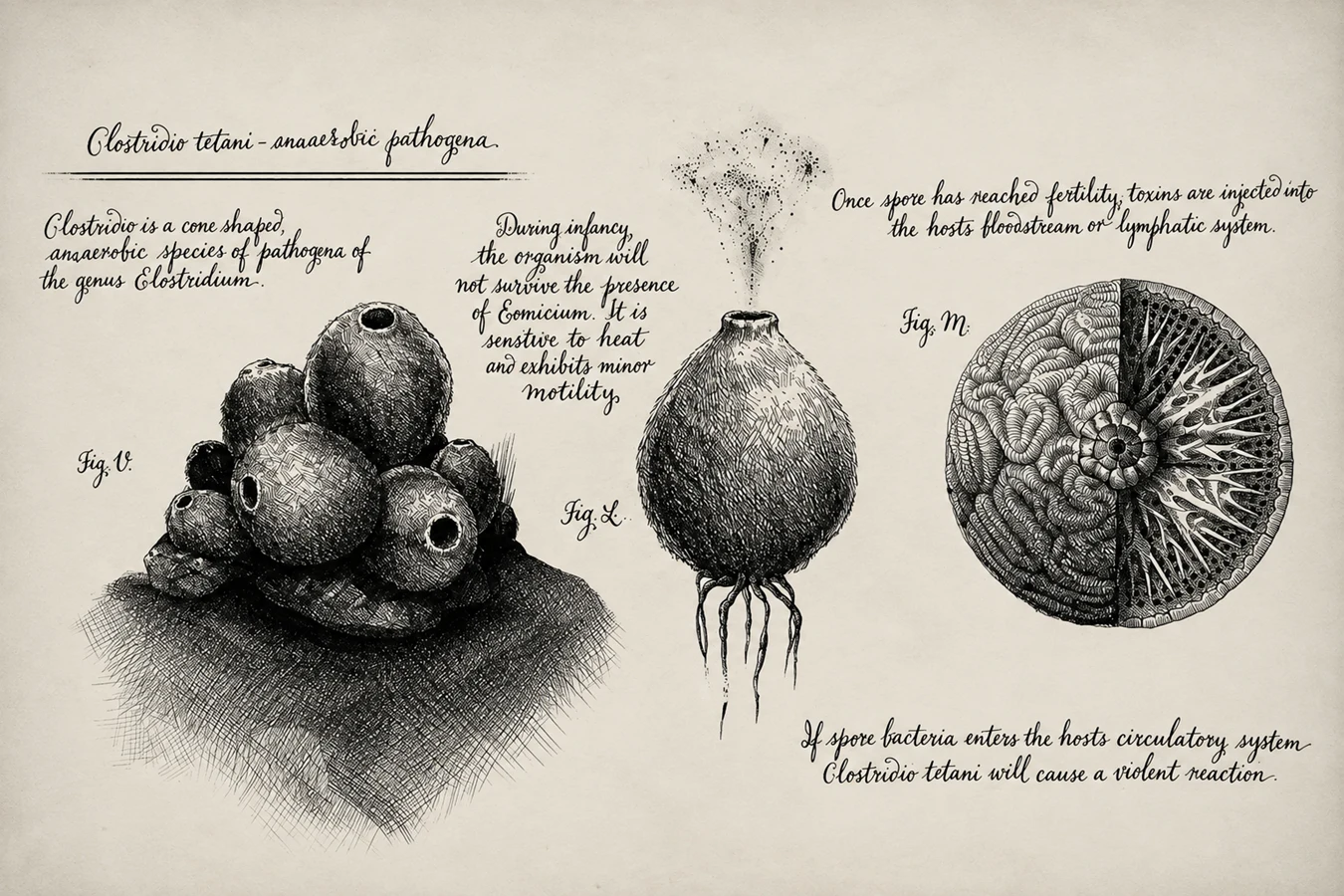
David drew a cluster of round pods with open holes, a single pod releasing a spray of spores, and a round cross section of the inside. He treated the growth as a pathogen. While it was young, it would not survive one substance he named, it was sensitive to heat, and it managed only slight movement. Once a spore was fertile, it sent toxins into the host's blood or lymph, and bacteria in the circulation caused a violent reaction. In Alien: Covenant, spores from pods like these infected members of the crew and produced Neomorphs.
Latex, Silk, And Reeds
The early plates treat Planet 4 as a supply of materials as well as a field of specimens. David recorded local latex and plant silk for ropes, sheets, and restraints, and he judged the seeds plentiful enough to replace jute and resin. A darker milk from the less common form of the same plant was strong enough for large sheets of even thickness. A small pool of latex at the base of the reed was his sign that it was ready to cut. The outer casing could be used as lining or rope as well, so he would not have to take the same material from animals that could move.
David had not decided what the tiny insects around those seeds were doing. Planet 4 had many plants that ate animals, so the seeds might have been taking the insects in through the wall. The latex might also have broken down anything that got inside, before the plant was fully grown. He wrote that he would need young plants to test that. On the same sheet he noticed that his descriptions often became sexual comparisons. He blamed that on the Engineers' belief that living things are connected, not on a shortage of words.
Pitchers And Lilies
David used pitcher plants on Planet 4 to collect insects and small animals. Rain started a reaction that turned the water inside acidic, so he had to take the prey out quickly if he wanted more than bones. Spiders lived on the same plants without helping them. They no longer clung to a vine with the back showing. They lay against the pitcher and used that as cover. He drew three stages, young, intermediate, and mature, and he noted that the thick vein patterns on the plants also appeared on animals.
Other Planet 4 drawings show giant flowers like corpse lilies, the kind that smell of rotting flesh. David wrote that the buds stayed closed for protection. The seeds were held inside a husk so thick that they remained there until the plant began to die and the walls grew weak. Most of the seeds seemed to get out on their own. Ragged holes in some husks looked like bird or rodent damage. A caption on a different sheet calls one plant a cobra lily from the outer country, pairs it with a larger tree he named a wrath oak, and says the seeds could be ground into a drug. The picture under that caption is a fern, so the name and the drawing do not match.
Shells, Beetles, And Borrowed Names
Other early Planet 4 plates name a weeping fruit, a toxic fungus, a sample from thin ground, ocean snails, and a spotted egg. David drew beetles with hard shells and hard wing covers. One animal from wet ground is captioned as eating its own kind. A horseshoe-crab plate says the females cut the males' heads off after mating. A trilobite-like plate treats the different horn shapes as one family that stopped changing and then started again, not as separate kinds. On that sheet the soft tentacles are colored like the thorns, so they would be hard to see once they came out of the shell. The figures run from a split horn, to a long horn, to two sets of prongs, to a shape he called extremely arrested.
A large share of those names are borrowed or invented, and the diary does not say which. Real Earth names turn up as captions: a woodlouse, a titan arum, a horn shark fixed to underwater rock whose young are left to themselves, and a Venus comb murex. Two plant headings reuse the names Bishop and Parker. One shell plate is titled for pipi, a bivalve, while the paragraph under it describes ammonites, a different kind of shelled animal. The notes still show what David was trying to do with life on Planet 4. They are a poor guide to the real groups of those plants and animals. Before printing, any name a reader might know from Earth had to be changed. That is why so many captions are a step away from a real species, a song lyric, or a crewman from an earlier film.
Engineer Head Studies
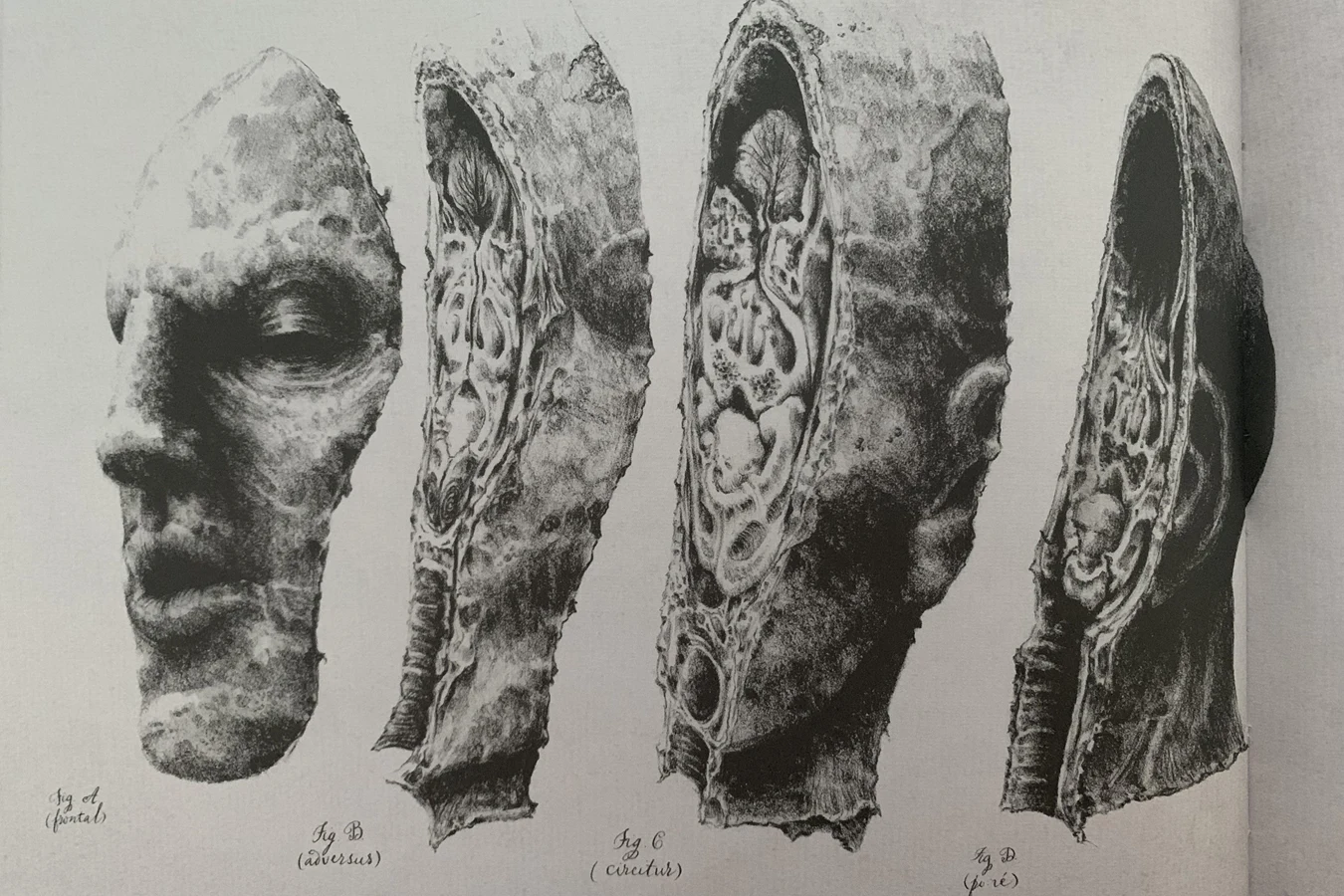
One plate cuts an Engineer head four ways, labeled frontal, adversus, circulus, and a rear section. The closed profile is a long, pale face with the eye shut. The opened views show a crowded interior of folded tissue, chambers, and a thick outer wall, and the rear cut is mostly a dark cavity with a small knot of structures near the lower end. A separate skull note says a specimen looked ordinary until it was opened, and that the join at the top of the skull was unusually clean. Handwritten notes beside the bone studies argue that the Engineers had strengthened their bodies and left an earlier form in place, in the same way they preserved older cities as records.
David wrote that the Engineers had made their bodies tougher, but had left the older shape in place, the same way they preserved older cities as records. Their early buildings look industrial. The later cities look like the work of a people who travel between stars. The bodies did not change along with the cities. He did not want these plates to be a plan for repairing that body. He took the black pathogen and the Xenomorph as the end of the Engineer line. He called that result biblical. He also wrote that his own making, as an android, meant the line from them to the creature was not a straight one.
Forearm, Infants, And Sensing
A forearm study shows an ordinary Engineer arm beside a rebuilt one. Transverse views mark a lighter, more fibrous marrow so the bone loses weight and keeps its strength. The next pair of views moves mass into ridges along the sides. He was also looking at plant and mineral cells for a tougher, more flexible substitute, and he thought chitin-like compounds were the promising ones. Other notes describe binding the heads of Engineer infants after a chemical dose taken from local plant poisons, before any genetic change. He treated the infants as proof that the skull could be reshaped, and he thought the current fetal work was going well on that point.
A sensing diagram replaces the eye sockets with pits that read heat, and it lengthens the brain case into a surface that receives signals. David put that surface toward the back so it would not get in the way of movement. Turning the head would cover the other directions. The strongest coverage is at the front, where the eye area and the new surface overlap. It then fades through two wider arcs. A further piece at the rear is drawn to grow in as the animal matures. A tongue and teeth are drawn as a fast strike, driven by a rippling muscle. A spike at the back of the head is the defense for the side those senses would miss.
Spine And A Reproductive Opening
The rib notes move the simpler organs so they cover a delicate sac in the throat. David had that sac lead to one opening used for both sexes, and he left open how far the animal should be able to change that opening to fit a host. The spine note gives the column several upright lengths and ball-shaped joints, so the back can bend in more than one direction. Fibrous bracing, the same idea as the rebuilt forearm, is there to add movement while the back stays strong.
Hands And Hind Limbs
Hand and foot plates in the plant half of the diary study limbs the same way, even though those sheets come earlier. David captions one Engineer hand as a feat of design, then labels it with finger-bone names that do not point at the bones they name. A hind limb is drawn stretched back, with the tibia and fibula together and a separate view of muscle and tendon. The foot labels are placed the same empty way. These sheets show him taking a limb apart on the page. They are not a reliable map of the bones.
Creature Studies
A Fourth Generation
A note on a fourth generation of the organism calls the work encouraging. David was working on fibrous supports inside the body, and he wanted soft tissue and a hard outer skin to grow faster. He did not count on food after birth, because the animal might come out somewhere with nothing to eat. For that reason he cared more about fast growth than about feeding. The same notes say the creature develops while a plant, an animal, or a person is supporting it, and they add more work on the egg-laying tube and on breathing. Insect names on those sheets are jokes in the lettering, not real identifications.
The Egg Sac
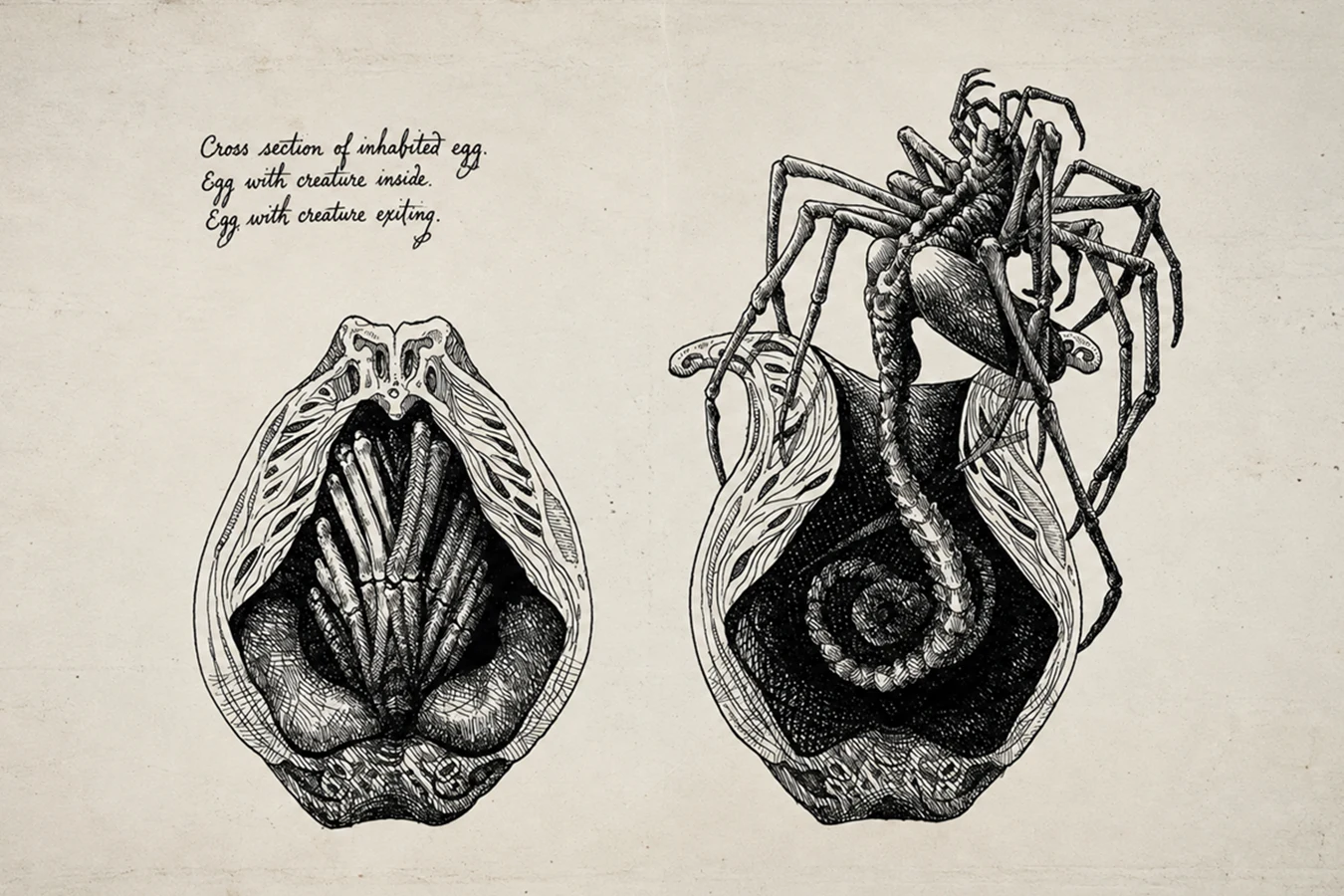
One drawing shows the egg as a sac in line with a tube. David calls that tube an ovipositor, a drill, and a feeler, all in one label, so the shell and the organ that places it are drawn as a single part. Fine hairs on the sketch are for moving material through the air. Diagonal bands of muscle are marked for piercing a host and for the time spent inside. A nearby line says the embryos grew inside a brood pouch. This egg is formed in the body, not only laid on the ground. The other words on that sheet are insect names, and they are too unclear to treat as species. Another plate shows three stages of an occupied egg: a cross section, the creature still inside, and the creature coming out. In that last view the animal has many jointed legs, and the tail is still coiled in the shell.
Specimens Taken Apart
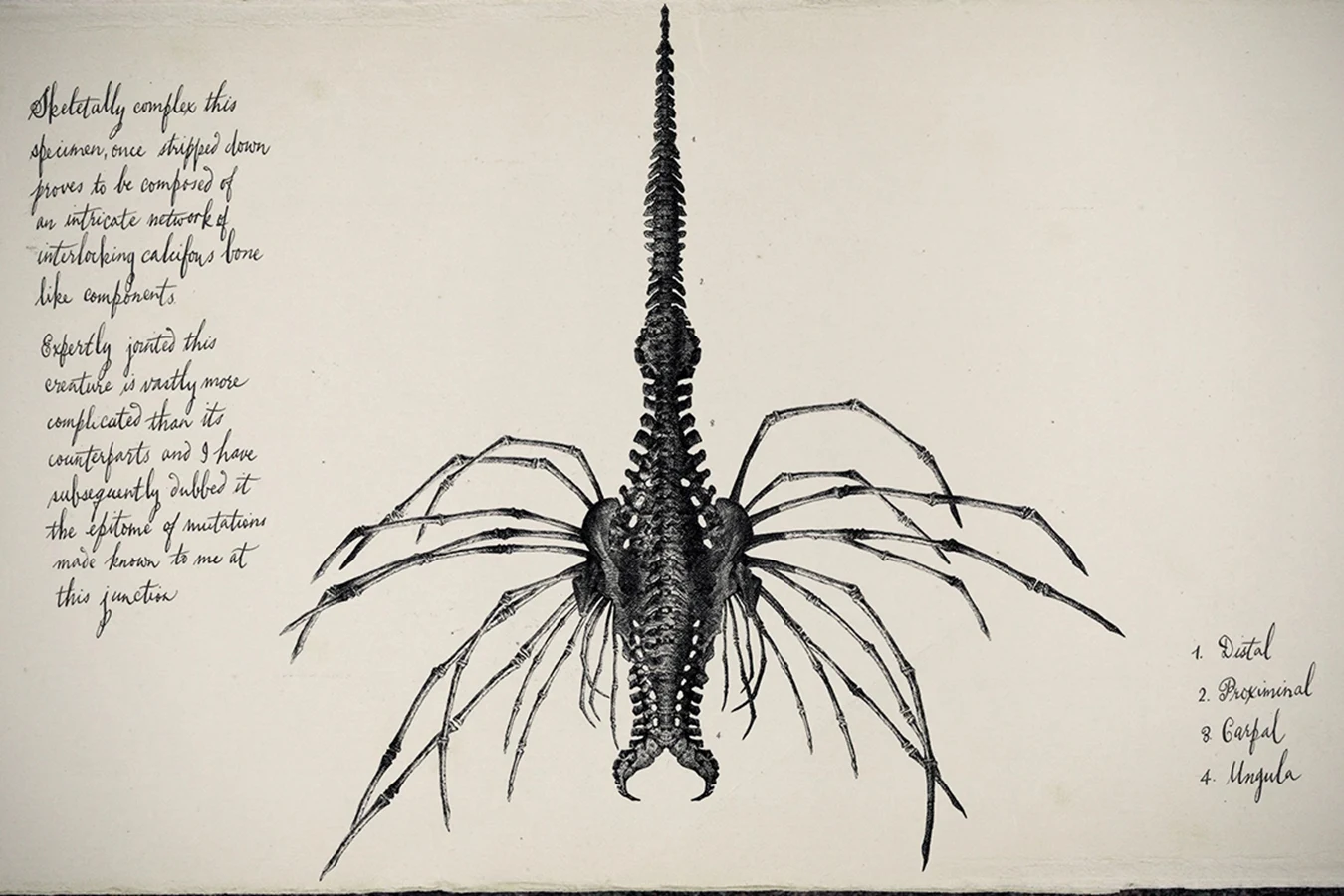
Later plates take failed and half-finished bodies apart. David stripped one specimen and found a network of interlocking bone-like pieces. He called it the furthest mutation he had reached so far. The labels on that sheet are ordinary limb words, distal, proximal, carpal, and ungula, placed on a body that is not a familiar animal. Another birth he judged a step forward is drawn taken apart, with a shell, a gut, and a tail marked, so he could see how the parts worked. A breastplate study shows a body fully covered in skin and armor, with the tail cut off. He thought that animal could live without the tail, and that cutting the tail ended any chance it would reproduce.
A dried corpse is drawn as the flesh went and the skeleton became easier to read. David used those bone studies to judge how the animal worked and what disease had done to it, down to the small structure of the bone. A cross-section that looks ordinary from the outside is different once opened. The organs are spread evenly through each segment of the body. The heart muscle is placed opposite a brain that is smaller and, in his note, no weaker for that. On a hand plate the nerves are compared with the human paths in the wrist and fingers. He wrote that he had removed the parts of the left hand so he could study the outer shell. Other creatures on these pages are described with only a few traits: many long legs, a curled tail, and a ribbed body.
Bone Maps And A Shared Goal
One framework sheet names a joint, a hardened plate, the upper spine, and the middle of the spine. David describes the skeleton plus those plates as the frame for what the specimen mainly does. Finger labels on a related drawing mix hand bones with a metatarsal, which is a foot bone, so the words do not match the picture. A longer skeleton plate uses ordinary human names for the skull, shoulder, arm, and hip, from the parietal bone and the cheekbone through the clavicle, humerus, ulna, and radius to the hip bones. The chest note calls the rib cage a column and a breastbone with cartilage between them, then labels the regions with words that are not standard anatomy. A spinal column is drawn as pieces of bone separated by discs, divided into neck, chest, lower back, and sacrum. A brain plate separates the frontal, parietal, occipital, and temporal lobes, the cerebellum, and the brain stem from the skull bones around them.
The face-muscle note says the network around the skull accounts for most of the expression in the profile beside it. David writes that tissue, muscle, and nerve endings together give the animal movement and a sense of touch. How much it can feel varies from one creature to the next. He also wrote that a hive-like link seemed to pull them toward one goal. By that point in the series he thought the body plan was nearly finished. Later changes, in his account, would come from staying alive and from producing more of the species, not from more planning on his part. A late note says movement had become a straight crawl. The limbs join the chest through a flexible waist, and a long tube from the head supplies a part earlier specimens had lacked. Alien: Covenant showed the result of these studies as the Protomorph in the Engineer city and later on the colony ship.
Studies Of Elizabeth Shaw
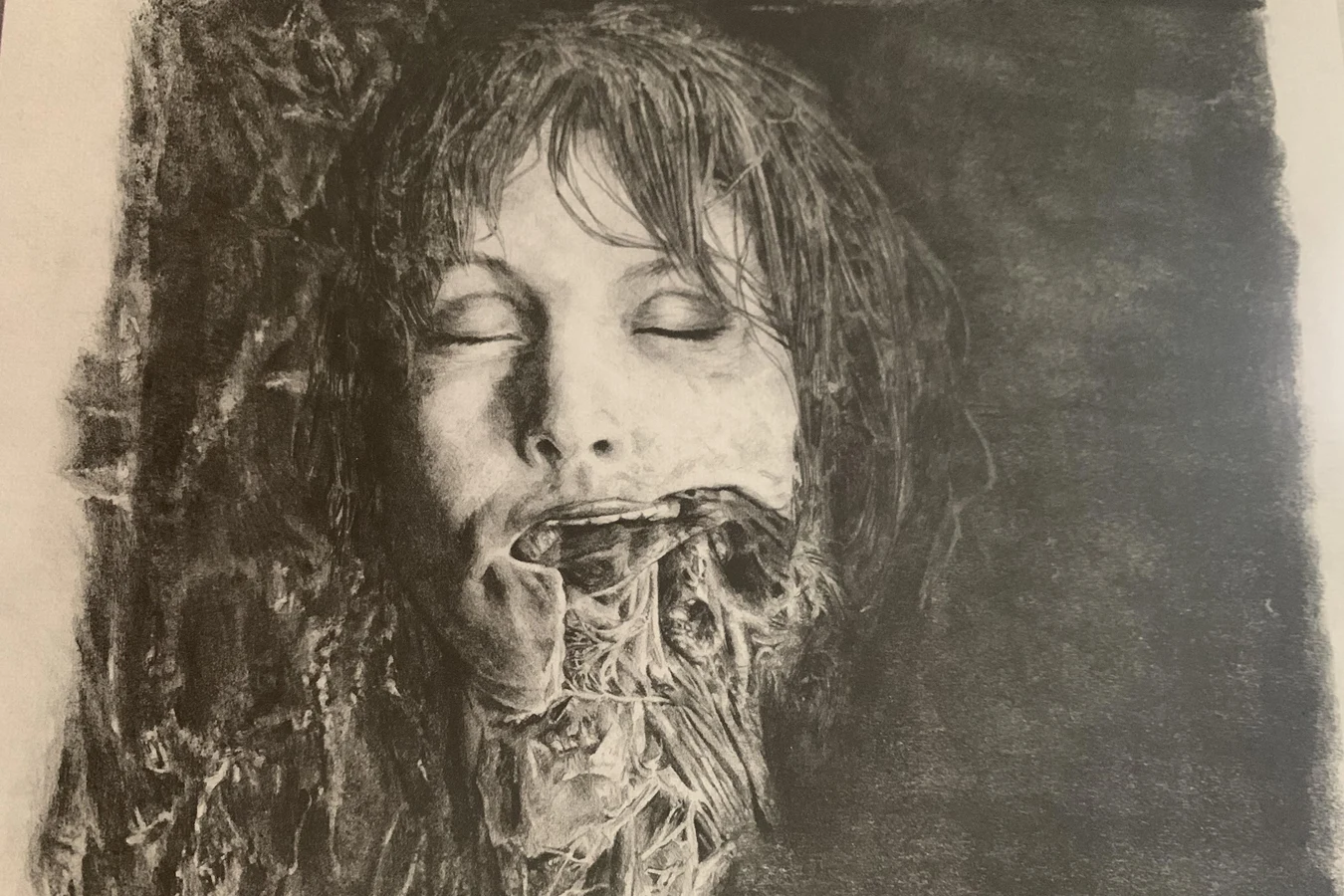
Elizabeth Shaw left LV-223 with David at the end of Prometheus, and the sketchbook's last quarter is given to what he drew of her on Planet 4. Those plates have no captions in his hand, unlike the plant notes and the bone notes. One laid her body open along the chest and neck while she rested on a dark support, with tissue pulled back from the shoulder and the side of the face. Another, a tighter study of the head, opened the jaw and the throat under it and filled the wound with cords of tissue. The book does not mark which of those studies he carried out and which he only drew.
Daniels Finds The Sheets In The Scroll Room
In Alien: Covenant, Daniels found these sheets in the scroll room, and the body in the laboratory did not match them. David gave her death as the crash of the Engineer ship. The sketchbook does not connect that account to these opened plates, and it does not date them. Alan Dean Foster's novelization put the same studies in the laboratory as scrolls: Shaw drawn, then tubes in her neck and nostril, then a vivisection, beside an urn dated 2058 to 2094. Hatton drew the Shaw sheets used on the set, because he could match Noomi Rapace's face, and some of Hallett's versions are in the book as well.
The Immaculate Heart
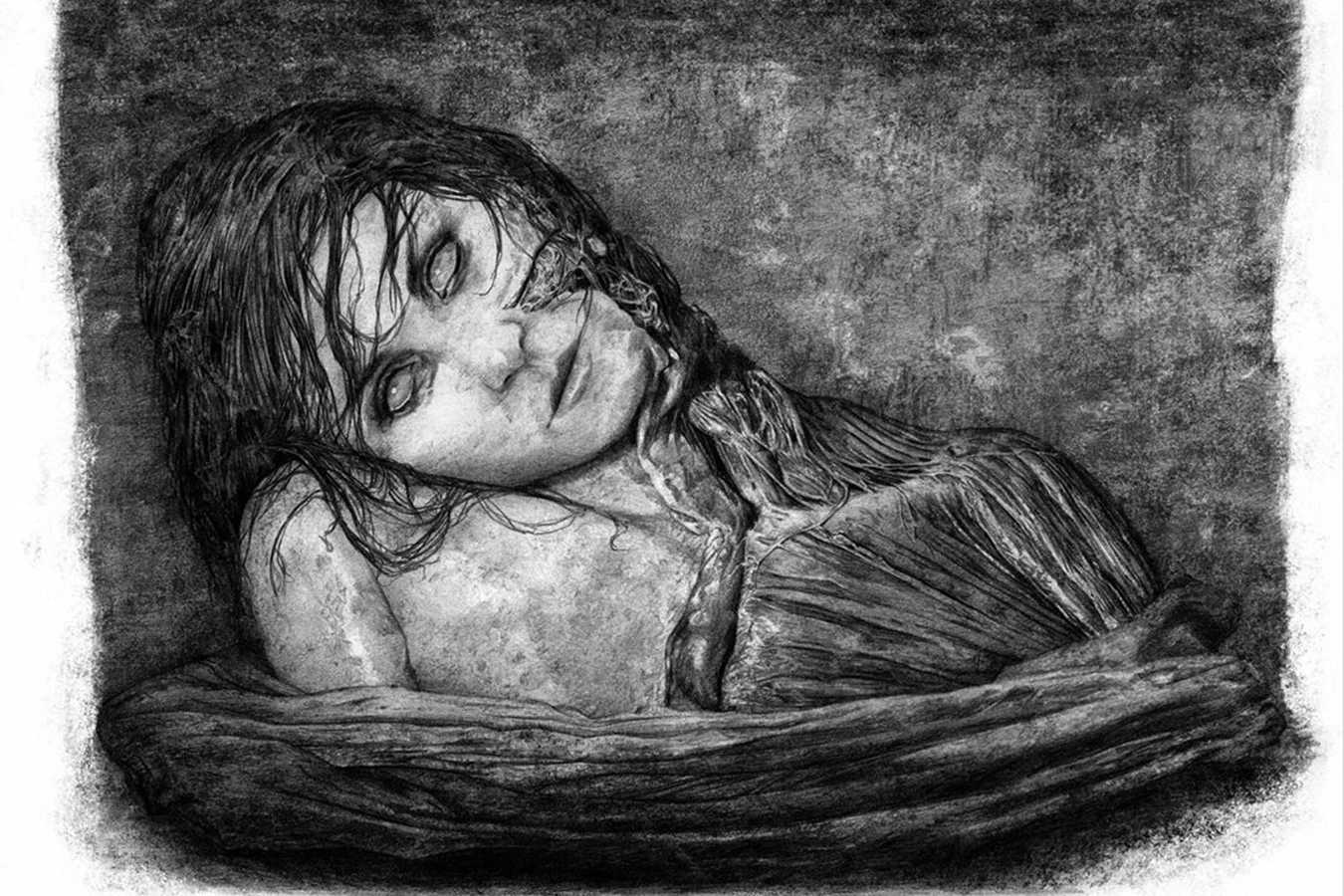
One religious plate shows Elizabeth Shaw as a madonna, and the sketchbook titles it an immaculate heart. The outline of an astronaut helmet is used as a halo. David drew her there as a holy mother and, in the same group of sheets, as a figure of hate. The pictures take up her own religious beliefs and turn them. Hallett and Hatton left it open whether these plates record what he did to her, or only what he wanted to draw.
Shaw's Face Plate
Another sheet shows Elizabeth Shaw with a creature over her face. The diary never calls that creature a Facehugger. The words on the sheet say the organism continued to develop while the host went on breathing, and they mention the egg-laying tube from the egg sketch again. Those same lines were copied onto a later specimen page, beside a list of insect groups that does not describe the thing on her face. The plate shows the picture and that short note. It does not name the animal or say how long it remained on her.
Behind The Scenes
Set decorator Victor J. Zolfo commissioned the plates for David's living quarters and laboratory, under production designer Chris Seagers. The first count he was given was thirty to fifty drawings. Once the rooms were planned, Dane Hallett and Matt Hatton had to fill walls instead, drawing in one style so Ridley Scott could not tell the sheets apart. Quarters were drawn first. Hallett then took the laboratory, and Hatton took the scroll room where Daniels found the Shaw studies. The drawings are on screen in Alien: Covenant, released in 2017, a year before Titan collected them. Hallett's other film work includes vehicles and props on Mad Max: Fury Road.
The pictures are charcoal, pen, and Indian ink, the tools the notes give David. Hallett and Hatton wrote the wording, then scanned each sheet and dropped in placeholder lines. Ridley Scott picked a handwriting sample, and calligrapher Heather Courtis copied it. Assistants Meghan Leonard and Grace Brown, with Emma Gracie coordinating, swapped that hand back onto the scan. The finals were printed on textured Japanese paper so the walls would not look like office copies. A tight Victorian style was tried and dropped, because that finish could not be repeated across the number of plates. Drawings Scott called too repulsive were left off the set.
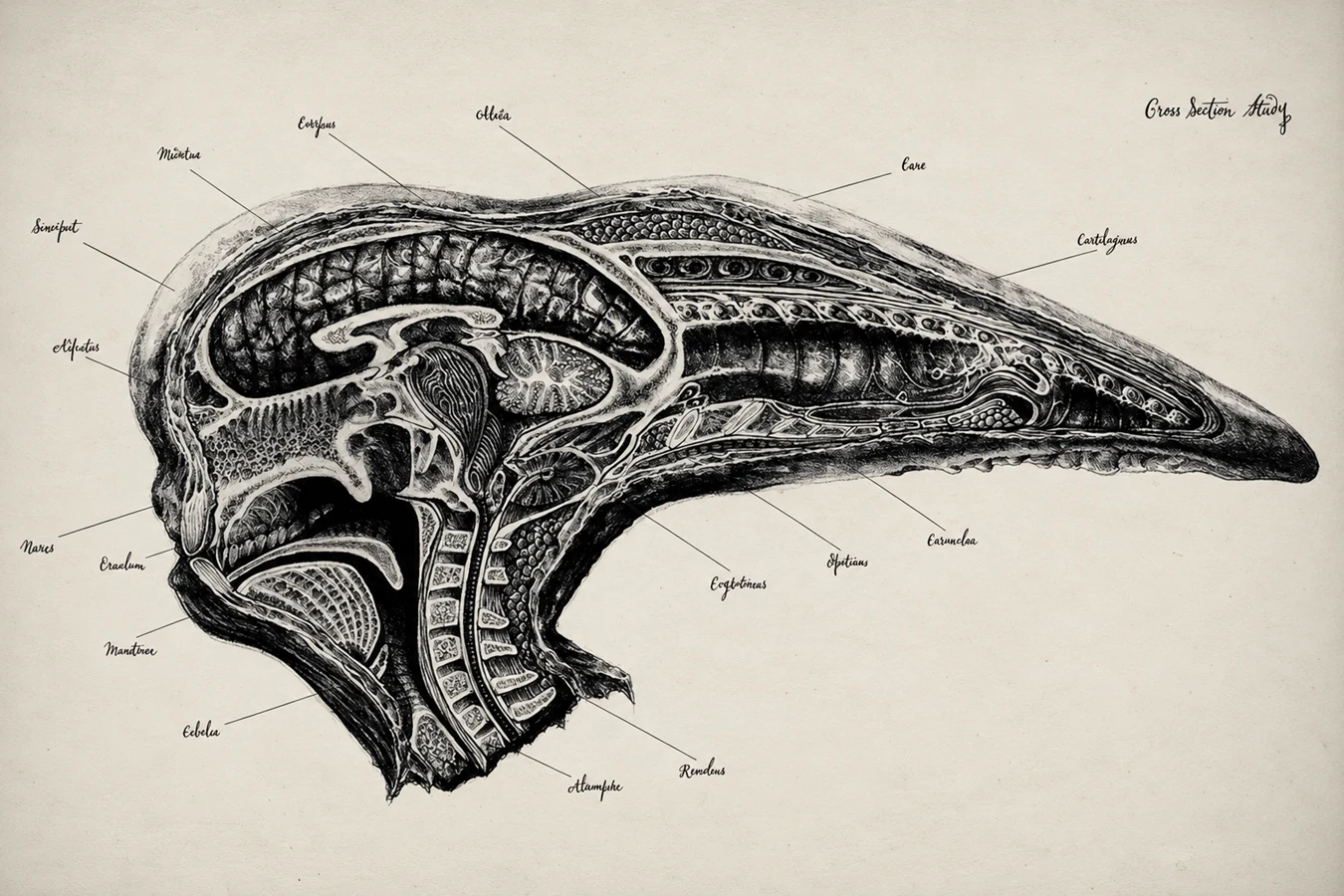
Hallett also drew early Neomorph forms to match sculptures the creature crew was building. One of those sheets is a labeled cross section of a long-snouted head, with the jaw open. He also placed H.R. Giger's toothed facehugger studies among the laboratory sheets.
Shorter versions of some experiment plates had already appeared in Simon Ward's The Art and Making of Alien: Covenant and in the film's Blu-ray gallery, often with the handwritten text cut down. On the bone-density plate, those printings omit the opening, including the comparison between Engineer bodies and Engineer cities, and start later in the note. The missing lines are legible on Matt Hatton's Instagram and as loose paper in Advent, the Blu-ray prologue in which David sent a message to Weyland-Yutani. The handwriting on the Instagram sheets for the deformed infants does not match the hand used on the same images in the film. One of those infant paragraphs is filler on the desk in Advent, and another is visible behind him during the transmission.
Titan Books published the set on 4 September 2018 as a hardcover pair listed at 192 pages. The sketchbook's scan-like presentation leaves plain scanner background on some sheets, and some drawings overlap. The box uses an Engineer-like pattern, and the diary volume uses a faux-leather cover. Developing the Art of an Android is the second book in the same package, not a later reprint. The sketchbook is the edition that gathers the full run, including the unannotated Shaw drawings, in one place.
Conclusion
David's Drawings is Dane Hallett and Matt Hatton's 2018 Titan Books set. The sketchbook runs from Planet 4 plants and Engineer heads to the unannotated studies of Elizabeth Shaw, and the companion volume records how the two artists made those plates for Alien: Covenant.
External Sources
- Alien Covenant: David's Drawings at Titan Books
- Alien: Covenant – David's Drawings review at Alien vs. Predator Galaxy