Alien: Black, White & Blood: Marvel Comic Overview

Alien: Black, White & Blood was a Marvel anthology comic that stripped the franchise down to black, white, and red violence. Published in four oversized issues from February through May 2024, the series followed Marvel's broader Black, White & Blood format used for characters such as Wolverine and Venom, but applied it to the Xenomorph for a collection of short horror tales and one continuing serial. Each issue mixed a chapter of the generations-spanning story Utopia with standalone shorts about corporate cruelty, survival guilt, and the biology of fear.
Comic Overview
Alien: Black, White & Blood was part of Marvel's licensed Alien line, published alongside Aliens: What If? in early 2024, and used the same Black, White & Blood anthology format Marvel had previously applied to characters such as Wolverine and Venom. The book's defining look came from its limited palette: stark monochrome art flooded with red for human blood and green for Xenomorph acid, often using halftone textures reminiscent of classic horror printing. Collin Kelly, Jackson Lanzing, and Michael Dowling handled the ongoing Utopia storyline across all four issues, while guest writers including Ryan Cady, Stephanie Phillips, Paul Jenkins, Cody Ziglar, Steve Foxe, Bryan Hill, and Pornsak Pichetshote contributed one-shot chapters.
Because it was an anthology rather than a single miniseries, Black, White & Blood functioned less like a unified sequel and more like a sampler of modern Marvel Alien voices. Some shorts leaned on familiar franchise beats such as Weyland-Yutani exploitation and Colonial Marine slaughter, while others experimented with AI caretakers, hunting safaris, and sympathetic Xenomorph perspectives. The result was uneven in quality, but useful as a snapshot of how Marvel approached short-form Alien horror before longer runs such as Alien: Paradiso, including Steve Foxe's earlier short Lucky in issue #3.
Plot Summary
The four issues ran from February through May 2024, with each installment advancing one chapter of the serial Utopia and adding one or more standalone shorts. The stories below follow publication order rather than a shared timeline, since most chapters were self-contained nightmares that could sit almost anywhere in Marvel's expanded Alien continuity.
Utopia
Written by Collin Kelly and Jackson Lanzing with art by Michael Dowling, Utopia ran through all four issues and followed the ring-shaped colony vessel Forward, crewed by the Union of Progressive Peoples, a socialist faction that had set out to prove humanity could live without war or coercion. The ship's guiding voice, Siostra, narrated each generation's attempt to hold that ideal together even after the Forward answered a distress call from a Weyland-Yutani craft carrying a live Xenomorph. What began as a rescue mission became a slow collapse: quarantine brutality, militarization, and sacrifice replaced pacifism as the infestation spread through the vessel's corridors. By the final chapter, the worst instincts the Forward's founders had tried to leave behind were on full display, and the serial ended as a grim parable about how quickly utopian principles break when survival demands violence.
The Hunt
Stephanie Phillips and Marcelo Ferreira's opening short turned Xenomorph slaughter into a luxury product for the galaxy's idle rich. Weyland-Yutani marketed the hunt as the ultimate thrill, giving wealthy clients weapons, guides, and a controlled environment in which to pursue the deadliest species in known space. The story treated the outbreak less like a disaster and more like sport, leaning into the franchise's corporate cynicism while showing how easily death becomes entertainment when someone else is paying for the body count.
Maternal Instinct
Ryan Cady and Devmalya Pramanik shifted the focus from combat to caretaking after a Xenomorph massacre left a small child as the only survivor aboard a deep-space vessel. The ship's soothing AI, also called Mother, had watched the rest of her charges die and was forced to step outside her usual operating role to protect the last living passenger. The short explored how far programmed compassion could stretch when a machine built for guidance suddenly had to function as a parent, and whether moral duty meant anything in a corridor already soaked in blood.
Morsel
Paul Jenkins and Luigi Teruel used issue #2 to examine the chemistry of fear through the lens of predation and food. The story climbed the chain from hunting on open plains to industrialized meat production and then to a future where humans no longer occupy the top rung they assumed was theirs. For the Xenomorph, prey was singular and uncomplicated, which made the human terror in the comic feel less like random monster violence and more like the natural order snapping shut.
First Day
Stephanie Williams and Jethro Morales followed a Colonial Marine through what might be her first day in combat and quite possibly her last. Orders piled up faster than she could process them, each one pushing her to treat casualties as acceptable losses and to discard the hesitation that still made her human. The short worked as a compressed version of the franchise's usual military slaughter, but from the perspective of someone who had not yet learned to stop counting the dead.
Gear in the Machine
Cody Ziglar and Claire Roe sent a Weyland-Yutani science team into the field to recover Xenomorph larvae and reminded them, in the bloodiest way possible, how little the company valued their lives. The researchers believed their expertise made them indispensable until the outbreak reduced them to line items on a corporate balance sheet. It was one of the anthology's bleakest commentaries on human evil, arguing that the Aliens were horrifying but not always more cruel than the employers who sent people to fetch them.
Lucky
Steve Foxe and Tommaso Bianchi flipped the usual survivor formula by shifting attention toward a more sympathetic reading of the predator-prey relationship. Where most Alien stories treat the human perspective as the only one worth mourning, Lucky asked the reader to feel something for the creature on the other side of the hunt. The experiment in viewpoint and empathy made the short memorable within the collection and foreshadowed Foxe's later work on Alien: Paradiso, another Marvel story willing to complicate who counts as the monster.
Hide & Seek
Bryan Hill and Chris Cross closed issue #4 with a claustrophobic game of survival inside tight quarters where staying unseen was the only remaining strategy. Characters moved through vents, lockers, and blind corners while Xenomorphs hunted by sound and scent, turning the ship into a maze with no safe room. The story also pushed the anthology's corporate theme to a bleak conclusion, showing how Weyland-Yutani could exploit even basic human hope when someone was desperate enough to believe the company might help.
Mother
Pornsak Pichetshote and Partha Pratim ended the series with a quiet, intimate horror story driven by dread rather than firepower. A survivor wrestled with guilt, isolation, and the creeping sense that infection was changing not just the body but the moral choices left to the living. After three issues of red-splashed violence, Mother closed the book on a note of psychological rot, suggesting the franchise's real damage sometimes happened long after the chestburster stopped moving.
Timeline And Canon
Alien: Black, White & Blood belonged to Marvel's licensed Alien comic continuity and did not tie directly into the film saga of Alien, Aliens, or the later crossover events. Most shorts were self-contained nightmares that could fit almost anywhere in the expanded timeline, while Utopia functioned as its own generational sci-fi parable aboard an original starship. That flexibility was both a strength and a weakness: readers could dip into individual stories without continuity homework, but the anthology rarely built lasting lore comparable to long-running Dark Horse arcs.
Legacy
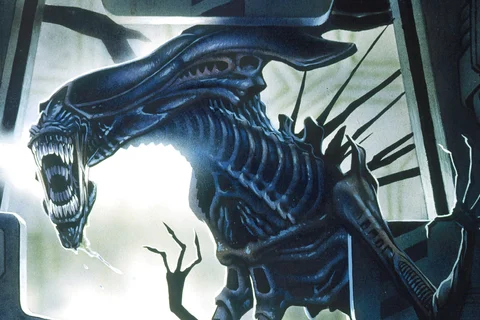
Black, White & Blood stood out visually even when individual stories felt familiar. The red-soaked print style, especially on covers such as the Xenomorph perched over a blood-splattered Weyland-Yutani sign, gave Marvel's Alien line a distinct identity separate from standard full-color event comics. Utopia remains the most remembered segment because it had room to breathe, while shorts like Lucky and Mother showed that short-form Alien horror could still surprise readers who thought they had seen every variation on the formula. As an overall package, though, it was too uneven to rank among the franchise's essential reads and did not appear on our best Alien comics list.
External Sources
Tag Categories: Alien Comics | Alien Merchandise